Diffusion of Religion and Language
Introduced 7:49
Cultural Patterns and Processes
This gate stands over a street in Seattle, in the United States. But the roof, the colours and the writing all come from China, nearly ten thousand kilometres…
English narration · English and 中文 subtitles you can switch
In this lesson
| English | Meaning |
|---|---|
| universalizing religion/ˌjuːnɪˈvɜːsəlaɪzɪŋ rɪˈlɪdʒn/ | A religion that seeks followers beyond a particular ethnic group and presents its teachings as broadly applicable. |
| ethnic religion/ˈeθnɪk rɪˈlɪdʒn/ | A religion closely associated with a particular people or cultural group and generally not focused on converting all humanity. |
| language families/ˈlæŋɡwɪdʒ ˈfæmɪliz/ | Groups of languages that developed from a common ancestral language. |
| dialects/ˈdaɪəlekts/ | Regional or social varieties of a language distinguished by features such as pronunciation, vocabulary or grammar. |
| lingua franca/ˈlɪŋɡjuːə ˈfræŋkə/ | A shared language used between groups with different first languages: Swahili in East Africa, English in business and science worldwide. |
Born in India, practised in China
- Buddhism began in northeast India around 500 BCE. Today very few Indians are Buddhist, but hundreds of millions of people in China, Japan, Thailand and Sri Lanka are. Traders and monks carried it along the Silk Road and sea routes, while in India it was absorbed back into Hinduism.
- Religions and languages are the clearest examples of cultural diffusion. Each has a hearth, and each spread through migration, trade, conquest and missionaries.
Universalizing and ethnic religions
| Universalizing religion 普世宗教 | Ethnic religion 民族宗教 | |
|---|---|---|
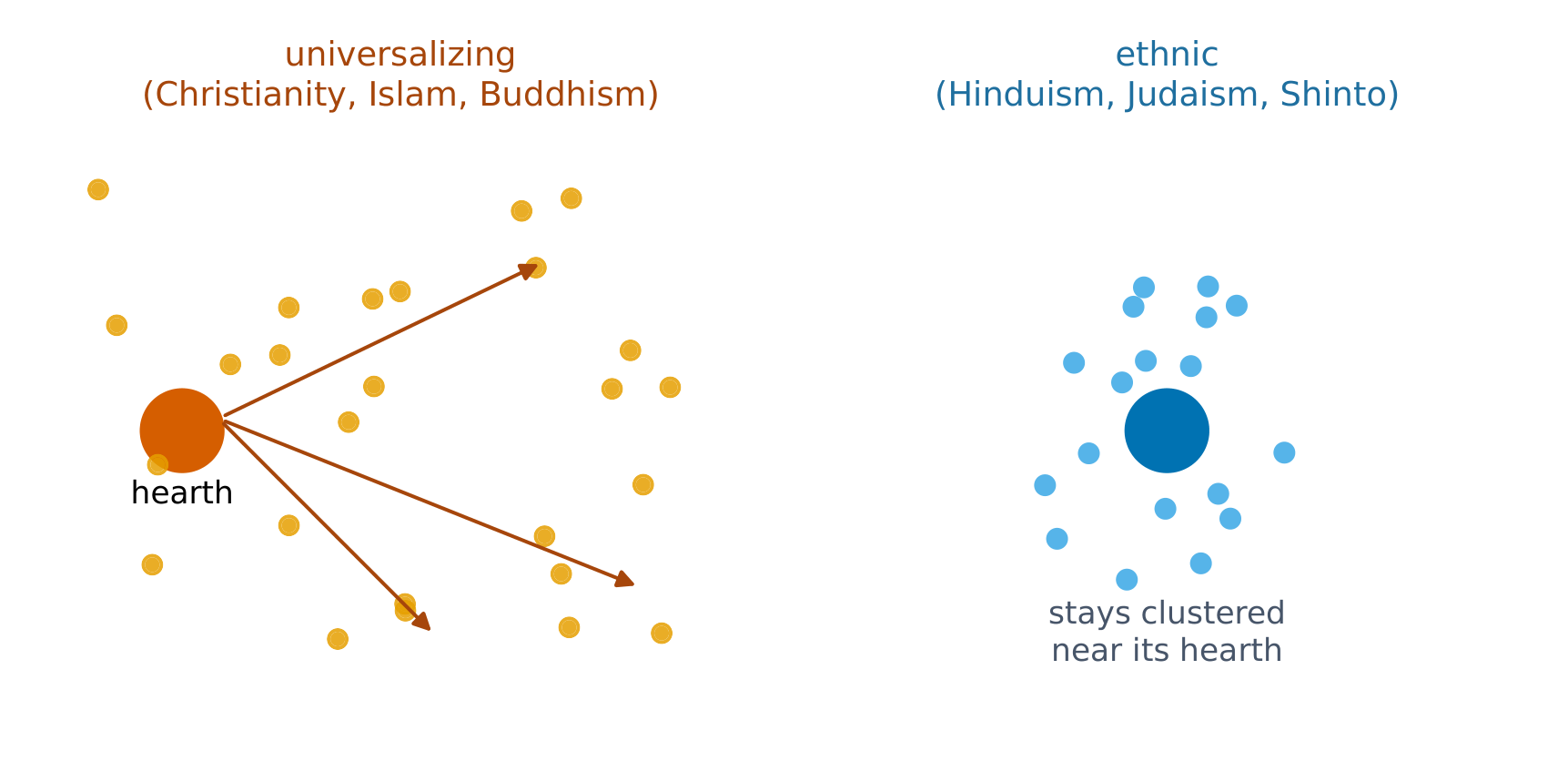
| Goal | seeks converts everywhere | tied to one people and place; few converts |
| Main diffusion | expansion (contagious, hierarchical) and relocation | mainly relocation, as believers migrate |
| Examples and hearths | Christianity (Jerusalem), Islam (Mecca and Medina), Buddhism (northeast India) | Hinduism (Indus and Ganges valleys), Judaism (the Levant, in the eastern Mediterranean) |
| Pattern today | spread over several continents | clustered near the hearth or among migrant communities |
Universalizing or ethnic religion?
Sort each feature as belonging to a universalizing or ethnic religion.
Match each religion to its type.
Difficulty 2/5 · 140 coins + a small bonus on first completion today
Universalizing religions seek converts; ethnic religions are tied to one people.
How the big three spread
- Christianity: relocation (missionaries such as Paul), then hierarchical (the Roman emperor Constantine, 313 CE), then colonial expansion to the Americas, Africa and the Philippines.
- Islam: from Mecca and Medina by conquest and trade across North Africa and Southwest Asia; by merchants along Indian Ocean routes to Indonesia, now the country with the most Muslims. Buddhism: by monks and merchants to East and Southeast Asia.
Match each religion to its hearth.
Difficulty 2/5 · 140 coins + a small bonus on first completion today
Hearths are where the religion began, not where it is largest today.
How did Islam mainly reach Indonesia?
Difficulty 1/5 · 100 coins + a small bonus on first completion today
Trade carried Islam to coastal rulers and then to the wider population.
How languages spread
- Languages belong to language families 语系 with a common ancestor. The Indo-European family (English, Spanish, Hindi, Persian) is spoken by about half of humanity, spread by ancient migrations and later by European colonialism.
- Over time a language splits into dialects 方言 and then new languages (Latin → Spanish, French, Italian). A lingua franca 通用语 is a shared language used between groups with different first languages: Swahili in East Africa, English in business and science worldwide.
A lingua franca is a language used between people who have different first languages.
Difficulty 1/5 · 100 coins + a small bonus on first completion today
Swahili and English are common examples.
Worked FRQ answer
(A) Explain the difference between a universalizing and an ethnic religion. A universalizing religion seeks converts from all peoples, while an ethnic religion is tied to one group and place and rarely seeks converts.
(B) Explain how trade contributed to the diffusion of Islam to Southeast Asia. Muslim merchants from Arabia and India traded in ports across the Indian Ocean; local rulers and traders who did business with them converted, and Islam then spread to the wider population of places such as Indonesia.
(C) Explain why English has become a global lingua franca. British colonialism spread English across the world, and later US economic, scientific and media power made it the main language of business, the internet and research.
- Why it scores: each part names the process (contagious and hierarchical diffusion through trade; colonial relocation) and gives a place.
A religion's hearth is not always where it is strongest today. Buddhism began in India but is now mainly practised elsewhere; Christianity began in Southwest Asia but has the most followers in the Americas, Europe and Africa.
Universalizing religions (Christianity, Islam, Buddhism) seek converts and spread by expansion and relocation; ethnic religions (Hinduism, Judaism) spread mainly by migration. Languages spread with migration, conquest and trade, belong to language families, split into dialects, and a lingua franca connects speakers of different languages.
FRQ practice. (A) Identify the hearth of Hinduism. (B) Explain why Hinduism is concentrated in South Asia while Christianity is found on every continent. (C) Explain ONE way relocation diffusion has spread Hinduism beyond South Asia.
Type explains pattern.
What went wrong? Only the site team sees this.