Classification of goods and services
Introduced| English | Meaning |
|---|---|
| economic good/ˌiːkəˈnɒmɪk ɡʊd/ | A good that is scarce relative to wants and therefore has an opportunity cost. |
| free good/friː ɡʊd/ | A good available in sufficient abundance relative to wants that using it has no opportunity cost. |
| public good/ˈpʌblɪk ɡʊd/ | A good that is non-rival in consumption and non-excludable. |
| private good/ˈpraɪvət ɡʊd/ | A good that is rival in consumption and excludable. |
| rival/ˈraɪvl/ | rival |
| excludable/eksˈkluːdəbl/ | excludable |
| free-rider/friː ˈraɪdə/ | Someone who receives the benefit of a shared good without contributing to its provision. |
| demerit good/ˈdemərɪt ɡʊd/ | A good whose harmful effects consumers may underestimate, leading to consumption above a socially desirable level. |
| merit good/ˈmerɪt ɡʊd/ | A good whose benefits consumers may underestimate, leading to consumption below a socially desirable level. |
Why no one sells fresh air
- Air is essential — yet free, because it isn't scarce. The moment something is scarce, it gets a price and becomes an economic good 经济物品.
- Not all goods behave the same way in a market; sorting them explains where markets work and where they fail.
Goods and services lab
Classify examples by rivalry, excludability or whether they are services.
Free vs economic goods
- A free good 免费物品 has no opportunity cost — unlimited relative to wants (e.g. air, sunlight).
- An economic good is scarce, so producing it has an opportunity cost and it commands a price.
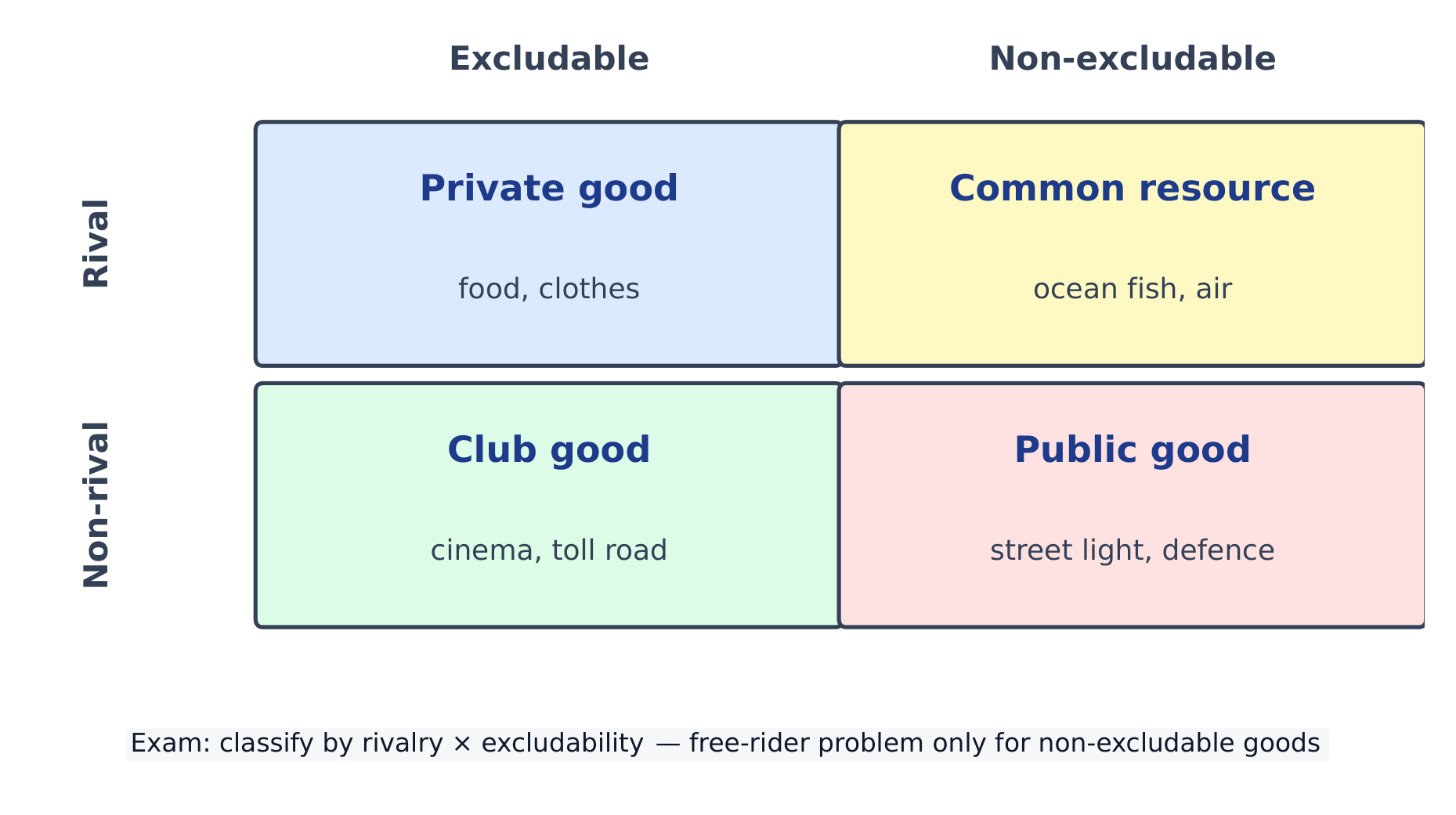
The four types of good, classified by rivalry and excludability
A free good is one that:
Difficulty 1/5 · 100 coins + a small bonus on first completion today
A free good (like air) is unlimited relative to wants, so using it costs nothing.
Private vs public goods 公共物品
- Rival: one person's use reduces another's. Excludable: you can stop non-payers. Public goods are neither — so markets under-provide them (the free-rider 搭便车 problem).
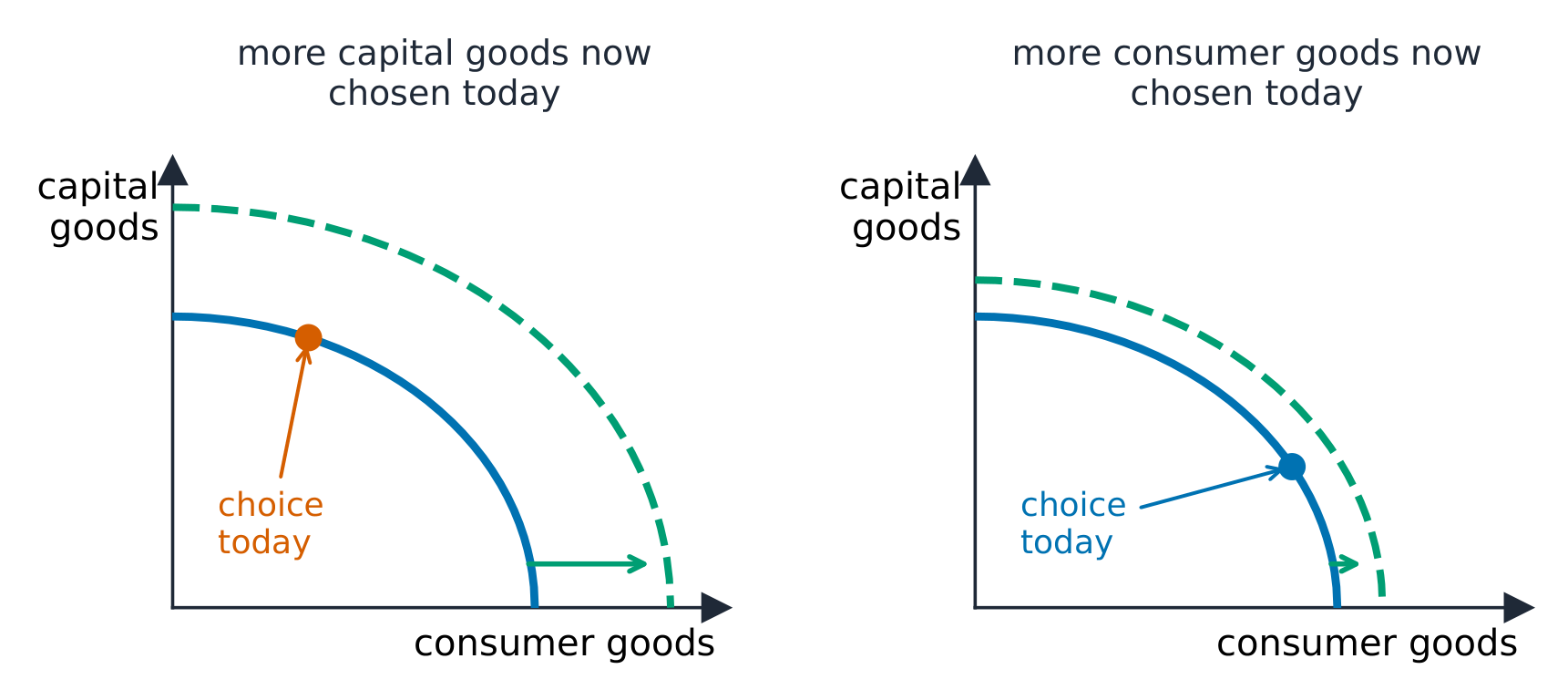
Making more capital goods today shifts the future PPC out further
A public good is:
Difficulty 1/5 · 100 coins + a small bonus on first completion today
Public goods (e.g. street lighting) are non-rival and non-excludable — hence the free-rider problem.
Because non-payers cannot be excluded from a public good, markets suffer the ______-rider problem.
Difficulty 1/5 · 100 coins + a small bonus on first completion today
People can enjoy a public good without paying — the free-rider problem — so markets under-provide it.
Merit and demerit goods 劣值品
- A merit good 优值品 is better for you than you realise, so it's under-consumed (education, vaccines) — governments encourage it.
- A demerit good is worse than you realise, so it's over-consumed (tobacco, alcohol) — governments discourage it.
Public ≠ merit. A public good is defined by non-rivalry/non-excludability; a merit good is about mis-judged benefit. Education is a merit good but is excludable (so not a pure public good).
Match each good to its type.
Difficulty 2/5 · 140 coins + a small bonus on first completion today
Street lighting is non-rival/non-excludable; an apple is rival/excludable; vaccines are under-consumed merit goods; tobacco is an over-consumed demerit good.
A merit good is under-consumed because people undervalue its benefits.
Difficulty 1/5 · 100 coins + a small bonus on first completion today
Merit goods (education, vaccines) are under-consumed, so governments encourage them.
You've got it
- free good (no opportunity cost) vs economic good (scarce, has a price)
- public good = non-rival and non-excludable → markets under-provide (free-rider problem)
- merit goods under-consumed (encourage); demerit goods over-consumed (discourage)