Profitability and liquidity ratios
Introduced| English | Meaning |
|---|---|
| profitability/ˌprɒfɪtəˈbɪlɪti/ | The ability of a business to generate profit in relation to its sales, costs, assets or investment. |
| liquidity/lɪˈkwɪdɪti/ | The ease of converting assets into cash without substantial loss, or the ability to meet short-term payment obligations. |
| gross profit margin/ɡrəʊs ˈprɒfɪt ˈmɑːdʒɪn/ | Gross profit expressed as a percentage of sales revenue. |
| ROCE/ˌɑː əʊ siː ˈiː/ | Operating profit ÷ capital employed × 100 — the key return measure. |
| capital employed/ˈkæpɪtl emˈplɔɪd/ | The long-term funds used in a business, commonly measured as total assets minus current liabilities. |
| operating margin/ˈɒpəreɪtɪŋ ˈmɑːdʒɪn/ | operating margin |
| current ratio/ˈkʌrənt ˈreɪʃɪəʊ/ | Current assets divided by current liabilities, used as an indicator of short-term liquidity. |
| acid-test ratio/ˈæsɪd test ˈreɪʃɪəʊ/ | acid-test ratio |
Reading between the lines
- Raw profit figures don't tell you if a business is doing well relative to its size. Ratios do.
- Two families matter most: profitability 盈利能力 and liquidity 流动性.
Accounts ratio diagnosis
Classify ratios by the question they answer about a business.
Gross profit is 90 and revenue is 300. What is the gross profit margin (%)?
Difficulty 2/5 · 140 coins + a small bonus on first completion today
90 ÷ 300 × 100 = 30%.
Operating profit is 40 and capital employed is 200. What is ROCE (%)?
Difficulty 2/5 · 140 coins + a small bonus on first completion today
40 ÷ 200 × 100 = 20%.
Profitability ratios
- Gross profit margin 毛利率 = gross profit ÷ revenue × 100.
- Operating (net) profit margin = operating profit ÷ revenue × 100.
- ROCE 已动用资本回报率 = operating profit ÷ capital employed 所用资本 × 100 — the key return measure.
Worked example. Operating profit 30, revenue 200 → operating margin 营业利润率 = 30 ÷ 200 × 100 = 15%. With capital employed of 150, ROCE = 30 ÷ 150 × 100 = 20%.
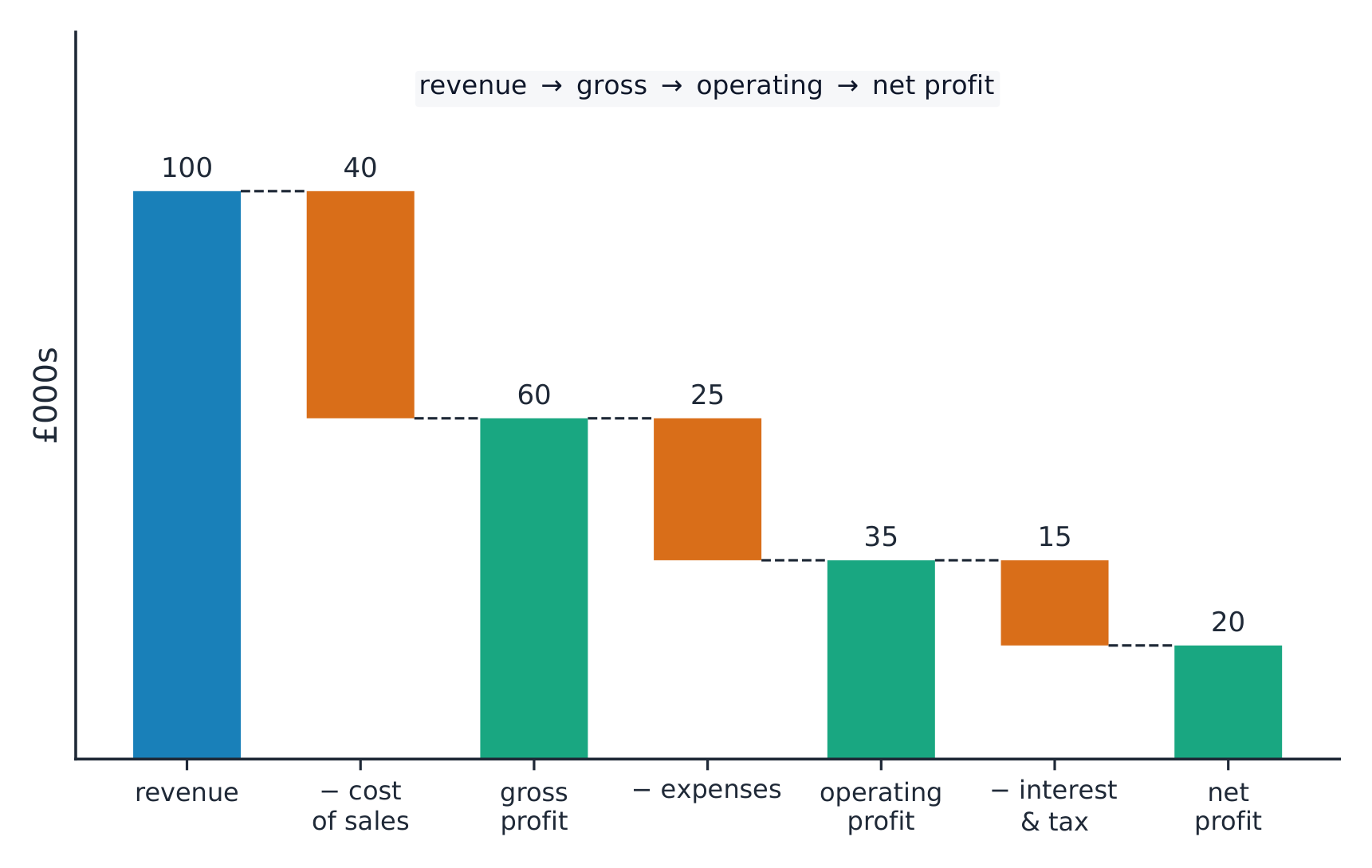
An income statement falls from revenue down to net profit
Current assets are 120 and current liabilities are 60. What is the current ratio?
Difficulty 2/5 · 140 coins + a small bonus on first completion today
120 ÷ 60 = 2 (i.e. 2:1).
The liquidity ratio that excludes inventory is the ______-test ratio.
Difficulty 1/5 · 100 coins + a small bonus on first completion today
Acid-test = (current assets − inventory) ÷ current liabilities.
Liquidity ratios
- Current ratio 流动比率 = current assets ÷ current liabilities (around 1.5–2 is healthy).
- Acid-test ratio 速动比率 = (current assets − inventory) ÷ current liabilities — a stricter test.
A profitable business can still have poor liquidity if its cash is tied up in stock and debtors.
Difficulty 1/5 · 100 coins + a small bonus on first completion today
Profit and cash are different — check liquidity separately.
What the ratios reveal
- Profitability ratios show how well the firm turns sales and capital into profit.
- Liquidity ratios show whether it can pay its short-term debts.
High profit doesn't guarantee good liquidity. A firm can be very profitable yet unable to pay this month's bills if its cash is tied up in stock or unpaid invoices. Check both ratio types.
You've got it
- profitability: gross margin, operating margin, and ROCE (operating profit ÷ capital employed)
- liquidity: current ratio and the stricter acid-test (excludes inventory)
- profitability and liquidity are different — a profitable firm can still run short of cash