Critical path analysis
Introduced| English | Meaning |
|---|---|
| critical path analysis/ˈkrɪtɪkl pæθ əˈnæləsɪs/ | A project-planning method that identifies the longest chain of dependent activities and the earliest possible completion time. |
| network diagram/ˈnetwɜːk ˈdaɪəɡræm/ | network diagram |
| activity/ækˈtɪvɪti/ | activity |
| duration/djʊəˈreɪʃn/ | duration |
| nodes/nəʊdz/ | Points or units in a network, graph or linked structure, connected by relationships or edges. |
| critical path/ˈkrɪtɪkl pæθ/ | The longest route through the network — it sets the minimum project time. |
| float/fləʊt/ | The spare time a non-critical activity has before it would hold things up. |
The schedule that can't slip
- A big project — a building, a product launch — has dozens of tasks, some at once, some in sequence.
- Critical path analysis 关键路径分析 (CPA) finds the fastest way through and the tasks that must not be late.
A diagram of activities, durations and dependencies used in CPA is a ______ diagram.
Difficulty 1/5 · 100 coins + a small bonus on first completion today
The network diagram is the basis of critical path analysis.
Networks of activities
- A network diagram 网络图 shows each activity 活动, its duration 工期, and what must finish before it can start.
- Nodes 节点 mark events (start/finish points); arrows are the activities.
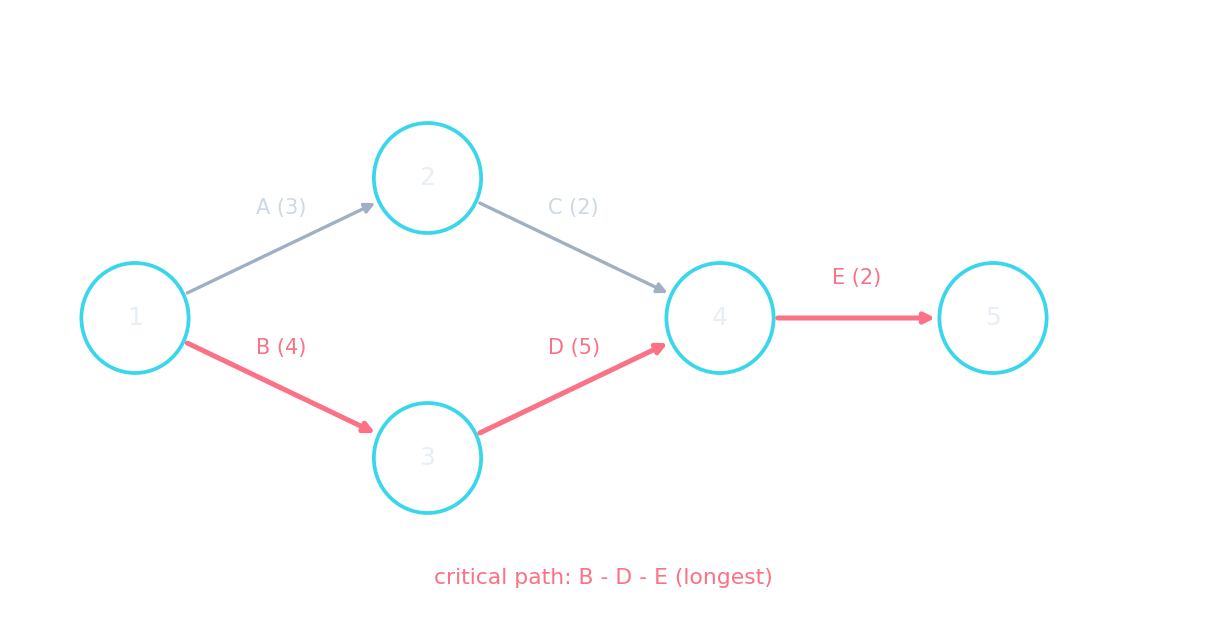
The critical path 关键路径 is the longest route through the network — it sets the minimum project time.
Critical path analysis
CPA finds the sequence of tasks that decides the shortest time a project can take.
The critical path is the:
Difficulty 1/5 · 100 coins + a small bonus on first completion today
The longest route determines the minimum completion time.
Float is:
Difficulty 1/5 · 100 coins + a small bonus on first completion today
Float is slack time on non-critical activities.
The critical path and float 浮动时间
- The critical path is the sequence of activities with no spare time — any delay delays the whole project.
- Float is the spare time a non-critical activity has before it would hold things up.
Worked example. If path B-D-E takes 4 + 5 + 2 = 11 days and every other route is shorter, then 11 days is the minimum project time, and B, D and E are critical — no float.

A critical path network with the critical path of zero-float activities highlighted
Find the critical path
Drag the durations — the network rolls forward and back, the floats update, and the critical path jumps to whichever route is longest.
A critical path runs through activities of 3, 5 and 4 days. What is the minimum project duration (days)?
Difficulty 2/5 · 140 coins + a small bonus on first completion today
3 + 5 + 4 = 12 days along the critical path.
A delay to an activity on the critical path delays the whole project.
Difficulty 1/5 · 100 coins + a small bonus on first completion today
Critical activities have no float to absorb a delay.
Why CPA helps
- It reveals the shortest possible completion time and which tasks to watch.
- It helps schedule resources and run activities in parallel to save time.
A delay on the critical path delays everything. Non-critical tasks have float to absorb slips; critical ones do not. Managers must protect the critical path above all.
You've got it
- a network diagram shows activities, durations and dependencies
- the critical path is the longest route — it sets the minimum project time
- float is spare time on non-critical tasks; a delay on the critical path delays the project