Location and scale
Introduced| English | Meaning |
|---|---|
| location/ləʊˈkeɪʃn/ | The place chosen for a business or activity, considered in relation to factors such as customers, costs and transport. |
| scale/skeɪl/ | The size or extent of an operation or energy supply. |
| infrastructure/ˈɪnfrəstrʌktʃə/ | Basic facilities and networks, such as transport, energy and communications, that support economic and social activity. |
| incentives/ɪnˈsentɪvz/ | Rewards, penalties or other factors that encourage people to act in a particular way. |
| economies of scale/ɪˈkɒnəmiz ɒv skeɪl/ | Falls in average production cost as the scale of output increases. |
| offshoring/ˈɒfʃərɪŋ/ | Moving business activities to another country, whether within the same organisation or through an external provider. |
Where to set up shop
- Two identical businesses can thrive or fail purely on where they locate.
- Choosing a location 选址 — and the right scale 规模 of operation — is a major strategic decision.
Location factor lab
Classify why a business chooses one site over another.
For a high-street retailer, the most important location factor is usually:
Difficulty 1/5 · 100 coins + a small bonus on first completion today
Retailers need footfall — closeness to customers.
Which are location factors? (Select all that apply.)
Difficulty 2/5 · 140 coins + a small bonus on first completion today
Costs, infrastructure and incentives matter; the last does not.
Factors affecting location
- Costs: land, labour, transport.
- Market: closeness to customers (vital for retail).
- Materials and labour supply, infrastructure 基础设施, and government incentives 激励.

A location decision weighs quantitative factors like cost against qualitative ones like nearness to customers
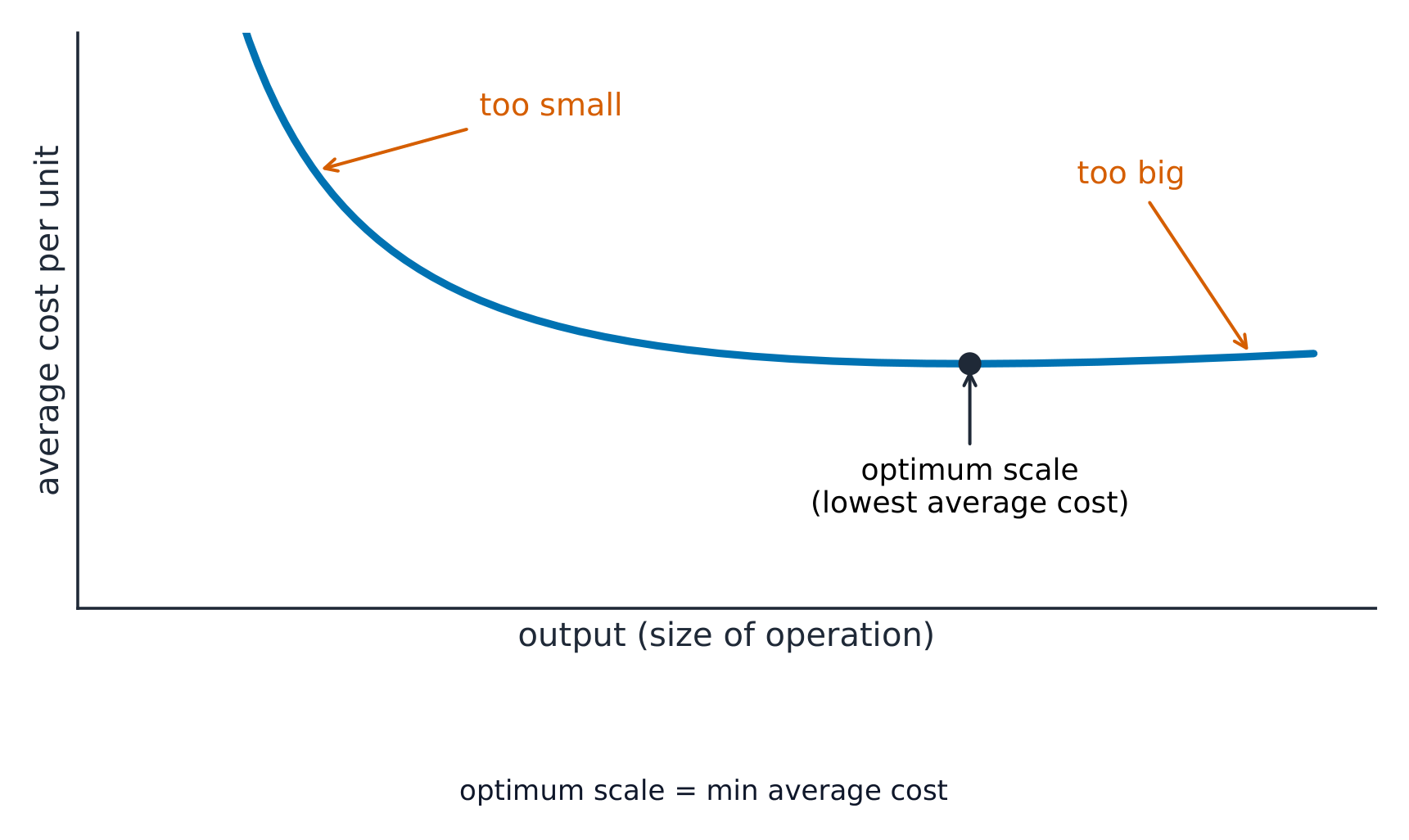
The optimum scale is the output with the lowest average cost
Operating at a larger scale can unlock:
Difficulty 1/5 · 100 coins + a small bonus on first completion today
Larger scale lowers average cost through economies of scale.
The maximum output a business is set up to produce is its ______ of operation.
Difficulty 1/5 · 100 coins + a small bonus on first completion today
Scale links closely to economies of scale.
The scale of operation
- Scale is the maximum output a business is set up to produce.
- A larger scale unlocks economies of scale 规模经济 — but demands heavy investment and steady demand.
Worked example. A steel maker locates near a port and raw materials to cut transport costs; a coffee shop locates on a busy high street near its customers. The best location depends on the business.
Offshoring can cut costs but adds risks of distance, culture and control.
Difficulty 1/5 · 100 coins + a small bonus on first completion today
Locating abroad trades cost savings for added complexity.
Globalisation and location
- Firms increasingly locate offshore to cut costs or reach new markets.
- This is relocation/offshoring 离岸外包 — powerful, but it brings risks of distance, culture and control.
You've got it
- location factors: costs, market, materials, labour, infrastructure, incentives
- scale = maximum set-up output; larger scale unlocks economies of scale
- firms may offshore to cut costs or reach markets, accepting distance/control risks
Write from a rent gap of 4000
- A site near customers costs 7000 in rent. A distant site costs 3000.
- Find the rent gap, and name one location factor besides rent.
A city site has rent of 7000 and a distant site has rent of 3000. How much more rent does the city site cost, and why might a firm still choose it?
7000 minus 3000 is 4000.
How much more rent does the city site cost?
Difficulty 1/5 · 100 coins + a small bonus on first completion today
The two rents differ by 4000. Other options — 7000 (the city rent used as the gap); 3000 (the distant rent used as the gap).