Business strategy
Introduced| English | Meaning |
|---|---|
| strategy/ˈstrætədʒi/ | A coordinated long-term approach for achieving an organisation's objectives and allocating its resources. |
| SWOT/swɒt/ | Strengths, Weaknesses (internal) + Opportunities, Threats (external). |
| strengths/streŋθs/ | Internal capabilities or advantages that help a person or organisation achieve its aims. |
| weaknesses/ˈwiːknəsɪz/ | Internal limitations or shortcomings that hinder an organisation or project. |
| opportunities/ɒpəˈtjuːnɪtiz/ | External conditions or developments that an organisation could use to achieve its objectives. |
| threats/θrets/ | External conditions or developments that could harm an organisation's performance or objectives. |
| tactics/ˈtæktɪks/ | The short-term actions that carry it out (a promotion, a price cut). |
Choosing a direction
- Day-to-day decisions keep a business running; strategy 战略 decides where it is going over years.
- Good strategy starts by understanding the firm's position — inside and out.
SWOT strategy lab
Sort strategy evidence into internal and external factors.
In a SWOT analysis, opportunities and threats are:
Difficulty 1/5 · 100 coins + a small bonus on first completion today
Opportunities and threats are external; strengths and weaknesses are internal.
Which are INTERNAL factors in SWOT? (Select all that apply.)
Difficulty 2/5 · 140 coins + a small bonus on first completion today
Strengths and weaknesses are internal; opportunities and threats are external.
In SWOT, the letter W stands for ______.
Difficulty 1/5 · 100 coins + a small bonus on first completion today
SWOT = Strengths, Weaknesses, Opportunities, Threats.
SWOT SWOT分析 analysis
- SWOT examines Strengths 优势, Weaknesses 劣势 (internal) and Opportunities 机会, Threats 威胁 (external).
- It summarises a firm's position to guide strategic choices.

SWOT analysis sorts internal strengths and weaknesses from external opportunities and threats
A SWOT analysis is only useful if the business acts on its findings.
Difficulty 1/5 · 100 coins + a small bonus on first completion today
Analysis without action changes nothing.
From analysis to strategy
- Use strengths to seize opportunities; fix weaknesses; defend against threats.
- A strategy is a long-term plan to achieve the firm's objectives.
Worked example. A bakery's SWOT: strong local brand (S), no online presence (W), growing demand for delivery (O), a new rival (T). Strategy: build an online ordering service to turn the opportunity into sales before the rival does.
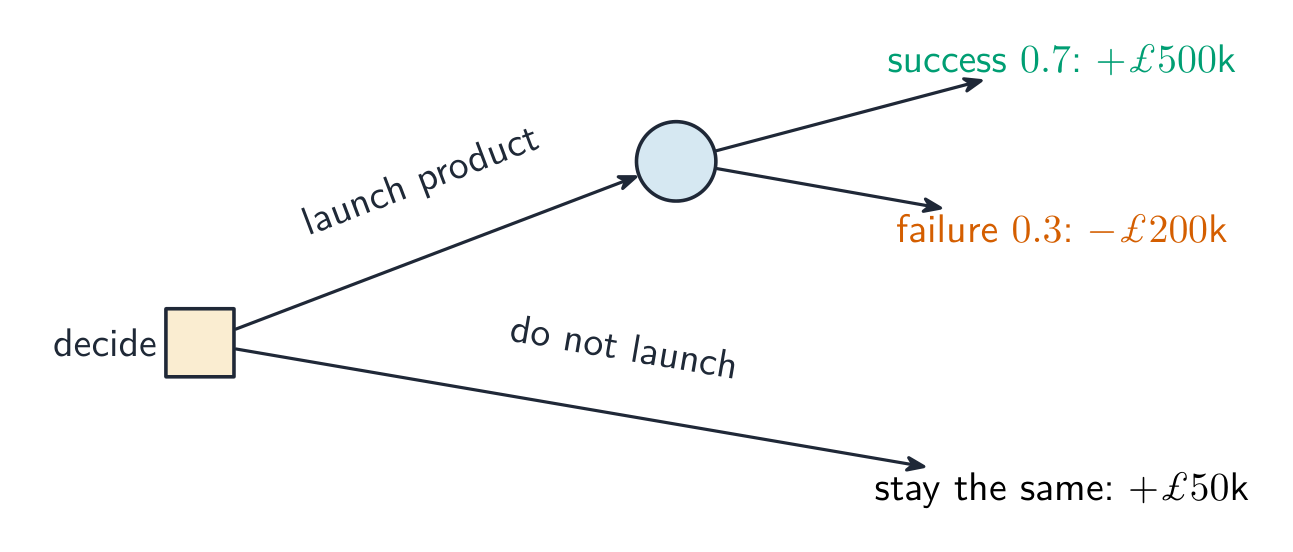
A decision tree weighs each choice by its likely payoff
Decision tree — roll back the EMV
Drag the probability and payoffs. Each option's expected value updates live — the losing branch gets the cut marks, and the note shows the probability where the decision flips.
A strategy is best described as:
Difficulty 1/5 · 100 coins + a small bonus on first completion today
Strategy is the long-term direction; tactics are short-term actions.
Strategy vs tactics 策略
- Strategy is the long-term direction (which markets, which products).
- Tactics are the short-term actions that carry it out (a promotion, a price cut).
SWOT describes, it doesn't decide. Listing strengths and threats is only the start — the value is in acting on it. A SWOT that gathers dust changes nothing.
You've got it
- SWOT = Strengths, Weaknesses (internal) + Opportunities, Threats (external)
- turn strengths onto opportunities, fix weaknesses, defend against threats
- strategy = long-term direction; tactics = the short-term actions