Economic external influences
Introduced| English | Meaning |
|---|---|
| recession/rɪˈseʃn/ | A significant, sustained decline in an economy's overall activity. |
| exchange rate/eksˈtʃeɪndʒ reɪt/ | The price of one currency expressed in units of another currency. |
| business cycle/ˈbɪznəs ˈsaɪkl/ | Fluctuations in economic activity between expansion and contraction over time. |
| boom/buːm/ | A period of strong economic activity, often with rapid growth and high demand. |
| recovery/rɪˈkʌvəri/ | A phase in which economic activity rises again after a downturn. |
| interest rates/ˈɪntrest reɪts/ | Charges for borrowing, or returns on lending, expressed as percentages of the amount over a period. |
| currency/ˈkʌrənsi/ | The money used in a particular economy, especially its notes, coins and unit of denomination. |
| exports/ˈekspɔːts/ | Goods and services sold to buyers in other countries. |
| imports/ɪmˈpɔːts/ | Goods and services bought from sellers in other countries. |
| inflation/ɪnˈfleɪʃn/ | A sustained increase in the general price level of goods and services. |
The weather a business can't control
- A firm can run itself perfectly and still be hit by a recession 衰退, a rate rise, or a swing in the exchange rate 汇率.
- These external economic influences shape every business, yet lie outside its control.
External influences lab
Classify outside changes by the channel that hits the business.
During a recession, most businesses experience:
Difficulty 1/5 · 100 coins + a small bonus on first completion today
A recession cuts demand and sales for most firms.
The phase of the business cycle with falling output and rising unemployment is a ______.
Difficulty 1/5 · 100 coins + a small bonus on first completion today
A recession is the downturn phase.
The business cycle 经济周期
- Economies move through boom 繁荣 → slowdown → recession → recovery 复苏.
- In a boom, demand and profits rise; in a recession, sales fall and firms may cut jobs.
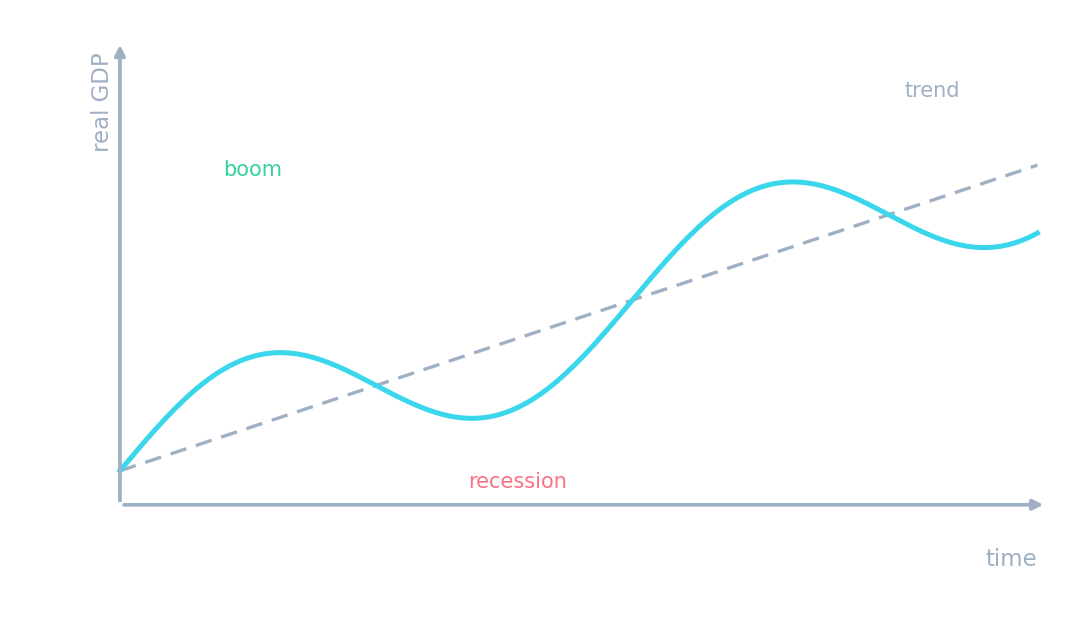
Demand for most firms rises in a boom and falls in a recession.
A rise in interest rates is likely to:
Difficulty 1/5 · 100 coins + a small bonus on first completion today
Dearer borrowing cuts spending and demand.
A stronger domestic currency makes a firm's exports:
Difficulty 1/5 · 100 coins + a small bonus on first completion today
A strong currency raises the foreign price of exports.
Interest rates 利率 and exchange rates
- Higher interest rates raise borrowing costs and cut consumer spending → lower demand.
- A stronger currency 货币 makes exports 出口 dearer abroad and imports 进口 cheaper at home.

A strong currency makes exports dearer and imports cheaper; a weak one does the reverse

A multinational's outlets look the same worldwide: a global brand
Inflation tends to raise a firm's costs and reduce customers' real spending power.
Difficulty 1/5 · 100 coins + a small bonus on first completion today
Both effects squeeze the business.
Inflation 通货膨胀
- Inflation raises a firm's costs (materials, wages) and erodes customers' real spending power.
- Firms respond by raising prices, cutting costs, or improving efficiency.
External shocks hit different firms differently. A recession devastates a luxury-goods maker but barely touches a discount retailer — which may even grow. Always link the influence to the specific business.

Inflation is a sustained rise in prices over time
You've got it
- the business cycle: boom → slowdown → recession → recovery
- higher interest rates cut demand; a stronger currency hurts exporters
- inflation raises costs and erodes spending power — effects vary by firm