Inventory management
Introduced| English | Meaning |
|---|---|
| just-in-time/dʒʌst ɪn taɪm/ | A production and inventory approach in which supplies arrive close to when they are needed, reducing stock held. |
| stock/stɒk/ | stock |
| inventory/ˈɪnvəntri/ | Stocks of materials, work in progress and finished goods held by a business. |
| delivery/dɪˈlɪvəri/ | delivery |
| re-order level/riː ˈɔːdə ˈlevl/ | re-order level |
| buffer stock/ˈbʌfə stɒk/ | The minimum held to cope with delays or demand spikes. |
| lead time/liːd taɪm/ | The gap between ordering and delivery. |
| just-in-case/dʒʌst ɪn keɪs/ | just-in-case |
| suppliers/səˈplaɪəz/ | Businesses or people that provide goods, materials or services to another organisation. |
Just enough, just in time 准时制
- Too little stock 存货 and production halts; too much and cash is tied up in a warehouse.
- Inventory 库存 (stock) management walks this tightrope.
Leadership style lab
Pick the management style that fits each situation.
On a stock control chart, the re-order level is the stock level at which:
Difficulty 1/5 · 100 coins + a small bonus on first completion today
Reaching the re-order level triggers a new order.
The stock control chart
- As stock is used up, it falls; when a delivery 交货 arrives, it jumps back to the maximum.
- Key levels: maximum, re-order level 再订货水平 (place an order), and buffer stock 缓冲库存 (the safety minimum).
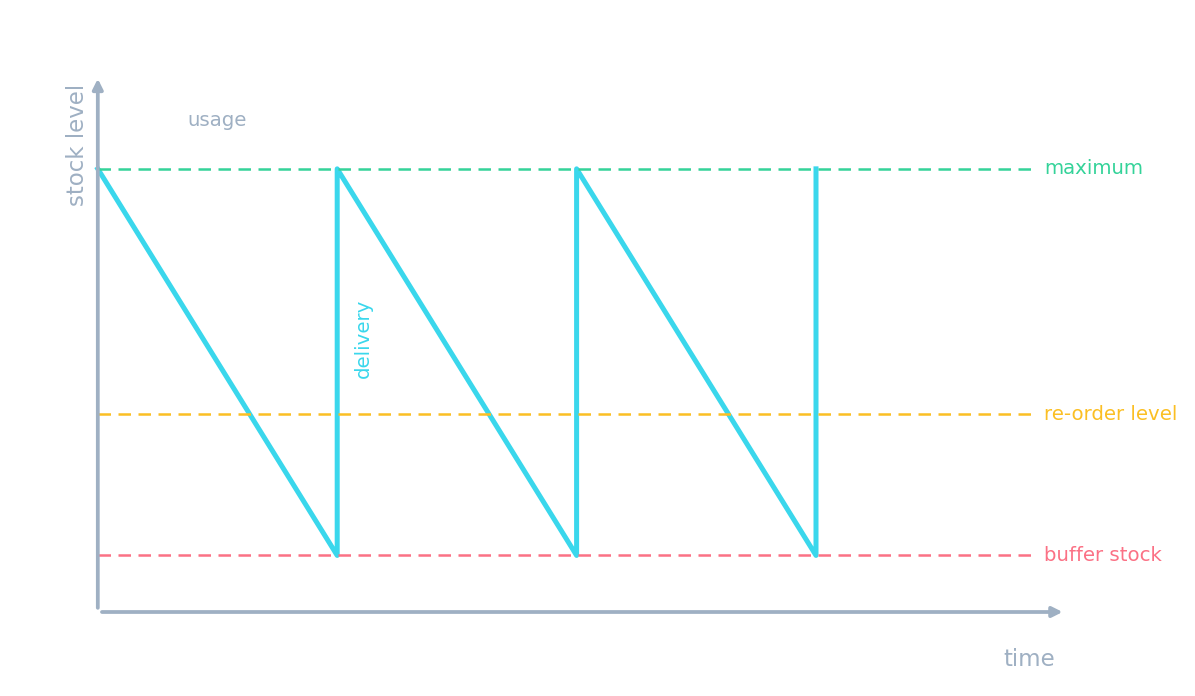
Stock falls as it is used, then deliveries return it to the maximum, never falling below the buffer.
Buffer stock is held to:
Difficulty 1/5 · 100 coins + a small bonus on first completion today
Buffer stock is a safety minimum.
Lead time is the gap between placing an order and receiving the delivery.
Difficulty 1/5 · 100 coins + a small bonus on first completion today
Longer lead times require higher buffer stock.
Lead time 交货周期 and buffer stock
- Lead time is the gap between ordering and delivery.
- Buffer stock is the minimum held to cope with delays or demand spikes.
A benefit of just-in-time (JIT) is that it:
Difficulty 1/5 · 100 coins + a small bonus on first completion today
JIT minimises stock and frees cash, but relies on reliable supply.
Holding extra stock for safety, in case of problems, is the just-in-______ approach.
Difficulty 1/5 · 100 coins + a small bonus on first completion today
Just-in-case holds buffer stock; just-in-time holds almost none.
JIT vs JIC
- Just-in-time (JIT): hold almost no stock; materials arrive as needed. Frees cash, but risky if supply fails.
- Just-in-case 备货制 (JIC): hold buffer stock for safety. Reliable, but ties up cash.

Just-in-time holds almost no stock; just-in-case keeps a buffer for safety
JIT saves cash but removes the safety net. With no buffer stock, a single late delivery stops production. JIT needs very reliable suppliers 供应商 — its strength is also its weakness.
You've got it
- the stock control chart shows usage, re-order level, deliveries and buffer stock
- lead time = order-to-delivery gap; buffer stock = safety minimum
- JIT (no stock) frees cash but is risky; JIC (buffer stock) is safer but ties up cash
Write from a buffer of 30 units
- A firm keeps a buffer of 30 units.
- Lead time is 4 days.
- Say what the buffer is for, and what JIT would do instead.
A firm holds a buffer stock of 30 units, and the lead time from order to delivery is 4 days. What is the buffer for, and how would just-in-time production treat that stock?
Buffer stock covers the wait. JIT tries not to hold it.
What is the stock of 30 units called?
Difficulty 1/5 · 100 coins + a small bonus on first completion today
The safety minimum is the buffer.