Market research
Introduced| English | Meaning |
|---|---|
| market research/ˈmɑːkɪt rɪˈsɜːtʃ/ | Collecting and analysing information about customers, competitors and market conditions. |
| secondary research/ˈsekəndəri rɪˈsɜːtʃ/ | Research using information that has already been collected for another purpose. |
| primary research/ˈpraɪməri rɪˈsɜːtʃ/ | Research that collects new data directly for the question being investigated. |
| surveys/ˈsɜːveɪz/ | surveys |
| focus groups/ˈfəʊkəs ɡruːps/ | focus groups |
| qualitative/ˈkwɒlɪteɪtɪv/ | Describing qualities or categories rather than numerical measurements. |
| quantitative/ˈkwɒntɪteɪtɪv/ | Based on numerical values, measurements or counts. |
| sampling/ˈsæmplɪŋ/ | Selecting a subset of people or observations to obtain information about a wider population. |
| sample/ˈsæmpl/ | A subset of a population selected for observation, measurement or analysis. |
| representative/ˌreprɪˈzentətɪv/ | Reflecting the relevant characteristics of the larger group or population. |
Asking before you act
- Launching a product on a hunch is gambling. Smart firms find out what customers want first.
- That is market research 市场调研 — turning guesses into evidence.
Market research cycle
Follow how a business turns customer data into a marketing decision.
Conducting a new customer survey is an example of:
Difficulty 1/5 · 100 coins + a small bonus on first completion today
Primary research collects new first-hand data.
Using existing government statistics is:
Difficulty 1/5 · 100 coins + a small bonus on first completion today
Secondary research uses data that already exists.
Primary vs secondary research 二手调研
- Primary research 一手调研: new data collected first-hand (surveys 问卷调查, interviews, focus groups 焦点小组). Specific but costly.
- Secondary research: existing data (reports, government stats, internal sales). Cheap and fast, but not tailored.
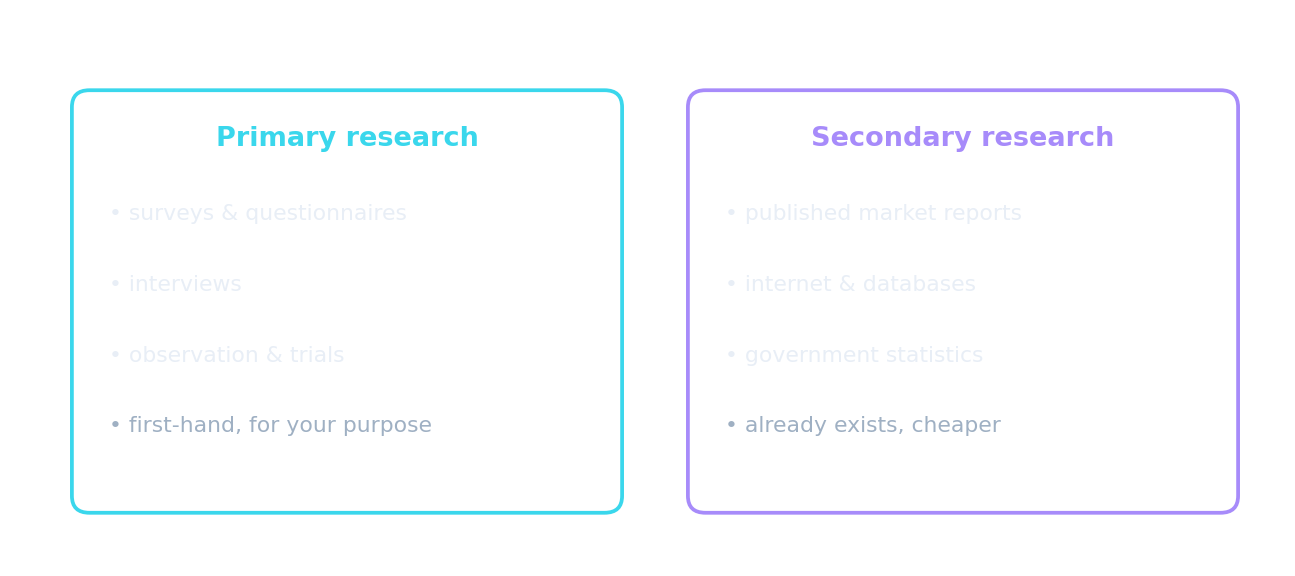
Market research: primary (first-hand) versus secondary (already exists)
Research that explores WHY customers feel as they do is:
Difficulty 1/5 · 100 coins + a small bonus on first completion today
Qualitative research captures opinions and reasons.
Qualitative 定性 vs quantitative 定量
- Quantitative: numbers — how many, how much (sales figures, survey counts).
- Qualitative: opinions and reasons — why customers behave as they do (interviews, focus groups).

A mass market targets everyone; a niche serves a small specialist group
A sample that is not representative can give misleading results, however large it is.
Difficulty 1/5 · 100 coins + a small bonus on first completion today
Representativeness matters as much as sample size.
A small group chosen to represent the whole market is a ______.
Difficulty 1/5 · 100 coins + a small bonus on first completion today
Sampling avoids the impossible task of asking everyone.
Sampling 抽样
- A sample 样本 is a small group chosen to represent the whole market — you can't ask everyone.
- A bigger, more representative 有代表性的 sample gives more reliable results, but costs more.
Bad sampling ruins good research. If the sample isn't representative (e.g. only asking existing customers), the results mislead — no matter how many people you ask. Sample design matters as much as sample size.
You've got it
- primary research = new first-hand data; secondary = existing data
- quantitative = numbers; qualitative = opinions and reasons (the "why")
- a representative sample stands in for the whole market — design beats size