Copying and sorting DNA
Introduced| English | Meaning |
|---|---|
| amplify/ˈæmplɪfaɪ/ | To make many copies of a selected DNA sequence. |
| gel electrophoresis/dʒel ɪˌlektrəʊfɔːˈriːsɪs/ | A technique that separates charged molecules through a gel using an electric field. |
| microarray/ˈmaɪkrəʊəreɪ/ | A surface carrying many known molecular probes used to test numerous sample targets in parallel. |
| genome/ˈdʒiːnəʊm/ | The complete set of genetic material of an organism or cell, or of a virus. |
| polymerase chain reaction/ˌpɒlɪməˈreɪz tʃeɪn rɪˈækʃn/ | A method that repeatedly copies a chosen DNA region using primers, a DNA polymerase and cycles of temperature change. |
| Taq polymerase/tæk ˌpɒlɪməˈreɪz/ | Taq polymerase |
Amplifying 扩增 the evidence
- To study DNA, we often need millions of copies.
- PCR makes them; gel electrophoresis 凝胶电泳 sorts fragments by length.
- Microarrays 微阵列 and databases handle whole genomes 基因组.
PCR
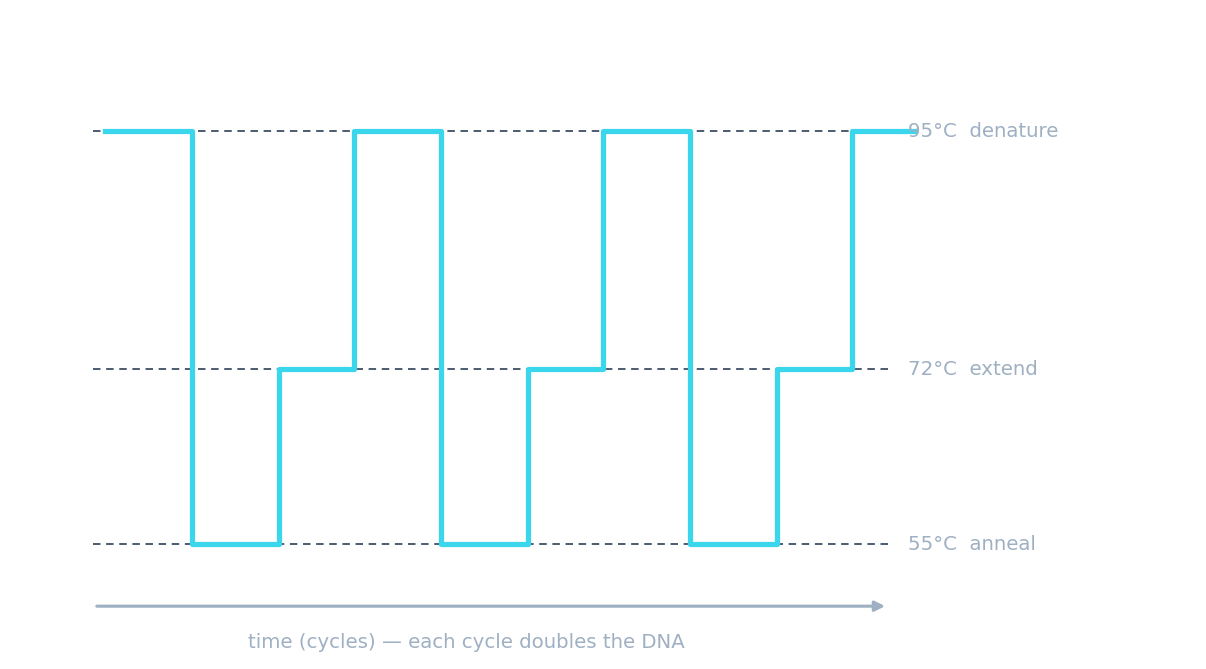
- The polymerase chain reaction 聚合酶链式反应 (PCR) clones and amplifies DNA — millions of copies.
- It repeats cycles of heating and cooling, using the heat-stable enzyme Taq polymerase Taq聚合酶.
- Each cycle doubles the DNA.

A thermal cycler automates the heat/cool cycles of PCR.
The polymerase chain reaction (PCR)
Step through one cycle. Heat splits the DNA, primers bind, polymerase copies — and the amount doubles every cycle.
The polymerase chain reaction (PCR) is used to:
Difficulty 1/5 · 100 coins + a small bonus on first completion today
PCR amplifies DNA through repeated heat/cool cycles using Taq polymerase.
The technique that makes millions of copies of a DNA sample is the ______ chain reaction.
Difficulty 1/5 · 100 coins + a small bonus on first completion today
PCR (the polymerase chain reaction) uses Taq polymerase to copy DNA over many cycles.
In each PCR cycle, the amount of DNA:
Difficulty 1/5 · 100 coins + a small bonus on first completion today
Each cycle copies every strand, so the DNA roughly doubles — giving exponential growth.
Put one PCR cycle in order.
Difficulty 3/5 · 200 coins + a small bonus on first completion today
Denature → anneal → extend, then repeat. The doubling makes it exponential.
Gel electrophoresis
- Gel electrophoresis separates DNA fragments by length.
- Fragments move through a gel in an electric field, towards the + end.
- Shorter fragments travel further, so the lengths spread into bands.

An electric field pulls DNA fragments through the gel; shorter ones travel further, sorting them by length
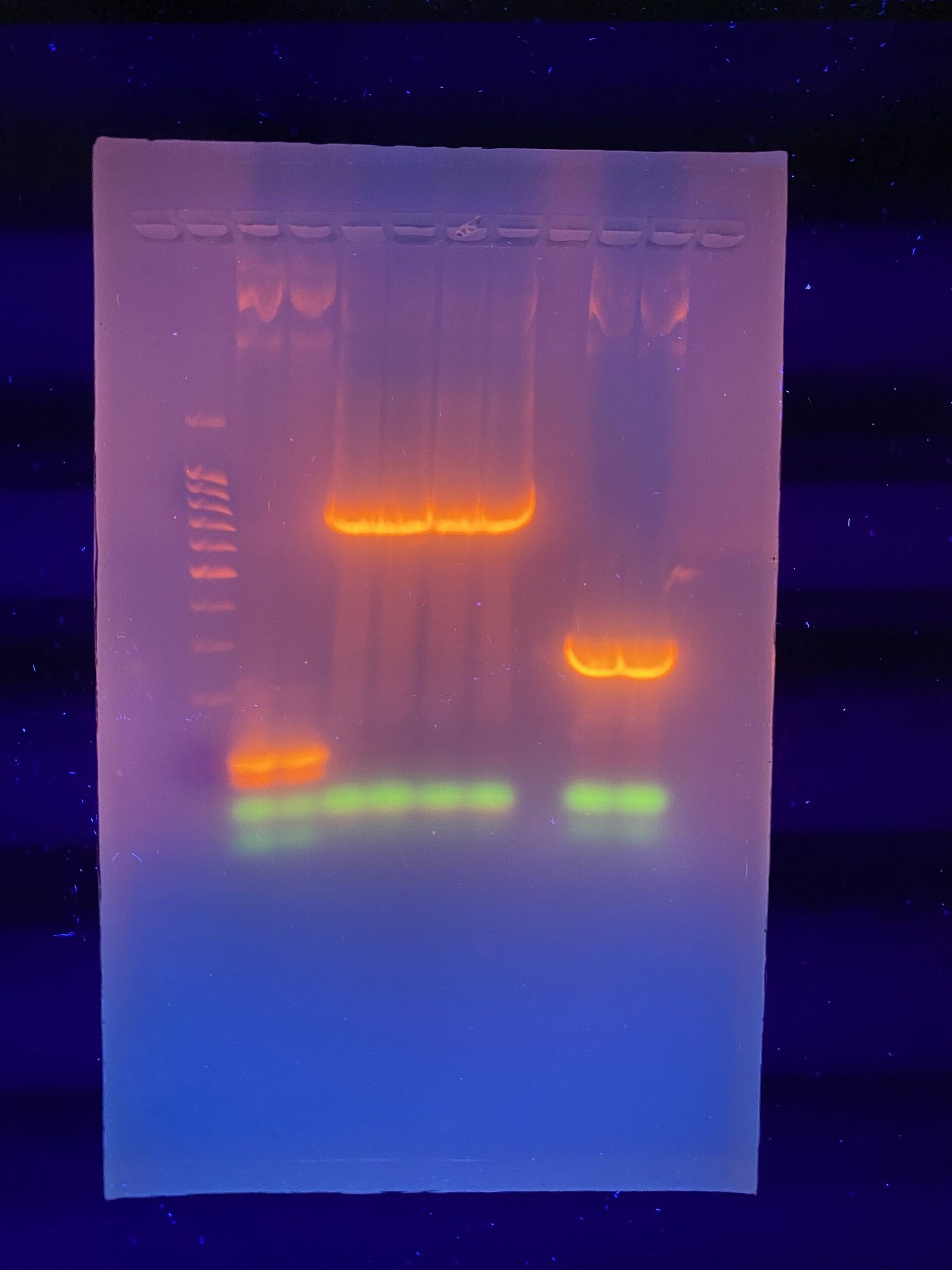
DNA fragments separated into glowing bands by gel electrophoresis, seen under UV light
In gel electrophoresis, shorter DNA fragments:
Difficulty 1/5 · 100 coins + a small bonus on first completion today
Fragments move toward the + end; shorter ones travel further, separating the DNA by length.
In gel electrophoresis, shorter DNA fragments travel further through the gel than longer ones.
Difficulty 1/5 · 100 coins + a small bonus on first completion today
DNA is negative, so it moves to the + electrode; small fragments slip through the gel more easily, so they go further.
Microarrays and databases
- Microarrays study whole genomes and detect which genes are switched on (by picking up their mRNA).
- Databases store DNA and protein sequences, so scientists anywhere can compare them.
Microarrays are used to:
Difficulty 1/5 · 100 coins + a small bonus on first completion today
Microarrays detect gene activity across a genome by picking up the mRNA of expressed genes.
You've got it
- PCR amplifies DNA (heat/cool cycles, Taq polymerase); each cycle doubles it
- gel electrophoresis sorts fragments by length — shorter travel further toward the + end
- microarrays show which genes are switched on; databases store sequences for comparison