The taxonomic hierarchy and kingdoms
Introduced| English | Meaning |
|---|---|
| taxonomic hierarchy/ˌtæksəˈnɒmɪk ˈhaɪərɑːki/ | The nested levels used to classify organisms into increasingly specific groups. |
| kingdom/ˈkɪŋdəm/ | A broad taxonomic rank below domain and above phylum. |
| phylum/ˈfaɪləm/ | A taxonomic rank below kingdom and above class. |
| genus/ˈdʒenəs/ | A taxonomic group containing one or more closely related species. |
| Protoctista/ˈprəʊtəʊktɪstə/ | Mostly single-celled (e.g. *Amoeba*). |
| Fungi/ˈfʌŋɡi/ | Feed by absorbing food. |
| photosynthesis/ˌfəʊtəʊˈsɪnθəsɪs/ | The process by which plants and other organisms use light energy to make organic substances from carbon dioxide and water. |
Sorting all of life
- Inside the Eukarya, organisms are sorted into smaller and smaller groups.
- This is the taxonomic hierarchy 分类层级.
- The Eukarya split into four kingdoms 界.
The smallest, most specific group in the taxonomic hierarchy is the ______.
Difficulty 1/5 · 100 coins + a small bonus on first completion today
Domain → kingdom → phylum → class → order → family → genus → species.
Kingdom to species
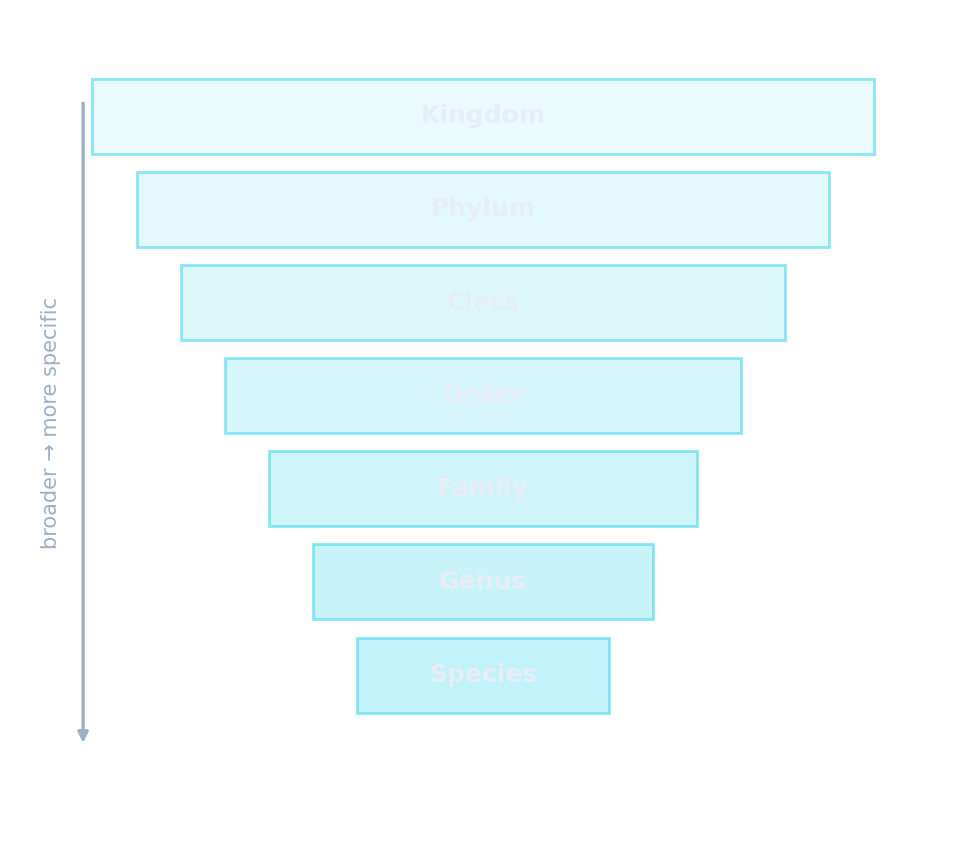
- The levels: Kingdom → Phylum 门 → Class → Order → Family → Genus 属 → Species.
- Each level is a smaller, more closely related group, ending at a single species.
The taxonomic hierarchy
Step down the levels for one species — humans — from the broadest domain to the most specific species.
Put the taxonomic levels in order, from broadest to most specific.
Difficulty 3/5 · 200 coins + a small bonus on first completion today
Kingdom → Phylum → Class → Order → Family → Genus → Species (broad to specific).
Which level is the smallest, most closely related group?
Difficulty 1/5 · 100 coins + a small bonus on first completion today
Species is the most specific level; kingdom is the broadest.
Two organisms in the same genus are more closely related than two that only share the same class.
Difficulty 1/5 · 100 coins + a small bonus on first completion today
The further down the hierarchy two organisms still match, the more closely related they are.
The four eukaryote kingdoms
- Protoctista 原生生物界 — mostly single-celled (e.g. Amoeba).
- Fungi 真菌界 — feed by absorbing food; cell walls of chitin.
- Plantae — make their own food by photosynthesis 光合作用.
- Animalia — feed on other organisms.

A museum insect collection: classification groups organisms by shared features.
Which kingdom makes its own food by photosynthesis?
Difficulty 1/5 · 100 coins + a small bonus on first completion today
Plantae photosynthesise; Animalia feed on others; Fungi absorb food; Protoctista are mostly single-celled.
Match each kingdom to how it feeds.
Difficulty 2/5 · 140 coins + a small bonus on first completion today
Plantae photosynthesise; Fungi absorb; Animalia feed on other organisms; Protoctista are a mixed group.
Why classification changes
- New evidence — especially DNA and protein comparisons — can reveal true relationships.
- Organisms are reclassified when the evidence shows the old grouping was wrong.
You've got it
- hierarchy: Kingdom → Phylum → Class → Order → Family → Genus → Species (broad → specific)
- four eukaryote kingdoms: Protoctista, Fungi (absorb), Plantae (photosynthesise), Animalia (feed on others)