Transport of oxygen
Introduced| English | Meaning |
|---|---|
| haemoglobin/ˌhiːməˈɡləʊbɪn/ | The iron-containing protein in red blood cells that binds and transports oxygen. |
| oxygen dissociation curve/ˈɒksɪdʒn dɪˌsəʊsɪˈeɪʃn kɜːv/ | A graph showing how haemoglobin's percentage saturation with oxygen varies with oxygen partial pressure. |
| saturation/ˌsætʃəˈreɪʃn/ | The proportion of available binding sites occupied, such as oxygen-binding sites on haemoglobin. |
| partial pressure/ˈpɑːʃl ˈpreʃə/ | The pressure a gas in a mixture would exert if it alone occupied the same volume at the same temperature. |
| Bohr shift/ˈbəʊə ʃɪft/ | The release of more oxygen from haemoglobin where carbon dioxide is high, such as in respiring tissues. |
| fetal haemoglobin/ˈfiːtl ˌhiːməˈɡləʊbɪn/ | fetal haemoglobin |
| affinity/əˈfɪnɪti/ | The tendency or strength with which one molecule binds to another, such as oxygen binding to haemoglobin. |
Carrying oxygen
- Oxygen is carried by haemoglobin 血红蛋白 in red blood cells.
- How tightly haemoglobin holds oxygen depends on how much oxygen is around.
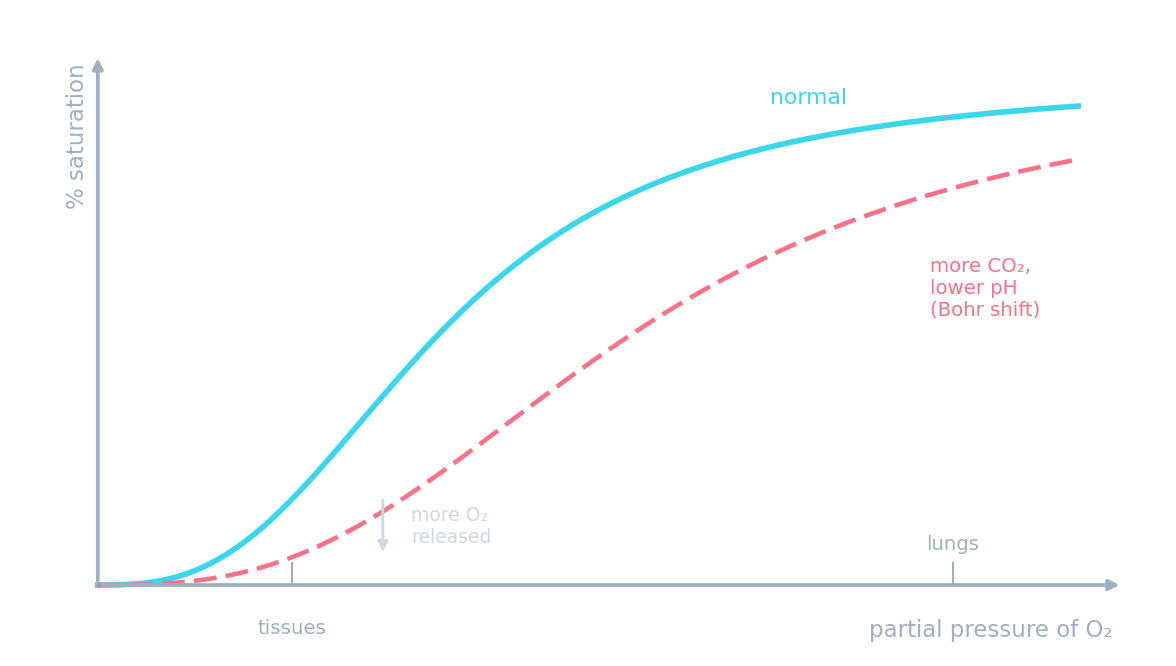
- The oxygen dissociation curve 氧解离曲线 captures this in one S-shaped graph.
Loading and unloading
- The curve plots % saturation 饱和度 (how full of oxygen) against the partial pressure 分压 of oxygen.
- Where oxygen is high (the lungs), haemoglobin loads up and becomes almost fully saturated.
- Where oxygen is low (respiring tissues), haemoglobin unloads its oxygen for the cells.
How blood carries oxygen
Haemoglobin picks up oxygen where there is lots of it (the lungs) and releases it where there is little (the tissues).
Where the partial pressure of oxygen is high (the lungs), haemoglobin:
Difficulty 1/5 · 100 coins + a small bonus on first completion today
At high oxygen partial pressure (lungs), haemoglobin loads up and becomes nearly fully saturated.
In respiring tissues, where oxygen is low, haemoglobin:
Difficulty 1/5 · 100 coins + a small bonus on first completion today
At low oxygen partial pressure (tissues), haemoglobin releases oxygen to the cells.
The oxygen dissociation curve is S-shaped (sigmoid).
Difficulty 1/5 · 100 coins + a small bonus on first completion today
It is S-shaped: binding one oxygen makes the next bind more easily, giving the characteristic sigmoid curve.
The Bohr shift 波尔位移
- Active tissues release more carbon dioxide, which lowers the pH.
- This makes haemoglobin release oxygen more easily — the curve shifts to the right.
- So oxygen is given up exactly where it is needed most. This is the Bohr shift — the right-shifted curve above.
Match each situation to what haemoglobin does.
Difficulty 2/5 · 140 coins + a small bonus on first completion today
Hb loads in the lungs, unloads in tissues; high CO₂ shifts the curve right; fetal Hb grabs oxygen from the mother.
The Bohr shift describes how:
Difficulty 1/5 · 100 coins + a small bonus on first completion today
More CO₂ lowers pH, shifting the curve right so haemoglobin releases more oxygen where tissues need it.
The rightward shift of the curve when CO₂ rises, releasing more oxygen to active tissues, is the ______ shift.
Difficulty 1/5 · 100 coins + a small bonus on first completion today
The Bohr shift means active tissues (high CO₂, low pH) get more oxygen unloaded to them.
Fetal haemoglobin 胎儿血红蛋白
- A fetus must take oxygen from its mother's blood, so its fetal haemoglobin has a higher affinity 亲和力 for oxygen.
- Its dissociation curve lies to the left of the adult curve — it loads oxygen where adult haemoglobin would unload it.
You've got it
- haemoglobin carries oxygen; the dissociation curve is S-shaped
- high oxygen (lungs) → loads / saturated; low oxygen (tissues) → unloads
- Bohr shift: more CO₂ → lower pH → curve moves right → more oxygen released
- the Bohr shift delivers oxygen where active tissues need it most
Write from the Bohr shift
- Respiring tissue releases extra carbon dioxide.
- Haemoglobin is carrying oxygen past that tissue.
What does the extra carbon dioxide do to unloading?
More carbon dioxide makes haemoglobin give up oxygen.
What is the Bohr shift?
Difficulty 1/5 · 100 coins + a small bonus on first completion today
The curve shifts right and oxygen is released.