Nucleotides and the structure of DNA
Introduced| English | Meaning |
|---|---|
| nucleotide/ˈnjuːklɪɒtaɪd/ | A unit of a nucleic acid containing a nitrogenous base, a pentose sugar and a phosphate group. |
| nucleic acid/njuːˈklɪɪk ˈæsɪd/ | A polymer of nucleotides that stores or transmits genetic information, such as DNA or RNA. |
| double helix/ˈdʌbl ˈhiːlɪks/ | The structure formed by two strands coiled around a common axis, as in DNA. |
| purine/ˈpjʊəriːn/ | A nitrogen-containing base with two fused rings; adenine and guanine are purines in nucleic acids. |
| pyrimidine/ˈpɪrɪmɪdiːn/ | A nitrogen-containing base with one ring; cytosine, thymine and uracil are pyrimidines in nucleic acids. |
| deoxyribose/diːˈɒksɪrɪbəʊs/ | The five-carbon sugar in DNA, with hydrogen in place of ribose's hydroxyl group at the 2-prime carbon. |
| phosphodiester bond/ˈfɒsfəʊdɪstə bɒnd/ | A covalent linkage through a phosphate group joining adjacent sugars in a nucleic-acid strand. |
| antiparallel/ˌæntɪˈpærəlel/ | Running alongside one another in opposite directions, as the two strands of DNA do. |
| complementary base pairing/ˌkɒmplɪˈmentəri beɪs ˈpeərɪŋ/ | Specific hydrogen bonding between matching bases: A with T in DNA or U in RNA, and G with C. |
Nucleotides 核苷酸 and DNA
- DNA and RNA are nucleic acids 核酸 — polymers of small units called nucleotides.
- The same building block also powers the cell as ATP.
- DNA's famous shape, the double helix 双螺旋, comes from how its bases pair up.
Nucleotides and bases
- Each nucleotide has three parts: a phosphate, a 5-carbon sugar, and a base.
- ATP is a nucleotide with the base adenine, the sugar ribose, and three phosphates — breaking off the last one releases energy.
- Five bases, in two groups:
- purines 嘌呤 (double ring): adenine (A), guanine (G).
- pyrimidines 嘧啶 (single ring): cytosine (C), thymine (T), uracil (U).

Purines (A, G) have a double ring; pyrimidines (C, T, U) have a single ring

A space-filling model of the DNA double helix, showing its twisted-ladder shape
A single nucleotide is made of:
Difficulty 1/5 · 100 coins + a small bonus on first completion today
Every nucleotide has three parts: a phosphate group, a pentose sugar, and a nitrogen-containing base.
ATP releases energy for the cell when:
Difficulty 1/5 · 100 coins + a small bonus on first completion today
ATP has three phosphates; breaking off the terminal phosphate releases energy.
The DNA backbone
- DNA is two strands twisted into a double helix.
- Each strand has a backbone of alternating deoxyribose 脱氧核糖 sugar and phosphate, joined by phosphodiester bonds 磷酸二酯键.
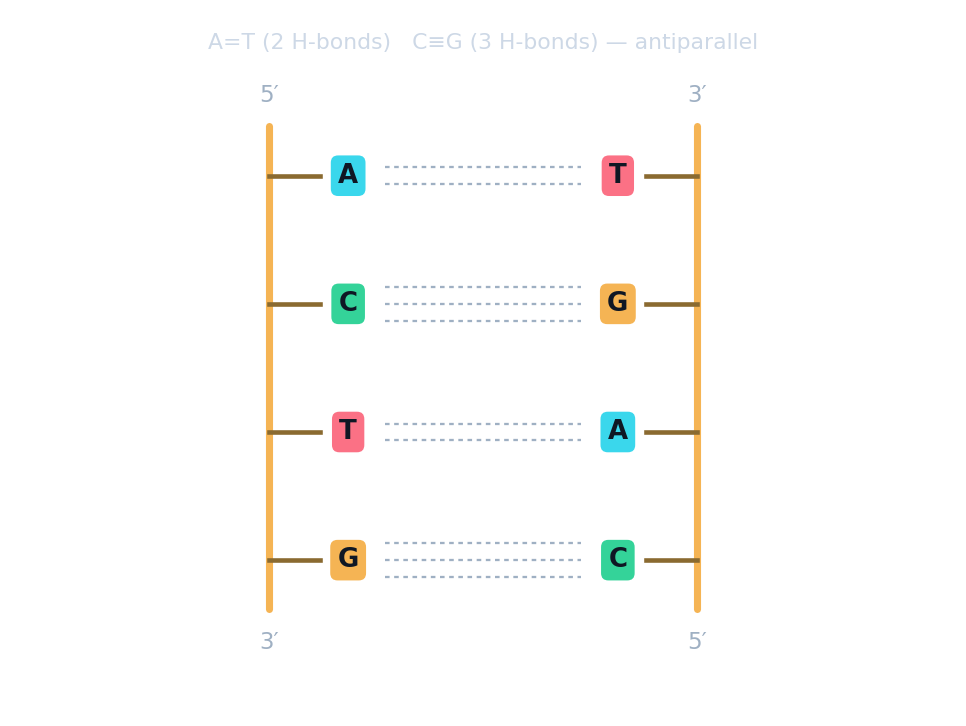
- The two strands run in opposite directions — they are antiparallel 反平行 (one 5′→3′, the other 3′→5′).

A nucleotide and ATP
Explore the DNA ladder
Tap each part of the double helix — two antiparallel backbones with complementary base pairs as the rungs.
The two DNA strands are described as antiparallel because they:
Difficulty 1/5 · 100 coins + a small bonus on first completion today
Antiparallel means the strands point in opposite directions: 5′→3′ on one, 3′→5′ on the other.
Complementary base pairing 碱基互补配对
- The strands are held together by their bases in the middle, paired exactly:
- A pairs with T — 2 hydrogen bonds.
- C pairs with G — 3 hydrogen bonds (so C–G is harder to separate).
Match each group of bases to its description.
Difficulty 2/5 · 140 coins + a small bonus on first completion today
A purine (double ring) always pairs with a pyrimidine (single ring): A–T and C–G.
In DNA, A always pairs with T, and C always pairs with ______.
Difficulty 1/5 · 100 coins + a small bonus on first completion today
Complementary base pairing: A–T (2 hydrogen bonds) and C–G (3 hydrogen bonds).
A DNA sample contains 30% adenine. Because A pairs with T, what percentage is thymine?
Difficulty 2/5 · 140 coins + a small bonus on first completion today
A always pairs with T, so %A = %T. With 30% adenine there is 30% thymine (leaving 40% split between C and G).
C–G base pairs have 3 hydrogen bonds, so they are harder to separate than A–T pairs.
Difficulty 1/5 · 100 coins + a small bonus on first completion today
C–G is held by 3 hydrogen bonds and A–T by only 2, so DNA with more C–G is more stable.
You've got it
- nucleotide = phosphate + sugar + base; ATP = adenine + ribose + 3 phosphates (energy)
- purines (A, G, double ring) vs pyrimidines (C, T, U, single ring)
- DNA = double helix; backbone = deoxyribose + phosphate (phosphodiester bonds); strands antiparallel
- A–T (2 H-bonds), C–G (3 H-bonds) — complementary base pairing