Chromosomes and the cell cycle
Introduced| English | Meaning |
|---|---|
| chromosome/ˈkrəʊməsəʊm/ | Structures made of DNA and associated proteins that carry genetic information. |
| histone/ˈhɪstəʊn/ | A protein around which eukaryotic DNA winds to help organise chromatin. |
| replication/ˌreplɪˈkeɪʃn/ | The copying of DNA to produce molecules with the same nucleotide sequence. |
| sister chromatid/ˈsɪstə ˈkrəʊmətɪd/ | sister chromatid |
| centromere/ˈsentrəʊmə/ | A chromosome region where the kinetochore assembles for spindle attachment during cell division. |
| telomere/ˈteləʊmə/ | A protective DNA-and-protein structure at the end of a linear chromosome. |
| interphase/ˌɪntəˈfeɪz/ | The part of the cell cycle between divisions, including growth and DNA replication. |
| mitosis/maɪˈtəʊsɪs/ | Nuclear division that produces two genetically identical nuclei with the same chromosome number as the original nucleus. |
| cytokinesis/ˌsaɪtəkəˈniːsɪs/ | The division of a cell's cytoplasm to form separate daughter cells. |
How one cell becomes two
- Your DNA is huge — to fit in the nucleus it is wound up into chromosomes 染色体.
- Before a cell divides, all of that DNA must be copied perfectly.
- The whole repeating life of a cell is the cell cycle.
A chromosome is:
Difficulty 1/5 · 100 coins + a small bonus on first completion today
Chromosomes are DNA wound tightly around histone proteins, packing a huge length into the nucleus.
A replicated chromosome
- A chromosome is one long DNA molecule wound tightly around proteins called histones 组蛋白.
- After the DNA is copied (replication 复制), the chromosome is two identical sister chromatids 姐妹染色单体 joined at the centromere 着丝粒.
- The tips are capped by telomeres 端粒, which protect the ends.
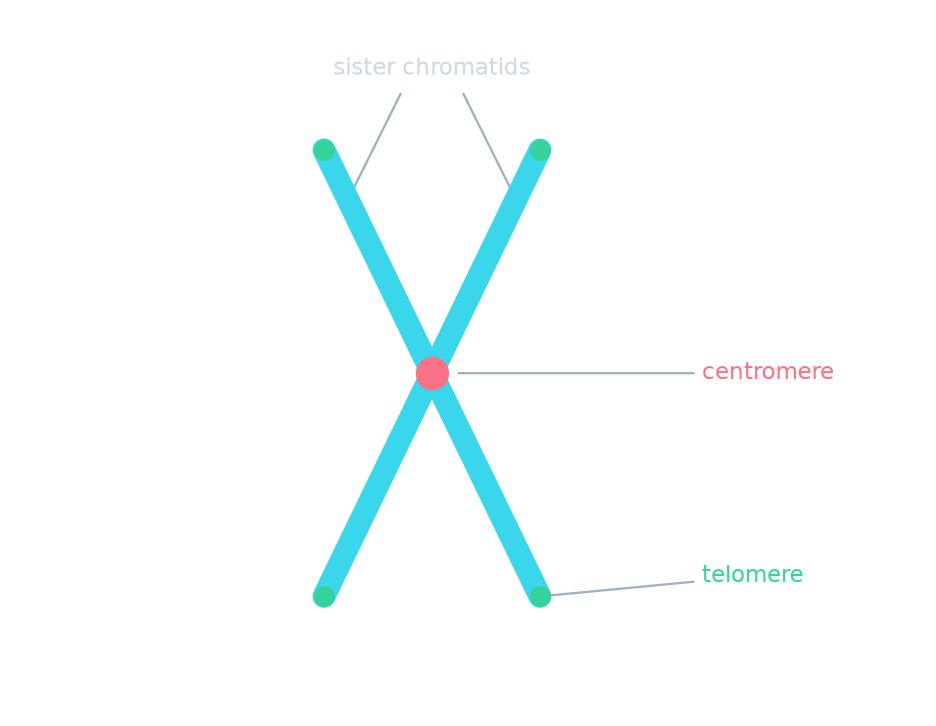
After replication, a chromosome is two identical sister ______ joined at the centromere.
Difficulty 1/5 · 100 coins + a small bonus on first completion today
Replication makes an identical copy; the two sister chromatids stay joined at the centromere until anaphase.
The cell cycle
- Interphase 间期 — the longest part: grow (G₁), copy DNA (S phase), grow and prepare to divide (G₂).
- Mitosis 有丝分裂 — the nucleus divides into two identical nuclei.
- Cytokinesis 胞质分裂 — the rest of the cell splits into two daughter cells.
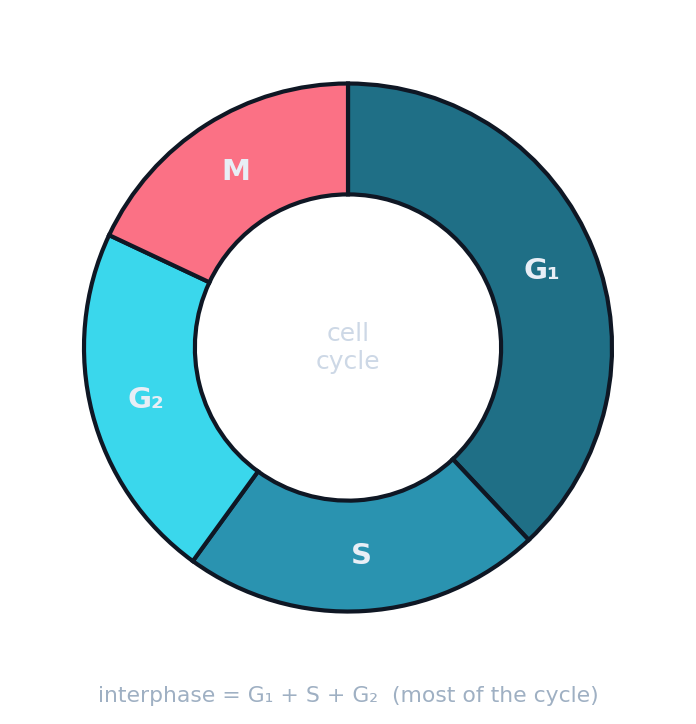
The cell cycle
Step around the cycle. Most of it is interphase (grow, copy DNA, grow); mitosis and cytokinesis are short, then it repeats.
Match each phase of the cell cycle to what happens.
Difficulty 2/5 · 140 coins + a small bonus on first completion today
G₁ → S → G₂ make up interphase; then mitosis divides the nucleus and cytokinesis splits the cell.
Put the cell cycle in order, starting from G₁.
Difficulty 3/5 · 200 coins + a small bonus on first completion today
Interphase (G₁ → S → G₂) is the longest part; mitosis and cytokinesis finish the cycle.
During which phase of interphase is the DNA copied?
Difficulty 1/5 · 100 coins + a small bonus on first completion today
DNA replication happens in the S (synthesis) phase, between G₁ and G₂.
Telomeres and the ends
- When DNA is copied, the machinery cannot reach the very end, so a little is lost each time.
- Telomeres are short repeats that carry no genes — they are shortened instead, so no important genes are lost.
Mitosis is the longest part of the cell cycle.
Difficulty 1/5 · 100 coins + a small bonus on first completion today
False. Interphase (G₁, S, G₂) takes up most of the cycle; mitosis and cytokinesis are comparatively short.
Why does shortening telomeres protect a cell's genes?
Difficulty 1/5 · 100 coins + a small bonus on first completion today
The ends cannot be fully copied, so a little is lost; because telomeres hold no genes, the loss is harmless.
You've got it
- chromosome = DNA wound on histones; after replication → two sister chromatids joined at the centromere
- cell cycle: interphase (G₁ → S = copy DNA → G₂) → mitosis → cytokinesis
- interphase is the longest part
- telomeres cap the ends, carry no genes, and protect against losing DNA in copying
Write from replication in S phase
- A cell is in interphase.
- Mitosis has not started.
When is the DNA copied?
S phase is the synthesis stage of interphase.
When does DNA replication happen?
Difficulty 1/5 · 100 coins + a small bonus on first completion today
The copies are made before mitosis divides them.