Surface area to volume ratio
Introduced| English | Meaning |
|---|---|
| volume/ˈvɒljuːm/ | The amount of three-dimensional space occupied. |
| surface area/ˈsɜːfɪs ˈeərɪə/ | The total area of the outer surfaces of a three-dimensional object. |
| agar/ˈeɪɡɑː/ | A jelly-forming material obtained from red algae, commonly used to solidify microbial culture media. |
| dialysis tubing/daɪˈæləsɪs ˈtjuːbɪŋ/ | A partially permeable membrane tube that lets small dissolved molecules pass while retaining larger ones. |
| exchange surface/eksˈtʃeɪndʒ ˈsɜːfɪs/ | A surface across which substances move between an organism and its surroundings or between body compartments. |
Why cells stay small
- A cell takes in food and oxygen, and removes waste, across its surface.
- But as something grows, its volume 体积 grows faster than its surface area 表面积.
- So big cells struggle to supply their inside fast enough.
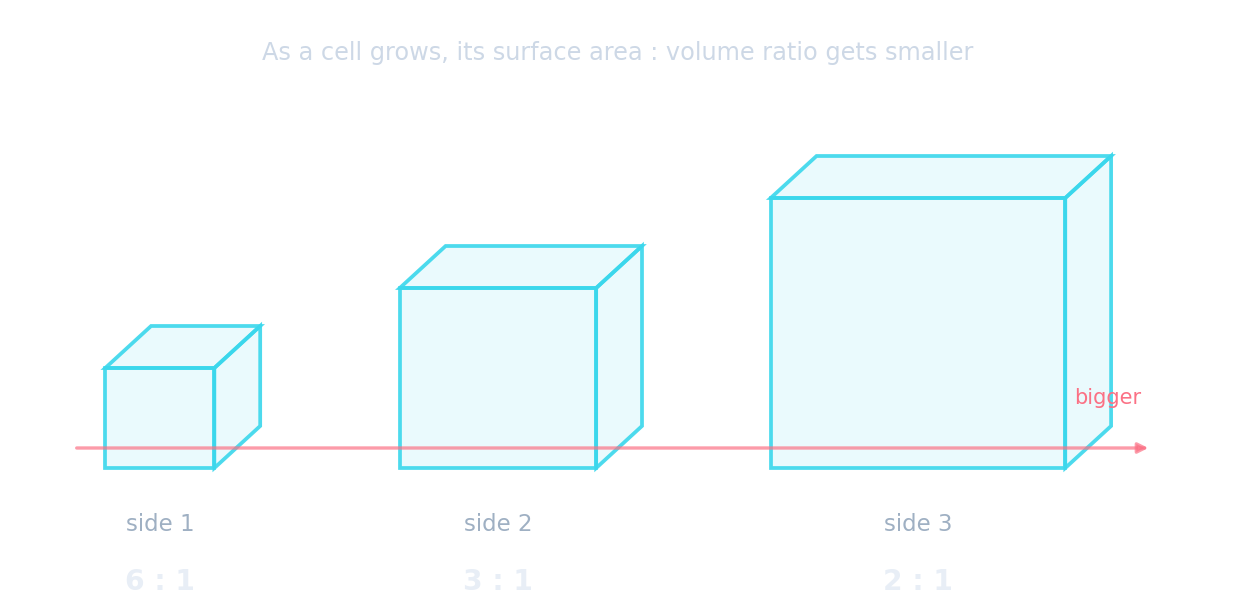
The ratio falls as size grows
For a cube of side $L$:
- A bigger $L$ gives a smaller ratio.
Diffusion across the surface
Particles spread on their own from crowded to sparse. A small cell has a large surface-area-to-volume ratio, so substances diffuse in and out fast enough.
As a cell gets larger, its surface area to volume ratio:
Difficulty 1/5 · 100 coins + a small bonus on first completion today
Volume (L³) grows faster than surface area (6L²), so the ratio 6/L falls as L increases.
A cube has side length 2. Using ratio = 6/L, what is its surface-area-to-volume ratio?
Difficulty 2/5 · 140 coins + a small bonus on first completion today
ratio = 6 / L = 6 / 2 = 3 (i.e. 3 : 1).
A cube has side length 3. Using ratio = 6/L, what is its surface-area-to-volume ratio?
Difficulty 2/5 · 140 coins + a small bonus on first completion today
ratio = 6 / L = 6 / 3 = 2 (i.e. 2 : 1) — smaller than the side-2 cube, because it is bigger.
Order these cubes by surface-area-to-volume ratio, largest ratio first.
Difficulty 3/5 · 200 coins + a small bonus on first completion today
The smallest cube has the largest ratio; as the side grows, 6/L falls.
Why it matters
- A large surface area to volume ratio = fast exchange. So small cells and thin, flat shapes exchange materials quickly.
- Large cells cannot rely on diffusion alone — they need transport systems.
- You can show this with agar 琼脂 blocks of different sizes soaked in dye: the smallest block (largest ratio) changes colour all the way through fastest. (Diffusion through non-living material is studied with dialysis tubing 透析袋.)
Surface area : volume
Make the cube bigger: its volume grows faster than its surface, so the SA:V ratio falls — which is why exchange surfaces and cells stay small.
Why do small cells and thin, flat shapes exchange materials quickly?
Difficulty 1/5 · 100 coins + a small bonus on first completion today
A large ratio means lots of surface for each unit of volume, so exchange by diffusion is fast.
Small cells exchange materials quickly because they have a ______ surface-area-to-volume ratio.
Difficulty 1/5 · 100 coins + a small bonus on first completion today
A large ratio gives plenty of surface for each unit of volume, so diffusion supplies the whole cell quickly.
In the agar-block experiment, which block changes colour all the way through fastest?
Difficulty 1/5 · 100 coins + a small bonus on first completion today
The smallest block has the largest ratio, so dye/acid diffuses to its centre fastest.
Exchange surfaces 交换表面 solve the problem
- Large organisms can't rely on their small surface, so they evolve specialised exchange surfaces (lungs, gills, root hairs, villi).
- These give a huge surface area, thin walls and a good blood supply for fast exchange.
A bigger organism has a smaller surface-area-to-volume ratio. That's why a mouse loses heat fast but a whale doesn't, and why big organisms need exchange and transport systems that single cells don't.
You've got it
- volume grows faster than surface area → bigger means a smaller ratio
- cube: $\text{SA}=6L^2$, $V=L^3$, ratio $=\dfrac{6}{L}$
- large ratio = fast exchange → small cells and thin, flat shapes win
- agar-block demo: the smallest block colours through fastest