The dc motor: two time constants and three limits
도입됨| English | 의미 |
|---|---|
| time constant/taɪm ˈkɒnstənt/ | The characteristic time for an exponential process to change by a factor of e; in decay, the quantity falls to one over e of its starting value. |
| dc motor | A motor driven by direct current, whose speed is set by voltage and torque by current. |
| back emf | The voltage a spinning motor generates, which opposes the supply and is proportional to speed. |
| mechanical time constant | The time a motor takes to reach about 63% of its final speed after a voltage step. |
| torque–speed characteristic | The line or curve of a motor's speed against its load torque at a fixed supply voltage. |
Electricity becomes motion
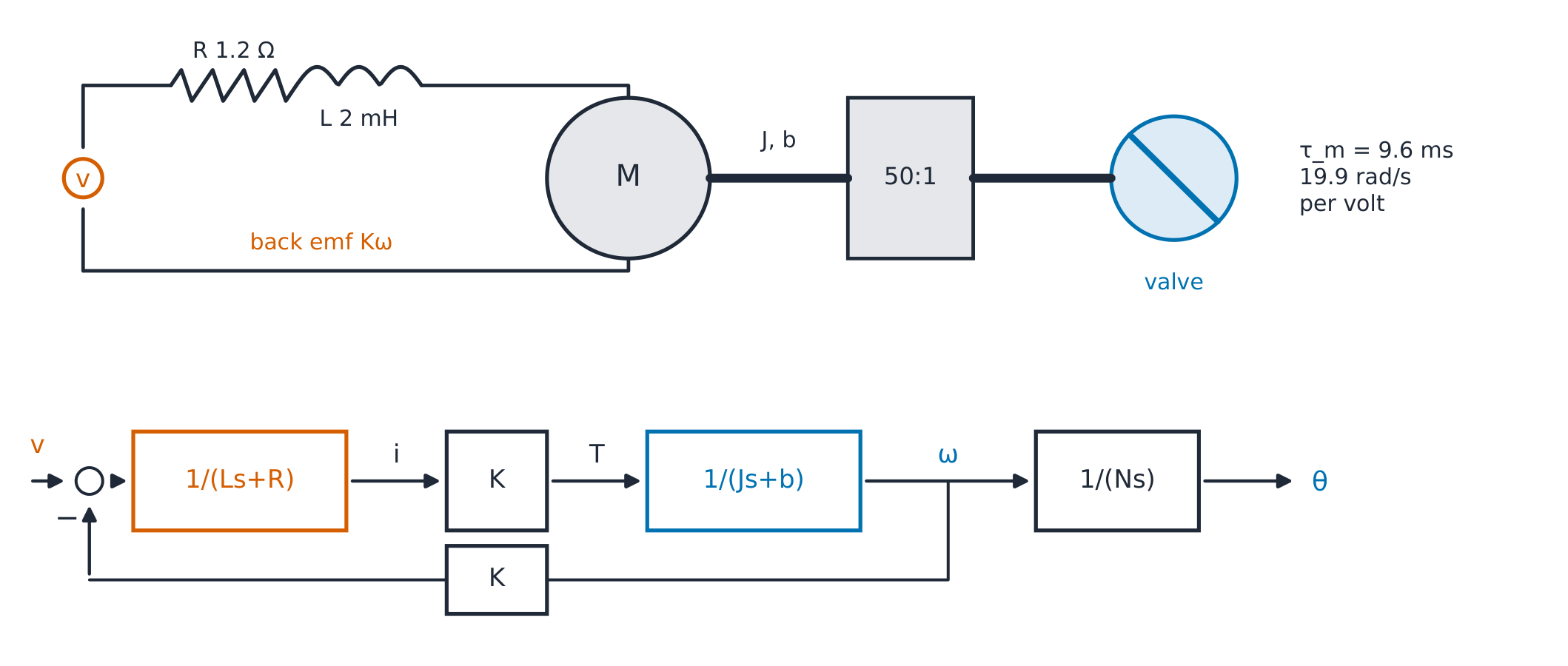
- The loop's valve is turned by a small motor through a gearbox. Its two time constants and its limits (voltage, current, speed) decide how fast the valve can move.
- A permanent-magnet dc motor joins its circuit and rotor with two laws: torque $T = Ki$ and back emf $e = K\omega$. In SI units the two constants are equal, because $ei = T\omega$.
In SI units the torque and back-emf constants are equal because:
난이도 1/5 · 100코인 + 오늘 첫 완료 시 작은 보너스 추가
Energy conversion is exact.
Speed per volt
- Eliminating the current: $\Omega/V = K/[(Js + b)(Ls + R) + K^2]$.
- With small $L$ it is first order, with gain $K/(bR + K^2)$ and mechanical time constant $\tau_m = JR/(bR + K^2) \approx JR/K^2$; the electrical one is $\tau_e = L/R$.
The valve motor
- $R = 1.2$ Ω, $L = 2$ mH, $K = 0.05$, $J = 2 \times 10^{-5}$, $b = 10^{-5}$.
- Gain $\mathbf{19.9}$ rad/s per volt, so 12 V gives 239 rad/s. $\tau_m = \mathbf{9.6}$ ms, $\tau_e = \mathbf{1.7}$ ms.
- Stall: $12/1.2 = 10$ A and 0.5 N·m.
Which limit or constant?
Match each motor behaviour to its cause.
Speed per volt K/(bR + K^2) with K = 0.05, b = 1.0e-5, R = 1.2 (one decimal, rad/s per V)?
난이도 2/5 · 140코인 + 오늘 첫 완료 시 작은 보너스 추가
0.05 over 0.002512.
Mechanical time constant J R/(bR + K^2), J = 2.0e-5 (one decimal, ms)?
난이도 2/5 · 140코인 + 오늘 첫 완료 시 작은 보너스 추가
2.4e-5 over 0.002512.
Electrical time constant L/R with L = 2 mH (one decimal, ms)?
난이도 2/5 · 140코인 + 오늘 첫 완료 시 작은 보너스 추가
0.002 over 1.2.
Through the gearbox
- With $N = 50$ the valve sees $\mathbf{0.398}$ rad/s per volt, so at 12 V it turns at most 4.78 rad/s: a 90° move takes at least $\mathbf{0.33}$ s.
- Through the 80%-efficient gearbox a 5 N·m load reaches the motor as $5/(50 \times 0.8) = 0.125$ N·m and costs $\mathbf{3.0}$ V. A 5 A current limit allows 10 N·m at the valve: the linear model is valid only below it.
Shortest 90 degree move at 4.78 rad/s (two decimals, s)?
난이도 2/5 · 140코인 + 오늘 첫 완료 시 작은 보너스 추가
1.571 over 4.78.
Voltage to hold 0.125 N m at the motor, K = 0.05, R = 1.2 (one decimal, V)?
난이도 2/5 · 140코인 + 오늘 첫 완료 시 작은 보너스 추가
Current 2.5 A times R.
The linear motor model stays valid when the current limit is reached.
난이도 1/5 · 100코인 + 오늘 첫 완료 시 작은 보너스 추가
Saturation makes the system nonlinear.
The torque–speed line
- In steady state $V = iR + K\omega$ and $T = Ki$, so $\omega = V/K - TR/K^2$: speed falls linearly with load. This torque–speed characteristic 转矩-转速特性 runs from 240 rad/s with no load to 0.5 N·m at stall.
- Output power $T\omega$ peaks at half speed and half torque: $0.25 \times 0.5 \times 240 = \mathbf{30}$ W. That is the most this 12 V motor can deliver, whatever the gearbox.
Motor with no-load speed 240 rad/s and stall torque 0.5 N·m: maximum output power (W)?
난이도 2/5 · 140코인 + 오늘 첫 완료 시 작은 보너스 추가
At half speed and half torque: $120 \times 0.25 = 30$ W.
Worked example: the motor under load
- The valve's load reaches the motor as 0.125 N·m, and friction adds $b\omega$. Solving $Ki = 0.125 + b\omega$ with $12 = 1.2i + 0.05\omega$ gives $i = \mathbf{2.54}$ A and $\omega = 179$ rad/s: $\mathbf{3.58}$ rad/s at the valve.
- It draws $12 \times 2.54 = 30.4$ W and delivers $0.125 \times 179 = 22.4$ W to the gearbox: 74% efficient, with 7.7 W lost in the copper as $i^2R$.
12 V, $R = 1.2$ Ω, $K = 0.05$, $b = 10^{-5}$, load 0.125 N·m at the motor: current (two decimals, A)?
난이도 2/5 · 140코인 + 오늘 첫 완료 시 작은 보너스 추가
$\omega = (12 - 0.125 \times 1.2/0.05)/(0.05 + 1.2 \times 10^{-5}/0.05) = 179.1$ rad/s; $i = (0.125 + 0.0018)/0.05 = 2.54$ A.
Same motor through the 50:1 gearbox: valve speed under that load (two decimals, rad/s)?
난이도 2/5 · 140코인 + 오늘 첫 완료 시 작은 보너스 추가
$179.1/50 = 3.58$ rad/s.
Three motor slips
- Forgetting the back emf. It is what limits the speed.
- The linear model after saturation. Voltage and current limits change the behaviour.
- $K_t \ne K_e$ in SI. They are the same constant.
Recap
- $\Omega/V = K/[(Js + b)(Ls + R) + K^2]$: 19.9 rad/s per volt.
- $\tau_m \approx 9.6$ ms, $\tau_e = 1.7$ ms.
- At the valve: 0.398 rad/s per volt, at least 0.33 s per 90°, 3.0 V to hold 5 N·m.