Radiation: the third of the loss nobody counted
도입됨| English | 의미 |
|---|---|
| emissivity/ɪmɪˈsɪvɪti/ | The ratio of the thermal radiation a surface emits to that of a perfect black body at the same temperature. |
| view factor | The fraction of radiation leaving one surface that strikes another directly. |
| grey surfaces | Surfaces whose emissivity is the same at all wavelengths, which makes radiation exchange simpler to calculate. |
| radiosity | The total radiation leaving a surface, both emitted and reflected, per unit area. |
The pipe also glows
- The bare pipe's 110 W/m counted only convection. A 60 °C surface also radiates, and leaving that out underestimates the loss by about a third.
- Every surface emits $\varepsilon\sigma T^4$, with emissivity $\varepsilon$ and absolute temperature $T$, and $\sigma = 5.67 \times 10^{-8}$ W/(m²·K⁴).
Temperatures in sigma T^4 must be in:
난이도 1/5 · 100코인 + 오늘 첫 완료 시 작은 보너스 추가
Emission depends on absolute temperature.
A network for radiation
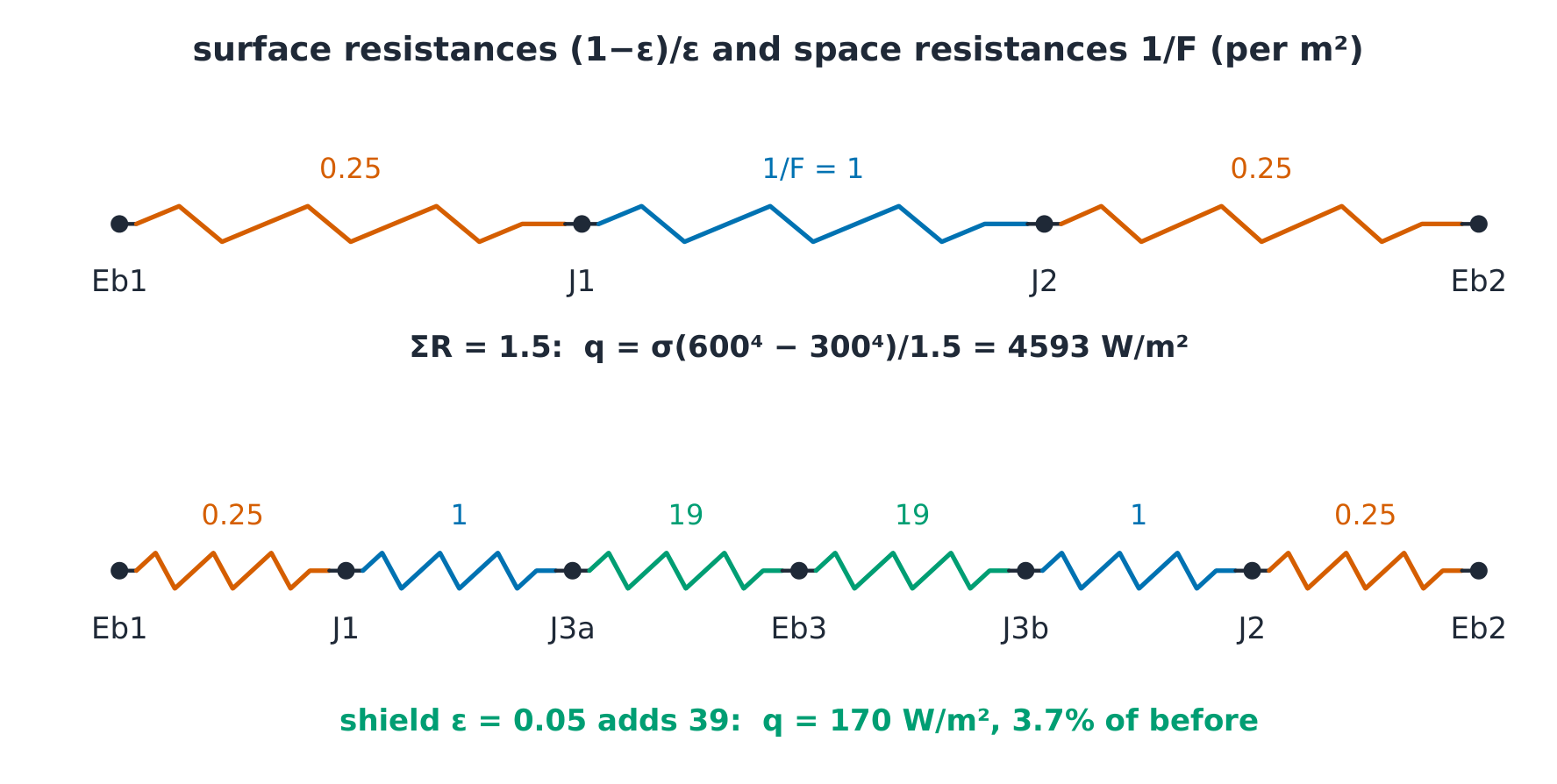
- The view factor $F_{ij}$ is the fraction of radiation leaving $i$ that reaches $j$. For grey surfaces, each surface adds $(1 - \varepsilon)/(\varepsilon A)$ and each pair adds $1/(A_iF_{ij})$; the radiosity $J$ is the node between them.
- For large parallel plates: $q = \sigma(T_1^4 - T_2^4)/(1/\varepsilon_1 + 1/\varepsilon_2 - 1)$.
Which radiation resistance?
Place each effect in the radiation network.
The bare pipe, honestly
- Linearise: $h_r = \varepsilon\sigma(T_s^2 + T_{sur}^2)(T_s + T_{sur}) = \mathbf{5.58}$ W/(m²·K) at 59.5 °C, beside $h_c = 10$.
- With $h_c + h_r$ in parallel: $q = \mathbf{170}$ W/m, of which radiation is 61.
- Insulated, $q = 18.0$ W/m: the saving is 89%, larger than the 84% found without radiation.
Radiation share of the 170 W/m bare-pipe loss (W/m)?
난이도 2/5 · 140코인 + 오늘 첫 완료 시 작은 보너스 추가
170 minus the 109 W/m of convection.
Including radiation makes insulating the pipe save a larger share.
난이도 1/5 · 100코인 + 오늘 첫 완료 시 작은 보너스 추가
89% against 84%.
A radiation shield
- An oven wall at 600 K faces a casing at 300 K, both $\varepsilon = 0.8$: $q = \mathbf{4593}$ W/m².
- A polished shield ($\varepsilon = 0.05$) between them adds $2/0.05 - 1 = 39$ to the sum: $q = \mathbf{170}$ W/m², 3.7% of before.
Plates at 600 K and 300 K, both eps = 0.8: flux (W/m2, whole number)?
난이도 2/5 · 140코인 + 오늘 첫 완료 시 작은 보너스 추가
sigma (T1^4 - T2^4) over 1.5.
The same with a shield adding 39 to the 1.5 sum (W/m2, whole number)?
난이도 2/5 · 140코인 + 오늘 첫 완료 시 작은 보너스 추가
6889 over 40.5.
What a shield of eps = 0.05 on both sides adds to the sum?
난이도 2/5 · 140코인 + 오늘 첫 완료 시 작은 보너스 추가
2/0.05 - 1.
White in sunlight, black in infrared
- Emissivity depends on wavelength. White paint absorbs only about 20% of sunlight, which peaks near 0.5 µm, but emits about 90% at the 10 µm of room-temperature infrared.
- So a white roof stays cool in sun, and a polished metal roof (low emissivity) stays warm at night. Choose a surface for the wavelength it meets.
A white-painted roof stays cool in sunshine because it:
난이도 1/5 · 100코인 + 오늘 첫 완료 시 작은 보너스 추가
Low absorptivity at solar wavelengths, high emissivity at infrared ones.
Worked example: the thermocouple that reads low
- A thermocouple in a duct of 200 °C gas, with walls at 100 °C, $h = 100$ and $\varepsilon = 0.8$, balances convection in against radiation out: $h(T_g - T) = \varepsilon\sigma(T^4 - T_w^4)$.
- Solving gives $T = \mathbf{188}$ °C: it reads 12 K low, with no fault in the sensor. A polished radiation shield around the tip cuts the error.
Gas 200 °C, walls 100 °C, $h = 100$, $\varepsilon = 0.8$: thermocouple reading (°C, nearest whole)?
난이도 2/5 · 140코인 + 오늘 첫 완료 시 작은 보너스 추가
Solve $100(473.15 - T) = 0.8\sigma(T^4 - 373.15^4)$: $T = 461.4$ K $= 188$ °C.
A thermocouple reading 12 K below the gas must be faulty.
난이도 1/5 · 100코인 + 오늘 첫 완료 시 작은 보너스 추가
It radiates to cooler walls; the balance with convection settles at 188 °C in 200 °C gas.
Three radiation slips
- Celsius in $T^4$. Use kelvin.
- Radiation ignored at low temperature. It was 36% of the bare-pipe loss.
- Adding emissivities. Add resistances.
Recap
- Surface resistance $(1 - \varepsilon)/\varepsilon A$, space resistance $1/A_iF_{ij}$.
- $h_r = 5.58$ adds in parallel with $h_c$: the bare pipe loses 170 W/m.
- One shield cuts 4593 W/m² to 170.