Conduction: resistances in series
도입됨| English | 의미 |
|---|---|
| Fourier's law | The law that heat flux by conduction is proportional to the temperature gradient: q = −k dT/dx. |
| thermal conductivity/ˈθɜːml kɒndəkˈtɪvɪti/ | A material property, k, that measures how well it conducts heat, in watts per metre kelvin. |
| thermal resistance/ˈθɜːml rɪˈzɪstəns/ | Temperature difference divided by heat flow, so that layers in series add like electrical resistors. |
| critical radius | The insulation radius at which heat loss from a pipe or wire is greatest, equal to k/h for a cylinder. |
| U-value | The overall heat transfer coefficient of a wall or window, in watts per square metre per kelvin; lower means better insulation. |
A quarter of the thickness, most of the drop
- In a pump-room wall of brick, mineral wool and plaster, the thin wool layer takes almost three quarters of the temperature drop. Seeing why takes one law and one idea.
- Fourier's law: heat flux follows the temperature gradient, $q'' = -k\,dT/dx$, with thermal conductivity $k$.
Every layer is a resistance
- Each layer is a thermal resistance: plane wall $L/(kA)$, cylinder $\ln(r_2/r_1)/(2\pi k\ell)$, surface convection $1/(hA)$.
- In series they add like electrical resistors, and the temperature drop across each is $qR$.
Which resistance formula?
Match each layer to its resistance formula.
Resistance of 50 mm of wool, k = 0.04, over 12 m2 (four decimals, K/W)?
난이도 2/5 · 140코인 + 오늘 첫 완료 시 작은 보너스 추가
L over k A.
Thermal resistances in series add.
난이도 1/5 · 100코인 + 오늘 첫 완료 시 작은 보너스 추가
The same heat crosses each one.
The composite wall
- 12 m² of wall: resistances 0.0104, 0.0238, 0.1042 (wool), 0.0020 and 0.0033 K/W, a total of $\mathbf{0.1437}$ K/W.
- From 22 °C inside to −5 °C outside: $q = 27/0.1437 = \mathbf{188}$ W.
- The wool carries 73% of the drop: from 15.6 to −4.0 °C across it.
Total resistance 0.1437 K/W across 27 K: heat flow (W, whole number)?
난이도 2/5 · 140코인 + 오늘 첫 완료 시 작은 보너스 추가
Delta T over R.
In the wall, the largest temperature drop is across:
난이도 1/5 · 100코인 + 오늘 첫 완료 시 작은 보너스 추가
It has the largest resistance.
The insulated pipe
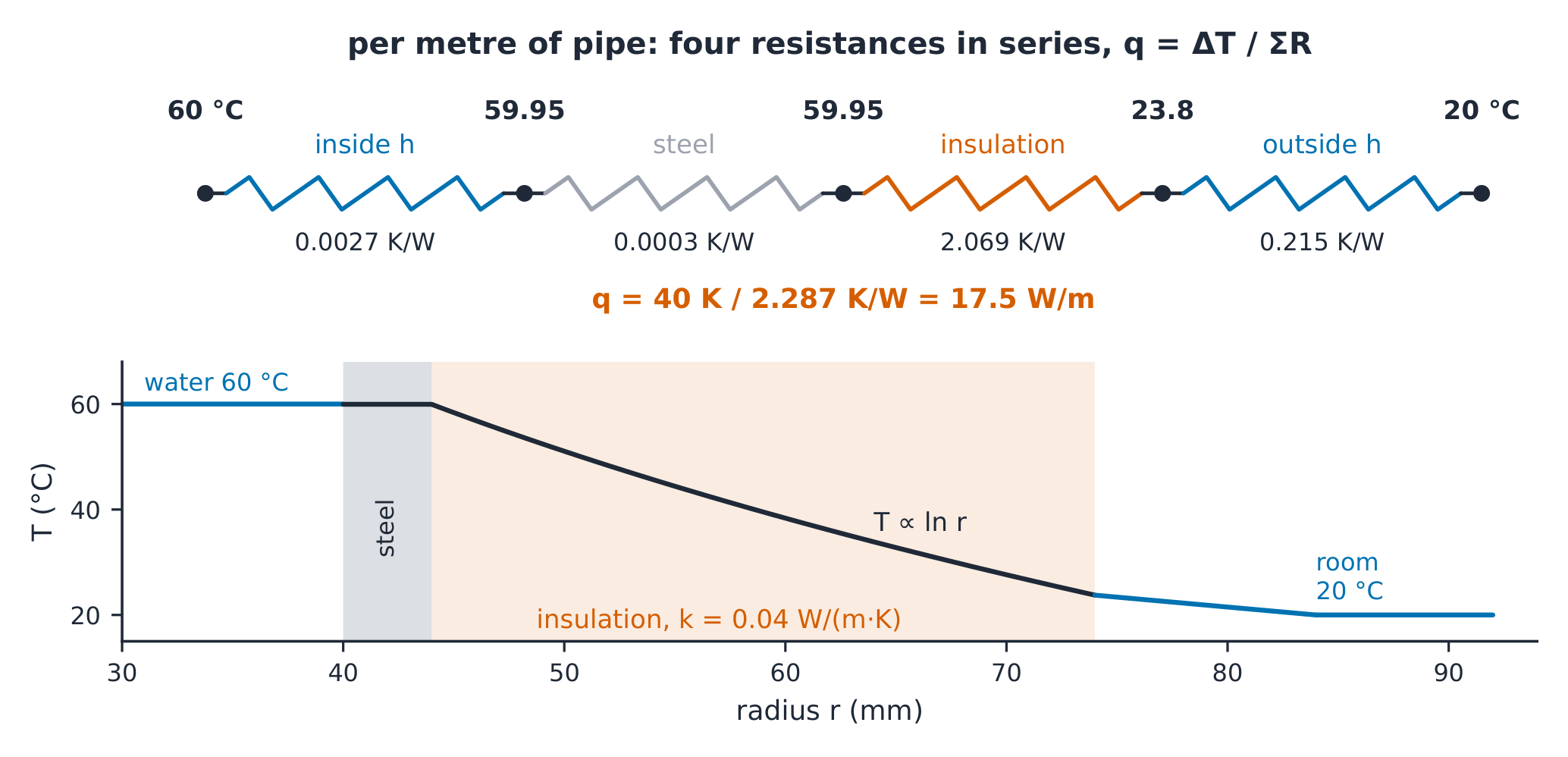
- Water at 60 °C in a steel pipe of radii 40 and 44 mm, insulated out to a 74 mm radius with $k = 0.04$: per metre $R = 2.287$ K/W, almost all of it in the insulation (2.069), so $q = \mathbf{17.5}$ W/m.
- The bare pipe loses $\mathbf{110}$ W/m: insulation saves 84%. The critical radius $r_c = k/h = 4$ mm is far below 44 mm, so insulating can only help here.
Pipe loss with R = 2.287 K/W per metre and a 40 K difference (one decimal, W/m)?
난이도 2/5 · 140코인 + 오늘 첫 완료 시 작은 보너스 추가
40 over 2.287.
Critical radius with k = 0.04 and h = 10 (mm)?
난이도 2/5 · 140코인 + 오늘 첫 완료 시 작은 보너스 추가
k over h = 0.004 m.
The U-value on the specification
- Buildings quote the U-value 传热系数, $U = 1/(R_{tot}A)$, in W/(m²·K). The pump-room wall has $U = 1/(0.1437 \times 12) = \mathbf{0.58}$.
- Double the wool to 100 mm: its resistance doubles to 0.2083, the total becomes 0.2479 K/W, $U = 0.34$ and the loss falls from 188 to $\mathbf{109}$ W. The layer with the largest resistance is the one worth thickening.
Wall of 12 m² with total resistance 0.1437 K/W: U-value (two decimals, W/(m²·K))?
난이도 2/5 · 140코인 + 오늘 첫 완료 시 작은 보너스 추가
$U = 1/(0.1437 \times 12) = 0.58$.
Wool doubled, adding 0.1042 K/W: heat loss across 27 K (W, nearest whole)?
난이도 2/5 · 140코인 + 오늘 첫 완료 시 작은 보너스 추가
$27/(0.1437 + 0.1042) = 27/0.2479 = 109$ W.
Worked example: insulation that cools a wire
- A cable of 2 mm radius with PVC ($k = 0.16$) in air at $h = 10$: $r_c = k/h = 16$ mm, far above the wire.
- Bare, $R = 1/(10 \times 2\pi \times 0.002) = 7.96$ K/W per metre. Insulated to 16 mm, $R = \ln 8/(2\pi \times 0.16) + 1/(10 \times 2\pi \times 0.016) = 3.06$ K/W: the insulated wire sheds $\mathbf{2.6}$ times as much heat. Below $r_c$ extra surface outweighs extra conduction.
A 2 mm radius wire insulated to the 16 mm critical radius: loss with insulation over loss bare (one decimal)?
난이도 2/5 · 140코인 + 오늘 첫 완료 시 작은 보너스 추가
$7.96/3.06 = 2.6$.
Three conduction slips
- Forgetting the surface resistances. $1/hA$ belongs in the chain.
- Adding conductances in series. Add resistances.
- Insulating a thin wire. Below $r_c$ insulation can raise the loss.
Recap
- $R = L/kA$, $\ln(r_2/r_1)/2\pi k\ell$, $1/hA$; in series they add.
- Wall: 0.1437 K/W, 188 W. Pipe: 17.5 W/m insulated against 110 bare.
- Insulation helps only above $r_c = k/h$.