Your learning plan · Continue · Review →
저장된 위치는 이 브라우저에 유지됩니다. 계속하기는 수업을 완료하거나 질문에 답하는 것이 아닙니다.
Tell an interviewer why your choice worked
- Outcome: record a relevant reply, adapt to a changed follow-up and use actual playback to revise one content and one audible feature. Start with the speaking task overview. A campus interviewer asks: Tell me about a time you solved a problem with other people. Answer that experience, rather than delivering a prepared speech about teamwork in general.
- The official interview uses spoken prompts and recorded replies. This lesson uses written practice questions and local recorded replies. Written examples show how to develop an answer; they cannot assess pronunciation, pace or hesitation or demonstrate recognition of a spoken question.
Your favourite speech may be excellent and still have arrived at the wrong interview.
Identify the kind of answer needed
- Tell me about a time… needs a specific event. Which would you prefer…? needs a choice and reasons. Why might students…? asks for an explanation that can go beyond your own experience.
- Take a brief moment to identify the demand. Start with a relevant sentence you can control; there is no universal “start in one second” scoring rule.
Match each part of the answer shape to its job.
난이도 2/5 · 140 코인 + 오늘 첫 완료 시 소액 보너스
Answer, reason and example are a flexible planning aid. A follow-up may ask for a new kind of response; no one-second rule determines the score.
Develop one example instead of listing virtues
- Prompt: Tell me about a time you solved a problem with other people. Original model: Our club's room booking was cancelled. I asked the office for an accessible replacement while my classmate updated the invitations. We checked the new room together before sending the message, so everyone received one clear set of directions.
- The problem, division of work and result make the claim concrete. We were helpful, organised and very good gives labels without showing what happened.
You need a brief moment to think. Which response best keeps you on task?
난이도 1/5 · 100 코인 + 오늘 첫 완료 시 소액 보너스
A brief thinking pause is possible. Begin a relevant point rather than waiting for a perfect script; fillers are optional and do not earn automatic marks.
Adapt the answer when the question changes
- Follow-up: Would you handle the same problem differently now? Move from past events to a proposed improvement: I would confirm a backup room earlier, because finding one at the last minute delayed our invitation.
- Do not repeat the entire first answer. The new question asks for reflection; connect your proposed change to the difficulty you described.
Memorising a few strong general answers is a good use of preparation time.
난이도 1/5 · 100 코인 + 오늘 첫 완료 시 소액 보너스
A complete stock answer may not answer the actual prompt or its follow-up. Practise flexible language with changed questions instead of relying on recitation.
Repair meaning and keep speaking
- If you name the wrong day, a short repair can help: On Tuesday—sorry, on Thursday—we checked the room. Correct the detail, then continue the idea.
- Fillers and repairs are tools, not bonus marks. Avoid adding that's an interesting question to every reply if it only consumes time.
- Do not invent a personal event you cannot explain just to fit a model. Choose an ordinary true example, or clearly frame a hypothetical answer when the question permits one.
- Memorise useful language in flexible pieces, then practise responding to changed questions. No claim here assigns an automatic penalty to a memorised phrase.
Writing out what you would say is a good substitute for speaking practice.
난이도 1/5 · 100 코인 + 오늘 첫 완료 시 소액 보너스
A typed answer can be timed and can help plan content, but supplies no evidence of actual pronunciation, audible pauses or spoken pace. Record a spoken response to inspect those features.
Rehearse with evidence of what you said
- Record a first attempt without writing a complete script. Listen for a direct answer, a reason and a specific detail; check whether a follow-up would require a different kind of response.
- Repeat with a fresh prompt and compare. Text editing improves written organisation; only the recording can reveal pauses, audibility and spoken delivery.
Task description checked on 19 October 2026: ETS Speaking. The interview case and models are original, unrated teaching examples.
A follow-up changes the job of your answer
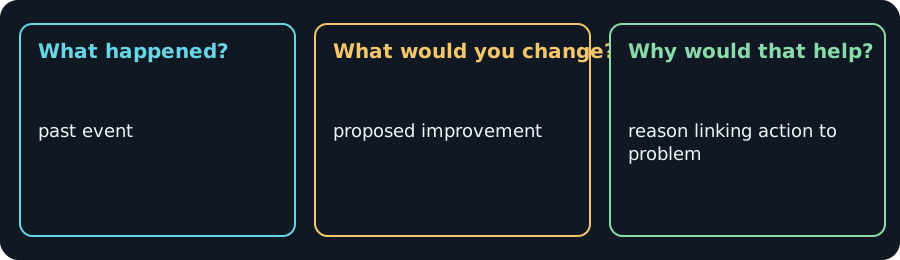
- “What happened?” asks for the past room-booking problem. “What would you change?” asks for an improvement now. Repeating the same story answers only the first question.
- A useful reflective reply is “I would confirm a backup room earlier because the late change delayed our invitations.” The action is linked to the problem; the answer needs no impressive invented event.

View the original follow-up case at full size
- Answer–reason–example is a flexible aid. A request for a description, comparison or reflection may need a different structure.
- Identify the question’s demand, give relevant detail and review the actual recording for spoken delivery.
- Try the transfer checks below before returning to the explanation. These are original self-checks, with no official score conversion.
Match the three distinctions from the worked case.
난이도 2/5 · 140 코인 + 오늘 첫 완료 시 소액 보너스
A useful reflective reply is “I would confirm a backup room earlier because the late change delayed our invitations.” The action is linked to the problem; the answer needs no impressive invented event.
Which reply answers “What would you change next time?”?
난이도 1/5 · 100 코인 + 오늘 첫 완료 시 소액 보너스
“What happened?” asks for the past room-booking problem. “What would you change?” asks for an improvement now. Repeating the same story answers only the first question. A useful reflective reply is “I would confirm a backup room earlier because the late change delayed our invitations.” The action is linked to the problem; the answer needs no impressive invented event.
Complete the worked-case label: What happened? → ____. Use the phrase in the diagram.
난이도 1/5 · 100 코인 + 오늘 첫 완료 시 소액 보너스
Identify the question’s demand, give relevant detail and review the actual recording for spoken delivery.
A specific event shows what the help involved
- Written weaker illustration: “I helped a student at the library. I was helpful and patient. Helping people is important, and students need many things. It was a good experience.” This identifies an occasion but replaces the actions with evaluations; the listener still cannot tell what help was given.
- Written improved illustration: “A new student could not find the collection desk for a reserved book. I checked the floor guide with her and showed her which staircase led there. Before leaving, I asked her to point out the return route on the guide. That helped me check that I had explained the directions clearly.” The actions and small check develop the requested help. This fictional teaching text has no model audio, rating or calibrated speaking duration.
A preference needs a reason that fits the task
- Written weaker illustration: “I prefer instructions in writing because they are good. Demonstrations are also good. Different students like different things. There are many ways to learn.” This names a preference but gives no reason connected to using the instructions.
- Written improved illustration: “I prefer written instructions when I already know the basic task but need to check a detail. I can return to one step without asking someone to repeat the whole explanation. For an unfamiliar movement, though, I might first need a demonstration. My choice depends on what I need to learn.” Another preference can work with relevant development; this is a written content contrast, not a rated spoken performance.
Explain a perspective instead of defending a slogan
- Written weaker illustration: “Students should always work together. Teamwork is essential. I like teamwork, so everyone should use it for every assignment.” Repeating a value does not explain why a particular method might suit a task or another person.
- Written improved illustration: “Working together can help when students need to compare different explanations. Someone might still prefer an individual first attempt because it reveals what they can do without help. I would not treat that preference as a rejection of teamwork; it could be one stage before a useful discussion.” The reasoning allows a different priority without inventing what all students think. The question’s demand chooses the structure, not a universal answer template.

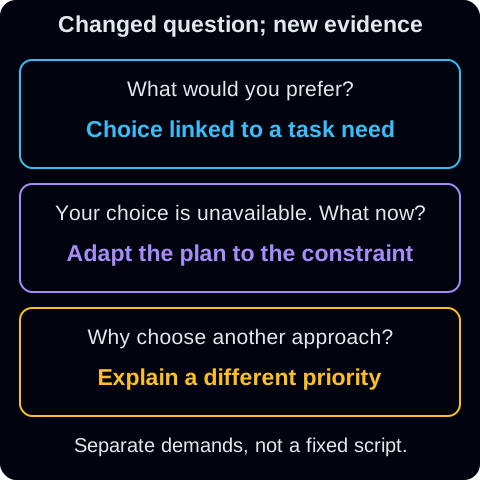
Guided decisions — name the demand and the evidence
- Use the cues to distinguish an event, reflection, preference, comparison and possible explanation. Choose the development that answers the actual wording; an impressive topic cannot repair a mismatched answer.
- These ten decisions use written situations. They teach content interpretation, scope and repair, not listening recognition or spoken delivery. Read the feedback, identify its decisive clue and explain a repair before moving on.
Original written situation: Tell me about a time you helped someone learn a new task.
Planning cue: Identify the past event being requested.
Question: Which opening answers the demand? Choose ONE answer.
난이도 1/5 · 100 코인 + 오늘 첫 완료 시 소액 보너스
The specific teaching event gives a person, task and situation. Repair: replace a general virtue with an ordinary event you can explain. This written check concerns content choices; it supplies no evidence of listening recognition or actual speech.
Original written situation: After describing a failed room booking, the interviewer asks: What would you change next time?
Planning cue: Separate a past event from a proposed improvement.
Question: Which next point adapts to the follow-up? Choose ONE answer.
난이도 1/5 · 100 코인 + 오늘 첫 완료 시 소액 보너스
The proposed change responds to the request for reflection and links it to the earlier difficulty. Repair: move from retelling to a reasoned change. This written check concerns content choices; it supplies no evidence of listening recognition or actual speech.
Original written situation: Would you prefer to study alone or with a partner when revising a difficult topic?
Planning cue: Look for a choice and a relevant explanation.
Question: Which response begins a defensible preference? Choose ONE answer.
난이도 1/5 · 100 코인 + 오늘 첫 완료 시 소액 보너스
The response states an approach and a reason, with room for a later partner stage. Repair: answer the choice rather than merely name both options. This written check concerns content choices; it supplies no evidence of listening recognition or actual speech.
Original written situation: Why might students hesitate to ask questions in a large workshop?
Planning cue: The question asks why students might behave this way.
Question: Which development explains a possible reason? Choose ONE answer.
난이도 1/5 · 100 코인 + 오늘 첫 완료 시 소액 보너스
A plausible reason is qualified rather than assigned to every student. Repair: connect a condition to a possible response. This written check concerns content choices; it supplies no evidence of listening recognition or actual speech.
Original written situation: Compare getting feedback by email with discussing it in person.
Planning cue: Choose criteria that can apply to both methods.
Question: Which plan addresses both methods? Choose ONE answer.
난이도 1/5 · 100 코인 + 오늘 첫 완료 시 소액 보너스
Shared criteria allow a meaningful comparison of both methods. Repair: use the same practical question for each option. This written check concerns content choices; it supplies no evidence of listening recognition or actual speech.
Original written situation: Do you think group work helps students learn?
Planning cue: Check the scope of the claim, not the strength of the adjective.
Question: Which claim leaves room for a reasoned limit? Choose ONE answer.
난이도 1/5 · 100 코인 + 오늘 첫 완료 시 소액 보너스
The condition identifies a mechanism and the limit prevents an unsupported universal claim. Repair: explain when and how the benefit could occur. This written check concerns content choices; it supplies no evidence of listening recognition or actual speech.
Original written situation: While answering, you say Monday, but the event happened on Wednesday.
Planning cue: The listener needs the accurate day and the continuing idea.
Question: Which repair best preserves meaning? Choose ONE answer.
난이도 1/5 · 100 코인 + 오늘 첫 완료 시 소액 보너스
A brief correction fixes the relevant fact and lets the event continue. Repair: correct the detail rather than make the repair a new topic. This written check concerns content choices; it supplies no evidence of listening recognition or actual speech.
Original written situation: You cannot recall the technical name of a tool used in your example.
Planning cue: Explain meaning when the label is unavailable.
Question: Which strategy keeps the example understandable? Choose ONE answer.
난이도 1/5 · 100 코인 + 오늘 첫 완료 시 소액 보너스
A clear paraphrase can preserve meaning without an invented term. Repair: describe the function you actually used. This written check concerns content choices; it supplies no evidence of listening recognition or actual speech.
Original written situation: You wrote an improved answer after listening to a hesitant first take.
Planning cue: Separate planned language from recorded delivery.
Question: What evidence is still needed to review the spoken revision? Choose ONE answer.
난이도 1/5 · 100 코인 + 오늘 첫 완료 시 소액 보너스
A written revision cannot show the delivery of a second spoken attempt. Repair: record the revised answer and compare the actual sound. This written check concerns content choices; it supplies no evidence of listening recognition or actual speech.
Original written situation: A follow-up asks: Could the other approach ever work better?
Planning cue: Look for a condition under which the alternative has value.
Question: Which response engages with that changed demand? Choose ONE answer.
난이도 1/5 · 100 코인 + 오늘 첫 완료 시 소액 보너스
The changed question asks for a circumstance favouring the alternative. Repair: identify such a condition instead of defending the first answer by repetition. This written check concerns content choices; it supplies no evidence of listening recognition or actual speech.
Fresh decisions — apply the method without a cue
- Try ten new written situations without reopening the planning examples. A changed follow-up may ask for a new perspective or constraint while keeping the same topic. Repeating the previous answer is not necessarily a response to the new question.
- A correct written choice is a preparation step. Continue to the separate recorded questions below: only actual speech supplies material for reviewing your audible links, pauses or intelligibility. These are local practice decisions without official score conversion.
Original written situation: Describe a time you changed a plan after receiving advice.
Question: Which development best answers the question? Choose ONE answer.
난이도 1/5 · 100 코인 + 오늘 첫 완료 시 소액 보너스
The reply connects advice to a specific changed action and consequence. Repair: make the change visible rather than praising advice. This written check concerns content choices; it supplies no evidence of listening recognition or actual speech.
Original written situation: Would you prefer written instructions or a live demonstration when learning unfamiliar equipment?
Question: Which reply gives a preference with a relevant reason? Choose ONE answer.
난이도 1/5 · 100 코인 + 오늘 첫 완료 시 소액 보너스
The preference links the format to an actual learning need without making a universal rule. Repair: connect the choice to what you need to understand. This written check concerns content choices; it supplies no evidence of listening recognition or actual speech.
Original written situation: What might make an online group meeting less effective?
Question: Which response explains a possible problem? Choose ONE answer.
난이도 1/5 · 100 코인 + 오늘 첫 완료 시 소액 보너스
The condition explains how participation could become difficult. Repair: give the mechanism and limit its scope. This written check concerns content choices; it supplies no evidence of listening recognition or actual speech.
Original written situation: You described solving a problem by asking a tutor for help. The follow-up asks: What did you learn from that experience?
Question: Which point changes from recounting to reflection? Choose ONE answer.
난이도 1/5 · 100 코인 + 오늘 첫 완료 시 소액 보너스
The answer identifies a transferable lesson and why it matters. Repair: explain what the event changed in your approach. This written check concerns content choices; it supplies no evidence of listening recognition or actual speech.
Original written situation: Compare planning a group project in advance with deciding tasks as you go.
Question: Which response uses a meaningful shared criterion? Choose ONE answer.
난이도 1/5 · 100 코인 + 오늘 첫 완료 시 소액 보너스
Both methods are evaluated in relation to assigning and adapting work. Repair: compare consequences rather than repeat a preference. This written check concerns content choices; it supplies no evidence of listening recognition or actual speech.
Original written situation: Do you think students should share study notes?
Question: Which reply is supported without overstating the benefit? Choose ONE answer.
난이도 1/5 · 100 코인 + 오늘 첫 완료 시 소액 보너스
The claim names a possible benefit and a limit. Repair: separate access to notes from understanding them. This written check concerns content choices; it supplies no evidence of listening recognition or actual speech.
Original written situation: You accidentally name the wrong person in an example, then notice it.
Question: Which response repairs the reference clearly? Choose ONE answer.
난이도 1/5 · 100 코인 + 오늘 첫 완료 시 소액 보너스
The short correction identifies the person and retains the action. Repair: correct the reference, then continue the relevant event. This written check concerns content choices; it supplies no evidence of listening recognition or actual speech.
Original written situation: A prompt asks why a campus might keep some quiet study spaces despite demand for group rooms.
Question: Which development addresses that explanation? Choose ONE answer.
난이도 1/5 · 100 코인 + 오늘 첫 완료 시 소액 보너스
The reply explains the distinct need instead of rejecting all group work. Repair: connect the space to its purpose. This written check concerns content choices; it supplies no evidence of listening recognition or actual speech.
Original written situation: You chose to prepare alone. The follow-up asks how you would work if a partner were required.
Question: Which response adapts to the new constraint? Choose ONE answer.
난이도 1/5 · 100 코인 + 오늘 첫 완료 시 소액 보너스
The revised plan respects the required partner while retaining useful individual preparation. Repair: respond to the new condition before defending the old choice. This written check concerns content choices; it supplies no evidence of listening recognition or actual speech.
Original written situation: You have two recordings of the same answer and a written illustration.
Question: Which comparison can provide evidence about your own delivery? Choose ONE answer.
난이도 1/5 · 100 코인 + 오늘 첫 완료 시 소액 보너스
Only the actual recordings show the change in your spoken attempt. Repair: name the feature and compare the sound rather than infer it from text. This written check concerns content choices; it supplies no evidence of listening recognition or actual speech.
Pair one — a learning event and a proposed change
- Record a true ordinary experience of learning a useful skill, then answer the changed follow-up in its own recording. Keep the event available in memory, but select new information when asked what you would do differently. There is no requirement to invent an exceptional achievement.
- Stop and replay each response before opening its written guidance. Use Record for a revised take; My recording is the latest and Previous recording the preceding valid take. Compare the actual attempts, then answer the changed question. Clear recordings removes the local takes; it does not erase saved practice history.
Original written interview question: Tell me about a time someone helped you learn a useful skill. What did they do that helped? Use an ordinary true event you can explain; the skill need not be impressive.
This is a written practice question, not interviewer audio or a timed official task. Record without reading a full script. Stop, play My recording, then open the written guidance. Record a revision and compare My recording with Previous recording; Clear recordings removes those local takes. No automatic speech or pronunciation score is provided.
This records speaking self-review, not automatic correctness, pronunciation or a TOEFL estimate. Same-question revision and a fresh changed question provide different evidence.
Changed follow-up to your previous answer: If you learned a similar skill again, what would you do differently? Connect your proposed change to the event you just described.
This is a written practice question, not interviewer audio or a timed official task. Record without reading a full script. Stop, play My recording, then open the written guidance. Record a revision and compare My recording with Previous recording; Clear recordings removes those local takes. No automatic speech or pronunciation score is provided.
This records speaking self-review, not automatic correctness, pronunciation or a TOEFL estimate. Same-question revision and a fresh changed question provide different evidence.
Pair two — a preference under a new constraint
- Explain which study space suits a difficult assignment. Then respond separately when that preferred space is unavailable. Preserve the practical need behind your choice while changing what you would do; the new constraint is part of the question.
- Use brief notes if needed, not a full script to read. Written illustrations become available after a recording, and confirmation requires replay of the latest take. The page provides no automatic timer, speech recognition or pronunciation judgement. Browser microphone access is needed to make your own recording; text-only study cannot complete these speaking activities.
Original written interview question: For a difficult assignment, would you prefer a quiet room or a busy shared study space? Explain what makes your choice useful for that task. A relevant alternative or limit may help, but no fixed answer pattern is required.
This is a written practice question, not interviewer audio or a timed official task. Record without reading a full script. Stop, play My recording, then open the written guidance. Record a revision and compare My recording with Previous recording; Clear recordings removes those local takes. No automatic speech or pronunciation score is provided.
This records speaking self-review, not automatic correctness, pronunciation or a TOEFL estimate. Same-question revision and a fresh changed question provide different evidence.
Changed follow-up to your previous answer: Suppose your preferred study space is unavailable today. How would you adapt your plan? Respond to that constraint rather than only restating which space you like.
This is a written practice question, not interviewer audio or a timed official task. Record without reading a full script. Stop, play My recording, then open the written guidance. Record a revision and compare My recording with Previous recording; Clear recordings removes those local takes. No automatic speech or pronunciation score is provided.
This records speaking self-review, not automatic correctness, pronunciation or a TOEFL estimate. Same-question revision and a fresh changed question provide different evidence.
Pair three — a disagreement and another perspective
- Describe a small real disagreement about a shared task, including how a decision was reached. The follow-up asks why another approach could be reasonable. Explain the other priority without pretending your own opinion has completely changed.
- You can choose a harmless ordinary event and omit names or private details. A question asking for an experience needs an event you can develop; a question asking what someone might do can permit a hypothetical explanation. Do not silently turn an invented event into a claim about your life.
Original written interview question: Tell me about a time you and another person wanted different approaches to a shared task. How did you decide what to do? A small real disagreement is enough; avoid private details you do not want to record.
This is a written practice question, not interviewer audio or a timed official task. Record without reading a full script. Stop, play My recording, then open the written guidance. Record a revision and compare My recording with Previous recording; Clear recordings removes those local takes. No automatic speech or pronunciation score is provided.
This records speaking self-review, not automatic correctness, pronunciation or a TOEFL estimate. Same-question revision and a fresh changed question provide different evidence.
Changed follow-up to your previous answer: Why might someone reasonably prefer the approach you did not initially choose? Explain that perspective, even if your own preference has not completely changed.
This is a written practice question, not interviewer audio or a timed official task. Record without reading a full script. Stop, play My recording, then open the written guidance. Record a revision and compare My recording with Previous recording; Clear recordings removes those local takes. No automatic speech or pronunciation score is provided.
This records speaking self-review, not automatic correctness, pronunciation or a TOEFL estimate. Same-question revision and a fresh changed question provide different evidence.
Transfer to a new question about participation
- Try the two fresh written decisions, then record the question about waiting until the end of a workshop to ask for clarification. Discuss a benefit and a limitation of waiting. The new question needs its own evidence rather than the room-booking story from the opening.
- Listen to the result and choose one precise revision. “More fluent” is a direction, not an observable repair; “make the connection between the delay and the missed step clear” gives you something to compare in two recordings. These written prompts do not reproduce interviewer audio or the official timed interaction.
Original written situation: A student says: I always wait until the end of a workshop to ask a question. The interviewer asks: What could be a disadvantage of that approach?
Question: Which reply answers the follow-up? Choose ONE answer.
난이도 1/5 · 100 코인 + 오늘 첫 완료 시 소액 보너스
The new question asks for a limit of the preferred approach. Repair: explain a consequence of waiting in a particular situation. This written check concerns content choices; it supplies no evidence of listening recognition or actual speech.
Original written situation: An interviewer asks whether new students should ask older students for advice about choosing activities.
Question: Which answer develops a balanced view? Choose ONE answer.
난이도 1/5 · 100 코인 + 오늘 첫 완료 시 소액 보너스
The reply links advice to a possible use and a relevant limitation. Repair: check whether the advice fits the person and situation. This written check concerns content choices; it supplies no evidence of listening recognition or actual speech.
Fresh written interview question: Some students ask questions immediately during a workshop; others wait until the end. What are the benefits and limits of waiting? Explain your view with a relevant situation.
This is a written practice question, not interviewer audio or a timed official task. Record without reading a full script. Stop, play My recording, then open the written guidance. Record a revision and compare My recording with Previous recording; Clear recordings removes those local takes. No automatic speech or pronunciation score is provided.
This records speaking self-review, not automatic correctness, pronunciation or a TOEFL estimate. Same-question revision and a fresh changed question provide different evidence.
Return later with a fresh example and actual playback
- On another day, attempt the two written review decisions and the separate recorded question about checking advice. Retrieve the way you interpret a demand, then use a fresh example. Same-question revision and a new-question response provide different evidence.
- Revisit the speaking overview to separate the task types, or Listen and Repeat for its different requirement to reproduce heard language. A written plan is not a listening trial, and local self-review is not an examiner judgement or an official score.
Task description checked on 19 October 2026: ETS Speaking. All questions, situations and written illustrations are original teaching material, separate from reserved forms. This lesson offers written prompts and local recorded replies, without interviewer/model audio, calibrated duration, adaptive simulation or automatic speech assessment.
Original written situation: You described trying a new revision method. The next question is: Why might another student reject that method?
Question: What should the new response add? Choose ONE answer.
난이도 1/5 · 100 코인 + 오늘 첫 완료 시 소액 보너스
The follow-up changes the perspective. Repair: identify a relevant difference in needs instead of treating your own preference as universal. This written check concerns content choices; it supplies no evidence of listening recognition or actual speech.
Original written situation: You completed one recorded answer, read guidance and planned a repair.
Question: Which next step tests transfer rather than only rehearsal of that answer? Choose ONE answer.
난이도 1/5 · 100 코인 + 오늘 첫 완료 시 소액 보너스
A fresh prompt asks whether the method works beyond the familiar response. Repair: keep same-prompt revision and new-prompt performance distinct. This written check concerns content choices; it supplies no evidence of listening recognition or actual speech.
Later-review written interview question: Describe one way you check whether advice fits your situation. Why is that check useful? Give a relevant example if it helps you explain the method.
This is a written practice question, not interviewer audio or a timed official task. Record without reading a full script. Stop, play My recording, then open the written guidance. Record a revision and compare My recording with Previous recording; Clear recordings removes those local takes. No automatic speech or pronunciation score is provided.
This records speaking self-review, not automatic correctness, pronunciation or a TOEFL estimate. Same-question revision and a fresh changed question provide different evidence.