Your learning plan · Continue · Review →
저장된 위치는 이 브라우저에 유지됩니다. 계속하기는 수업을 완료하거나 질문에 답하는 것이 아닙니다.
A cooler courtyard still leaves a cause to investigate
- Outcome: read a complete expository text for main ideas, detail, vocabulary, reference, inference and purpose, preserving the source’s evidence limits. Start with academic-reading principles. Read the original study below before checking what each comparison measured and what it can establish.
This is an original, site-created TOEFL-style Read an Academic Passage drill, not an ETS question. ETS describes this task as a short expository passage of about 200 words followed by five questions. Read the passage and answer the five checks before using the worked notes below. All the information you need is in the text.
What can a courtyard comparison show?
At the fictional Lydon College, students asked whether shade alone could cool the air in a courtyard. They put identical thermometers at the same height in two spaces, one with trees and grass and one with bare brick. At noon on eight dry days, the greener courtyard averaged three degrees cooler. But this result could not isolate the effect of shade. The spaces also differed in ground cover, airflow and how much water their surfaces held.A ninth day brought rain, and the temperature gap became smaller. The students did not take this as proof that rain removed the effect of trees: clouds, wet surfaces and wind had changed together. Instead, they compared two halves of the same brick courtyard. A removable cloth shaded one half; the ground surface remained brick on both sides. They switched the thermometers' positions each day in case one device read consistently high. Over six dry afternoons, the shaded half averaged one degree cooler.
The second test supports a limited claim: shade contributed to cooler air there under those conditions. It does not show that trees would have exactly the same effect, since cloth and trees differ in other ways. Nor does it establish that people felt more comfortable; nobody was asked. A better comparison narrows an explanation without settling every consequence.
The thermometers took measurements, not sides in an argument.
What was observed on the first eight dry days?
난이도 1/5 · 100 코인 + 오늘 첫 완료 시 소액 보너스
The passage says the greener courtyard averaged three degrees cooler at noon on eight dry days. The one-degree cloth result belongs to the later test.
In the passage, what does 'isolate the effect of shade' mean?
난이도 1/5 · 100 코인 + 오늘 첫 완료 시 소액 보너스
Trees, grass, brick and airflow differed together; the first comparison could not separate the effect of shade from these other factors.
Why did the students test shade cloth within the same brick courtyard?
난이도 1/5 · 100 코인 + 오늘 첫 완료 시 소액 보너스
The passage states that both halves stayed brick while one gained shade. This removes one difference that complicated the first comparison.
How does the rainy ninth day relate to the first eight days?
난이도 1/5 · 100 코인 + 오늘 첫 완료 시 소액 보너스
The gap became smaller, but clouds, wet surfaces and wind changed together. The observation qualifies the pattern without proving which change caused it.
Why does the writer mention that nobody was asked about comfort?
난이도 1/5 · 100 코인 + 오늘 첫 완료 시 소액 보너스
The second test measured air temperature, not human experience. The sentence prevents readers from treating a cooler reading as proof of greater comfort.
Separate what was observed from what caused it
The first comparison found a difference: the greener courtyard was cooler on eight dry days. It did not show that shade alone caused all three degrees of the difference. Trees, grass, brick and airflow changed together. When several features differ, one observed result cannot assign a precise share to each feature.
The rain day was another observation, not a controlled rain experiment. Because clouds, moisture and wind changed at the same time, a narrower gap cannot be assigned to rain alone. This is the paragraph's reasoning, not specialist climate knowledge.
Notice what the second comparison holds steady
In the second test, both halves are in the brick courtyard, so the ground surface is the same. The removable cloth changes the shade. Switching the thermometers' positions reduces the risk that a warmer-reading device always sits on the same side. The test is more informative about shade than the first, though it still does not recreate everything a tree does.
Observation: under the cloth, the measured air averaged one degree cooler. Reasonable inference: shade contributed to the difference in that place during those six dry afternoons. Overclaim: trees always cool every courtyard by one degree.
Match each question to a sentence or a limit
A detail question points to a measured result. A vocabulary question asks what a word does in this argument: isolate means separating one possible cause from others. An inference question may ask why the researchers changed the design. A purpose question asks why the writer adds a limitation, such as the fact that nobody was asked about comfort.
When reviewing, point to the line that makes the correct option true and the line or missing evidence that makes each attractive wrong option fail. Do not use outside knowledge to strengthen a claim the passage itself keeps narrow.
Task description checked on 19 October 2026: ETS updated TOEFL iBT overview, Academic Passage sample tasks and ETS Reading section.
Name the claim the measurements can support
- The greener courtyard was three degrees cooler, but it differed in several ways. The cloth test used the same brick surface on both sides and found a one-degree difference. It gives a narrower comparison of shade.
- Switching thermometer positions checks a possible device bias. It does not make the study a measurement of comfort, and it cannot make cloth identical to a living tree.

View the original courtyard case at full size
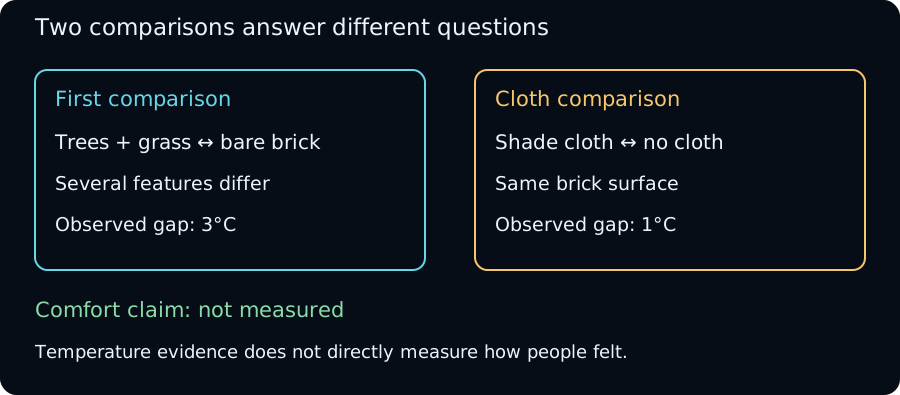
- The first temperature gap and the later cloth result answer different questions. Do not combine them into an invented exact share for trees, grass or airflow.
- Match each claim to its measured variable, comparison and stated limit.
- Try the transfer checks below before returning to the explanation. These are original self-checks, with no official score conversion.
Match the three distinctions from the worked case.
난이도 2/5 · 140 코인 + 오늘 첫 완료 시 소액 보너스
Switching thermometer positions checks a possible device bias. It does not make the study a measurement of comfort, and it cannot make cloth identical to a living tree.
Which conclusion goes beyond the courtyard passage?
난이도 1/5 · 100 코인 + 오늘 첫 완료 시 소액 보너스
The greener courtyard was three degrees cooler, but it differed in several ways. The cloth test used the same brick surface on both sides and found a one-degree difference. It gives a narrower comparison of shade. Switching thermometer positions checks a possible device bias. It does not make the study a measurement of comfort, and it cannot make cloth identical to a living tree.
Complete the worked-case label: First comparison → ____. Use the phrase in the diagram.
난이도 1/5 · 100 코인 + 오늘 첫 완료 시 소액 보너스
Match each claim to its measured variable, comparison and stated limit.
Use context, reference and a sentence’s job
- Word in context: “Pause length was a proxy for attention: an observable indicator rather than a direct measure.” The explanation after the colon tells you the intended sense. A pause can suggest where to investigate without proving understanding. Do not replace a local definition with a familiar unrelated meaning.
- Reference and purpose: “The second trial made the comparison more informative, but it did not settle every question.” Here it refers to the trial. The contrast recognises a contribution while limiting it. Ask what the sentence does in the argument, not only which nouns it contains. A careful limitation has a job; it is not just an academic way to clear one’s throat.
Guided passage one — museum labels
- Read this full original text, then use the cues in its five questions. A question may ask for a definition, a referent, a detail or the job of a limitation. Locate the relevant wording before choosing.
- Each question also has a Read the original passage panel. Open it whenever you need the source, including in recall mode. Source access is expected reading, not an answer hint. All studies, institutions and numbers in these new passages are hypothetical teaching cases, not reported research findings.
Original passage: What does a pause at a display show?
At the fictional Merrow Museum, a team wanted to know whether longer labels helped visitors understand an object. They first compared two displays. One had a long explanation beside a popular model near the entrance; the other had a short label beside a small object in a quiet corner. Visitors paused longer at the first display. However, label length was not the only difference: object, location and visitor traffic also varied.
The team then used the same object and position throughout a second trial. On alternate mornings they displayed either the long or short label, recording how long visitors remained nearby. The longer label was again associated with longer pauses. The researchers treated pause length as a proxy for attention: it was an observable indicator rather than a direct measure of what someone understood. Visitors were not asked to explain the object afterwards.
The second trial made the label comparison more informative, but it did not settle every question. Different visitors attended on different mornings, and a longer pause might reflect reading difficulty as well as interest. The team proposed adding a short comprehension question in a later study. The observations supported further investigation of the labels, not a claim that more words necessarily produced more learning.
Read the original passage: What does a pause at a display show?
At the fictional Merrow Museum, a team wanted to know whether longer labels helped visitors understand an object. They first compared two displays. One had a long explanation beside a popular model near the entrance; the other had a short label beside a small object in a quiet corner. Visitors paused longer at the first display. However, label length was not the only difference: object, location and visitor traffic also varied.
The team then used the same object and position throughout a second trial. On alternate mornings they displayed either the long or short label, recording how long visitors remained nearby. The longer label was again associated with longer pauses. The researchers treated pause length as a proxy for attention: it was an observable indicator rather than a direct measure of what someone understood. Visitors were not asked to explain the object afterwards.
The second trial made the label comparison more informative, but it did not settle every question. Different visitors attended on different mornings, and a longer pause might reflect reading difficulty as well as interest. The team proposed adding a short comprehension question in a later study. The observations supported further investigation of the labels, not a claim that more words necessarily produced more learning.
Reading cue: Identify all differences in the first comparison.
Question: Why was the first display comparison limited? Choose ONE answer.
난이도 1/5 · 100 코인 + 오늘 첫 완료 시 소액 보너스
Several features varied together, so pause differences cannot be assigned to label length alone. Repair: list what changed before selecting a cause.
Read the original passage: What does a pause at a display show?
At the fictional Merrow Museum, a team wanted to know whether longer labels helped visitors understand an object. They first compared two displays. One had a long explanation beside a popular model near the entrance; the other had a short label beside a small object in a quiet corner. Visitors paused longer at the first display. However, label length was not the only difference: object, location and visitor traffic also varied.
The team then used the same object and position throughout a second trial. On alternate mornings they displayed either the long or short label, recording how long visitors remained nearby. The longer label was again associated with longer pauses. The researchers treated pause length as a proxy for attention: it was an observable indicator rather than a direct measure of what someone understood. Visitors were not asked to explain the object afterwards.
The second trial made the label comparison more informative, but it did not settle every question. Different visitors attended on different mornings, and a longer pause might reflect reading difficulty as well as interest. The team proposed adding a short comprehension question in a later study. The observations supported further investigation of the labels, not a claim that more words necessarily produced more learning.
Reading cue: Read the phrase after the colon and the stated limitation.
Question: What does proxy mean in the discussion of pause length? Choose ONE answer.
난이도 1/5 · 100 코인 + 오늘 첫 완료 시 소액 보너스
The passage contrasts an observable pause with direct understanding, which was not tested. Repair: use the definition supplied by the surrounding sentence.
Read the original passage: What does a pause at a display show?
At the fictional Merrow Museum, a team wanted to know whether longer labels helped visitors understand an object. They first compared two displays. One had a long explanation beside a popular model near the entrance; the other had a short label beside a small object in a quiet corner. Visitors paused longer at the first display. However, label length was not the only difference: object, location and visitor traffic also varied.
The team then used the same object and position throughout a second trial. On alternate mornings they displayed either the long or short label, recording how long visitors remained nearby. The longer label was again associated with longer pauses. The researchers treated pause length as a proxy for attention: it was an observable indicator rather than a direct measure of what someone understood. Visitors were not asked to explain the object afterwards.
The second trial made the label comparison more informative, but it did not settle every question. Different visitors attended on different mornings, and a longer pause might reflect reading difficulty as well as interest. The team proposed adding a short comprehension question in a later study. The observations supported further investigation of the labels, not a claim that more words necessarily produced more learning.
Reading cue: Read the preceding clause and check which referent fits the contrast.
Question: What does it refer to in “it did not settle every question”? Choose ONE answer.
난이도 1/5 · 100 코인 + 오늘 첫 완료 시 소액 보너스
The preceding clause names the second trial as making the comparison more informative; it then limits what that trial settled. Repair: connect the pronoun to the noun and meaning in the surrounding clause.
Read the original passage: What does a pause at a display show?
At the fictional Merrow Museum, a team wanted to know whether longer labels helped visitors understand an object. They first compared two displays. One had a long explanation beside a popular model near the entrance; the other had a short label beside a small object in a quiet corner. Visitors paused longer at the first display. However, label length was not the only difference: object, location and visitor traffic also varied.
The team then used the same object and position throughout a second trial. On alternate mornings they displayed either the long or short label, recording how long visitors remained nearby. The longer label was again associated with longer pauses. The researchers treated pause length as a proxy for attention: it was an observable indicator rather than a direct measure of what someone understood. Visitors were not asked to explain the object afterwards.
The second trial made the label comparison more informative, but it did not settle every question. Different visitors attended on different mornings, and a longer pause might reflect reading difficulty as well as interest. The team proposed adding a short comprehension question in a later study. The observations supported further investigation of the labels, not a claim that more words necessarily produced more learning.
Reading cue: Connect the limitation to the conclusion being considered.
Question: Why does the writer mention that a longer pause could reflect reading difficulty? Choose ONE answer.
난이도 1/5 · 100 코인 + 오늘 첫 완료 시 소액 보너스
Difficulty is a possible explanation that limits a simple attention-or-learning conclusion. Repair: ask what claim the sentence prevents, not which unsupported event it might imply.
Read the original passage: What does a pause at a display show?
At the fictional Merrow Museum, a team wanted to know whether longer labels helped visitors understand an object. They first compared two displays. One had a long explanation beside a popular model near the entrance; the other had a short label beside a small object in a quiet corner. Visitors paused longer at the first display. However, label length was not the only difference: object, location and visitor traffic also varied.
The team then used the same object and position throughout a second trial. On alternate mornings they displayed either the long or short label, recording how long visitors remained nearby. The longer label was again associated with longer pauses. The researchers treated pause length as a proxy for attention: it was an observable indicator rather than a direct measure of what someone understood. Visitors were not asked to explain the object afterwards.
The second trial made the label comparison more informative, but it did not settle every question. Different visitors attended on different mornings, and a longer pause might reflect reading difficulty as well as interest. The team proposed adding a short comprehension question in a later study. The observations supported further investigation of the labels, not a claim that more words necessarily produced more learning.
Reading cue: Notice the time and status of the proposed next step.
Question: What does the final comprehension-question proposal add? Choose ONE answer.
난이도 1/5 · 100 코인 + 오늘 첫 완료 시 소액 보너스
The question is proposed for later; it is not an existing result. Repair: distinguish a planned investigation from evidence already collected.
Guided passage two — model channels
- Read the new source before its five guided checks. Follow the cue, then use the explanation to identify the line or relationship that makes one option fit. A stated possibility is not automatically an observed fact.
- After a mistake, name the distinction you lost before trying again. A corrected answer repairs that item; it does not become another independent passage or a calibrated TOEFL result.
Original passage: A model channel and a river bank
In a fictional field course, students noticed that one river bend had a deeper hollow near its outer bank than another bend. They wondered whether channel width explained the difference. Yet the bends also differed in water speed, bank material and the amount of vegetation nearby. Measuring a hollow accurately did not allow the students to assign its whole depth to one feature.
To examine width more closely, they built two small channels with the same loose material and supplied each with an equal flow of water for the same period. One channel was narrower. They measured a deeper hollow in that model. Repeating the comparison several times produced a similar pattern, although the precise depths varied. In their report, replicate meant repeat the comparison, not reproduce every feature of a real river.
The model helped the students investigate one proposed explanation under simplified conditions. It did not establish how large the effect would be at either original bend. A real bank could contain layers absent from the model, and water flow might change over time. The report therefore separated the original observation, the model result and the limits of applying one to the other. The model was useful partly because its boundaries could be stated clearly.
Read the original passage: A model channel and a river bank
In a fictional field course, students noticed that one river bend had a deeper hollow near its outer bank than another bend. They wondered whether channel width explained the difference. Yet the bends also differed in water speed, bank material and the amount of vegetation nearby. Measuring a hollow accurately did not allow the students to assign its whole depth to one feature.
To examine width more closely, they built two small channels with the same loose material and supplied each with an equal flow of water for the same period. One channel was narrower. They measured a deeper hollow in that model. Repeating the comparison several times produced a similar pattern, although the precise depths varied. In their report, replicate meant repeat the comparison, not reproduce every feature of a real river.
The model helped the students investigate one proposed explanation under simplified conditions. It did not establish how large the effect would be at either original bend. A real bank could contain layers absent from the model, and water flow might change over time. The report therefore separated the original observation, the model result and the limits of applying one to the other. The model was useful partly because its boundaries could be stated clearly.
Reading cue: Separate original field conditions from model conditions.
Question: Which feature differed between the two model channels? Choose ONE answer.
난이도 1/5 · 100 코인 + 오늘 첫 완료 시 소액 보너스
The passage keeps material, supplied flow and period equal while varying width. Repair: locate the specific model contrast instead of importing differences from the river bends.
Read the original passage: A model channel and a river bank
In a fictional field course, students noticed that one river bend had a deeper hollow near its outer bank than another bend. They wondered whether channel width explained the difference. Yet the bends also differed in water speed, bank material and the amount of vegetation nearby. Measuring a hollow accurately did not allow the students to assign its whole depth to one feature.
To examine width more closely, they built two small channels with the same loose material and supplied each with an equal flow of water for the same period. One channel was narrower. They measured a deeper hollow in that model. Repeating the comparison several times produced a similar pattern, although the precise depths varied. In their report, replicate meant repeat the comparison, not reproduce every feature of a real river.
The model helped the students investigate one proposed explanation under simplified conditions. It did not establish how large the effect would be at either original bend. A real bank could contain layers absent from the model, and water flow might change over time. The report therefore separated the original observation, the model result and the limits of applying one to the other. The model was useful partly because its boundaries could be stated clearly.
Reading cue: Use the report’s own clarification of the word.
Question: What does replicate mean in the report? Choose ONE answer.
난이도 1/5 · 100 코인 + 오늘 첫 완료 시 소액 보너스
The passage explicitly defines replicate as repeating the comparison, with precise depths still varying. Repair: interpret the word in its sentence rather than assume perfect duplication.
Read the original passage: A model channel and a river bank
In a fictional field course, students noticed that one river bend had a deeper hollow near its outer bank than another bend. They wondered whether channel width explained the difference. Yet the bends also differed in water speed, bank material and the amount of vegetation nearby. Measuring a hollow accurately did not allow the students to assign its whole depth to one feature.
To examine width more closely, they built two small channels with the same loose material and supplied each with an equal flow of water for the same period. One channel was narrower. They measured a deeper hollow in that model. Repeating the comparison several times produced a similar pattern, although the precise depths varied. In their report, replicate meant repeat the comparison, not reproduce every feature of a real river.
The model helped the students investigate one proposed explanation under simplified conditions. It did not establish how large the effect would be at either original bend. A real bank could contain layers absent from the model, and water flow might change over time. The report therefore separated the original observation, the model result and the limits of applying one to the other. The model was useful partly because its boundaries could be stated clearly.
Reading cue: Read the opening of the final paragraph.
Question: How does the model relate to the original river observation? Choose ONE answer.
난이도 1/5 · 100 코인 + 오늘 첫 완료 시 소액 보너스
The model narrows attention to width but does not reproduce all field conditions. Repair: identify both what a model tests and what it leaves outside.
Read the original passage: A model channel and a river bank
In a fictional field course, students noticed that one river bend had a deeper hollow near its outer bank than another bend. They wondered whether channel width explained the difference. Yet the bends also differed in water speed, bank material and the amount of vegetation nearby. Measuring a hollow accurately did not allow the students to assign its whole depth to one feature.
To examine width more closely, they built two small channels with the same loose material and supplied each with an equal flow of water for the same period. One channel was narrower. They measured a deeper hollow in that model. Repeating the comparison several times produced a similar pattern, although the precise depths varied. In their report, replicate meant repeat the comparison, not reproduce every feature of a real river.
The model helped the students investigate one proposed explanation under simplified conditions. It did not establish how large the effect would be at either original bend. A real bank could contain layers absent from the model, and water flow might change over time. The report therefore separated the original observation, the model result and the limits of applying one to the other. The model was useful partly because its boundaries could be stated clearly.
Reading cue: Identify the job of a possible difference in the argument.
Question: Why mention that a real bank could contain layers absent from the model? Choose ONE answer.
난이도 1/5 · 100 코인 + 오늘 첫 완료 시 소액 보너스
The possible missing layers make direct numerical transfer uncertain. Repair: treat a stated possibility as a limitation, not as a measured new fact.
Read the original passage: A model channel and a river bank
In a fictional field course, students noticed that one river bend had a deeper hollow near its outer bank than another bend. They wondered whether channel width explained the difference. Yet the bends also differed in water speed, bank material and the amount of vegetation nearby. Measuring a hollow accurately did not allow the students to assign its whole depth to one feature.
To examine width more closely, they built two small channels with the same loose material and supplied each with an equal flow of water for the same period. One channel was narrower. They measured a deeper hollow in that model. Repeating the comparison several times produced a similar pattern, although the precise depths varied. In their report, replicate meant repeat the comparison, not reproduce every feature of a real river.
The model helped the students investigate one proposed explanation under simplified conditions. It did not establish how large the effect would be at either original bend. A real bank could contain layers absent from the model, and water flow might change over time. The report therefore separated the original observation, the model result and the limits of applying one to the other. The model was useful partly because its boundaries could be stated clearly.
Reading cue: Combine the model’s contribution with the writer’s qualification.
Question: Which conclusion best matches the passage as a whole? Choose ONE answer.
난이도 1/5 · 100 코인 + 오늘 첫 완료 시 소액 보너스
The final paragraph combines usefulness with limits. Repair: choose a main idea that preserves both rather than turning a qualified argument into an absolute.
Independent passage A — town records
- Read the complete source and answer its five questions without the guided cues. Use the question’s own expandable source panel if you need to reread. All information needed is in the text; specialist historical knowledge is not required.
- After checking, identify the passage evidence and why a plausible alternative fails. The four independent sets below are four passages with twenty questions, not twenty different passages.
Original passage: Reading a town through surviving records
In the fictional town of Belden, an archive holds rental ledgers from a single property company. A researcher initially used them to describe housing throughout the town a century earlier. The ledgers contain detailed entries, but most concern large buildings near the central market. Small houses managed by individual owners appear only occasionally. The collection is therefore extensive for one part of the rental market without being a complete picture of the town.
A second source complicates the account. A shopkeeper’s diary mentions crowded houses beyond the market district and payments made to private owners. The diary is fragmentary: several months are missing, and its writer recorded personal concerns rather than conducting a housing survey. Nevertheless, it draws attention to residents who appear rarely in the company’s ledgers. The researcher used it to form questions for further investigation, not to calculate how many households rented privately.
The two sources have different strengths. The ledgers offer regular figures for properties the company managed; the diary provides a less systematic view of another setting. Reading them together reveals a boundary in the original account. A precise record can still describe a narrow population, while an incomplete personal source can suggest where that record needs supplementing. Neither source alone establishes the living conditions of every resident.
Read the original passage: Reading a town through surviving records
In the fictional town of Belden, an archive holds rental ledgers from a single property company. A researcher initially used them to describe housing throughout the town a century earlier. The ledgers contain detailed entries, but most concern large buildings near the central market. Small houses managed by individual owners appear only occasionally. The collection is therefore extensive for one part of the rental market without being a complete picture of the town.
A second source complicates the account. A shopkeeper’s diary mentions crowded houses beyond the market district and payments made to private owners. The diary is fragmentary: several months are missing, and its writer recorded personal concerns rather than conducting a housing survey. Nevertheless, it draws attention to residents who appear rarely in the company’s ledgers. The researcher used it to form questions for further investigation, not to calculate how many households rented privately.
The two sources have different strengths. The ledgers offer regular figures for properties the company managed; the diary provides a less systematic view of another setting. Reading them together reveals a boundary in the original account. A precise record can still describe a narrow population, while an incomplete personal source can suggest where that record needs supplementing. Neither source alone establishes the living conditions of every resident.
Question: What is the passage mainly explaining? Choose ONE answer.
난이도 1/5 · 100 코인 + 오늘 첫 완료 시 소액 보너스
The ledgers are precise but narrow; the diary is incomplete but points beyond that coverage. Repair: keep both strengths and limits in the main idea.
Read the original passage: Reading a town through surviving records
In the fictional town of Belden, an archive holds rental ledgers from a single property company. A researcher initially used them to describe housing throughout the town a century earlier. The ledgers contain detailed entries, but most concern large buildings near the central market. Small houses managed by individual owners appear only occasionally. The collection is therefore extensive for one part of the rental market without being a complete picture of the town.
A second source complicates the account. A shopkeeper’s diary mentions crowded houses beyond the market district and payments made to private owners. The diary is fragmentary: several months are missing, and its writer recorded personal concerns rather than conducting a housing survey. Nevertheless, it draws attention to residents who appear rarely in the company’s ledgers. The researcher used it to form questions for further investigation, not to calculate how many households rented privately.
The two sources have different strengths. The ledgers offer regular figures for properties the company managed; the diary provides a less systematic view of another setting. Reading them together reveals a boundary in the original account. A precise record can still describe a narrow population, while an incomplete personal source can suggest where that record needs supplementing. Neither source alone establishes the living conditions of every resident.
Question: Which properties appear most often in the company’s ledgers? Choose ONE answer.
난이도 1/5 · 100 코인 + 오늘 첫 완료 시 소액 보너스
The first paragraph directly identifies the ledgers’ main coverage. Repair: distinguish the recorded population from the larger population the researcher first tried to describe.
Read the original passage: Reading a town through surviving records
In the fictional town of Belden, an archive holds rental ledgers from a single property company. A researcher initially used them to describe housing throughout the town a century earlier. The ledgers contain detailed entries, but most concern large buildings near the central market. Small houses managed by individual owners appear only occasionally. The collection is therefore extensive for one part of the rental market without being a complete picture of the town.
A second source complicates the account. A shopkeeper’s diary mentions crowded houses beyond the market district and payments made to private owners. The diary is fragmentary: several months are missing, and its writer recorded personal concerns rather than conducting a housing survey. Nevertheless, it draws attention to residents who appear rarely in the company’s ledgers. The researcher used it to form questions for further investigation, not to calculate how many households rented privately.
The two sources have different strengths. The ledgers offer regular figures for properties the company managed; the diary provides a less systematic view of another setting. Reading them together reveals a boundary in the original account. A precise record can still describe a narrow population, while an incomplete personal source can suggest where that record needs supplementing. Neither source alone establishes the living conditions of every resident.
Question: What does fragmentary mean as used for the diary? Choose ONE answer.
난이도 1/5 · 100 코인 + 오늘 첫 완료 시 소액 보너스
Missing months explain the word. The text does not establish deliberate deception. Repair: use the stated feature rather than infer a motive.
Read the original passage: Reading a town through surviving records
In the fictional town of Belden, an archive holds rental ledgers from a single property company. A researcher initially used them to describe housing throughout the town a century earlier. The ledgers contain detailed entries, but most concern large buildings near the central market. Small houses managed by individual owners appear only occasionally. The collection is therefore extensive for one part of the rental market without being a complete picture of the town.
A second source complicates the account. A shopkeeper’s diary mentions crowded houses beyond the market district and payments made to private owners. The diary is fragmentary: several months are missing, and its writer recorded personal concerns rather than conducting a housing survey. Nevertheless, it draws attention to residents who appear rarely in the company’s ledgers. The researcher used it to form questions for further investigation, not to calculate how many households rented privately.
The two sources have different strengths. The ledgers offer regular figures for properties the company managed; the diary provides a less systematic view of another setting. Reading them together reveals a boundary in the original account. A precise record can still describe a narrow population, while an incomplete personal source can suggest where that record needs supplementing. Neither source alone establishes the living conditions of every resident.
Question: Why could the researcher not use the diary to calculate the number of private-renting households? Choose ONE answer.
난이도 1/5 · 100 코인 + 오늘 첫 완료 시 소액 보너스
The missing months and personal focus limit counting, though the diary still suggests questions. Repair: distinguish a source’s useful clue from a representative count.
Read the original passage: Reading a town through surviving records
In the fictional town of Belden, an archive holds rental ledgers from a single property company. A researcher initially used them to describe housing throughout the town a century earlier. The ledgers contain detailed entries, but most concern large buildings near the central market. Small houses managed by individual owners appear only occasionally. The collection is therefore extensive for one part of the rental market without being a complete picture of the town.
A second source complicates the account. A shopkeeper’s diary mentions crowded houses beyond the market district and payments made to private owners. The diary is fragmentary: several months are missing, and its writer recorded personal concerns rather than conducting a housing survey. Nevertheless, it draws attention to residents who appear rarely in the company’s ledgers. The researcher used it to form questions for further investigation, not to calculate how many households rented privately.
The two sources have different strengths. The ledgers offer regular figures for properties the company managed; the diary provides a less systematic view of another setting. Reading them together reveals a boundary in the original account. A precise record can still describe a narrow population, while an incomplete personal source can suggest where that record needs supplementing. Neither source alone establishes the living conditions of every resident.
Question: Why does the final paragraph contrast a precise record with an incomplete personal source? Choose ONE answer.
난이도 1/5 · 100 코인 + 오늘 첫 완료 시 소액 보너스
The contrast preserves each source’s contribution while exposing coverage limits. Repair: do not turn complementary evidence into a universal ranking or a complete solution.
Independent passage B — seedling counts
- Read this new complete source, then answer the five questions from its wording and relationships. Keep any outside knowledge separate from what this fictional text establishes.
- Use the feedback to identify a missed distinction rather than memorise the letter. A later fresh question offers different evidence from repeating a corrected choice.
Original passage: Early counts and later outcomes
At a fictional college greenhouse, students compared two batches of seeds under the same planting conditions. They placed equal numbers in matching trays and recorded how many seedlings appeared each day. More seedlings from Batch A appeared during the first five days. The students called this an early-emergence difference, a term describing their observation window rather than a judgement about every seed’s eventual condition.
When they continued counting, additional seedlings appeared from Batch B. By the end of the observation period, the difference between the totals was smaller. This later count did not erase the earlier result: the batches still differed in how quickly seedlings appeared. It changed what the students could reasonably infer from that result. A seed that had not produced a visible seedling by the fifth day could not simply be classified as one that would never produce a seedling.
The students also avoided assigning the timing difference to a particular cause. Although the trays received the same treatment during the exercise, the batches had different and incompletely documented histories before planting. The report suggested a further comparison using seeds with known histories. For the present exercise, the clearest conclusion concerned the observed sequence of emergence. Neither long-term survival nor the reason for the initial timing difference had been established by the counts.
Read the original passage: Early counts and later outcomes
At a fictional college greenhouse, students compared two batches of seeds under the same planting conditions. They placed equal numbers in matching trays and recorded how many seedlings appeared each day. More seedlings from Batch A appeared during the first five days. The students called this an early-emergence difference, a term describing their observation window rather than a judgement about every seed’s eventual condition.
When they continued counting, additional seedlings appeared from Batch B. By the end of the observation period, the difference between the totals was smaller. This later count did not erase the earlier result: the batches still differed in how quickly seedlings appeared. It changed what the students could reasonably infer from that result. A seed that had not produced a visible seedling by the fifth day could not simply be classified as one that would never produce a seedling.
The students also avoided assigning the timing difference to a particular cause. Although the trays received the same treatment during the exercise, the batches had different and incompletely documented histories before planting. The report suggested a further comparison using seeds with known histories. For the present exercise, the clearest conclusion concerned the observed sequence of emergence. Neither long-term survival nor the reason for the initial timing difference had been established by the counts.
Question: What changed when counting continued beyond the first five days? Choose ONE answer.
난이도 1/5 · 100 코인 + 오늘 첫 완료 시 소액 보너스
The later count narrows the total gap without erasing the earlier timing pattern. Repair: keep a later result separate from a denial of an earlier observation.
Read the original passage: Early counts and later outcomes
At a fictional college greenhouse, students compared two batches of seeds under the same planting conditions. They placed equal numbers in matching trays and recorded how many seedlings appeared each day. More seedlings from Batch A appeared during the first five days. The students called this an early-emergence difference, a term describing their observation window rather than a judgement about every seed’s eventual condition.
When they continued counting, additional seedlings appeared from Batch B. By the end of the observation period, the difference between the totals was smaller. This later count did not erase the earlier result: the batches still differed in how quickly seedlings appeared. It changed what the students could reasonably infer from that result. A seed that had not produced a visible seedling by the fifth day could not simply be classified as one that would never produce a seedling.
The students also avoided assigning the timing difference to a particular cause. Although the trays received the same treatment during the exercise, the batches had different and incompletely documented histories before planting. The report suggested a further comparison using seeds with known histories. For the present exercise, the clearest conclusion concerned the observed sequence of emergence. Neither long-term survival nor the reason for the initial timing difference had been established by the counts.
Question: What does early-emergence describe in this exercise? Choose ONE answer.
난이도 1/5 · 100 코인 + 오늘 첫 완료 시 소액 보너스
The first paragraph defines a time-window observation, not survival or cause. Repair: use the locally defined category rather than strengthen it.
Read the original passage: Early counts and later outcomes
At a fictional college greenhouse, students compared two batches of seeds under the same planting conditions. They placed equal numbers in matching trays and recorded how many seedlings appeared each day. More seedlings from Batch A appeared during the first five days. The students called this an early-emergence difference, a term describing their observation window rather than a judgement about every seed’s eventual condition.
When they continued counting, additional seedlings appeared from Batch B. By the end of the observation period, the difference between the totals was smaller. This later count did not erase the earlier result: the batches still differed in how quickly seedlings appeared. It changed what the students could reasonably infer from that result. A seed that had not produced a visible seedling by the fifth day could not simply be classified as one that would never produce a seedling.
The students also avoided assigning the timing difference to a particular cause. Although the trays received the same treatment during the exercise, the batches had different and incompletely documented histories before planting. The report suggested a further comparison using seeds with known histories. For the present exercise, the clearest conclusion concerned the observed sequence of emergence. Neither long-term survival nor the reason for the initial timing difference had been established by the counts.
Question: Why is the sentence about a seed without a visible seedling on day five important? Choose ONE answer.
난이도 1/5 · 100 코인 + 오늘 첫 완료 시 소액 보너스
Later appearances demonstrate why the early absence cannot establish a permanent outcome. Repair: identify the distinction that the sentence protects.
Read the original passage: Early counts and later outcomes
At a fictional college greenhouse, students compared two batches of seeds under the same planting conditions. They placed equal numbers in matching trays and recorded how many seedlings appeared each day. More seedlings from Batch A appeared during the first five days. The students called this an early-emergence difference, a term describing their observation window rather than a judgement about every seed’s eventual condition.
When they continued counting, additional seedlings appeared from Batch B. By the end of the observation period, the difference between the totals was smaller. This later count did not erase the earlier result: the batches still differed in how quickly seedlings appeared. It changed what the students could reasonably infer from that result. A seed that had not produced a visible seedling by the fifth day could not simply be classified as one that would never produce a seedling.
The students also avoided assigning the timing difference to a particular cause. Although the trays received the same treatment during the exercise, the batches had different and incompletely documented histories before planting. The report suggested a further comparison using seeds with known histories. For the present exercise, the clearest conclusion concerned the observed sequence of emergence. Neither long-term survival nor the reason for the initial timing difference had been established by the counts.
Question: Why do the batches’ earlier histories matter to the report? Choose ONE answer.
난이도 1/5 · 100 코인 + 오늘 첫 완료 시 소액 보너스
Equal conditions during the exercise do not supply missing information about earlier histories. Repair: retain an unresolved explanation without inventing a specific cause.
Read the original passage: Early counts and later outcomes
At a fictional college greenhouse, students compared two batches of seeds under the same planting conditions. They placed equal numbers in matching trays and recorded how many seedlings appeared each day. More seedlings from Batch A appeared during the first five days. The students called this an early-emergence difference, a term describing their observation window rather than a judgement about every seed’s eventual condition.
When they continued counting, additional seedlings appeared from Batch B. By the end of the observation period, the difference between the totals was smaller. This later count did not erase the earlier result: the batches still differed in how quickly seedlings appeared. It changed what the students could reasonably infer from that result. A seed that had not produced a visible seedling by the fifth day could not simply be classified as one that would never produce a seedling.
The students also avoided assigning the timing difference to a particular cause. Although the trays received the same treatment during the exercise, the batches had different and incompletely documented histories before planting. The report suggested a further comparison using seeds with known histories. For the present exercise, the clearest conclusion concerned the observed sequence of emergence. Neither long-term survival nor the reason for the initial timing difference had been established by the counts.
Question: Which conclusion is supported by the passage? Choose ONE answer.
난이도 1/5 · 100 코인 + 오늘 첫 완료 시 소액 보너스
The final paragraph explicitly limits the conclusion to the observed emergence sequence. Repair: match conclusions to measured variables and the observation period.
Independent passage C — an incomplete panel
- Read the full passage and answer all five checks before moving to the worked illustration in the next step. No image is needed to answer this text’s questions.
- Use only the evidence described here. A source panel remains available inside each question so that the necessary text stays accessible when reviewing an individual item.
Original passage: Reconstructing an incomplete decorative panel
A fictional museum received fragments of a decorative panel arranged originally as four tiles in two rows. Only the two upper tiles survived. Their outer edges carried a repeated border, and each had a different central symbol. A drawing made when the fragments entered storage showed their relative positions, but it did not include the missing lower row. The curators therefore had evidence for part of the panel rather than a complete design.
Two proposed reconstructions kept the surviving upper row and continued its border around the missing area. They used the same two suggested lower symbols but placed them in opposite positions. Both proposals matched the preserved border. That agreement was not enough to identify the original arrangement: a repeated edge pattern did not determine which symbol belonged below each surviving tile. Similar panels from another room provided possible comparisons, but they were not records of this particular object.
The museum displayed both proposals as provisional interpretations. Here provisional indicated that further evidence could change the reconstruction. A later photograph or an additional fragment might favour one arrangement, suggest a third, or show that both were mistaken. Presenting alternatives made the uncertainty visible instead of hiding it behind a single finished picture. The exercise distinguished a design compatible with existing evidence from a design established as historically original.
Read the original passage: Reconstructing an incomplete decorative panel
A fictional museum received fragments of a decorative panel arranged originally as four tiles in two rows. Only the two upper tiles survived. Their outer edges carried a repeated border, and each had a different central symbol. A drawing made when the fragments entered storage showed their relative positions, but it did not include the missing lower row. The curators therefore had evidence for part of the panel rather than a complete design.
Two proposed reconstructions kept the surviving upper row and continued its border around the missing area. They used the same two suggested lower symbols but placed them in opposite positions. Both proposals matched the preserved border. That agreement was not enough to identify the original arrangement: a repeated edge pattern did not determine which symbol belonged below each surviving tile. Similar panels from another room provided possible comparisons, but they were not records of this particular object.
The museum displayed both proposals as provisional interpretations. Here provisional indicated that further evidence could change the reconstruction. A later photograph or an additional fragment might favour one arrangement, suggest a third, or show that both were mistaken. Presenting alternatives made the uncertainty visible instead of hiding it behind a single finished picture. The exercise distinguished a design compatible with existing evidence from a design established as historically original.
Question: What evidence did the museum have for the original panel? Choose ONE answer.
난이도 1/5 · 100 코인 + 오늘 첫 완료 시 소액 보너스
The first paragraph specifies both survivors and the drawing’s boundary. Repair: identify what the source actually preserves before judging a reconstruction.
Read the original passage: Reconstructing an incomplete decorative panel
A fictional museum received fragments of a decorative panel arranged originally as four tiles in two rows. Only the two upper tiles survived. Their outer edges carried a repeated border, and each had a different central symbol. A drawing made when the fragments entered storage showed their relative positions, but it did not include the missing lower row. The curators therefore had evidence for part of the panel rather than a complete design.
Two proposed reconstructions kept the surviving upper row and continued its border around the missing area. They used the same two suggested lower symbols but placed them in opposite positions. Both proposals matched the preserved border. That agreement was not enough to identify the original arrangement: a repeated edge pattern did not determine which symbol belonged below each surviving tile. Similar panels from another room provided possible comparisons, but they were not records of this particular object.
The museum displayed both proposals as provisional interpretations. Here provisional indicated that further evidence could change the reconstruction. A later photograph or an additional fragment might favour one arrangement, suggest a third, or show that both were mistaken. Presenting alternatives made the uncertainty visible instead of hiding it behind a single finished picture. The exercise distinguished a design compatible with existing evidence from a design established as historically original.
Question: Why did both proposed arrangements match the preserved border? Choose ONE answer.
난이도 1/5 · 100 코인 + 오늘 첫 완료 시 소액 보너스
Matching an edge pattern leaves alternative interior arrangements possible. Repair: separate compatibility with one feature from a uniquely determined full design.
Read the original passage: Reconstructing an incomplete decorative panel
A fictional museum received fragments of a decorative panel arranged originally as four tiles in two rows. Only the two upper tiles survived. Their outer edges carried a repeated border, and each had a different central symbol. A drawing made when the fragments entered storage showed their relative positions, but it did not include the missing lower row. The curators therefore had evidence for part of the panel rather than a complete design.
Two proposed reconstructions kept the surviving upper row and continued its border around the missing area. They used the same two suggested lower symbols but placed them in opposite positions. Both proposals matched the preserved border. That agreement was not enough to identify the original arrangement: a repeated edge pattern did not determine which symbol belonged below each surviving tile. Similar panels from another room provided possible comparisons, but they were not records of this particular object.
The museum displayed both proposals as provisional interpretations. Here provisional indicated that further evidence could change the reconstruction. A later photograph or an additional fragment might favour one arrangement, suggest a third, or show that both were mistaken. Presenting alternatives made the uncertainty visible instead of hiding it behind a single finished picture. The exercise distinguished a design compatible with existing evidence from a design established as historically original.
Question: What does provisional indicate about the displayed interpretations? Choose ONE answer.
난이도 1/5 · 100 코인 + 오늘 첫 완료 시 소액 보너스
The next sentence names new evidence that could favour one, suggest another or reject both. Repair: use that explanation to interpret the status word.
Read the original passage: Reconstructing an incomplete decorative panel
A fictional museum received fragments of a decorative panel arranged originally as four tiles in two rows. Only the two upper tiles survived. Their outer edges carried a repeated border, and each had a different central symbol. A drawing made when the fragments entered storage showed their relative positions, but it did not include the missing lower row. The curators therefore had evidence for part of the panel rather than a complete design.
Two proposed reconstructions kept the surviving upper row and continued its border around the missing area. They used the same two suggested lower symbols but placed them in opposite positions. Both proposals matched the preserved border. That agreement was not enough to identify the original arrangement: a repeated edge pattern did not determine which symbol belonged below each surviving tile. Similar panels from another room provided possible comparisons, but they were not records of this particular object.
The museum displayed both proposals as provisional interpretations. Here provisional indicated that further evidence could change the reconstruction. A later photograph or an additional fragment might favour one arrangement, suggest a third, or show that both were mistaken. Presenting alternatives made the uncertainty visible instead of hiding it behind a single finished picture. The exercise distinguished a design compatible with existing evidence from a design established as historically original.
Question: Why are similar panels from another room not decisive evidence? Choose ONE answer.
난이도 1/5 · 100 코인 + 오늘 첫 완료 시 소액 보너스
The passage explicitly distinguishes analogous examples from object-specific evidence. Repair: do not treat resemblance as direct documentation.
Read the original passage: Reconstructing an incomplete decorative panel
A fictional museum received fragments of a decorative panel arranged originally as four tiles in two rows. Only the two upper tiles survived. Their outer edges carried a repeated border, and each had a different central symbol. A drawing made when the fragments entered storage showed their relative positions, but it did not include the missing lower row. The curators therefore had evidence for part of the panel rather than a complete design.
Two proposed reconstructions kept the surviving upper row and continued its border around the missing area. They used the same two suggested lower symbols but placed them in opposite positions. Both proposals matched the preserved border. That agreement was not enough to identify the original arrangement: a repeated edge pattern did not determine which symbol belonged below each surviving tile. Similar panels from another room provided possible comparisons, but they were not records of this particular object.
The museum displayed both proposals as provisional interpretations. Here provisional indicated that further evidence could change the reconstruction. A later photograph or an additional fragment might favour one arrangement, suggest a third, or show that both were mistaken. Presenting alternatives made the uncertainty visible instead of hiding it behind a single finished picture. The exercise distinguished a design compatible with existing evidence from a design established as historically original.
Question: What is the purpose of presenting both reconstructions? Choose ONE answer.
난이도 1/5 · 100 코인 + 오늘 첫 완료 시 소액 보너스
The final paragraph contrasts visible alternatives with the false certainty of one finished picture. Repair: identify the rhetorical role of the display choice.
After passage C — compare compatible proposals
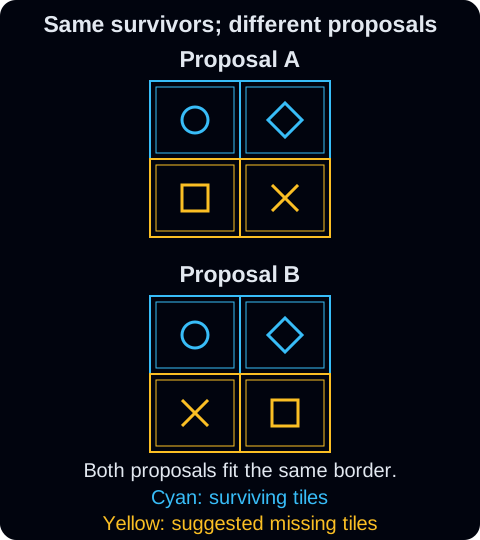
- These original schematic alternatives illustrate the source after its questions. Both keep the same two surviving upper tiles and continue the border; the proposed lower symbols swap places. The surviving evidence does not by itself choose between those lower arrangements.
- The illustration is a teaching model of the fictional case, not an archaeological record or a new piece of evidence. A finished-looking reconstruction can make an interpretation feel settled before its source warrants that confidence.

Independent passage D — campus information guides
- Read the complete source and answer its five questions without a planning cue. Reopen the source in a question when needed; rereading is part of comprehension, not a failure to remember the whole passage.
- When reviewing, identify which clause, example or relationship supports the choice. A familiar topic does not justify adding a result the writer has not supplied.
Original passage: Different ways to organise the same information
In a fictional campus project, students built two guides to the same set of rooms and services. One was an alphabetical directory: a reader who knew a service’s name could look for its entry and find its room number. The other was a connection diagram showing how rooms linked to entrances and corridors. It preserved the same labels but arranged them according to physical relationships rather than the alphabet.
The formats answered different kinds of questions. The directory made a named entry straightforward to locate, while the diagram showed which spaces a route passed through. A reader could use the directory to find the room number for equipment loans, then use the diagram to trace a path there. Replacing one guide with the other would remove a form of organisation that some questions required.
The project team thought that combining the guides might reduce unnecessary searching. They described this as a proposal to test, not a measured result. No comparison of completion times had been conducted, and users unfamiliar with either format might need instructions. The project therefore did not establish that diagrams were universally faster or that directories were obsolete. It illustrated how the value of an information display depends partly on the question a reader is trying to answer.
Read the original passage: Different ways to organise the same information
In a fictional campus project, students built two guides to the same set of rooms and services. One was an alphabetical directory: a reader who knew a service’s name could look for its entry and find its room number. The other was a connection diagram showing how rooms linked to entrances and corridors. It preserved the same labels but arranged them according to physical relationships rather than the alphabet.
The formats answered different kinds of questions. The directory made a named entry straightforward to locate, while the diagram showed which spaces a route passed through. A reader could use the directory to find the room number for equipment loans, then use the diagram to trace a path there. Replacing one guide with the other would remove a form of organisation that some questions required.
The project team thought that combining the guides might reduce unnecessary searching. They described this as a proposal to test, not a measured result. No comparison of completion times had been conducted, and users unfamiliar with either format might need instructions. The project therefore did not establish that diagrams were universally faster or that directories were obsolete. It illustrated how the value of an information display depends partly on the question a reader is trying to answer.
Question: How do the two guides organise the information differently? Choose ONE answer.
난이도 1/5 · 100 코인 + 오늘 첫 완료 시 소액 보너스
The first paragraph defines the organisational contrast while preserving the same labels. Repair: distinguish representation from the underlying information.
Read the original passage: Different ways to organise the same information
In a fictional campus project, students built two guides to the same set of rooms and services. One was an alphabetical directory: a reader who knew a service’s name could look for its entry and find its room number. The other was a connection diagram showing how rooms linked to entrances and corridors. It preserved the same labels but arranged them according to physical relationships rather than the alphabet.
The formats answered different kinds of questions. The directory made a named entry straightforward to locate, while the diagram showed which spaces a route passed through. A reader could use the directory to find the room number for equipment loans, then use the diagram to trace a path there. Replacing one guide with the other would remove a form of organisation that some questions required.
The project team thought that combining the guides might reduce unnecessary searching. They described this as a proposal to test, not a measured result. No comparison of completion times had been conducted, and users unfamiliar with either format might need instructions. The project therefore did not establish that diagrams were universally faster or that directories were obsolete. It illustrated how the value of an information display depends partly on the question a reader is trying to answer.
Question: What does there refer to in the equipment-loans example? Choose ONE answer.
난이도 1/5 · 100 코인 + 오늘 첫 완료 시 소액 보너스
The reader first finds the room number for equipment loans and then traces a route to that room. Repair: connect the place word to the destination named in the preceding clause.
Read the original passage: Different ways to organise the same information
In a fictional campus project, students built two guides to the same set of rooms and services. One was an alphabetical directory: a reader who knew a service’s name could look for its entry and find its room number. The other was a connection diagram showing how rooms linked to entrances and corridors. It preserved the same labels but arranged them according to physical relationships rather than the alphabet.
The formats answered different kinds of questions. The directory made a named entry straightforward to locate, while the diagram showed which spaces a route passed through. A reader could use the directory to find the room number for equipment loans, then use the diagram to trace a path there. Replacing one guide with the other would remove a form of organisation that some questions required.
The project team thought that combining the guides might reduce unnecessary searching. They described this as a proposal to test, not a measured result. No comparison of completion times had been conducted, and users unfamiliar with either format might need instructions. The project therefore did not establish that diagrams were universally faster or that directories were obsolete. It illustrated how the value of an information display depends partly on the question a reader is trying to answer.
Question: Why does the passage describe a reader using both guides for equipment loans? Choose ONE answer.
난이도 1/5 · 100 코인 + 오늘 첫 완료 시 소액 보너스
Finding a named entry and tracing a path use different forms of organisation. Repair: interpret the example’s role without inventing a measured outcome.
Read the original passage: Different ways to organise the same information
In a fictional campus project, students built two guides to the same set of rooms and services. One was an alphabetical directory: a reader who knew a service’s name could look for its entry and find its room number. The other was a connection diagram showing how rooms linked to entrances and corridors. It preserved the same labels but arranged them according to physical relationships rather than the alphabet.
The formats answered different kinds of questions. The directory made a named entry straightforward to locate, while the diagram showed which spaces a route passed through. A reader could use the directory to find the room number for equipment loans, then use the diagram to trace a path there. Replacing one guide with the other would remove a form of organisation that some questions required.
The project team thought that combining the guides might reduce unnecessary searching. They described this as a proposal to test, not a measured result. No comparison of completion times had been conducted, and users unfamiliar with either format might need instructions. The project therefore did not establish that diagrams were universally faster or that directories were obsolete. It illustrated how the value of an information display depends partly on the question a reader is trying to answer.
Question: Why does the final paragraph mention that completion times were not compared? Choose ONE answer.
난이도 1/5 · 100 코인 + 오늘 첫 완료 시 소액 보너스
The team’s efficiency idea remains a proposal because timing evidence is absent. Repair: separate a plausible mechanism from a demonstrated effect.
Read the original passage: Different ways to organise the same information
In a fictional campus project, students built two guides to the same set of rooms and services. One was an alphabetical directory: a reader who knew a service’s name could look for its entry and find its room number. The other was a connection diagram showing how rooms linked to entrances and corridors. It preserved the same labels but arranged them according to physical relationships rather than the alphabet.
The formats answered different kinds of questions. The directory made a named entry straightforward to locate, while the diagram showed which spaces a route passed through. A reader could use the directory to find the room number for equipment loans, then use the diagram to trace a path there. Replacing one guide with the other would remove a form of organisation that some questions required.
The project team thought that combining the guides might reduce unnecessary searching. They described this as a proposal to test, not a measured result. No comparison of completion times had been conducted, and users unfamiliar with either format might need instructions. The project therefore did not establish that diagrams were universally faster or that directories were obsolete. It illustrated how the value of an information display depends partly on the question a reader is trying to answer.
Question: Which statement best expresses the passage’s main idea? Choose ONE answer.
난이도 1/5 · 100 코인 + 오늘 첫 완료 시 소액 보너스
The text combines complementary organisation with a limit on the untested efficiency claim. Repair: preserve both ideas rather than choose an absolute preference.
Transfer to a new display comparison
- The new short source below supports three transfer questions. It is one shared context and a focused local drill, not a complete five-question academic set or three independent passages.
- Read before checking the choices. Use the same evidence method while selecting new facts from this source; do not import the courtyard’s numbers or the museum-label study’s results.
Original passage: A display that visitors could hear
In a fictional science centre, visitors could explore a model with either a written guide or recorded instructions. More visitors finished the model’s sequence when the recording was available. The centre first called this evidence that sound was a better teaching method. However, the recorded version also used shorter instructions and placed a large numbered control beside each part of the model.
A later trial kept the instruction wording and numbered controls the same in both versions. The completion difference became smaller. Staff did not conclude that the recording had no value; they concluded that the original comparison had combined several changes. Neither trial asked visitors to explain the underlying scientific idea afterwards. The findings concerned completion of that sequence, not a complete measure of what the visitors learned.
Read the original passage: A display that visitors could hear
In a fictional science centre, visitors could explore a model with either a written guide or recorded instructions. More visitors finished the model’s sequence when the recording was available. The centre first called this evidence that sound was a better teaching method. However, the recorded version also used shorter instructions and placed a large numbered control beside each part of the model.
A later trial kept the instruction wording and numbered controls the same in both versions. The completion difference became smaller. Staff did not conclude that the recording had no value; they concluded that the original comparison had combined several changes. Neither trial asked visitors to explain the underlying scientific idea afterwards. The findings concerned completion of that sequence, not a complete measure of what the visitors learned.
Question: Why was the first comparison insufficient to isolate the value of sound? Choose ONE answer.
난이도 1/5 · 100 코인 + 오늘 첫 완료 시 소액 보너스
Several features changed together, so the first result cannot assign the whole difference to sound. Repair: list differences before attributing the outcome.
Read the original passage: A display that visitors could hear
In a fictional science centre, visitors could explore a model with either a written guide or recorded instructions. More visitors finished the model’s sequence when the recording was available. The centre first called this evidence that sound was a better teaching method. However, the recorded version also used shorter instructions and placed a large numbered control beside each part of the model.
A later trial kept the instruction wording and numbered controls the same in both versions. The completion difference became smaller. Staff did not conclude that the recording had no value; they concluded that the original comparison had combined several changes. Neither trial asked visitors to explain the underlying scientific idea afterwards. The findings concerned completion of that sequence, not a complete measure of what the visitors learned.
Question: What did the smaller later difference establish about the earlier result? Choose ONE answer.
난이도 1/5 · 100 코인 + 오늘 첫 완료 시 소액 보너스
The passage retains a possible contribution from sound while narrowing the first interpretation. Repair: do not turn a reduced difference into proof of no effect.
Read the original passage: A display that visitors could hear
In a fictional science centre, visitors could explore a model with either a written guide or recorded instructions. More visitors finished the model’s sequence when the recording was available. The centre first called this evidence that sound was a better teaching method. However, the recorded version also used shorter instructions and placed a large numbered control beside each part of the model.
A later trial kept the instruction wording and numbered controls the same in both versions. The completion difference became smaller. Staff did not conclude that the recording had no value; they concluded that the original comparison had combined several changes. Neither trial asked visitors to explain the underlying scientific idea afterwards. The findings concerned completion of that sequence, not a complete measure of what the visitors learned.
Question: Why does the passage say visitors were not asked to explain the idea? Choose ONE answer.
난이도 1/5 · 100 코인 + 오늘 첫 완료 시 소액 보너스
Completion and explanation are different outcomes. Repair: check which outcome was measured before extending a teaching claim.
Repair an overclaim in your own words
- The private response asks you to repair a claim about an animation and visitor understanding. Draft an explanation that separates the observation, another difference and the unmeasured outcome before opening the model.
- Compare with the checklist, revise one missing distinction and try a fresh source. Several concise explanations can work. This is private evidence-based self-review, not an automatically graded writing task or an official TOEFL estimate.
Original short study: At a fictional gallery, visitors looked longer at a display with a short animation than at one with a still image. The displays also concerned different objects. No question tested visitors’ understanding.
A reader concludes: “Animation alone made everyone understand the objects better.” Write a short repair naming the observation, one competing difference and the unmeasured outcome.
Evidence-based repair separates an observation, a causal claim and an unmeasured outcome. The page records comparison/revision only, not correctness or a proficiency score.
Return later with two focused review texts
- On another day, try the short archive and print-comparison questions before reopening worked notes. These are focused review sources, not additional complete academic sets. Explain the decisive wording after checking.
- Continue with fresh everyday reading for practical conditions, or word completion for letters, grammar and meaning. Revisit academic-reading principles when the difficulty is finding a text’s main contribution. Local accuracy and self-review do not convert to an official score.
Task description checked on 19 October 2026: ETS updated TOEFL iBT overview and ETS Reading. The primary overview describes approximately 200-word academic passages and five questions. All new studies, records, figures and examples here are originally authored hypothetical teaching material, separate from reserved forms; they do not report actual findings or simulate ETS adaptation/scoring.
Read the original passage: A short archival review
In a fictional archive, a list records ships that paid a harbour fee during one season. A historian uses it to study fee-paying traffic. The list does not include ships exempt from the fee, and no complete record of those ships survives. The historian treats the list as evidence for a defined group, not as a count of every ship that entered the harbour.
Question: Which conclusion fits the scope of the surviving list? Choose ONE answer.
난이도 1/5 · 100 코인 + 오늘 첫 완료 시 소액 보너스
The fee condition defines coverage, and exempt ships are absent. Repair: preserve the recorded population rather than treating missing entries as proof of nonexistence.
Read the original passage: A short measurement review
In a fictional classroom trial, learners using larger print finished a reading task more quickly. The larger-print sheet also used wider spacing. The report did not attribute the whole difference to print size. It proposed another comparison that would hold spacing steady. No later test result was yet available, so the proposal remained a way to investigate the question rather than an answer already established.
Question: What is the proposed comparison intended to do? Choose ONE answer.
난이도 1/5 · 100 코인 + 오늘 첫 완료 시 소액 보너스
Holding spacing steady would narrow the comparison. The text says no later result exists. Repair: distinguish experimental purpose from a result or a universal claim.