Niches, Hardy–Weinberg and conservation
도입됨 9:48
단원 2: 세포, 발달, 생물 다양성 및 보전
당신은 수정란 세포 하나로 시작했습니다. 이 단원은 그 세포가 어떻게 분열했는지, 복사본이 감수분열을 통해 섞이고 반으로 줄어든지, 동일한 유전자가…
영어 내레이션 · 영어와 중국어 자막 전환 가능
이 수업의 내용
| English | 의미 |
|---|---|
| niche/niːʃ/ | The role of a species in an ecosystem, including its resource use and interactions with environmental conditions and other organisms. |
| Seed banks/siːd bæŋks/ | |
| Corridors/ˈkɒrɪdɔːz/ |
Two birds on one tree, no competition
- Several species of warbler can feed in the same tree without pushing each other out: one feeds at the top, one in the middle, one near the trunk.
- Each species has its own way of life. This lesson covers niches, how to measure genetic change with Hardy–Weinberg, and how we protect species.
The niche
- A species' niche 生态位 is its role in the habitat: what it eats, where it lives and feeds, and the conditions it can survive.
- Two species cannot share exactly the same niche for long; one will out-compete the other.
Three kinds of adaptation
- Anatomical (body structure): thick fur, a long beak. Physiological (body processes): enzymes that work in the cold, kidneys that save water.
- Behavioural (actions): migration, hunting in groups, being active at night.
Match each adaptation to its type.
난이도 2/5 · 140코인 + 오늘 첫 완료 시 작은 보너스 추가
Structure, process or action.
The Hardy–Weinberg equations
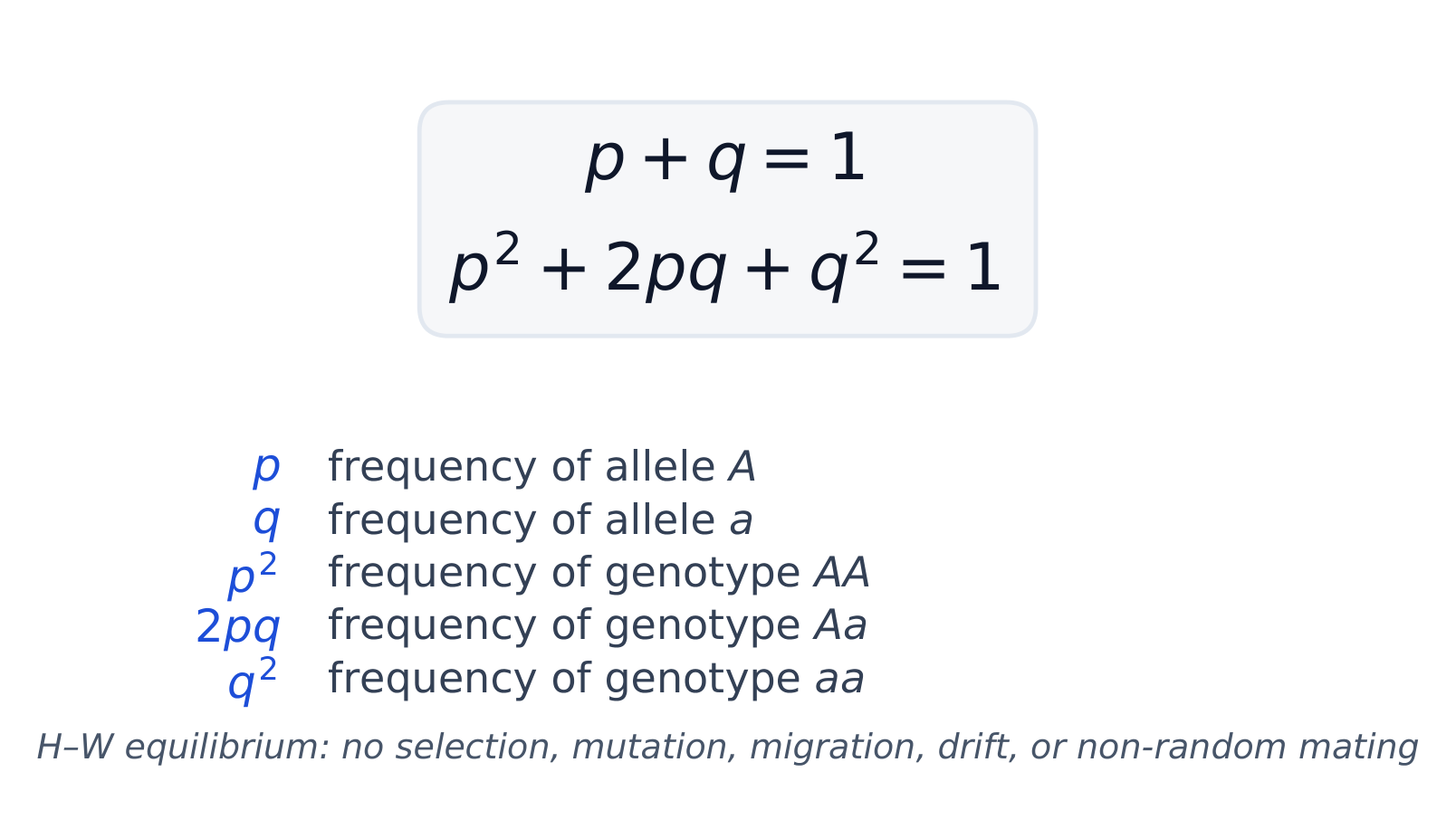
- p is the frequency of the dominant allele and q of the recessive allele, so p + q = 1.
- Genotype frequencies: p² + 2pq + q² = 1, where p² is homozygous dominant, 2pq is heterozygous (carriers) and q² is homozygous recessive.
Match each term to the group it describes.
난이도 2/5 · 140코인 + 오늘 첫 완료 시 작은 보너스 추가
The three genotype frequencies add up to 1.
Using the equation
- Start from q², the only group you can recognise by its phenotype. Take the square root to find q, then p = 1 − q.
- The equation assumes a large population, random mating, and no selection, migration or mutation. If real frequencies change over generations, one of these is happening — for example selection.
Worked example. Of 500 foxes, 45 show the recessive phenotype. How many are expected to be carriers?
- q² = 45 ÷ 500 = 0.09, so q = 0.3 and p = 1 − 0.3 = 0.7.
- Carriers: 2pq = 2 × 0.7 × 0.3 = 0.42, and 0.42 × 500 = 210 foxes.
16 % of a population shows a recessive phenotype. What is the frequency of the recessive allele, q?
난이도 2/5 · 140코인 + 오늘 첫 완료 시 작은 보너스 추가
q² = 0.16, so q = 0.4.
In a population of 1000, q = 0.2. How many people are expected to be carriers?
난이도 2/5 · 140코인 + 오늘 첫 완료 시 작은 보너스 추가
p = 0.8; 2pq = 2 × 0.8 × 0.2 = 0.32; 0.32 × 1000 = 320.
Which does the Hardy–Weinberg equation assume?
난이도 2/5 · 140코인 + 오늘 첫 완료 시 작은 보너스 추가
If frequencies change, one of the assumptions is broken.
Conserving species: zoos and seed banks
- Zoos run captive breeding programmes, keep records to avoid inbreeding, and can release animals back to the wild. Seed banks 种子库 store seeds cold and dry for many years.
- But captive animals may lose natural behaviour, and only a few individuals and a small part of the gene pool can be kept.
Captive breeding programmes keep records of which animals breed to avoid inbreeding.
난이도 1/5 · 100코인 + 오늘 첫 완료 시 작은 보너스 추가
This keeps as much genetic diversity as possible.
Conserving habitats
- Protecting habitats keeps whole communities and their interactions. Corridors 走廊 of habitat link separated areas so animals can move and populations can breed with each other.
- This needs land, money and agreement between governments and local people.
Do not start from p² or 2pq. You cannot tell homozygous dominant individuals from carriers by looking at them. Always begin with q², the recessive phenotype.
A niche is a species' role and needs; adaptations are anatomical, physiological or behavioural. Hardy–Weinberg: p + q = 1 and p² + 2pq + q² = 1; start from q² (recessive phenotype). It assumes no selection, migration or mutation. Zoos and seed banks protect species directly; habitat protection and corridors protect whole ecosystems.
Evaluate the use of seed banks to conserve plant species.
Evaluate means both sides.
어떤 문제가 있었나요? 사이트 팀만 이 내용을 볼 수 있습니다.