Climate change evidence, causes and effects
도입됨 10:46
단원 4: 에너지, 환경, 미생물학 및 면역
밀밭은 햇빛을 가리고 탄소를 고정하며 먹이사슬을 유지하지만, 모든 단계에서 에너지를 잃습니다. 이 단원은 광자부터 생태계까지의 에너지를 따라갑니다…
영어 내레이션 · 영어와 중국어 자막 전환 가능
이 수업의 내용
| English | 의미 |
|---|---|
| dendrochronology/ˌdendrəkrəˈnɒlədʒi/ | The study of tree-ring patterns to date wood and infer past environmental conditions. |
| enhanced greenhouse effect/enˈhænst ˈɡriːnhaʊs ɪˈfekt/ | Additional warming caused by increased greenhouse-gas concentrations strengthening the atmosphere's retention of outgoing infrared radiation. |
| global warming potential/ˈɡləʊbl ˈwɔːmɪŋ pəˈtenʃl/ | A measure comparing the warming effect of an emitted greenhouse gas with that of carbon dioxide over a specified time horizon. |
Spring is arriving earlier
- In many countries, trees now come into leaf and birds lay eggs days or weeks earlier than 50 years ago.
- Biologists use evidence like this, along with data from ice and trees, to study how the climate is changing and what it does to living things.
Evidence from the past
- Ice cores: air bubbles trapped in ice show the CO₂ concentration of the air thousands of years ago, and the ice itself shows past temperatures.
- Tree rings: wider rings form in warm, wet years (dendrochronology 树轮年代学). Pollen in peat bogs shows which plants grew, and so what the climate was like.
Match each source of evidence to what it shows.
난이도 2/5 · 140코인 + 오늘 첫 완료 시 작은 보너스 추가
Each gives a different record of the past climate.
The enhanced greenhouse effect
- The Earth's surface gives off long-wave (infrared) radiation. Carbon dioxide, methane and other greenhouse gases absorb it and re-emit some back towards the surface.
- Burning fossil fuels and cutting down forests add CO₂; farming and landfill add methane. More greenhouse gas means more warming: the enhanced greenhouse effect 温室效应.
Put the steps of the enhanced greenhouse effect in order.
난이도 3/5 · 200코인 + 오늘 첫 완료 시 작은 보너스 추가
Absorb and re-emit is the key mechanism.
Not all gases are equal
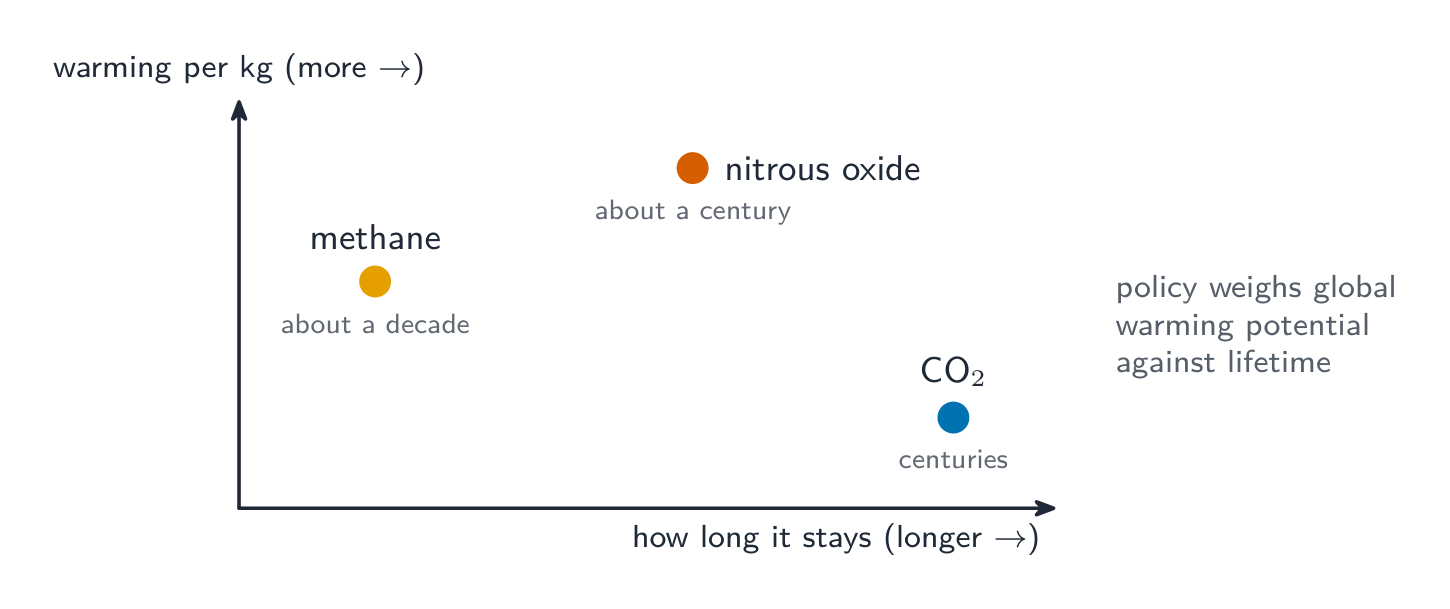
- Methane traps much more heat per kilogram than CO₂, but it lasts only about 12 years in the air. CO₂ is weaker per kilogram but lasts for centuries.
- Scientists compare gases using their global warming potential 全球增温潜势 over a fixed time, usually 100 years.
Methane traps more heat per kilogram than carbon dioxide but stays in the air for a much shorter time.
난이도 1/5 · 100코인 + 오늘 첫 완료 시 작은 보너스 추가
About 12 years, against centuries for CO₂.
Effects on living things
- Higher temperatures change the rate of enzyme reactions, so cold-blooded animals and plants develop at different rates. Rainfall patterns change, and species move towards the poles or up mountains.
- Timings can stop matching: if caterpillars appear earlier but birds still hatch at the old time, the young birds have less food.
Core practical 12: temperature and development
- Measure how temperature affects a process, for example how fast seedlings grow or brine shrimp eggs hatch, at five or more temperatures.
- Control light, water and the number of organisms. Calculate rates, and if asked, the temperature coefficient Q₁₀ = rate at (T + 10 °C) ÷ rate at T.
Worked example: Q₁₀. Brine shrimp eggs hatch at a rate of 12 per hour at 20 °C and 30 per hour at 30 °C.
- Q₁₀ = 30 ÷ 12 = 2.5.
- The rate more than doubles for a 10 °C rise, as expected for an enzyme-controlled process below its optimum.
Seedlings grow 4 mm per day at 15 °C and 9 mm per day at 25 °C. What is Q₁₀?
난이도 2/5 · 140코인 + 오늘 첫 완료 시 작은 보너스 추가
9 ÷ 4 = 2.25.
Reading trends with care
- Extrapolating a graph beyond its data assumes the trend will continue. State that assumption and say why it might fail.
- Correlation is not proof of cause: a rise in CO₂ and a rise in temperature over the same years support the link, and the physics of the greenhouse effect explains it.
What is the main weakness of extrapolating a temperature graph 50 years into the future?
난이도 1/5 · 100코인 + 오늘 첫 완료 시 작은 보너스 추가
Conditions such as emissions may change.
The greenhouse effect itself is natural and keeps the Earth warm enough for life. It is the enhanced greenhouse effect, from extra gases added by humans, that causes global warming.
Ice cores, tree rings and pollen show past climates. Greenhouse gases absorb and re-emit infrared radiation; extra CO₂ and methane from human activity enhance the effect. Methane is more potent but short-lived; CO₂ lasts for centuries. Warming changes enzyme rates, species ranges and timings. Q₁₀ compares rates 10 °C apart, and extrapolations must state their assumptions.
Explain how a rise in temperature could reduce the number of young birds that survive.
Link temperature to timing, then to food.
어떤 문제가 있었나요? 사이트 팀만 이 내용을 볼 수 있습니다.