본문 바로가기
과목

국제바칼로레이트 · IB Diploma · Classical Languages · SL

전체 어휘 연습
  • 1

    의미, 형식 및 언어 · 라틴어 형태론 및 번역

    곧 출시되는 학습 프로그램

    교재 자료

    English

    Scope and prerequisites

    IB classical languages first assessment 2024; Latin focus. This supplemental reference covers only the listed preparation outcomes. School selections, full-guide procedures and required live or recorded performance are separate.

    • Use cases and agreement to identify grammatical roles
    • Translate meaning accurately before refining English expression

    Prerequisites: Subject and object in English; basic present-tense verb endings.

    Explain and choose the method

    Puella is nominative singular and acts as subject; poetam is accusative singular and acts as object. Laudat is third-person singular present.

    Inflection carries grammatical information: first identify the finite verb 限定动词, then its subject and complements.

    Latin case 格 shows a noun's role. With these first-declension forms, -a is nominative singular and -am accusative singular. Use the supplied vocabulary: puella (girl), poeta (poet), fabula (story); laudat (praises), legit (reads), audit (hears). “Poetam puella laudat” has object poetam and subject puella: the girl praises the poet. “Poeta puellam laudat” reverses the roles: the poet praises the girl. Poeta is masculine despite its -a ending. First find the finite verb , then nouns agreeing with its number and the required cases. Do not apply these endings to every declension.
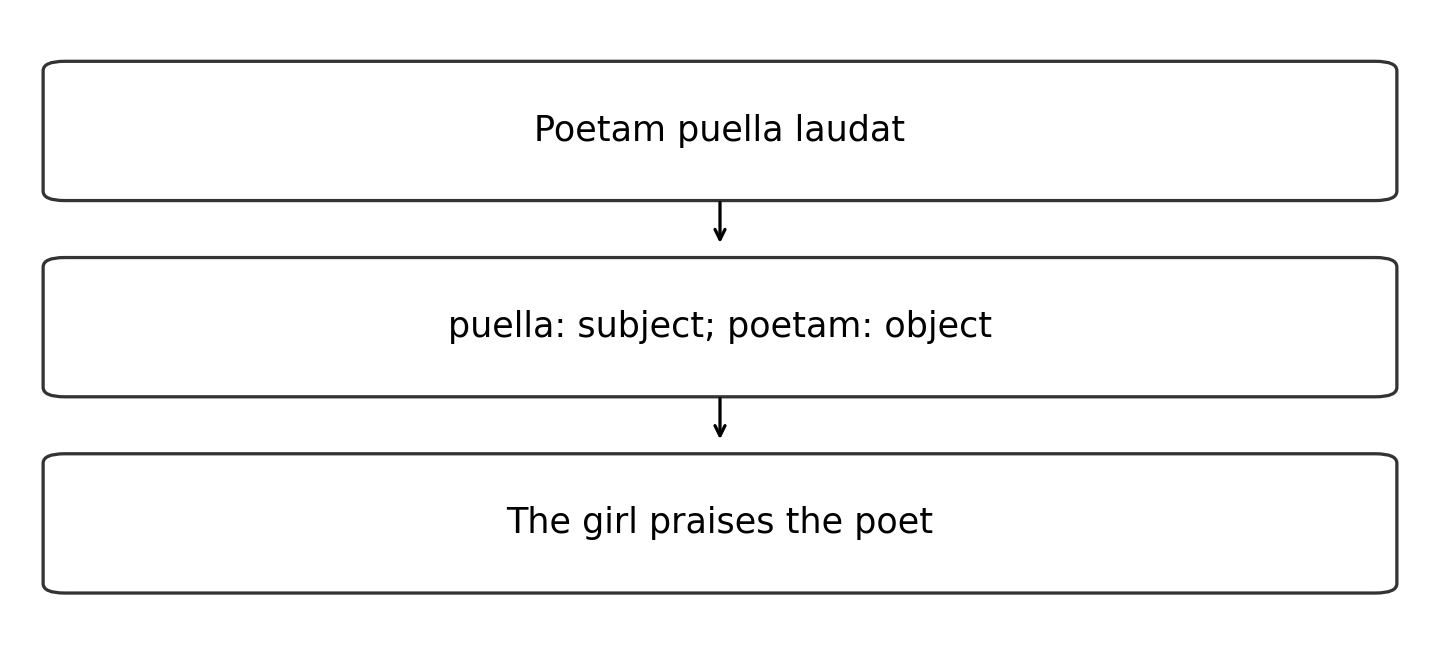
    Original diagram of the worked relationship; read the full wording and qualifications.
    Original diagram of the worked relationship; read the full wording and qualifications.

    Existing worked example: Poetam puella laudat keeps the same grammatical roles despite the new order. Translate as the girl praises the poet, then consider whether the changed position gives emphasis in a real passage.

    Complete original context

    Original Latin mini-passage: Puella fabulam legit. Poeta puellam audit. Puella poetam laudat. Poeta fabulam laudat. Vocabulary is supplied in the worked section. All four verbs are third-person singular present. No historical setting or emphasis is stipulated.

    Independent practice and checked reasoning

    Transfer 1

    Translate every sentence, identifying each subject and object.

    Reasoning: The girl reads the story (puella subject, fabulam object). The poet hears the girl (poeta subject, puellam object). The girl praises the poet (puella subject, poetam object). The poet praises the story (poeta subject, fabulam object). Retain all four relationships rather than making the first noun an automatic subject.

    Transfer 2

    Translate “Fabulam poeta legit”. Explain what changes and what does not if the order becomes “Poeta fabulam legit”.

    Reasoning: Both mean “The poet reads the story”. Nominative poeta and accusative fabulam retain their roles. Word order may influence emphasis in a fuller context, but no specific emphatic effect can be certified from this isolated exercise.

    Transfer 3

    A student translates “Poeta puellam audit” as “The girl hears the poet”. Diagnose and correct the error, then explain why poeta is not evidence 证据 that every -a noun is feminine.

    Reasoning: The student reversed grammatical roles. Poeta is nominative subject, puellam accusative object, so “The poet hears the girl”. Poeta is a masculine first-declension noun; grammatical gender must be learned with the noun, not inferred universally from the ending.

    Limits and next use

    Do not assume the first noun is the subject or invent a pronoun not implied by the verb. A dictionary entry is a starting point; case, number, tense and context determine the actual meaning.

    All tasks here are public original practice with authored guidance. They are not official questions or fresh diagnostics. Existing protected tests and mocks remain separate.

    Vocabulary card meanings

    case: A grammatical category showing what job a noun or pronoun does, rather than only the letters at its end.
    English 한국어
    finite verb/ˈfaɪnaɪt vɜːb/ 한정 동사
    evidence/ˈevɪdəns/ 증거
    case/keɪs/ 격
  • 2

    텍스트, 저자, 독자 · 라틴어 근본 독해 및 문학적 효과

    곧 출시되는 학습 프로그램

    교재 자료

    범위 및 전제 조건

    IB 고전 언어 첫 평가 2024; 라틴 집중. 이 보충 참고 자료는 나열된 준비 결과만 다룹니다. 학교 선택, 전체 가이드 절차 및 필수 실황 또는 녹화 Performance are separate.

    • 어휘, 구문 및 문학 양식을 의미와 연결하기
    • 정교한 라틴어 증거와 맥락적 지식을 통해 해석을 지지하기

    전제 조건: 제공된 어휘의 정확한 번역; 화자와 저자를 구분하기.

    방법 설명 및 선택

    근본 독해(close reading)는 가시적인 언어적 특징을 톤, 논증 또는 인물 묘사의 해석과 연결합니다.

    효과에 대한 논의를 하기 전에 관련 단어를 정확히 번역하십시오; 화자의 목소리와 저자의 의도를 구분하십시오.

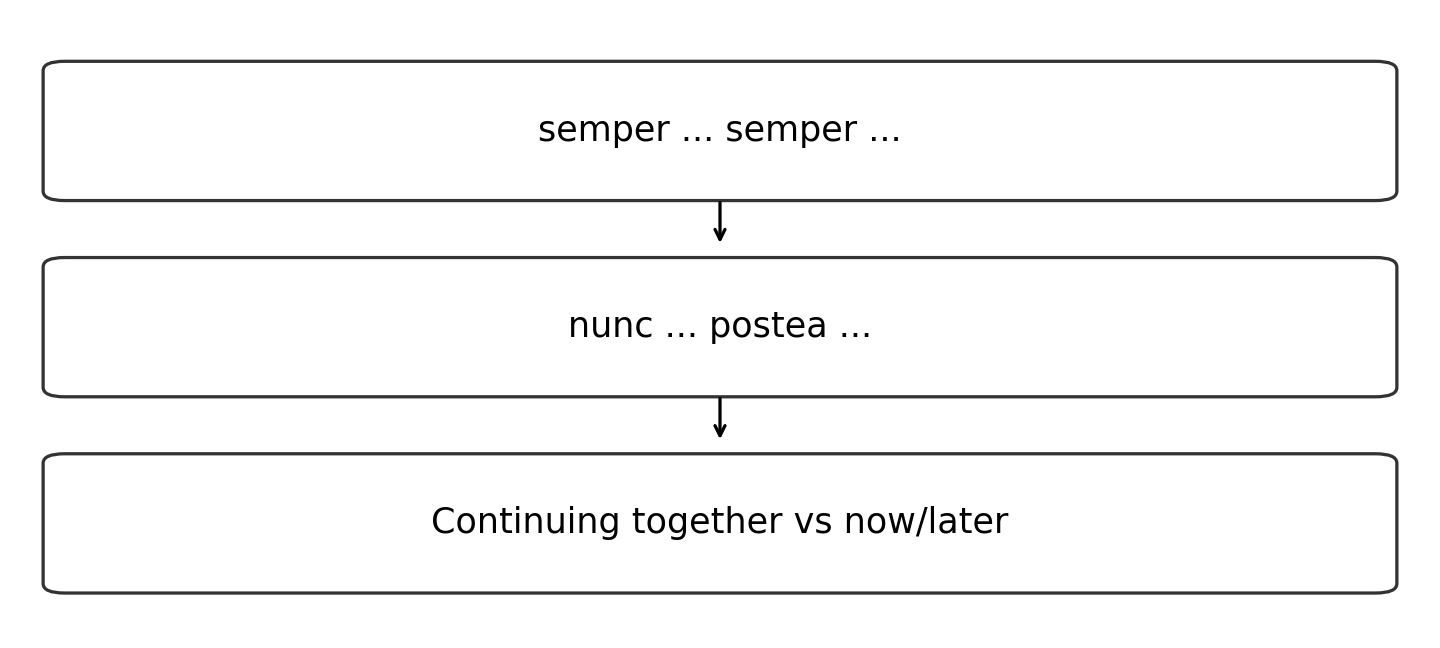
    어휘와 구문은 함께 의미를 구성한다. “Semper laborat, semper sperat”은 “항상 노력하며, 항상 희망한다”라는 뜻이다. 두 절 시작부에 반복되는 semper는 단구법(anaphora)이며, 두 가지 지속되는 행동을 연결한다. 그런 관계는 인내심을 지지하지만, 그것만으로 행복이나 성공, 혹은 특정 고대 작가의 신념을 증명할 수 있다.

    원본worked 관계 도식; 전체 문구 및 조건을 읽으십시오.
    원본worked 관계 도식; 전체 문구 및 조건을 읽으십시오.

    수행 예시: 교실 용어 “semper laborat, semper sperat”에서 반복되는 semper는 인내심을 강조한다: 항상 노력하며, 항상 희망한다. 평행 절이 단순히 텍스트를 흥미롭게 만드는 것보다 노고와 희망을 어떻게 연결하는지 설명하라.

    완전한 원문 맥락

    원문 라틴어 교실 쌍: A: Semper laborat, semper sperat. (항상 노력하며, 항상 희망한다.) B: Nunc laborat; postea sperat. (지금 노력하며; 나중에는 희망한다.) 어휘: semper = 항상; nunc = 지금; postea = 나중; laborat = 노력하다; sperat = 희망하다. 이들은 원문 산문 구문이다. 지정 인용구가 아니며, 격조적 주장은 하지 않는다.

    독립 연습 및 검증된 추론

    이양 1

    정교한 라틴어 증거를 사용하여 A와 B의 시간 조직을 비교하라.

    추론: A는 ‘semper’를 사용하여 현재 노동과 희망이 함께 지속됨을 보여줍니다. B는 ‘nunc’와 ‘postea’를 대조하여 이를 지금과 나중으로 구분합니다. 두 작품 모두 노동과 희망을 언급하지만, 시간적 관계가 다릅니다.

    이양 2

    ‘반복이 A의 생동감을 더한다’는 설명이 불완전한 이유를 설명하십시오. 더 포괄적인 해석 문장을 하나 제시하고 한 가지 제한점도 언급하십시오.

    추론: ‘ successive openings(연속적 시작)에서 ‘semper’를 반복하는 것은 지속되는 노동을 지속되는 희망과 연결하여, 단일한 완결된 노력보다는 인내심을 시사합니다.’ 이 구절은 노동자의最終成功, 감정 상태 또는 문화 전체의 가치를 명시하지 않습니다.

    이양 3

    평가 대상 텍스트의 격조(metre), 고대 청중 및 작가 의도를 분석하기 위해 추가적으로 어떤 증거가 필요합니까?

    추론: 실제 지정된 산문이나 시, 그 판본 및 맥락, 작성과 장르에 대한 증거, 그리고 적절한 언어학적 또는 격조지식입니다. 영어 의역문은 라틴어 격조를 입증할 수 없으며, 여기의 원문 구절들은 지정된 텍스트 증거로 대체될 수 없습니다.

    한계 및 향후 활용법

    이 원문 구절은 지정된 인용문이 아닙니다. 평가에 학교에서 승인한 핵심 및 보조 교재에서 실제 증거를 선택하십시오. HL(고급 수준)은 산문과 시를 모두 다뤄야 하며, 리듬 분석에는 영문 의역이 아닌 실제 시가 필요합니다.

    여기에 있는 모든 과제는 공식 질문이나 신규 진단이 아닌, 작성자 지침이 포함된 공개 원본 연습입니다. 기존 보호되는 시험 및 모의고사는 별도로 분류됩니다.

    어휘 카드 의미

    단어 반복: 강조를 위해 여러 구절의 시작에 동일한 단어를 사용하여 문장을 구성하는 수법.

    English 한국어
    close reading/kləʊs ˈriːdɪŋ/ 밀독
    translation/trænˈsleɪʃn/ 번역
    evidence/ˈevɪdəns/ 증거
    argument/ˈɑːɡjuːmənt/ 논증
    anaphora/ˈænəfɔːrə/ 초성 반복법
    diction/ˈdɪkʃn/ 어휘 선택
    syntax/ˈsɪntæks/ 문법
  • 3

    시간, 공간 및 문화; dossier · 고전 자료 및 연구 dossier

    곧 출시되는 학습 프로그램

    교재 자료

    English

    Scope and prerequisites

    IB classical languages first assessment 2024; Latin focus. This supplemental reference covers only the listed preparation outcomes. School selections, full-guide procedures and required live or recorded performance are separate.

    • Form a focused inquiry 聚焦探究 into Latin language or culture
    • Evaluate and annotate primary sources without claiming one genre represents all Romans

    Prerequisites: Research question; source origin, purpose and limits.

    Explain and choose the method

    A primary source 一手史料 comes from the world under investigation, but it does not give transparent access to every person's experience.

    An annotation 评注 should explain how the source answers the question, its context and a relevant limitation.

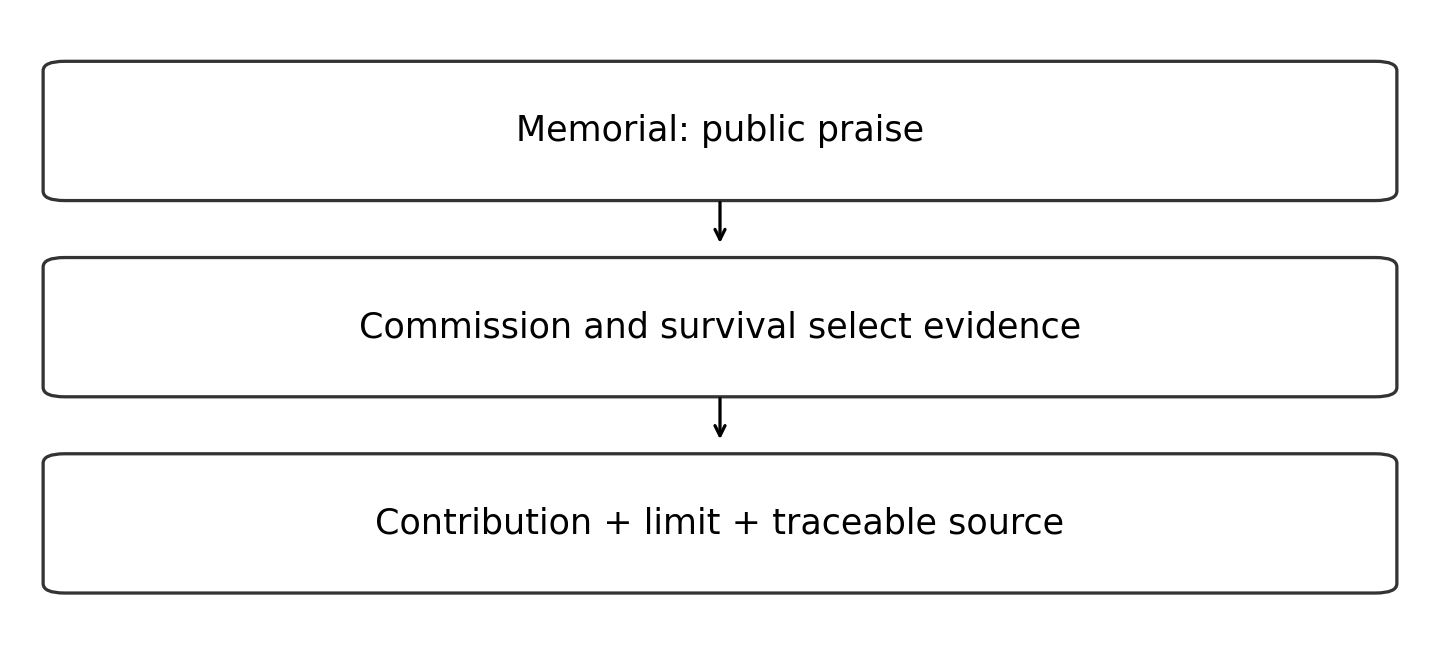
    A focused inquiry asks a bounded question that actual evidence 证据 can answer. “How does this household's memorial present generosity?” is more manageable than “What did all Romans believe?” An annotation identifies the source, explains its contribution and tests its limits. Separate an ancient object or text from its modern edition, catalogue and translation 翻译. Credit each accurately.

    Original diagram of the worked relationship; read the full wording and qualifications.
    Original diagram of the worked relationship; read the full wording and qualifications.

    Existing worked example: Ask how a particular commemorative practice represents family roles. Compare a bounded set of inscriptions with literary evidence and an object. Record exact location 位置, date range, text, translation source and why each item contributes to the inquiry.

    Complete original context

    Original simulated source cards for learning how to evaluate evidence, not ancient documents or a real dossier collection.

    Card A: A memorial inscription commissioned by one wealthy household, dated to a stated twenty-year interval by the supplied catalogue. The inscription praises a family member's generosity. The catalogue records the findspot but does not identify who wrote the wording. Card B: A satirical poem by an elite writer, preserved in a later manuscript. Its speaker exaggerates a dinner host's behaviour for comic effect. The supplied edition identifies the passage and translation, but the speaker is not automatically the author. Card C: A worn household vessel from an excavated domestic room. The excavation record gives its layer and measurements. No owner name or inscription survives.

    These descriptions deliberately omit actual inventory numbers, dates and Latin text. They can support method practice only. An assessed dossier needs real, traceable primary materials and the school's approved source selection, with accurate editions and translation credits.

    Independent practice and checked reasoning

    Transfer 1

    Choose a bounded inquiry for Card A and write a model annotation using only its supplied information.

    Reasoning: Inquiry: “How does the household's memorial represent generosity?” Annotation: “Card A presents generosity as a quality worth commemorating, so it can illuminate the household's public representation of the deceased. Commissioning and praise may select favourable qualities; the inscription does not independently verify every act or represent all social groups. Its twenty-year dating interval limits precise chronological claims. Before assessed use, replace this simulated card with the actual inscription, catalogue number, location, text and credited translation.”

    Transfer 2

    Compare one useful contribution and one limitation of Cards B and C for investigating dining practices.

    Reasoning: B may illuminate an elite literary representation of a host, but satire and speaker exaggeration limit literal reporting. C can illuminate a vessel's material form and excavated context, but no named owner or stated use survives. Corroborate any dining interpretation rather than assigning a personal story to the object.

    Transfer 3

    Explain why collecting attractive images and treating a modern translation as an ancient author are weak methods. State the exact next step before using these cards in a real dossier.

    Reasoning: Images without traceable identity, context and relevance 相关性 cannot support the inquiry; a translator's choices are modern mediation of an ancient text, not the ancient author. Obtain teacher-approved real primary sources, exact identifiers, dates, editions and translation credits, then compare their evidence and limitations. These simulated cards are not an assessed source collection.

    Limits and next use

    The dossier requires seven to nine primary source materials plus an inspiration source. Teacher checks full-guide details. Do not submit a scrapbook of attractive images or treat modern translation as an ancient source in its own right.

    All tasks here are public original practice with authored guidance. They are not official questions or fresh diagnostics. Existing protected tests and mocks remain separate.

    Vocabulary card meanings

    primary source: Evidence that comes from the time itself, not from a later retelling. annotation: A brief comment added to a text by the reader or editor.

    English 한국어
    focused inquiry 집중 탐구
    primary source/ˈpraɪməri sɔːs/ 일차 자료
    translation/trænˈsleɪʃn/ 번역
    annotation/ˌænəˈteɪʃn/ 주석
    relevance/ˈrelɪvəns/ 관련성
    evidence/ˈevɪdəns/ 증거
    location/ləʊˈkeɪʃn/ 위치

로그인 또는 계정 만들기

IGCSE, A-Level & AP