What this module is, and how it is marked · 이 모듈의 구성 및 채점 기준
English
GAC022 is the Level III business module. It takes what GAC012 established about one firm in one
country and asks what changes when the firm crosses a border.
Assessment mirrors GAC012 — a test, a research task 研究任务 on an international business,
a report or presentation, and coursework — but the standard expected of the analysis is higher.
A Level III report is judged on whether the evidence supports the judgement, not on whether the
sections are present.
⚠ Write about a real international firm with sources you can cite. A generic essay about
globalisation scores badly however well written.
Use the technical term the question uses: tariff 关税, exchange rate 汇率, joint
venture 合资企业. A correct idea in everyday words often loses the mark.
한국어
GAC022는 Level III 비즈니스 모듈이다. GAC012가 한 국가의 한 기업에 대해 확립한 내용을 바탕으로,
기업이 국경을 넘을 때 어떤 변화가 발생하는지 묻는다.
평가 방식은 GAC012와 유사하다 — 국제 비즈니스에 대한 시험, 연구 과제,
보고서나 발표, 그리고 coursework — 하지만 분석에 요구되는 수준은 더 높다.
Level III 보고서는 증명이 판단을 지지하는지에 따라 평가되며, 단락이 존재하는지에 따라 평가되지 않는다.
단락이 있는가 없는가에 따라 점수를 매기는 것이 아니다.
⚠ 인용 가능한 출처를 가진 실제 국제 기업에 대해 작성하라. 보편적인 논문에
글로벌화에 대한 서술은 문장이 아무리 훌륭해도 낮은 점수를 받기 쉽다.
문제에서 사용한 전문 용어를 사용하라: 관세(tariff), 환율(exchange rate), 합작사업(joint
venture). 일상 언어로 표현된 올바른 아이디어도 종종 감점 대상이 된다.
Introduction to international business · 국제 비즈니스 introduction
Syllabus
Unit 1 of 5 in GAC022 Business III: International Business Studies (Level III). The module is taught over about 40 class hours plus 20 hours of independent study, and is assessed at the teaching centre and moderated by ACT — there is no external exam.
Module purpose: On completion of this module, students should be able to demonstrate an understanding of international business and the impact of globalisation.
The module outcomes this unit works towards:
Learning Objective GAC022.1: Describe and analyse key concepts around globalisation.
Source: Cambridge International syllabus · 출처: Cambridge International syllabus
English
International business 国际商务 is commercial activity that crosses national borders, and
globalisation 全球化 is the process that has made it ordinary.
Firms go abroad to reach markets 市场, to lower costs 成本, or to secure resources资源.
Exporting 出口 is the lowest-commitment route; licensing 许可经营 and franchising特许经营 use a local partner's money; a joint venture shares ownership; a subsidiary子公司 is full control and full risk.
Globalisation is contested on purpose. It has moved hundreds of millions out of poverty and it
has moved industries out of towns, and a Level III answer says both.
Worked example. A Chinese appliance maker wants to sell in Germany.
Export means the lowest cost and the least control. Joint venture buys local knowledge and
distribution, and shares the profit. Subsidiary keeps all the profit and carries all the
risk, including a legal system the firm does not know.
The mark is for choosing one and justifying it against the firm's actual position — not for
listing all three.
한국어
**국제 비즈니스(international business)**는 국경 너머로 이루어지는 상업 활동이며,
**글로벌화(globalisation)**는 이를 일상이 만든 과정이다.
기업들은 **시장(market)**에 접근하거나, **비용(cost)**을 낮추거나, **자원(resource)**을 확보하기 위해 해외로 진출한다.
.
**수출(exporting)**은 가장 적게 참여하는 경로이며, **라이선싱(licensing)**과 프랜차이즈(franchising)
현지 파트너의 자금을 활용합니다; **합작사업(joint venture)**은 지분을 공유하고; **자회사(subsidiary)
완전한 통제와 완전한 위험을 의미한다.
글로벌화는 의도적으로 논쟁의 대상이 되었다. 수억 명의 people를 빈곤에서脱出시켰고它
산업들을 도시에서 이동시켰으며, Level III 답안은 이 두 가지 모두를 언급해야 한다.
해설 예시. 중국 가전 제조사가 독일 시장에서 판매를 원한다.
수출은 가장 낮은 비용과 최소한의 통제를 의미한다. 합작사업은 현지 지식과
유통망을 구매하고 수익을 공유한다. 자회사는 모든 수익을 유지하고 모든 위험을 감수하며, 기업이 알지 못하는 법적 시스템까지 포함한다.
법적 시스템까지 포함한다.
점수는 하나를 선택하여 해당 기업의 실제 상황에 맞춰 정당화할 때 부여되며, 세 가지 모두 나열할 때는 부여되지 않는다.
세 가지 모두를 나열할 때는 점수가 주어지지 않는다.
External influences: international economics · 외부 영향: 국제 경제
Syllabus
Unit 2 of 5 in GAC022 Business III: International Business Studies (Level III). The module is taught over about 40 class hours plus 20 hours of independent study, and is assessed at the teaching centre and moderated by ACT — there is no external exam.
The module outcomes this unit works towards:
Learning Objective GAC022.2: Demonstrate and apply an understanding of the external factors impacting on the development of international business.
Source: Cambridge International syllabus · 출처: Cambridge International syllabus
English
Exchange rates decide what a price abroad is worth at home. A weaker home currency makes
exports cheaper and imports dearer.
A tariff is a tax on imports; a quota 配额 is a limit on their quantity. Both protect
domestic producers and raise prices for domestic consumers.
A trade bloc 贸易集团 removes barriers between members and keeps them against outsiders.
The balance of trade 贸易差额 is exports minus imports.
Worked example. The home currency falls by 10% against the euro.
An exporter's goods now cost a German buyer 10% less, so demand rises. But imported components
cost 10% more, so the margin narrows. Whether the firm gains depends on how much of its input
it imports — and that dependency is the analysis the question wants.
한국어
**환율(exchange rates)**은 해외 가격의 자국 내 가치를 결정한다. 자국 화폐가 약해지면
수출품은 저렴해지고 수입품은 비싸진다.
**관세(tariff)**는 수입품에 부과되는 세금이며, **할당(quota)**은 수량 제한이다. 둘 다
국내 생산자를 보호하고 국내 소비자에게 가격을 인상시킨다.
무역 bloc은 회원국 간 장벽을 제거하고 외부인에 대해서는 장벽을 유지한다.
**통상 수지(balance of trade)**는 수출액 minus 수입액이다.
해설 예시. 자국 화폐가 유로화 대비 10% 하락했다.
수출업체의 상품의 가격이 독일 구매자에게 10% 저렴해져 수요가 증가한다. 그러나 수입 부품
가격이 10% 상승하므로 마진이 좁아진다. 기업이 이익을 보는지 여부는 Inputs의多少에 달려 있으며 — 그 종속성이 문제가 원하는 분석이다.
그 종속성이 문제가 원하는 분석이다.
Unit 3 of 5 in GAC022 Business III: International Business Studies (Level III). The module is taught over about 40 class hours plus 20 hours of independent study, and is assessed at the teaching centre and moderated by ACT — there is no external exam.
The module outcomes this unit works towards:
Learning Objective GAC022.2: Demonstrate and apply an understanding of the external factors impacting on the development of international business.
Learning Objective GAC022.5: Demonstrate investigative and analytical skills for a business research task.
Source: Cambridge International syllabus · 출처: Cambridge International syllabus
English
Political risk 政治风险 is the chance that a government's action changes the value of an
investment: expropriation, capital controls, sanctions, a changed tax regime.
Legal systems 法律体系 differ in contract enforcement and in intellectual property知识产权 protection.
Ethics 商业伦理 travels badly: what is legal in one market may be unacceptable to customers
in another, and a firm is judged in both.
Corporate social responsibility 企业社会责任 is a firm accepting obligations beyond the
legal minimum, and it is now a real factor in access to Western markets.
한국어
**정치적 리스크(political risk)**는 정부의 행동이 투자 가치에 영향을 줄 가능성이다: 국유화, 자본 규제, 제재, 세제 변경 등.
투자 위험: 국유화, 자본 통제, 제재, 세제 변경.
법체제는 계약 이행 및 지식재산권 보호에서 상이함.
보호.
윤리는 국가마다 다름: 한 시장에서는 합법적이더라도 다른 시장의 고객에게는 용납되지 않을 수 있으며, 기업은 두 시장에서 모두 평가받음.
평가받음.
기업의 사회적 책임(CSR) 은 기업이 현재 제시된 결과 이상으로 의무를 수용하는 것임.
법적 최소 요건 이상의 의무를 accept하는 것이며, 이는 현재 서구 시장 진입의 중요한 요소가 되었다.
Corporate social responsibility/ˈkɔːpərət ˈsəʊʃl rɪˌspɒnsəˈbɪlɪti/
企业社会责任(Corporate social responsibility)
3.4
Internal influences on international business · 국제 비즈니스에 미치는 내부 영향
Syllabus
Unit 4 of 5 in GAC022 Business III: International Business Studies (Level III). The module is taught over about 40 class hours plus 20 hours of independent study, and is assessed at the teaching centre and moderated by ACT — there is no external exam.
The module outcomes this unit works towards:
Learning Objective GAC022.3: Demonstrate, evaluate and apply an understanding of the internal factors which contribute to successful international business interactions.
Source: Cambridge International syllabus · 출처: Cambridge International syllabus
English
Organisational structure must answer to two masters: the product line and the region.
Staffing 人员配置 abroad chooses between sending home-country managers, hiring locally, or
both — each trades control against local knowledge.
Standardisation 标准化 keeps one product for every market and is cheaper;
adaptation 本地化 changes it per market and sells better.
Supply chain 供应链 length is a strategic choice. Long chains are cheap and fragile, as
every firm relearned recently.
한국어
**조직 구조(organisational structure)**는 제품 라인(region)과 지역(region)이라는 두 주체에게 accountability를 가져야 한다.
인사 배치(staffing) abroad는 자국 관리자를 파견하거나, 현지 인재를 채용하거나, 또는
둘 다 하는 것 사이에서 택한다 — 각 방법은 통제력을 현지 지식과 exchange한다.
**표준화(standardisation)**는 모든 시장에 동일한 제품을 유지하여 저렴하게 하고,
**적응(adaptation)**은 시장별로 변경하여 더 잘 판매되게 한다.
공급망(supply chain) 길이는 전략적 선택이다. 긴 공급망은 저렴하지만 취약하다, 모든 기업이 최근 다시 배운 바 있다.
모든 기업이 최근 다시 배운 바 있다.
International marketing and culture · 국제 마케팅 및 문화
Syllabus
Unit 5 of 5 in GAC022 Business III: International Business Studies (Level III). The module is taught over about 40 class hours plus 20 hours of independent study, and is assessed at the teaching centre and moderated by ACT — there is no external exam.
The module outcomes this unit works towards:
Learning Objective GAC022.4: Apply knowledge of marketing strategies to international business contexts.
Learning Objective GAC022.6: Communicate information using appropriate formats and language for business.
Source: Cambridge International syllabus · 출처: Cambridge International syllabus
English
Culture shapes what a product means, not only whether it is wanted. Colour, number and
imagery all carry local meaning.
Brand 品牌 names do not always survive translation, and a name that is unpronounceable in
a market is a real cost.
The marketing mix must usually be adapted: price to local incomes, place to local retail,
promotion to local media and local norms.
⚠ Market research abroad is harder and more necessary. Assuming your own market's
preferences is the error the whole unit exists to prevent.
Worked example. A snack brand enters a market where its flagship flavour is unfamiliar.
Standardise: one product, one factory, lowest cost — and slow sales.
Adapt: a local flavour, a smaller pack for local retail, promotion through the platform people
actually use — higher cost, and a market.
Most firms do both: a standard core with adapted edges. Saying which parts to standardise and
which to adapt, with a reason for each, is the Level III answer.
한국어
**문화(culture)**는 제품이 원하는지 여부뿐만 아니라 그 의미를 형성한다. 색상, 숫자 및
이미지에는 모두 현지적 의미가 담겨 있다.
브랜드명은 번역을 거치며 살아남지 않기도 하며, 시장에서 발음할 수 없는 이름은 실질적인 비용이 된다.
발음할 수 없는 이름은 실질적인 비용이 된다.
**마케팅 믹스(marketing mix)**는 일반적으로 적응되어야 한다: 가격에 현지 소득, 장소에 현지 소매업, 홍보에 현지 미디어 및 현지 규범 등.
현지 소득, 장소에 현지 소매업, 홍보에 현지 미디어 및 현지 규범 등.
⚠ 시장 조사(market research) abroad는 더 어렵고 필수적이다. 자신의 시장의
선호도를 가정하는 것은 이 단원이的存在 purpose를 방지하려는 오류이다.
해설 예시. 스낵 브랜드가 자사의 메인 플레버가 familiarity하지 않은 시장에 진입한다.
표준화: 하나의 제품, 하나의 공장, 최저 비용 — 그리고 느린 매출.
적응: 현지 플레버, 현지 소매를 위한 작은 포장, 사람들이 실제로 사용하는 플랫폼을 통한 홍보 — 높은 비용, 그리고 시장.
높은 비용, 그리고 시장.
대부분의 기업은 둘 다 수행한다: 표준화된 코어와 적응된 에지. 어느 부분을 표준화하고
어느 부분을 적응할지, 그리고 각각에 대한 이유를 제시하는 것이 Level III 답안이다.
Start with a cross-border decision and its evidence
Bright Kettle is an invented appliance maker. It wants to sell in a new overseas market.
Its managers must choose an entry method, price and delivery plan.
These examples are practice data, not current exchange rates, tariffs or company accounts.
A real-company research task needs real evidence. The final section shows how to begin that investigation.
Globalisation 全球化 links markets, production, finance and information across borders.
International business includes goods, services and investment across national borders.
A firm may seek new customers, lower costs, skills or reliable resources.
Explain which reason matters in the actual case. Going abroad does not guarantee any of these benefits.
Effects differ across groups. Customers may gain choice, while some workers face job changes.
Suppliers may gain orders but become more dependent on one buyer.
Owners may gain a market but face unfamiliar rules, costs and competition.
Describe a mechanism and evidence, rather than calling every effect good or bad.
A country's total gain does not mean every household or place gains equally.
Compare entry methods against the firm's position
Exporting 出口 supplies customers abroad from another country.
Direct exporting and using a distributor can involve different commitments and customer contact.
It can avoid owning a foreign factory, but transport, after-sales service and compliance still cost money.
Licensing 许可经营 allows another business to use agreed rights, such as technology, under a contract.
Franchising 特许经营 usually includes an agreed business format and brand, with continuing obligations.
These arrangements can use a partner's resources. They also need quality checks and protection of the agreed rights.
A joint venture 合资企业 involves shared ownership of a venture.
A wholly owned subsidiary 全资子公司 is fully owned by the parent company.
A subsidiary does not always mean full ownership; the phrase "wholly owned" makes that assumption explicit.
More ownership can provide more control, but contracts, staff, law and customers still affect actual control.
Method
Possible advantage for Bright Kettle
Cost or risk to check
Export through a distributor
Test demand without owning a local factory
Delivery, distributor service and less direct customer contact
Licence a partner
Use local production resources
Quality, contract enforcement and technology protection
Joint venture
Share local knowledge, resources and investment
Disagreement over decisions and sharing returns
Wholly owned subsidiary
Direct ownership of the local activity
Larger commitment, management demands and unfamiliar rules
Suppose Bright Kettle has limited funds and no evidence of repeat overseas demand.
A bounded export trial may fit better than building a subsidiary immediately.
The distributor must be checked for service, reporting and contract terms.
If demand becomes established, compare the next options again. One method is not always cheapest or best.
State the exchange-rate quote before calculating
An exchange rate 汇率 tells you how much of one currency buys another.
Always state the direction of the quote. Percentages for opposite quotes are not identical.
Use fictional home currency H. Initially one euro buys 10 H; later one euro buys 11 H.
The H-per-euro quote rises by 10%. The value of one H in euros falls from 0.10 to about 0.09091.
That is a fall of about 9.09%, not 10%.
$$\text{H per euro increase}=\frac{11-10}{10}\times100=10\%$$
$$\text{euro per H decrease}=\frac{0.10-1/11}{0.10}\times100\approx9.09\%$$
If Bright Kettle keeps its home-currency price at 1,000 H:
$$\text{euro price}=\frac{\text{home price in H}}{\text{H per euro}}$$
$$\text{old euro price}=1\,000\div10=100\text{ euros}$$
$$\text{new euro price}=1\,000\div11\approx90.91\text{ euros}$$
This may help price competitiveness. It does not prove demand rises.
Competitors, customer preferences and the final retail price also matter.
The seller or distributor may change its price instead of passing on the full exchange-rate change.
An imported component priced at 40 euros costs 400 H initially, then 440 H.
Imported costs may offset some benefit from overseas sales.
Contracts, invoice currency and payment dates change how quickly the effect appears.
Compare two pricing choices and their margins
Assume each kettle uses the 40-euro imported component plus 500 H of other variable costs.
Ignore delivery, fixed costs, tax and all other charges in this calculation.
Contribution 边际贡献 is sales revenue minus variable cost. It is not final profit.
Before the exchange-rate change, a 100-euro sale brings 1,000 H.
The component costs 400 H, leaving contribution of 100 H.
$$\text{old contribution}=1\,000-400-500=100\text{ H per kettle}$$
Choice A keeps the euro invoice at 100. It now brings 1,100 H, with component cost 440 H.
$$\text{A contribution}=1\,100-440-500=160\text{ H per kettle}$$
Choice B keeps the home price at 1,000 H. Its euro price falls to about 90.91.
$$\text{B contribution}=1\,000-440-500=60\text{ H per kettle}$$
A has higher contribution per kettle in this simplified model. B gives the buyer a lower euro price.
Total contribution also depends on quantity sold. Compare demand evidence before choosing.
A currency change does not mechanically make the buyer's price fall or the seller's profit rise.
Analyse trade barriers and other external influences
A tariff 关税 is a tax on imported goods.
A quota 配额 limits an import quantity or value under specified rules.
Their effects depend on the product, policy, market and who absorbs the extra cost.
Domestic producers may face less import competition; consumers may pay more or have fewer choices.
Firms using imported inputs may face higher costs too.
For a fictional 10% tariff on a stated customs value of 120 euros:
$$\text{value plus tariff}=120+12=132\text{ euros}$$
This excludes freight and any other taxes or charges. It is not a real country's import calculation.
A quota allowing 500 units would constrain a 600-unit import plan under those assumptions.
Check how rights to import are allocated; a market-wide quota is not every firm's personal allowance.
A free-trade area 自由贸易区 removes agreed barriers between members for qualifying trade.
Members can keep different external tariffs. A customs union 关税同盟 has a common external tariff arrangement.
Do not assume every trade agreement removes every barrier or uses identical rules against outsiders.
The product, origin rules and actual agreement must be checked in a real case.
For this exercise, define the goods trade balance as goods exports minus goods imports.
State the definition, currency and period when comparing data. Exports of 80 and imports of 95 give a deficit of 15.
That economy-wide figure is not Bright Kettle's own profit or evidence that every exporter is losing money.
Other external influences include political decisions, law, technology, income and social expectations.
Political risk 政治风险 concerns government action or instability affecting the business.
Intellectual property 知识产权 includes protected rights such as patents and trademarks.
Check the relevant jurisdiction's current official rules for a real product or contract.
Do not copy one country's requirements into another market.
Corporate social responsibility 企业社会责任 concerns a firm's responsibilities and effects on society.
Legal compliance and ethical judgement answer different questions.
A supplier policy is evidence of a stated policy, not proof that every supplier follows it.
Use records and checks to examine working conditions, product safety or waste claims.
Connect internal organisation to overseas delivery
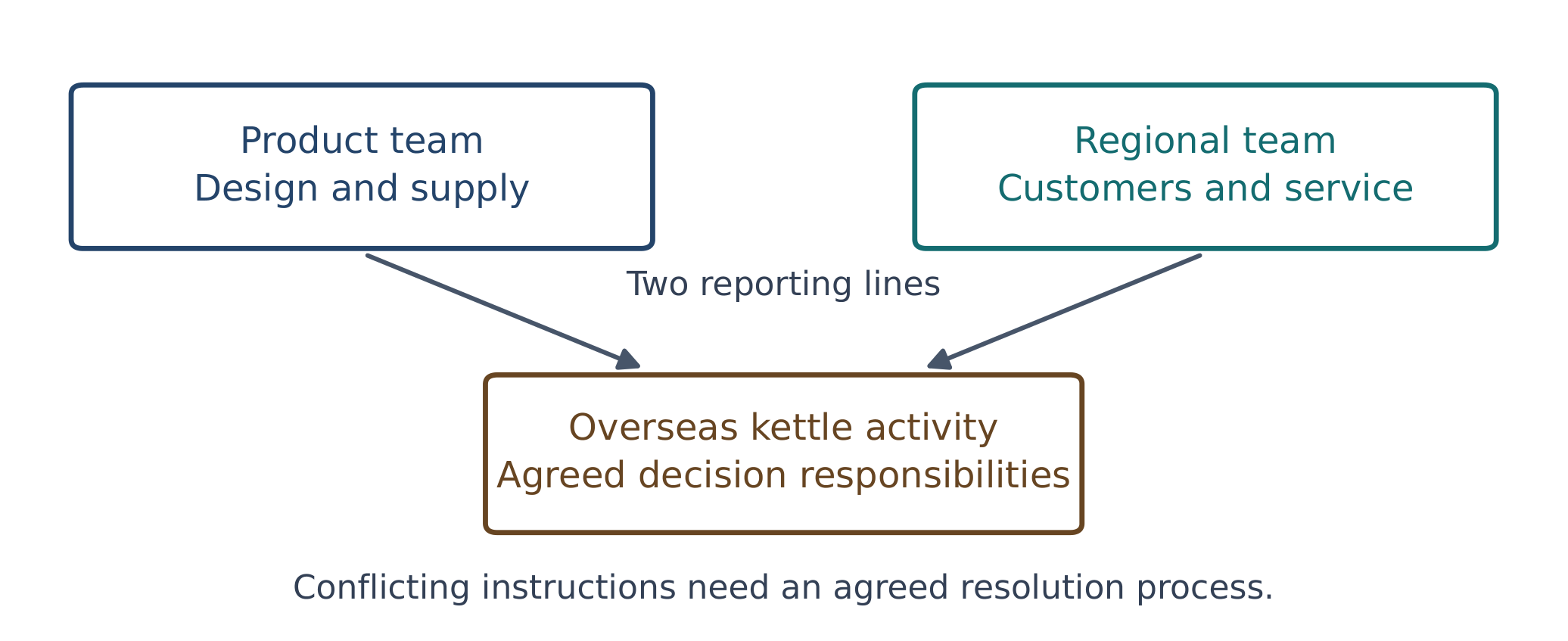
Bright Kettle must decide who has authority over price, design, supply and local service.
A product team understands the kettle; a regional team understands local customers and distribution.
A matrix structure 矩阵式结构 can combine these reporting lines, but conflicting instructions need a resolution process.
Choose a structure by its coordination needs, rather than assuming a label guarantees success.
Agree how decisions will be resolved when the two teams disagree.
Sending experienced home-country managers can help transfer routines.
Hiring local managers can improve language skills and knowledge of customers and operating rules.
A mixed team needs clear responsibilities, training and ways to resolve disagreements.
Avoid assuming nationality alone determines competence or values.
Standardisation 标准化 keeps agreed features consistent across markets.
Adaptation 本地化 changes features for a particular market.
Bright Kettle could keep a tested core design while checking local safety, power, instructions and service needs.
Adaptation can add cost; it does not automatically improve sales.
Standardisation can reduce some costs; it does not guarantee the product fits every market.
A supply plan must consider lead times, quality, stock, transport and alternative sources.
For example, two weeks of stock with a four-week replacement lead time may leave a gap after disruption.
An alternative supplier must be checked, not merely named. Its quality, capacity and delivery may differ.
Long and short supply chains both have costs and risks; length alone does not establish reliability.
Build an international marketing proposal without stereotypes
Define a reachable customer group and research its actual needs.
Do not treat every person in a country as having the same taste or income.
Translate and test names, instructions and promotions with suitable readers.
Check meaning, clarity and legal requirements rather than guessing from a colour or number.
Marketing choice
Proposal for the fictional kettle trial
Evidence needed
Product
Tested core with suitable instructions and local requirements checked
Customer use, safety and service needs
Price
Compare invoice currency, costs and competing offers
Suitable alternatives and willingness to pay
Place
A checked distributor with service arrangements
Coverage, delivery and after-sales records
Promotion
Clear claims in language customers understand
Comprehension, actual response and claim support
Run a permitted limited trial and measure paid orders, returns, complaints and contribution.
A favourable survey is not the same as repeat purchases.
Compare actual results with assumptions before expanding.
Keep any real-country compliance decision separate from this fictional teaching proposal.
Investigate a real company and communicate a supported judgement
Choose a narrow research question, a real firm, a period and relevant markets.
For example: how do overseas production arrangements affect a firm's control and supply risk?
Keep a source log with author, document, date, section and the claim it supports.
Separate reported facts, your analysis and untested assumptions.
Apple's Form 10-K for the year ended 27 September 2025 is one dated primary source.
Its Item 1 describes five geographic reporting segments, with similar offers managed separately for regional markets.
Its Item 1A discusses dependence on manufacturing and logistics partners outside the United States.
The firm identifies a tradeoff between lower operating costs and less direct control of production and distribution.
These are reported arrangements and risk statements, not proof that a particular disruption happened.
A supported interpretation is that partner arrangements need coordination and monitoring.
That inference follows the disclosed control issue. It does not establish which entry method is best in a new market.
Find additional evidence before recommending a change. An annual report alone does not prove every marketing or supplier claim.
Check definitions: a geographic reporting segment is not necessarily one country or one production site.
Use an appropriate business report: purpose, method, findings, analysis, recommendation, limitations and sources.
In a presentation, use readable evidence, clear units and concise explanations linked to the decision.
An evidence-based recommendation names a tradeoff, supporting facts, remaining uncertainty and a review condition.
Use the actual centre brief for required formats and assessed depth.
Practice and explained answers
Give two possible reasons for Bright Kettle to enter a foreign market. Explain a risk for each.
Choose an initial entry method for the limited-funds, untested-demand case. Give one condition and one drawback.
Calculate the new euro price of a 1,000-H kettle when the quote changes from 10 to 11 H per euro.
Explain why a 10% rise in H per euro is not a 10% fall in euros per H.
Calculate the imported component cost at both rates and the contribution for pricing choices A and B.
Why does choice A's higher contribution per kettle not prove higher total contribution?
Calculate the fictional tariff. Explain two groups that could be affected differently.
Distinguish a free-trade area from a customs union without assuming all trade is unrestricted.
Explain how regional and product teams could resolve a disagreement over an adaptation.
Identify a supply risk in the stock/lead-time example and a checked response.
Explain one conclusion supported by Apple's dated risk disclosure and one conclusion it does not prove.
Outline a real-company research report and a recommendation that names its evidence limits.
Explained answers
Answer 1. New customers may increase sales, but demand and competition remain uncertain.
A new source may reduce input costs, but quality or delivery may differ. Explain conditions, not guarantees.
Answer 2. A limited export trial can test demand with less ownership commitment than a new subsidiary.
Check the distributor and terms first. A drawback is less direct control of service and customer information.
The best method depends on actual costs, resources and objectives.
Answer 3. The new price is 1,000 divided by 11, or about 90.91 euros.
The home price is fixed in this calculation, and other charges are ignored.
Answer 4. Opposite quotes use different starting values.
The euro value of H falls from 0.10 to 1/11, giving a fall of about 9.09%.
Answer 5. The component rises from 400 H to 440 H.
A gives 1,100 minus 440 minus 500, or 160 H contribution.
B gives 1,000 minus 440 minus 500, or 60 H contribution.
These exclude the stated other costs and are not final profit.
Answer 6. Total contribution equals contribution per unit times quantity.
A higher price to the buyer could reduce orders. Use demand evidence rather than assume equal volumes.
Answer 7. The tariff is 12 euros; value plus tariff is 132 before other charges.
Domestic producers may face less import competition, while buyers or firms using imported inputs may pay more.
Who absorbs the charge affects the result.
Answer 8. A free-trade area's members can have different external tariffs.
A customs union has a common external tariff arrangement. Actual product coverage and origin rules still matter.
Answer 9. Specify which team decides safety, design and market matters, with an agreed escalation process.
Compare customer evidence, costs and applicable requirements before choosing. A matrix label alone does not resolve conflict.
Answer 10. Two weeks of stock may run out before a four-week replacement arrives.
Check an alternative source or a justified stock change, including cost, quality and capacity.
Do not assume an untested alternative can supply immediately.
Answer 11. The disclosure supports investigating coordination and partner-control risk.
It does not prove that a particular disruption occurred or that a subsidiary is the best response.
Keep the reported fact separate from your interpretation and recommendation.
Answer 12. State purpose, firm, period, sources and method. Present findings before analysis and recommendation.
Name source limits, conflicting evidence and missing information. Recommend a bounded next step with a review condition.
Interactive lessons on this topic · 이 주제에 대한 인터랙티브 수업
Work through it step by step, with instant-check exercises. · 즉시 체크 기능 exercises를 통해 단계별로 진행하세요.