The Create Performance Task (guided)
This page needs a recent browser (with SharedArrayBuffer support). Please update Chrome, Edge, Firefox or Safari to the latest version. · 이 페이지는 최신 브라우저(SharedArrayBuffer 지원)가 필요합니다. Chrome, Edge, Firefox 또는 Safari를 최신 버전으로 업데이트해 주세요.
English
The Create Performance Task
- The Create Performance Task is a small program you design and build yourself.
- For the real AP exam you submit it (your code, a video, and written answers) through the AP Digital Portfolio.
- Important: the real task is graded by AP, not by this site. This lesson only helps you practice and structure it.
한국어
Create 수행 평가 과제
- Create 수행 평가 과제는 직접 설계하고 구축하는 작은 프로그램입니다.
- 실제 AP 시험에서는 AP Digital Portfolio를 통해 제출합니다(코드, 영상, 서술형 답변 포함).
- 중요: 실제 과제는 이 사이트가 아닌 AP에서 채점합니다. 이 수업은 오직 연습과 구성을 돕기 위한 것입니다.
English
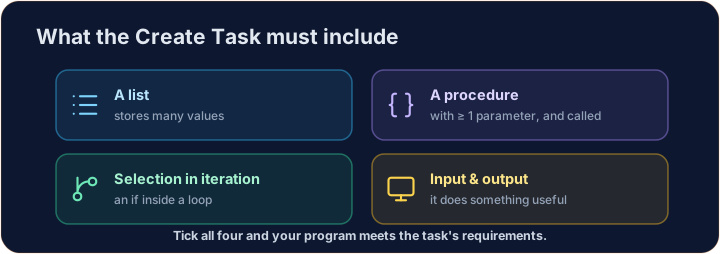
What your program must include
- A list (or other collection) that stores many values together.
- A procedure (a function) that takes at least one parameter, and that you call in your code.
- An algorithm with selection (
if) inside iteration (a loop). - Some input and some output so the program does something useful.
한국어
프로그램에 포함되어야 할 사항
- 여러 값을 함께 저장하는 리스트(List) (또는 다른 컬렉션).
- 절차(Procedure)(함수) 는 최소 하나의 매개변수를 받아야 하며, 코드 내에서 호출(Calling) 되어야 합니다.
- 선택(
if) 구조가 반복(Loop) 내부에 있는 알고리즘. - 유용한 작업을 수행하기 위해 일부 입력(Input) 과 출력(Output) 이 있어야 합니다.
English
Pick a small idea
- Keep it simple: you only need to show the skills above, not build a huge app.
- Good ideas: grade a list of scores, total a shopping list, sort students into teams, count words.
- Choose data you understand, so you can explain it later.
한국어
작은 아이디어 선택
- 간단하게 유지하십시오: 위 기술을 보여주는 것이지 거대한 앱을 만드는 것이 아닙니다.
- 좋은 아이디어: 점수 리스트 평점, 쇼핑 목록 합계, 학생 팀 배정, 단어 세기 등.
- 나중에 설명할 수 있도록 이해하는 데이터를 선택하십시오.
English
A starter scaffold
- The program below has all the required parts. Read the comments to find each one.
- It uses a fixed list so it runs the same every time (no live typing needed here).
- Run it, then change the data and rules to make it your own.
한국어
입문자용 지지대
- 아래 프로그램에는 필수적인 모든 부분이 포함되어 있습니다. 각 부분을 찾아보려면 주석을 읽으십시오.
- 고정된 리스트를 사용하여 매번 동일한 방식으로 실행됩니다(실제 타이핑 필요 없음).
- 실행한 후 데이터와 규칙을 변경하여 자신만의 프로그램으로 만드십시오.
# 1) A LIST that stores many values
scores = [72, 95, 58, 88, 40, 67]

# 2) A PROCEDURE with a PARAMETER, that returns a result
def grade_for(score):
    # selection inside the procedure: choose a letter for one score
    if score >= 90:
        return "A"
    elif score >= 70:
        return "B"
    elif score >= 50:
        return "C"
    else:
        return "F"

# 3) An ALGORITHM: SELECTION (if) INSIDE ITERATION (for loop)
pass_count = 0
for s in scores:                 # iteration: visit every score
    letter = grade_for(s)        # call the procedure with a parameter
    if letter != "F":            # selection: is this a pass?
        pass_count = pass_count + 1
    print(f"score {s} -> grade {letter}")   # output

# More output: a summary
print(f"{pass_count} out of {len(scores)} passed")
English
Make it your own
- Change the list to your own data (and try a different length).
- Change the procedure: new rule, new parameter name, or return something else.
- Change the algorithm: count something new, or keep only items that pass the
if. - Add input if you like, for example
input("Enter a name: ").
한국어
자신만의 것으로 만들기
- 리스트를 자신의 데이터로 변경하고(길이도尝试해 보십시오).
- 절程序를 변경하십시오: 새로운 규칙, 매개변수 이름 변경, 또는 다른 값 반환.
- 알고리즘을 변경하십시오: 새로운 것을 세거나,
if조건을 통과한 항목만 유지하십시오. - 필요하면 입력을 추가하십시오. 예를 들어
input("Enter a name: ")등.
English
Written-response prompts
- Answer these about your own program (this is the kind of writing the real task asks for):
- Purpose: What does your program do, and why is it useful?
- List: What does your list store, and how does using one list (instead of many separate variables) make the program simpler to manage?
한국어
서술형 질문
- 이 질문에 자신의 프로그램에 대해 답하십시오(실제 과제가 요구하는 작성 유형):
- 목적(Purpose): 당신의 프로그램은 무엇을 하며, 왜 유용합니까?
- 리스트(List): 당신의 리스트는 무엇을 저장하며, 여러 변수 대신 하나의 리스트를 사용하는 것이 프로그램을 관리하기 더 쉬워지는 이유는 무엇입니까?
English
More written-response prompts
- Procedure & parameter: Name your procedure. What is its parameter, and what does the procedure do with it? What does it return?
- Algorithm: Describe the algorithm inside your loop in your own words. Point to where it uses selection (
if) and where it uses iteration (the loop), and say why both are needed.
한국어
추가 서술형 질문
- 절程序 & 매개변수: 절程序의 이름을 말하십시오. 매개변수는 무엇이며, 절程序는 이를 어떻게 사용합니까? 무엇을 반환합니까?
- 알고리즘: 루프 내부의 알고리즘을 자신의 언어로 설명하십시오. 선택(
if) 과 반복(루프) 이 어디에 사용되는지 지목하고, 왜 둘 다 필요한지 설명하십시오.
English
Rubric checklist
- Tick each item once your program has it:
한국어
채점 기준 체크리스트
- 프로그램에 해당 항목이 있으면 체크하십시오:
[ ] A list (or collection) is used in the program
[ ] A procedure is defined WITH at least one parameter
[ ] That procedure is CALLED somewhere in the program
[ ] The procedure does real work (not empty)
[ ] An algorithm uses selection (if) INSIDE iteration (a loop)
[ ] The program has input and/or output
[ ] I can explain every part in my own words
English
You can do this
- Start small, run it often, and fix one thing at a time.
- When every box above is ticked, you have the structure the Create Task needs.
- Remember: practice here first, then submit the real task through the AP Digital Portfolio.
한국어
이 과제를 할 수 있습니다
- 작게 시작하여 자주 실행하고, 한 번에 하나씩 수정하십시오.
- 위의 모든 상자가 체크되면 Create 과제가 요구하는 구조를 갖추었습니다.
- 먼저 여기서 연습한 후, AP Digital Portfolio를 통해 실제 과제를 제출하십시오.
English
Common mistakes
- Plan the program's purpose first, then build in small tested pieces.
- Be ready to explain what each part of your code does.
한국어
흔한 실수
- 먼저 프로그램의 목적을 계획한 후, 검증된 작은 조각으로 구축하십시오.
- 코드의 각 부분이 무엇을 하는지 설명할 준비를 하십시오.
English
Now you try
- A warm-up: assemble the required parts once, using the scaffold's example data.
- Press Check answer to confirm every required part is there.
한국어
이제 직접 해보기
- 워밍업: 프릿의 예시 데이터를 사용하여 필수적인 부분을 한 번 조립해 보십시오.
- 답안 확인 버튼을 눌러 모든 필수 부분이 있는지 확인하십시오.
A warm-up that uses the scaffold's example data. (1) Keep the list scores. (2) Define grade_for(score) (one parameter) returning "A"/"B"/"C"/"F" by the rules above (>= 90, >= 70, >= 50, else "F"). (3) With selection (if) inside a loop over scores, count how many pass (grade is not "F") into pass_count. (4) print a summary line.
Click Run to see the output here. · 출력을 보려면 '실행'을 클릭하세요.
The Create task also needs an algorithm you built yourself. Write top_score(scores) that returns the highest value using a loop — start with the first score, then compare each one. Do not use the built-in max. Then print the result.
Click Run to see the output here. · 출력을 보려면 '실행'을 클릭하세요.