Skip to content
Subjects

英语语法 · B1

  • 1 现在完成时 vs 一般过去时
    1.1

    确定的过去 vs 与现在相关

    一般过去时 vs 现在完成时

    两个时态都讲过去,区别在于是否说具体时间是否和现在有关:

    • 一般过去时 (past simple):动作在确定的过去时间结束,和现在无关。
    • 现在完成时 (present perfect):不说具体时间,强调对现在的影响或经验。

    I saw him 昨天yesterday.

    我昨天见过他。(确定时间 → 一般过去时)

    I (完成时)have seen 那部that 电影film.

    我看过那部电影。(经验,没说何时 → 现在完成时)

    注意 一旦出现 yesterday、last week、in 2019、ago 等确定过去时间,就用一般过去时,不用完成时。

    1.2

    标志词

    留意这些词,能帮你判断用哪个时态:

    • 一般过去时:yesterday、last night、… ago、in 2019、then、when。
    • 现在完成时:just、already、yet、ever、never、so far、recently、since、for。

    She (完成时)has 刚刚just 到达arrived.

    她刚到。(just → 现在完成时)

    他们They 离开left an 小时hour ago.

    他们一小时前就走了。(ago → 一般过去时)

    注意 同一句里别混用:~~I have seen him yesterday~~ ✗ → I saw him yesterday ✓。

    1.3

    been 与 gone

    两个都是 go 的相关形式,但意思不同:

    • have been to:去过(已经回来)——表示经验。
    • have gone to:去了(还在那里 / 在路上)。

    He (完成时)has 去过been (介词)to 日本Japan.

    他去过日本。(去过,现在已回来)

    She (完成时)has 去了gone (介词)to (冠词)the 银行bank.

    她去银行了。(现在不在,还在那边)

    注意 "去过某地"用 been to;"去了还没回"用 gone to

    常见错误

    • ❌ ~~When have you arrived?~~ → ✓ When did you arrive? — when 问的就是具体过去时间,必须用一般过去时。
    • ❌ ~~I have finished it just now.~~ → ✓ I finished it just now. / I have just finished it. — just now(刚才)配过去时;just(刚刚)配完成时。
    • ❌ ~~I lost my keys — can you help me look?~~ → ✓ I have lost my keys… — 钥匙现在还没找到,影响延续到现在,用完成时更准确。
    • ❌ ~~This is the first time I go there.~~ → ✓ This is the first time I have been there. — "第一次 / 最好的一次"句型固定配现在完成时:the first time / the best film I have ever seen
  • 2 现在完成进行时
    2.1

    结构 (have been + V-ing)

    现在完成进行时:持续到现在

    现在完成进行时 (present perfect continuous) 强调一个动作从过去持续到现在,常常仍在进行。

    结构: 主语 + have / has + been + 动词-ing

    I (完成时)have (进行)been 等待waiting (持续)for an 小时hour.

    我已经等了一个小时了。(可能还在等)

    (天气it)It (完成时)has (进行)been 下雨raining all day.

    雨已经下了一整天了。

    注意 否定:haven't / hasn't been + V-ing。疑问:Have / Has + 主语 + been + V-ing?

    2.2

    持续到现在

    这个时态关注的是持续的过程时长,常和 forsince 连用:

    • for + 一段时间:for two hours。
    • since + 起点:since this morning。

    She (完成时)has (进行)been 学习studying 自从since 九点nine.

    她从九点起就一直在学习。

    与现在完成时的区别:

    • 现在完成进行时:强调过程 / 时长(I have been reading — 一直在读)。
    • 现在完成时:强调结果 / 完成(I have read it — 读完了)。

    注意 状态动词(know、like、be)一般不用进行时:~~I have been knowing~~ ✗ → I have known ✓。

    常见错误

    • ❌ ~~I am waiting for an hour.~~ → ✓ I have been waiting for an hour. — "等了一小时、还在等"必须用完成进行时;现在进行时不能带"已持续多久"。
    • ❌ ~~How long are you living here?~~ → ✓ How long have you been living here? — how long 问时长,配完成(进行)时。
    • ❌ ~~She has been finished her essay.~~ → ✓ She has finished her essay. — been 后面只能接 -ing;"已完成"直接用 has + 过去分词。
    • ❌ ~~I have been reading three books this week.~~ → ✓ I have read three books this week. — 报"完成的数量"用现在完成时;进行时只强调过程,不谈成果。
  • 3 过去完成时
    3.1

    结构 (had + 过去分词)

    过去完成时:过去的过去

    过去完成时 (past perfect) 表示"过去的过去"——在某个过去时间点之前已经完成的动作。

    结构: 主语 + had + 过去分词(所有人称都一样)

    当...时When I 到达arrived (冠词), the 火车train (过去完成)had 离开left.

    我到的时候,火车已经开走了。(先开走,后到)

    She (过去完成)had 完成finished 她的her 工作work 在...之前before 午饭lunch.

    她在午饭前就把工作做完了。

    注意 缩写:I'd、she'd、they'd(= had)。

    3.2

    两个过去动作中更早的那个

    过去完成时常和一般过去时一起用,表明两件过去的事谁先谁后:

    • 更早发生的 → 过去完成时(had done)。
    • 后发生的 → 一般过去时(did)。

    (冠词)The 电影film (过去完成)had 开始started 当...时when 我们we 到达got 那里there.

    我们到那儿时,电影已经开始了。

    对照时间线: had started(更早)→ got there(更晚)。

    注意 只有当需要强调先后顺序时才用过去完成时;按顺序叙述的事可以都用一般过去时。

    常见错误

    • ❌ ~~After he had left, I had cleaned the room.~~ → ✓ After he had left, I cleaned the room. — 只有更早的那个动作用过去完成时,不是两个都用。
    • ❌ ~~When I had arrived, the train left.~~ → ✓ When I arrived, the train had left. — 谁先发生谁用 had done;标反了,先后顺序就反了。
    • ❌ ~~I had seen this film.~~(单独一句)→ ✓ I have seen this film. — 过去完成时必须有一个"过去参照点";没有参照,就用现在完成时或一般过去时。
    • 记住强信号:by the time + 过去时,主句常用过去完成时:By the time we arrived, the film had started.
  • 4 used to(过去的习惯)
    4.1

    过去的习惯与状态

    used to:过去的习惯

    used to 表示过去经常做、但现在不再做的习惯,或过去的状态。

    结构: 主语 + used to + 动词原形

    I 过去常used to play 足球football.

    我过去常踢足球。(现在不踢了)

    (有)There 过去used to be 一家a 电影院cinema 这里here.

    这里以前有一家电影院。

    注意 used to 只讲过去;讲现在的习惯,用一般现在时(I play football now)。

    4.2

    否定与疑问

    否定和疑问要借助 did,并把 used 变回 use:

    • 否定: didn't use to + 动词原形。
    • 疑问: Did + 主语 + use to + 动词原形 ?

    I (否定)didn't 过去use to 喜欢like 咖啡coffee.

    我以前不喜欢咖啡。

    (助动词)Did you 过去use to live 这里here?

    你以前住在这里吗?

    注意 否定 / 疑问里是 use to(没有 d):~~didn't used to~~ ✗ → didn't use to ✓。

    常见错误

    • ❌ ~~I am used to play football.~~ → 两个不同的说法别混:✓ I used to play football.(过去常踢,现在不踢)vs ✓ I am used to playing football.(习惯于踢)— 后者的 to 是介词,接 -ing;还有 get used to(逐渐习惯)。
    • ❌ ~~I use to get up early.~~(想说现在的习惯)→ ✓ I usually get up early. — use to 没有现在时;现在的习惯用 usually。
    • ❌ ~~She used to living in Shanghai.~~ → ✓ She used to live in Shanghai. — used to 后面跟动词原形。
  • 5 将来时复习
    5.1

    will vs be going to

    将来形式:will / going to / 进行时

    谈论将来,willbe going to 各有侧重:

    • will:当场决定、预测、承诺。
    • be going to:已有的计划、有依据的预测。

    I 觉得think (天气it)it will (是)be cold.

    我觉得会冷。(预测 → will)

    我们We (be)are 打算going to move house.

    我们打算搬家。(计划 → be going to)

    注意 当场临时决定一定用 will:The bag is heavy — I'll carry it.

    5.2

    现在进行时表安排

    现在进行时可表示已经约好的将来安排(常有明确时间 / 地点):

    I (be)am meeting (冠词)the 医生doctor at 三点three.

    我三点要见医生。(已约好)

    注意 be going to 强调"打算",现在进行时强调"已经安排妥当",两者常可互换。

    5.3

    时间状语从句

    when、as soon as、before、after、until 引导的时间从句里,即使讲将来,也用一般现在时:

    I will 打电话call you 当...时when I 到达arrive.

    我到了就给你打电话。

    Wait 这里here 直到until (冠词)the rain stops.

    在这儿等到雨停。

    注意 时间从句里不用 will:~~when I will arrive~~ ✗ → when I arrive ✓。

    常见错误

    • ❌ ~~I will meeting him tomorrow.~~ → ✓ I will meet him. / I am meeting him. — will + 原形,be + -ing,两套结构不能拼在一起。
    • ❌ ~~What will you do tonight?~~(问对方的安排)→ ✓ What are you doing tonight? — 问已有的安排,用现在进行时更自然。
    • ❌ ~~I'll go to the dentist tomorrow — I booked it last week.~~ → ✓ I am going to the dentist tomorrow. — 早已订好的事不用"当场决定"的 will。
    • 提建议的问句用 Shall:Shall we go?(我们走吧?)Shall I open the window?(要我开窗吗?)
  • 6 条件句
    6.1

    零条件句与第一条件句

    第一与第二条件句

    • 零条件句(普遍真理):If + 一般现在时, 一般现在时
    • 第一条件句(将来真实可能):If + 一般现在时, will + 动词原形

    如果If you 加热heat water (它), it 沸腾boils.

    如果加热水,水就会沸腾。(普遍真理)

    如果If (天气it)it 下雨rains 我们, we will stay (在内)in.

    如果下雨,我们就待在家里。(将来可能)

    注意 if 从句里用一般现在时,即使说的是将来:~~If it will rain~~ ✗ → If it rains ✓。

    6.2

    第二条件句

    第二条件句现在 / 将来不真实或不太可能的假设:

    结构: If + 一般过去时, would + 动词原形

    如果If I had (冠词)a 很多lot (的)of money , I would 旅行travel.

    如果我有很多钱,我就会去旅行。(其实没有)

    注意 在第二条件句里,be 动词常统一用 were:If I were you, I would rest.(我要是你,就会休息。)

    6.3

    unless

    unless 表示"除非 / 如果不",相当于 if … not:

    You will (是)be 迟到late 除非unless you 快点hurry.

    你不快点就会迟到。(= if you don't hurry)

    注意 unless 本身已含否定,后面不再加 not:~~unless you don't hurry~~ ✗。

    常见错误

    • ❌ ~~If I would be rich, I would travel.~~ → ✓ If I were rich, I would travel. — would 只出现在主句;if 从句里用过去时。
    • ❌ ~~If it rains, we would stay home.~~ → ✓ If it rains, we will stay home. / If it rained, we would stay home. — 第一、第二条件句不能前后混搭,要整句配套。
    • ❌ ~~If I was you, I would rest.~~ → 口语能听到,但考试和写作用 ✓ If I were you。
    • 逗号规则:if 从句在要加逗号(If it rains**,** we stay in.);在不加(We stay in if it rains.)。
  • 7 被动语态
    7.1

    一般现在 / 过去时的被动

    主动 → 被动

    被动语态 (the passive) 把动作的承受者放在主语位置,强调"被怎么样",而不是谁做的。

    结构: 主语 + be + 过去分词(be 的时态决定句子时态)

    • 一般现在被动:am / is / are + 过去分词。
    • 一般过去被动:was / were + 过去分词。

    英语English (被动)is spoken 这里here.

    这里(被)说英语 / 这里讲英语。

    (冠词)The 窗户window (被动)was 打破broken.

    窗户被打破了。

    注意 主动变被动:宾语提前作主语,动词变 be + 过去分词They built it.It was built.

    7.2

    by + 动作执行者

    如果想说明"被谁"做的,用 by + 动作执行者:

    This book (被动)was written by 鲁迅Lu Xun.

    这本书是鲁迅写的。

    什么时候用被动?

    • 不知道、或不重要是谁做的:The road was repaired.(路被修好了。)
    • 想强调承受者:The painting was bought by a museum.

    注意 如果执行者不重要,常常省略 by …:The shop is closed.(店关门了。)

    常见错误

    • ❌ ~~The window was broke. / The book was wrote by him.~~ → ✓ was broken / was written — 被动用过去分词,不是过去式;不规则动词的第三列要背熟。
    • ❌ ~~It was happened last night.~~ → ✓ It happened last night. — happen、appear、die 这类不及物动词没有被动语态
    • ❌ ~~My phone was stolen by someone.~~ → ✓ My phone was stolen. — by someone / by people 是废话,直接删掉。
    • 中文说"我出生在……"是主动,英语永远用被动:✓ I was born in Chengdu.
  • 8 间接引语
    8.1

    转述陈述句

    直接 → 间接引语

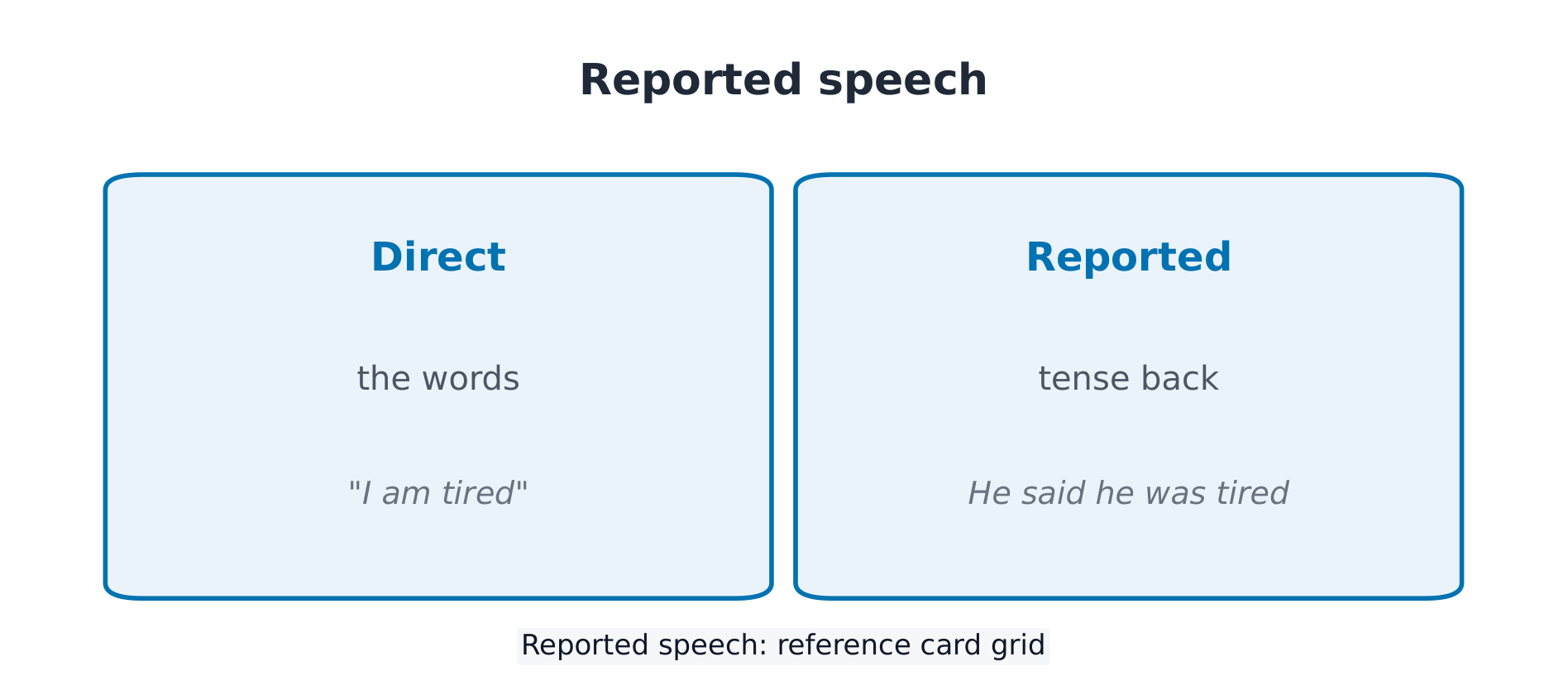
    间接引语 (reported speech) 用来转述别人说过的话,不用引号。常用 saidtold:

    • say 后面不接听话人:He said (that) …
    • tell 后面要接听话人:He told me (that) …

    He said (连词)that he (过去)was tired.

    他说他累了。(原话:"I am tired.")

    注意 that 可省略:He said he was tired. 意思一样。

    8.2

    时态后移

    转述时,如果引述动词是过去时(said / told),从句的时态通常往后退一步:

    • am / is → was;are → were;do / does → did
    • will → would;can → could;现在完成 / 一般过去 → 过去完成

    直接引语:"I will help you," she said.(原话)

    间接引语:

    She said she would help me.

    她说她会帮我。(will → would,I → she,you → me)

    人称和时间词也要变: I → he / she,now → then,today → that day,tomorrow → the next day。

    注意 如果转述的是普遍真理,时态可以不后移:He said the sun rises in the east.

    常见错误

    • ❌ ~~He said me the truth.~~ / ~~He told that he was busy.~~ → ✓ He told me… / He said (that)… — say 不接听话人,tell 必须接听话人,正好相反。
    • ❌ ~~He asked me where did I live.~~ → ✓ He asked me where I lived. — 转述疑问句要变回陈述语序,did 消失。
    • ❌ ~~She asked me that I was hungry.~~ → ✓ She asked me if / whether I was hungry. — 转述一般疑问句用 if / whether,不用 that。
    • ❌ ~~He said he will come tomorrow.~~ → ✓ He said he would come the next day. — 时态和时间词要一起后移。
  • 9 定语从句
    9.1

    who 与 which / that

    关系代词:who/which/where/whose

    定语从句 (relative clauses) 用来补充说明前面的名词。用关系代词引导:

    • who:指
    • which:指
    • that:人或物都可以(口语常用)。

    (冠词)The 女人woman (关系代词)who lives 隔壁next door is 一名a 医生doctor.

    住在隔壁的那位女士是医生。

    This is (冠词)the book (关系代词)which 获得won (冠词)the prize.

    这就是那本获奖的书。

    注意 关系代词放在它所指的名词后面,引出补充信息。

    9.2

    where, when, whose

    • where:指地点when:指时间whose:表示所属("……的")。

    那是That's (冠词)the town (在那里)where I 长大grew up.

    那就是我长大的小镇。

    她是She's (冠词)the 作家writer (谁的)whose books I 喜爱love.

    她就是那位我喜欢其作品的作家。

    注意 whose 后面直接跟名词(whose books),表示"那个人的书"。

    9.3

    省略关系代词

    当关系代词在从句里作宾语时,可以省略(口语和写作都常见):

    (冠词)The 电影film 我们(that) we saw (是)was 很棒great.

    我们看的那部电影很棒。(that 可省略)

    判断方法:

    • 关系代词作主语(后面紧跟动词)→ 不能省略。
    • 关系代词作宾语(后面跟"主语 + 动词")→ 可以省略。

    注意 作主语时必须保留:the man who called(不能省略 who)。

    常见错误

    • ❌ ~~The man which lives next door…~~ → ✓ The man who / that… — 指人不用 which。
    • ❌ ~~The book what I read…~~ → ✓ The book that / which I read… — 英语没有 what 作关系代词的用法。
    • ❌ ~~This is the house which I live.~~ → ✓ …the house where I live / …the house which I live in. — 从句缺介词时,要么用 where,要么把 in 补回来。
    • ❌ ~~The friend who I met him yesterday…~~ → ✓ The friend who I met yesterday… — 关系代词已经代替了宾语,从句里不能再出现 him / it。
  • 10 推测情态动词
    10.1

    must 与 can't(确定)

    推测情态动词:确定程度

    情态动词也能表示推测。当你很确定时:

    • must:一定是(确定的肯定推测)。
    • can't:一定不是(确定的否定推测)。

    She 一定must be tired.

    她一定很累。(很确定)

    He 不可能can't be 饿hungry ; he just ate.

    他不可能饿,他刚吃过。

    注意 表示否定推测用 can't(不可能),不用 mustn't(那是"禁止")。

    10.2

    might, may, could(可能)

    当你不太确定、只是觉得有可能时:

    • might / may / could:可能、也许。

    (天气it)It 可能might 下雨rain 稍后later.

    待会儿可能会下雨。

    他们They 可能may be (在)at home.

    他们可能在家。

    确定程度对照:

    • 很确定:must(是)/ can't(不是)。
    • 不确定:might / may / could(可能)。

    注意 这些情态动词后面都跟动词原形:might be、must be(不是 might is)。

    常见错误

    • ❌ ~~It can be John at the door.~~ → ✓ It could / might be John. — 对具体某一次的推测用 could / might;can 只表示"一般来说有可能"。
    • ❌ ~~He might not can come.~~ → ✓ He might not be able to come. — 两个情态动词不能连用;第二个换成 be able to / have to。
    • ❌ ~~Maybe he be late. / It may be rain.~~ → ✓ Maybe he is late. / It may rain. — maybe 是副词,句子照常;may 是情态动词,后接原形。两个别搅在一起。
    • ❌ ~~She must is tired.~~ → ✓ She must be tired. — 情态动词后面永远是动词原形。
  • 11 动名词与不定式
    11.1

    动词 + -ing

    动词后:-ing 还是 to

    有些动词后面要跟动名词(动词-ing)。常见的有:enjoy、like、love、hate、finish、stop、mind、suggest、avoid。

    I 喜欢enjoy 阅读reading.

    我喜欢阅读。

    She 完成finished doing 她的her 作业homework.

    她做完了作业。

    注意 动名词 (gerund) 是动词当名词用,形式是动词-ing

    11.2

    动词 + 不定式

    另一些动词后面要跟不定式(to + 动词原形)。常见的有:want、need、decide、hope、promise、learn、would like、plan。

    I want (不定式)to learn 英语English.

    我想学英语。

    他们They 决定decided (不定式)to 留下stay.

    他们决定留下来。

    注意 有些动词两者都行,意思相近:like、love、start、begin。I like swimming. = I like to swim.

    11.3

    介词后用 -ing

    介词(in、on、at、of、about、for、good at、interested in…)后面,动词要用 -ing 形式:

    She's 擅长good at 画画drawing.

    她擅长画画。

    谢谢Thank you 因为for 帮助helping me.

    谢谢你帮我。

    注意 介词后绝不跟动词原形:~~good at draw~~ ✗ → good at drawing ✓。

    常见错误

    • ❌ ~~I enjoy to read.~~ / ~~I want reading.~~ → ✓ I enjoy reading. / I want to read. — 哪个动词接哪种形式是固定的,背搭配,别互换。
    • 区分 stop 的两种意思:He stopped smoking.(戒烟了)vs He stopped to smoke.(停下手头的事去抽烟)— 意思完全不同。
    • ❌ ~~I look forward to see you.~~ → ✓ I look forward to seeing you. — 这里的 to 是介词,后面接 -ing。
    • ❌ ~~Swim is good exercise.~~ → ✓ Swimming is good exercise. — 动词作主语要用 -ing 形式。
  • 12 too / enough / so / such
    12.1

    too 与 enough

    too 与 enough

    tooenough 表示程度,但位置和含义不同:

    • too + 形容词 = "太……了"(否定的过度),放在形容词
    • enough = "足够",放在形容词、名词

    This 咖啡coffee is too hot.

    这咖啡太烫了。

    He 不够isn't old 足够enough (不定式)to 开车drive.

    他还不够大,不能开车。

    注意 enough 放在形容词后(old enough),但放在名词前(enough money)。

    12.2

    so 与 such

    sosuch 都表示"如此 / 那么",用来加强语气:

    • so + 形容词 / 副词:so hot,so quickly。
    • such + (a/an) + (形容词) + 名词:such a hot day。

    (冠词)The 电影film (是)was 如此so 无聊boring.

    那部电影太无聊了。

    (这)It was 如此such 一个a good 主意idea.

    那真是个好主意。

    注意 so 后面跟形容词(so good),such 后面跟名词词组(such a good idea)。

    常见错误

    • ❌ 想夸"太开心了"却说 ~~I'm too happy!~~ → ✓ I'm so happy! — too 自带否定含义("过头了,以至于不行"),夸奖和感叹用 so。
    • ❌ ~~The box is too much heavy.~~ → ✓ The box is much too heavy. — 加强 too 用 much too,语序是 much 在前。
    • ❌ ~~The tea is too hot to drink it.~~ → ✓ The tea is too hot to drink. — too…to 结构里,句子主语就是 drink 的宾语,不再写 it。
    • ❌ ~~It was so a good idea.~~ → ✓ It was such a good idea. / The idea was so good. — 带名词就换 such。

Log in or create account

IGCSE & A-Level