Skip to content

Engagement project · Engagement and reflective research

International Baccalaureate · IB Diploma · Global Politics · SL · Topic 3

3.1

The engagement project

IB Diploma Programme Global Politics SL (first assessment 2019; 2016 guide). The internal assessment is shared by SL and HL: the engagement project 参与式项目: a 2 000-word written report on a political issue the student genuinely engages with beyond the classroom, worth 25% at SL and 20% at HL. This handout walks the four marked components — the issue and its synthesis, the research, the engagement itself, and the analysis-and-reflection spine — with the worked homelessness example throughout.

Must-know for the engagement project:

Component What it rewards
issue political, debatable, globally connected, key concepts applied
research sources gathered; perspectives compared and evaluated
engagement first-hand experience, documented and purposeful
analysis concepts applied to the experience; reflection and lessons
Vocabulary Train
English
engagement project/enˈɡeɪdʒmənt ˈprɒdʒekt/
3.2

Choosing the issue and framing the question

The issue 议题 must be political — about power, decisions and who gets what: not “the ocean is polluted” but “who decides what is dumped where, and who pays”. It must be DEBATABLE (real competing perspectives, not a settled question), GLOBALLY CONNECTED (a local manifestation of a global issue, or vice versa — the levels-linked framing), and ENGAGEABLE (something a student can genuinely act on: join, observe, interview, volunteer, campaign). The framed question names the issue, the level (local-to-global) and the key concepts from the core: “How does [my city]'s sanctuary policy exercise power and construct legitimacy, and whose rights does it serve?” beats “Is immigration good?” on every criterion.

The research plan 研究计划 follows: the sources needed (documents, data, reports, and PEOPLE to interview or observe), the PERSPECTIVES to represent (at least two, ideally the interested parties themselves), and a timeline that fits the engagement. The plan criterion rewards exactly this — an issue framed with concepts, a source map, and a realistic engagement route.

Vocabulary Train
English
issue/ˈɪʃuː/
research plan/rɪˈsɜːtʃ plæn/
3.3

Engagement, research and the report's structure

Engagement 参与 is the project's heart: FIRST-HAND experience of the issue — volunteering with the NGO, attending the council committee, interviewing the organiser and the affected, joining the campaign, observing the tribunal. It must be PURPOSEFUL (chosen to answer the framed question, not generic volunteering) and DOCUMENTED (notes, transcripts, photographs, logs — the evidence the report cites). Ethics 伦理 run through: informed consent for interviews, anonymity where requested, and the researcher's position owned in the reflection.

Research 研究 supplies the second stream: published sources — reports, statistics, treaty texts, journalism, scholarship — so the report can weigh what the engagement shows against the documented record, and compare PERSPECTIVES: the official, the activist, the affected, the academic. The synthesis criterion wants perspectives EVALUATED, not just quoted: whose account is self-serving, whose is evidenced, whose voice is missing.

The report 报告 (2 000 words) is structured as: the ISSUE and its context (levels-linked, concepts applied); the RESEARCH findings (sources and perspectives compared); the ENGAGEMENT (what was done, found, heard); the ANALYSIS (concepts applied to the experience — power observed, legitimacy contested, rights distributed) and the REFLECTION (what the engagement taught that research alone could not; the limits of what was learned; what the student would do differently — and the positionality: who the researcher was in the field).

Worked example. Issue: the city's response to street homelessness: a service question on its face, a power-and-rights question underneath. Framing: “How does [city]'s encampment-clearance policy exercise power over the unhoused, and on what legitimacy does it rest?” Engagement: twelve shifts at an outreach charity; interviews with an organiser, a housing officer and two residents of a cleared site (consent, anonymity). Research: the council's policy documents, national homelessness statistics, the housing charity's reports, one academic study of clearance effects. Analysis: the clearances show second-face power (the agenda set before residents are heard) and the legitimacy contest between procedure (mandated, consulted) and performance (the cleared return); rights frame the loss of shelter against the neighbourhood's claims. Reflection: the engagement showed the document-record gap — the official account of “support- first” bore no relation to the residents' experience; the project's limits (two residents, one city, twelve shifts) are named.
Vocabulary Train
English
engagement/enˈɡeɪdʒmənt/
research/rɪˈsɜːtʃ/
ethics/ˈeθɪks/
report/rɪˈpɔːt/
3.4

Checklist

  • The issue: political, debatable, globally connected, engageable — framed as a question with two key concepts (framing).
  • The plan: sources mapped, perspectives identified, a realistic engagement route (framing).
  • Engagement first-hand, purposeful, documented, ethical — consent and anonymity (engagement).
  • Research: published sources weighed against the experience; perspectives evaluated, silences named (research).
  • The report's four parts with reflection owning positionality and limits; the worked example's finding (report, worked).

Supported preparation: Engagement preparation and reflection

Scope and prerequisites

IB global politics first assessment 2026. Use the 2026 core/thematic model and HL stimulus paper, not the retired 2017 HL presentation. School approves a safe, non-partisan engagement and bounded case selection.

Mapped preparation outcomes: ib_global_politics_sl.3.1, ib_global_politics_sl.3.2. Read the matching native lesson first. Actual approved choices, evidence and final learner work remain separate.

Source vocabulary

engagement 参与; perspective 视角.

Explanation and worked method

A focused political issue identifies a contested allocation or relationship, actors and setting. Engagement informs inquiry but needs research and other perspectives. Keep consent, safe school approval and genuine evidence separate from classroom rehearsal.

Original classroom evidence panel for Engagement preparation and reflection

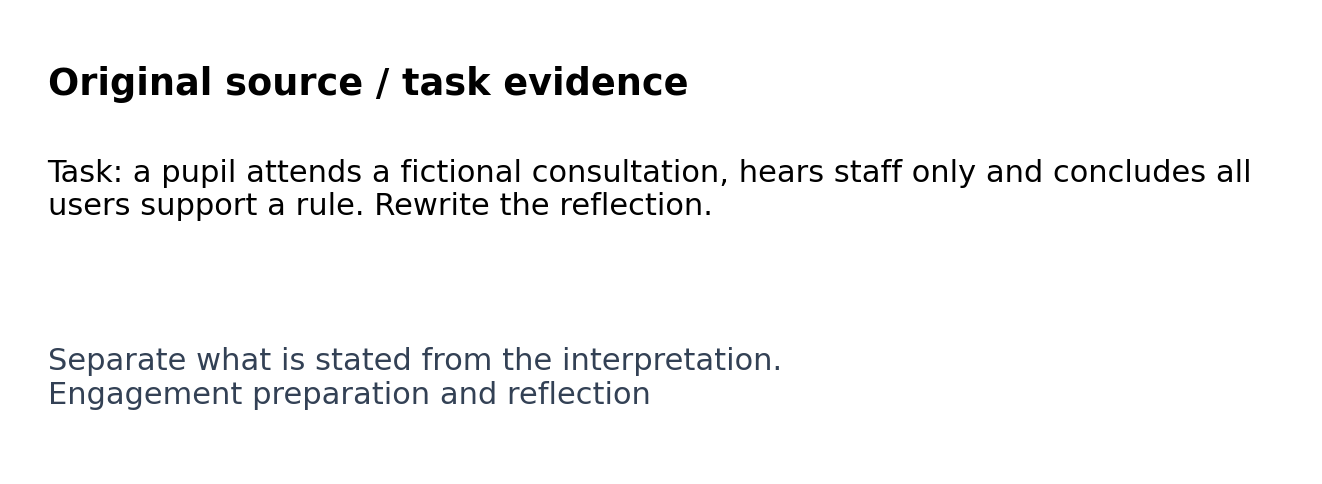
Task: a pupil attends a fictional consultation, hears staff only and concludes all users support a rule. Rewrite the reflection.

Staff accounts clarify institutional aims but do not establish users' experiences. The pupil's invited role affected access. Compare documents and approved voluntary accounts from affected groups, explain missing voices and limit the conclusion.

Independent transfer

A user challenges the pupil's staff-only account. What should critical reflection do?

Attempt independently before reading the model.

Checked original model

Check the account's context and evidence, identify the original access limitation and revise the question or conclusion where justified. Compare rather than merely append perspectives. An unexpected account is not automatically representative, but can expose a material missing experience.

These are authored formative expectations, not official IB descriptors. Accept other justified arguments with evidence and material limits.

Source and task holds

This supplement teaches the method for this part of the course. The full assessment criteria and any texts your school chooses come from your teacher.

Interactive lessons on this topic

Work through it step by step, with instant-check exercises.

More topics in International Baccalaureate · IB Diploma · Global Politics · SL

Log in or create account

IGCSE, A-Level & AP