Skip to content
Subjects

International Baccalaureate · IB Diploma · Classical Languages · SL

  • 1

    Meaning, form and language · Latin morphology and translation

    Learning program coming soon

    Handout

    Scope and prerequisites

    IB classical languages first assessment 2024; Latin focus. This supplemental reference covers only the listed preparation outcomes. School selections, full-guide procedures and required live or recorded performance are separate.

    • Use cases and agreement to identify grammatical roles
    • Translate meaning accurately before refining English expression

    Prerequisites: Subject and object in English; basic present-tense verb endings.

    Explain and choose the method

    Puella is nominative singular and acts as subject; poetam is accusative singular and acts as object. Laudat is third-person singular present.

    Inflection carries grammatical information: first identify the finite verb 限定动词, then its subject and complements.

    Latin case 格 shows a noun's role. With these first-declension forms, -a is nominative singular and -am accusative singular. Use the supplied vocabulary: puella (girl), poeta (poet), fabula (story); laudat (praises), legit (reads), audit (hears). “Poetam puella laudat” has object poetam and subject puella: the girl praises the poet. “Poeta puellam laudat” reverses the roles: the poet praises the girl. Poeta is masculine despite its -a ending. First find the finite verb , then nouns agreeing with its number and the required cases. Do not apply these endings to every declension.
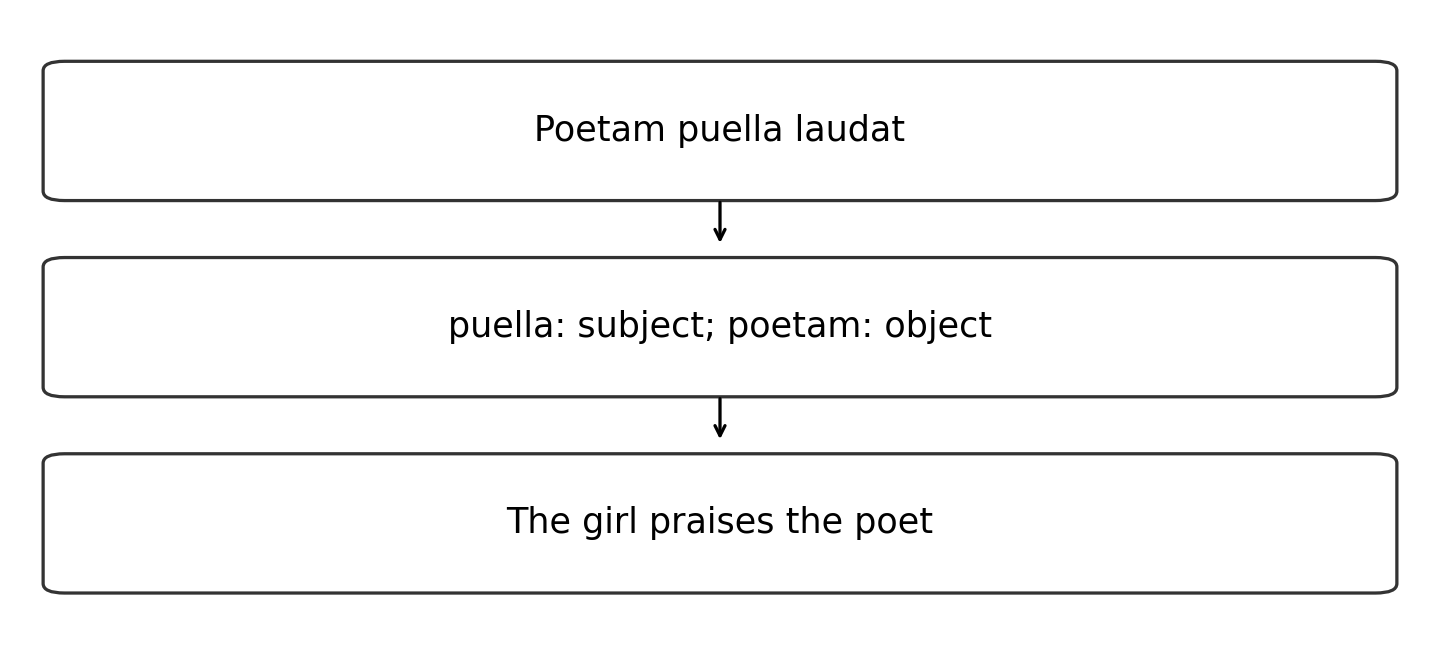
    Original diagram of the worked relationship; read the full wording and qualifications.
    Original diagram of the worked relationship; read the full wording and qualifications.

    Existing worked example: Poetam puella laudat keeps the same grammatical roles despite the new order. Translate as the girl praises the poet, then consider whether the changed position gives emphasis in a real passage.

    Complete original context

    Original Latin mini-passage: Puella fabulam legit. Poeta puellam audit. Puella poetam laudat. Poeta fabulam laudat. Vocabulary is supplied in the worked section. All four verbs are third-person singular present. No historical setting or emphasis is stipulated.

    Independent practice and checked reasoning

    Transfer 1

    Translate every sentence, identifying each subject and object.

    Reasoning: The girl reads the story (puella subject, fabulam object). The poet hears the girl (poeta subject, puellam object). The girl praises the poet (puella subject, poetam object). The poet praises the story (poeta subject, fabulam object). Retain all four relationships rather than making the first noun an automatic subject.

    Transfer 2

    Translate “Fabulam poeta legit”. Explain what changes and what does not if the order becomes “Poeta fabulam legit”.

    Reasoning: Both mean “The poet reads the story”. Nominative poeta and accusative fabulam retain their roles. Word order may influence emphasis in a fuller context, but no specific emphatic effect can be certified from this isolated exercise.

    Transfer 3

    A student translates “Poeta puellam audit” as “The girl hears the poet”. Diagnose and correct the error, then explain why poeta is not evidence 证据 that every -a noun is feminine.

    Reasoning: The student reversed grammatical roles. Poeta is nominative subject, puellam accusative object, so “The poet hears the girl”. Poeta is a masculine first-declension noun; grammatical gender must be learned with the noun, not inferred universally from the ending.

    Limits and next use

    Do not assume the first noun is the subject or invent a pronoun not implied by the verb. A dictionary entry is a starting point; case, number, tense and context determine the actual meaning.

    All tasks here are public original practice with authored guidance. They are not official questions or fresh diagnostics. Existing protected tests and mocks remain separate.
    Vocabulary
    English
    finite verb/ˈfaɪnaɪt vɜːb/
    evidence/ˈevɪdəns/
    case/keɪs/
  • 2

    Text, author, audience · Latin close reading and literary effect

    Learning program coming soon

    Handout

    Scope and prerequisites

    IB classical languages first assessment 2024; Latin focus. This supplemental reference covers only the listed preparation outcomes. School selections, full-guide procedures and required live or recorded performance are separate.

    • Connect diction 措辞, syntax 句法 and literary form to meaning
    • Support interpretations with precise Latin evidence 证据 and contextual knowledge

    Prerequisites: Accurate translation 翻译 of the supplied vocabulary; distinguish speaker and author.

    Explain and choose the method

    Close reading 细读 links a visible linguistic feature to an interpretation of tone, argument 论证 or characterization.

    Translate the relevant words accurately before arguing about the effect; distinguish the speaker's voice from the author's purposes.

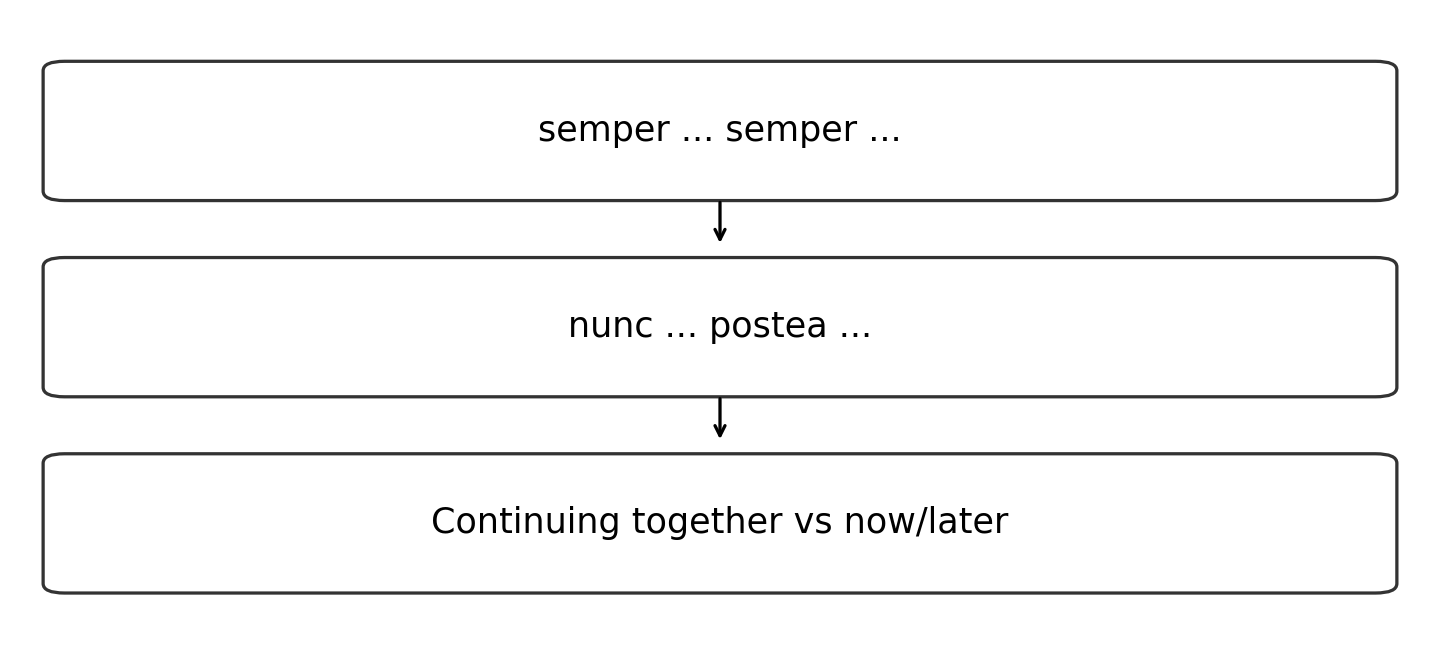
    Diction and syntax contribute to meaning together. “Semper laborat, semper sperat” means “always works, always hopes”. Repeated semper at both clause openings is anaphora 首语重复 ; it links two continuing actions. That relationship supports persistence. It does not alone prove happiness, success, or a particular ancient author's beliefs.

    Original diagram of the worked relationship; read the full wording and qualifications.
    Original diagram of the worked relationship; read the full wording and qualifications.

    Existing worked example: For a classroom phrase, semper laborat, semper sperat, the repeated semper emphasizes persistence: always works, always hopes. Explain how the parallel clauses link labour and hope rather than saying repetition merely makes the text interesting.

    Complete original context

    Original Latin classroom pair: A: Semper laborat, semper sperat. (Always works, always hopes.) B: Nunc laborat; postea sperat. (Now works; later hopes.) Vocabulary: semper = always; nunc = now; postea = later; laborat = works; sperat = hopes. These are original prose phrases. They are not prescribed quotations and no metrical claim is made.

    Independent practice and checked reasoning

    Transfer 1

    Compare the organisation of time in A and B using precise Latin evidence.

    Reasoning: A repeats semper to present work and hope as continuing together. B contrasts nunc with postea to separate them into now and later. Both mention work and hope, but their time relationships differ.

    Transfer 2

    Explain why “repetition makes A vivid” is incomplete. Give a fuller interpretive sentence and one limit.

    Reasoning: “Repeating semper at successive openings links ongoing labour with ongoing hope, suggesting persistence rather than a single completed effort.” The phrase does not establish the worker's eventual success, emotional state or a whole culture's values.

    Transfer 3

    What further evidence would be needed to analyse metre, an ancient audience and authorial purpose in an assessed passage?

    Reasoning: The actual prescribed prose or verse, its edition and context, authorship and genre evidence, and appropriate linguistic or metrical knowledge. An English paraphrase cannot establish Latin metre. The original phrases here cannot stand in for prescribed textual evidence.

    Limits and next use

    This original phrase is not a prescribed quotation. Select real evidence from the school's approved core and companion texts for assessment. HL must work across prose and verse; rhythm analysis needs the actual verse, not an English paraphrase.

    All tasks here are public original practice with authored guidance. They are not official questions or fresh diagnostics. Existing protected tests and mocks remain separate.

    Vocabulary
    English
    close reading/kləʊs ˈriːdɪŋ/
    translation/trænˈsleɪʃn/
    evidence/ˈevɪdəns/
    argument/ˈɑːɡjuːmənt/
    anaphora/ˈænəfɔːrə/
    diction/ˈdɪkʃn/
    syntax/ˈsɪntæks/
  • 3

    Time, space and culture; dossier · Classical sources and research dossier

    Learning program coming soon

    Handout

    Scope and prerequisites

    IB classical languages first assessment 2024; Latin focus. This supplemental reference covers only the listed preparation outcomes. School selections, full-guide procedures and required live or recorded performance are separate.

    • Form a focused inquiry 聚焦探究 into Latin language or culture
    • Evaluate and annotate primary sources without claiming one genre represents all Romans

    Prerequisites: Research question; source origin, purpose and limits.

    Explain and choose the method

    A primary source 一手史料 comes from the world under investigation, but it does not give transparent access to every person's experience.

    An annotation 评注 should explain how the source answers the question, its context and a relevant limitation.

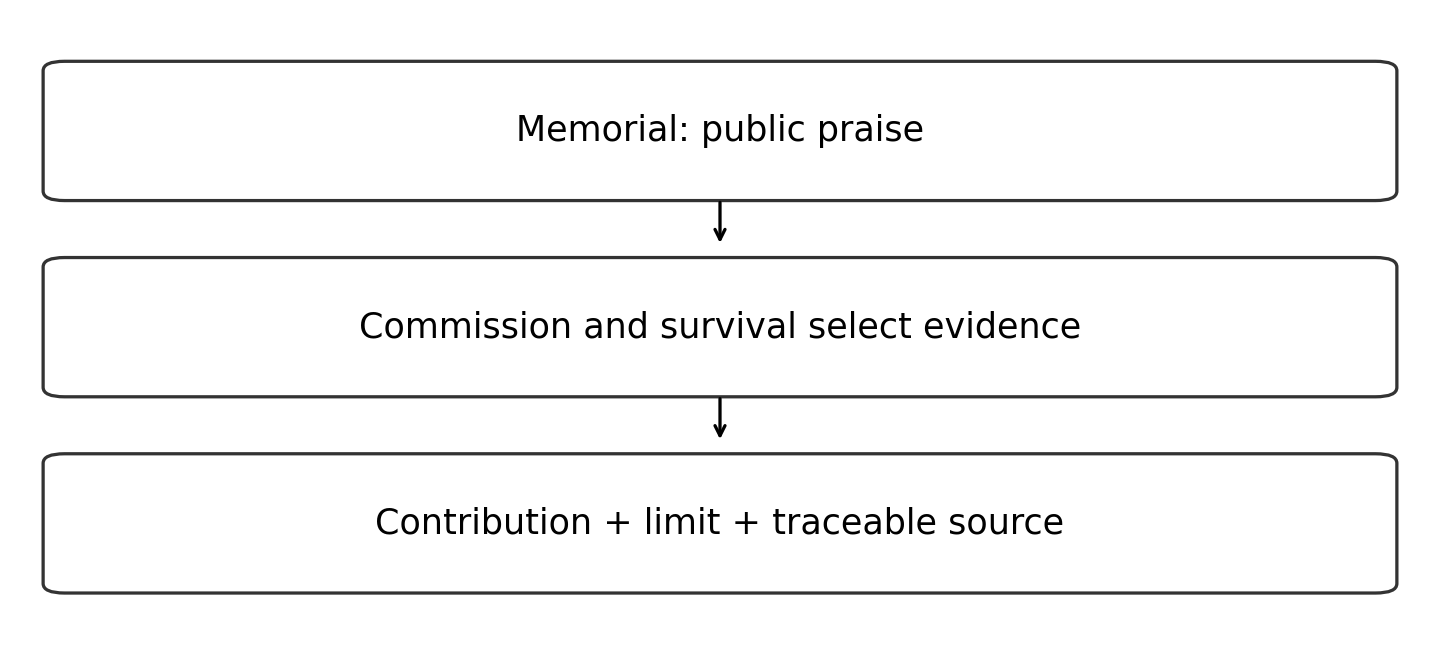
    A focused inquiry asks a bounded question that actual evidence 证据 can answer. “How does this household's memorial present generosity?” is more manageable than “What did all Romans believe?” An annotation identifies the source, explains its contribution and tests its limits. Separate an ancient object or text from its modern edition, catalogue and translation 翻译. Credit each accurately.

    Original diagram of the worked relationship; read the full wording and qualifications.
    Original diagram of the worked relationship; read the full wording and qualifications.

    Existing worked example: Ask how a particular commemorative practice represents family roles. Compare a bounded set of inscriptions with literary evidence and an object. Record exact location 位置, date range, text, translation source and why each item contributes to the inquiry.

    Complete original context

    Original simulated source cards for learning how to evaluate evidence, not ancient documents or a real dossier collection.

    Card A: A memorial inscription commissioned by one wealthy household, dated to a stated twenty-year interval by the supplied catalogue. The inscription praises a family member's generosity. The catalogue records the findspot but does not identify who wrote the wording. Card B: A satirical poem by an elite writer, preserved in a later manuscript. Its speaker exaggerates a dinner host's behaviour for comic effect. The supplied edition identifies the passage and translation, but the speaker is not automatically the author. Card C: A worn household vessel from an excavated domestic room. The excavation record gives its layer and measurements. No owner name or inscription survives.

    These descriptions deliberately omit actual inventory numbers, dates and Latin text. They can support method practice only. An assessed dossier needs real, traceable primary materials and the school's approved source selection, with accurate editions and translation credits.

    Independent practice and checked reasoning

    Transfer 1

    Choose a bounded inquiry for Card A and write a model annotation using only its supplied information.

    Reasoning: Inquiry: “How does the household's memorial represent generosity?” Annotation: “Card A presents generosity as a quality worth commemorating, so it can illuminate the household's public representation of the deceased. Commissioning and praise may select favourable qualities; the inscription does not independently verify every act or represent all social groups. Its twenty-year dating interval limits precise chronological claims. Before assessed use, replace this simulated card with the actual inscription, catalogue number, location, text and credited translation.”

    Transfer 2

    Compare one useful contribution and one limitation of Cards B and C for investigating dining practices.

    Reasoning: B may illuminate an elite literary representation of a host, but satire and speaker exaggeration limit literal reporting. C can illuminate a vessel's material form and excavated context, but no named owner or stated use survives. Corroborate any dining interpretation rather than assigning a personal story to the object.

    Transfer 3

    Explain why collecting attractive images and treating a modern translation as an ancient author are weak methods. State the exact next step before using these cards in a real dossier.

    Reasoning: Images without traceable identity, context and relevance 相关性 cannot support the inquiry; a translator's choices are modern mediation of an ancient text, not the ancient author. Obtain teacher-approved real primary sources, exact identifiers, dates, editions and translation credits, then compare their evidence and limitations. These simulated cards are not an assessed source collection.

    Limits and next use

    The dossier requires seven to nine primary source materials plus an inspiration source. Teacher checks full-guide details. Do not submit a scrapbook of attractive images or treat modern translation as an ancient source in its own right.

    All tasks here are public original practice with authored guidance. They are not official questions or fresh diagnostics. Existing protected tests and mocks remain separate.

    Vocabulary
    English
    focused inquiry
    primary source/ˈpraɪməri sɔːs/
    translation/trænˈsleɪʃn/
    annotation/ˌænəˈteɪʃn/
    relevance/ˈrelɪvəns/
    evidence/ˈevɪdəns/
    location/ləʊˈkeɪʃn/

Log in or create account

IGCSE, A-Level & AP