IB Diploma Programme Social and Cultural Anthropology HL (first assessment 2019; 2017 guide). This topic equips the internal assessment, ENGAGING IN ANTHROPOLOGICAL PRACTICE (25% HL): the student's own fieldwork (proposal, critical reflection, research report and reflection), conducted ethically with appropriate methods, the data interpreted and the practice itself critically reflected on. This handout teaches the fieldwork cycle, the ethics discipline and the write-up. All worked examples are original classroom projects, not ethnographic publications.
Must-know for anthropological practice:
Family
Content
cycle
observe, collect, interpret, reflect: the fieldwork loop run twice
methods
observation, counting and mapping, interviews: chosen to fit the question
ethics
informed consent, anonymity, do no harm: non-negotiable
data
fieldnotes and counts interpreted, not just displayed
reflection
the practice itself judged: methods justified, limits named
3.2
The fieldwork cycle
The internal assessment is the student's own fieldwork 田野调查: a question worth asking, a site that can answer it, methods chosen to fit (observation; counting and mapping; short interviews), data kept in fieldnotes 田野笔记, and interpretation that connects the data to a concept. The cycle runs twice: an initial observation report, then an extension with a second data collection and analysis, each followed by critical reflection.
Worked project. The corridor-flows project: question (how does the corridor's traffic order itself at break?); methods (a flow map drawn at the same minute on five days; a count of door-holding; three short interviews); concept (movement, time and space, read through power).
Three rules are non-negotiable: informed consent 知情同意 (the studied know they are studied, and may decline), anonymity 匿名 (names and identifying details changed), and do-no-harm (nothing collected that could damage a participant), with school permission coming first. The observer's own standpoint, positionality 立场性, is named in the report: the observer's role (a corridor user themselves) shapes what the field shows, and the strongest reports say so and use it.
Worked project, continued. The project's consent: the form class heard the project explained and could opt out of the interviews; the map anonymises individuals into flows; the reflection names the observer as a daily corridor user whose own route was one of the mapped.
The report presents question, method, data and interpretation, with the methodological choices justified (why a five-day same-minute map rather than one observation: comparability). The critical reflection 评估反思 judges the practice itself: what the methods could not see (the map misses meaning; the interviews miss the silent), what the second collection changed, and what the anthropologist would do next.
Worked project, concluded. The write-up's finding: door-holding follows form (the narrow door's queue holds itself) and familiarity (the regular's door held open), so the corridor orders movement through learned micro-rules; the reflection: the count saw behaviour but not meaning, and the next study would add greetings to the map.
The cycle run twice: observe, collect, interpret, reflect (cycle).
Methods chosen to fit the question, choices justified (methods).
Consent, anonymity, do-no-harm, school permission (ethics).
Data interpreted toward a concept, not displayed (data).
The worked corridor project and its reflection understood (worked).
Boundary notes: the examiner must see the discipline: concepts named, ethnographic evidence grounded, the observer positioned. All worked examples are original classroom vignettes, not ethnographic publications.
Supported preparation: Fieldwork rehearsal and reflection
Scope and prerequisites
IB social and cultural anthropology first assessment 2019. Select one inquiry area from each of three groups at SL; HL adds a fourth and theory extension. Teacher selects real ethnographies; classroom vignettes below are original teaching cases, not ethnographic publications.
Mapped preparation outcomes: ib_anthropology_hl.3.1, ib_anthropology_hl.3.2. Read the matching native lesson first. Actual approved choices, evidence and final learner work remain separate.
Source vocabulary
fieldwork 田野调查; informed consent 知情同意.
Explanation and worked method
Before observation, state a focused question, a recording unit, a sampling period and approved consent/privacy arrangements. Separate description from interpretation. Actual fieldwork and school approval cannot be supplied by a model answer.
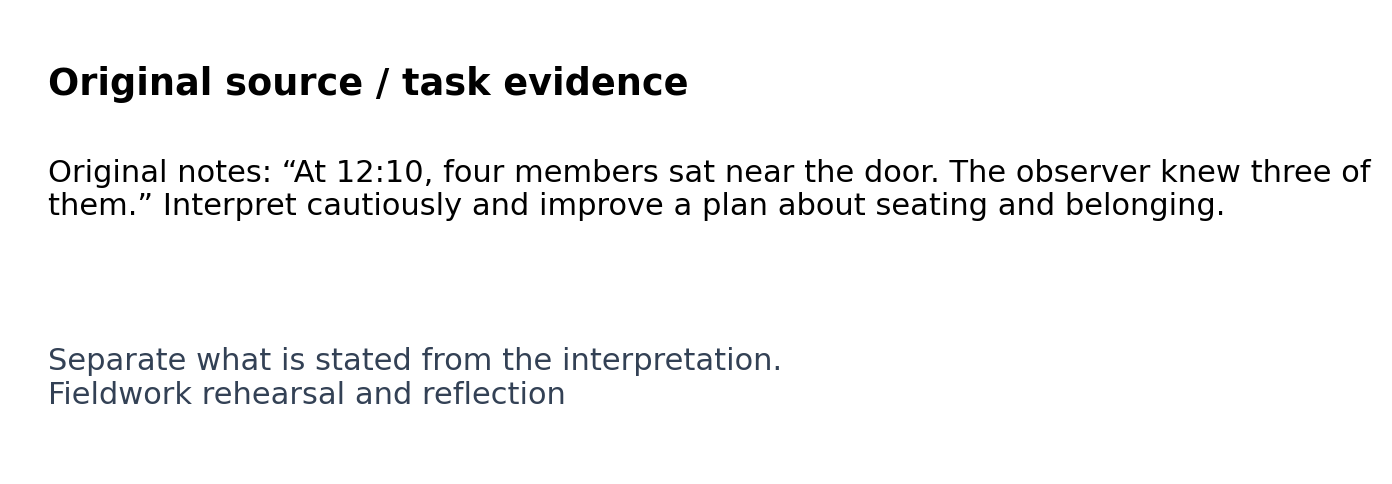
Original notes: “At 12:10, four members sat near the door. The observer knew three of them.” Interpret cautiously and improve a plan about seating and belonging.
The description records a location and count. Friendship, status and exclusion are hypotheses. Repeat observations at comparable times and ask voluntary, non-leading questions where approved. Record how the observer's friendships influence access and interpretation. Do not label identifiable people or assume consent from silence.
Independent transfer
The second seating observation breaks the initial pattern. How should the analysis respond?
Attempt independently before reading the model.
Checked original model
Retain the exception and compare timing, activity and participants. Revise a general friendship claim to a bounded observed pattern unless further evidence supports it. A discrepant observation can test the interpretation; deleting it would conceal evidence.
These are authored formative expectations, not official IB descriptors. Accept other justified arguments with evidence and material limits.
Source and task holds
This supplement teaches the method for this part of the course. The full assessment criteria and any texts your school chooses come from your teacher.
Interactive lessons on this topic
Work through it step by step, with instant-check exercises.