Skip to content
Subjects

GRE · GRE Subject Test · GRE Mathematics

  • 1

    C.1 · Single-variable calculus and applications

    1

    Scope and prerequisites

    Undergraduate GRE preparation. Local objectives within the reviewed ETS scope; this is original teaching, not an official test or score predictor.

    Prerequisites: Exact algebra, trigonometry in radians, functions and inequalities.

    • Use limits, continuity and differentiability
    • Apply derivatives, integrals and the fundamental theorem
    • Recognise Riemann sums and distinguish them from infinite series

    continuity 连续性: Agreement of a function value with its limit.

    convergence 收敛: Approach to a finite limiting value.

    Vocabulary Train
    English
    continuity/kɒntɪˈnjuːɪti/
    convergence/kənˈvɜːdʒəns/
    1

    Choose and justify a method

    A limit describes values near a point, without requiring the function to be defined there. Continuity adds the requirement that the function value exists and agrees with the limit. Algebraic cancellation is valid only away from the cancelled zero, but can reveal a removable limit. One-sided limits must agree for a two-sided limit. For quotient limits, check the denominator and hypotheses before applying a rule; 0/0 is an indeterminate form, not an answer.

    A derivative is a limit of difference quotients and implies continuity; the converse fails, as |x| at zero shows. Product, quotient and chain rules describe different structures: the derivative of f(g(x)) is f′(g(x))g′(x), not a product of unrelated values. Differentiating a composition a second time generally produces two terms. Check domains, nonzero denominators and differentiability assumptions before using a symbolic expression as a derivative.

    The fundamental theorem says that the derivative of ∫ from a to x of a continuous integrand f(t) is f(x). With a variable upper bound h(x), multiply by h′(x); with two variable bounds, subtract the corresponding lower-bound contribution. A definite integral also arises as a limit of Riemann sums. Rewrite the sum as (1/n)Σf(k/n) before identifying the integral on [0,1], rather than treating n-dependent terms as constants.

    For example Σ from k=1 to n of n/(n²+k²) equals (1/n)Σ1/(1+(k/n)²), tending to ∫₀¹1/(1+t²)dt=π/4. This limit uses continuity and the partition width 1/n. A series over an unbounded number of terms is a different limit: terms tending to zero do not alone guarantee convergence. For Σ1/k the partial sums diverge; compare, estimate or apply a valid series test instead of using the necessary term condition as sufficient.

    1

    Worked reasoning

    For F(x)=integral from 0 to x² of e^t dt, the fundamental theorem and chain rule give F′(x)=e^(x²)·2x. At x=1, F′(1)=2e. The upper limit is x², so omitting 2x misses its rate of change.

    Single-variable calculus and applications: course example
    Original course illustration; its values belong to the worked example, not the later practice.
    1

    Conditions and counterexamples

    A-level calculus is useful prerequisite material but does not cover the undergraduate analysis and applications tested here.

    1

    Guided application

    Let $F(x)=\int_x^{x^2}(1+t^2)\,dt$. Find $F'(x)$ and $F'(2)$. State why the theorem applies.

    Worked solution

    The integrand is continuous on the real line. The fundamental theorem and chain rule apply at both bounds:

    $$F'(x)=(1+x^4)2x-(1+x^2).$$
    $$F'(2)=(1+2^4)\,2\cdot2-(1+2^2)=63.$$
    Independently, an antiderivative is $t+t^3/3$. Thus $F=x^2+x^6/3-x-x^3/3$, with the same derivative.

    1

    Independent transfer

    Find $\lim_{n\to\infty}\sum_{k=1}^n k/(n^2+k^2)$. Explain why this is a Riemann-sum limit. Then decide whether $\sum_{k=1}^{\infty}1/k$ converges.

    Check after attempting

    Rewrite each term as $\frac1n\frac{k/n}{1+(k/n)^2}$. The continuous function $f(t)=t/(1+t^2)$ on $[0,1]$ and mesh $1/n$ give

    $$L=\int_0^1\frac{t}{1+t^2}\,dt=\frac12\ln2.$$
    The harmonic series diverges: the block from $2^{j-1}+1$ through $2^j$ contains $2^{j-1}$ terms at least $1/2^j$, so each block adds at least $1/2$. Terms tending to zero is necessary but insufficient. The finite-sum integrand here depends on the scaled index; it is not the harmonic series.

  • 2

    C.2 · Multivariable calculus and vector analysis

    2

    Scope and prerequisites

    Undergraduate GRE preparation. Local objectives within the reviewed ETS scope; this is original teaching, not an official test or score predictor.

    Prerequisites: Single-variable derivatives, dot products and iterated integration.

    • Compute partial derivatives, gradients and directional derivatives
    • Use multiple integrals and coordinate changes
    • Use derivative conditions to distinguish planes from curved surfaces

    gradient 梯度: Vector of partial derivatives.

    Jacobian 雅可比行列式: The local area or volume scaling in a coordinate change.

    Vocabulary Train
    English
    gradient/ˈɡreɪdɪənt/
    Jacobian/dʒæˈkəʊbɪən/
    2

    Choose and justify a method

    A partial derivative changes one coordinate while fixing the others. For f=x²+3xy, f_x=2x+3y and f_y=3x. The gradient collects these derivatives; if f is differentiable, the directional derivative along a unit vector v is grad f·v. Normalise the direction before taking this dot product. A direction vector of length two would double the answer if used without normalisation.

    Differentiability means a valid linear approximation, not merely the existence of some partial derivatives at one point. Continuous first partials in a neighbourhood are a sufficient condition. For a composition f(x(t),y(t)), the chain rule gives f_x x′+f_y y′. Second derivatives can introduce both direct and mixed terms; a zero mixed partial alone places no restriction on the pure second partials.

    A multiple integral sums contributions over a specified region. Describe the region before choosing iterated limits; nonrectangular bounds may change when the order changes. In polar coordinates area is r dr dtheta, not just dr dtheta. A general coordinate change uses the absolute Jacobian determinant. Sign belongs to oriented vector quantities, while area and volume scaling use a nonnegative factor.

    If both first partials of a globally defined function on R² are constant, f_x=a and f_y=b, integrating successively gives f=ax+by+c, a plane. This cannot be inferred from parallel straight level sets alone: e^x has vertical parallel level lines but a curved graph. Nor do f_xy=f_yx=0 force a plane: x²+y² is a counterexample. Distinguish first-derivative constancy from absent mixed dependence and from the shape of selected level sets.

    2

    Worked reasoning

    For f(x,y)=x²+3y², gradient f=(2x,6y). At (1,1) this is (2,6). In direction (3,4), the unit vector is (3/5,4/5), giving directional derivative 2·3/5+6·4/5=6.

    Multivariable calculus and vector analysis: course example
    Original course illustration; its values belong to the worked example, not the later practice.
    2

    Conditions and counterexamples

    A non-unit direction vector gives a scaled directional rate, not the derivative per unit distance.

    2

    Guided application

    For $f(x,y)=x^2+xy+2y^2$, find the directional derivative at $(1,-1)$ towards $(3,4)$. Evaluate $\iint_D(x^2+y^2)\,dA$ for the unit disk $D$.

    Worked solution

    The polynomial is differentiable. Normalise the direction: $u=(3/5,4/5)$. The gradient is $(2x+y,x+4y)$, hence $(1,-3)$ at the point.

    $$D_uf(1,-1)=\nabla f(1,-1)\cdot u=1\cdot3/5-3\cdot4/5=-9/5.$$
    Polar coordinates give $x^2+y^2=r^2$ and $dA=r\,dr\,d\theta$:
    $$I=\int_0^{2\pi}\int_0^1r^3\,dr\,d\theta=\pi/2.$$

    2

    Independent transfer

    Define $g(x,y)=xy/\sqrt{x^2+y^2}$ away from the origin and $g(0,0)=0$. Both partial derivatives at the origin are zero. Is $g$ differentiable there? Is it continuous?

    Check after attempting

    Along each axis $g=0$, so both partials are zero. Continuity follows from $|xy|\le(x^2+y^2)/2$, which gives $|g(x,y)|\le\sqrt{x^2+y^2}/2\to0$. If differentiable, its linear derivative would be zero. Along $x=y=t\ne0$,

    $$\frac{|g(t,t)|}{\sqrt{t^2+t^2}}=\frac12.$$
    The required remainder ratio does not tend to zero. Thus continuity and existing partial derivatives do not establish differentiability.

  • 3

    A.1 · Linear algebra

    3

    Scope and prerequisites

    Undergraduate GRE preparation. Local objectives within the reviewed ETS scope; this is original teaching, not an official test or score predictor.

    Prerequisites: Linear equations, matrix multiplication, polynomials and complex roots.

    • Relate rank, nullity and solutions of linear systems
    • Analyse vector spaces and linear transformations
    • Compute eigenvalues, determinants and diagonalisation conditions

    rank 秩: Dimension of the image of a linear map.

    eigenvalue 特征值: A scalar satisfying Av=λv for a nonzero v.

    Vocabulary Train
    English
    rank/ræŋk/
    eigenvalue/ˈaɪdʒənvæljuː/
    3

    Choose and justify a method

    A real vector space is closed under its specified addition and scalar multiplication and satisfies the vector-space axioms. A basis is an independent spanning list: every vector has a unique coordinate representation in that list. To test independence of matrix columns, solve the homogeneous system Ac=0; only the zero coefficient vector means independence. A spanning set can contain redundant vectors, so spanning alone does not make a basis.

    Row reduction exposes pivots and free variables without changing the solution set of a linear system. Rank is the dimension of the column image, equivalently the number of pivots. Nullity is the kernel dimension: for a map from an n-dimensional domain, rank+nullity=n. In a nonhomogeneous system, a zero coefficient row with nonzero right side means inconsistency; free variables give infinitely many solutions only after consistency has been established. The codomain dimension need not equal rank.

    A square matrix is invertible exactly when its determinant is nonzero, its kernel is zero and its rank equals its size. These statements do not require each entry to be nonzero. Triangular determinants are products of diagonal entries, so a matrix depending on a complex variable can be singular at complex roots absent from a real-only calculation. Row swaps reverse determinant sign; adding a multiple of one row to another leaves it unchanged. Check singularity before applying an inverse formula.

    An eigenvector is nonzero and satisfies Av=λv, so eigenvalues are roots of det(A−λI). Diagonalisation requires a full independent eigenvector basis over the chosen field. Distinct eigenvalues give independent eigenvectors, while repeated eigenvalues may have too small an eigenspace. A real symmetric matrix has a real orthonormal eigenbasis. A real odd-dimensional matrix has at least one real eigenvalue because its real characteristic polynomial has odd degree; that alone does not imply diagonalisation or all eigenvalues real.

    3

    Worked reasoning

    A=[[1,1],[0,1]] has characteristic polynomial (1−λ)². Eigenvectors satisfy y=0, so its eigenspace has dimension one. Two independent eigenvectors are needed to diagonalise a 2×2 matrix; A is not diagonalizable.

    Linear algebra: course example
    Original course illustration; its values belong to the worked example, not the later practice.
    3

    Conditions and counterexamples

    The algebraic multiplicity of an eigenvalue is not automatically the dimension of its eigenspace.

    3

    Guided application

    For $T:\mathbb R^3\to\mathbb R^2$ with $T(x,y,z)=(x+2y+z,2x+4y+2z)$, find bases of the kernel and image. Solve $T(v)=(3,6)$ and $T(v)=(3,7)$.

    Worked solution

    The second row is twice the first, so rank is one. The homogeneous equation gives $x=-2y-z$.

    $$\ker T=\operatorname{span}\{(-2,1,0),(-1,0,1)\}.$$
    The two displayed vectors are independent. Every output is $(s,2s)$, and $(1,2)$ occurs; this is an image basis. Rank plus nullity is $1+2=3$, the domain dimension. For $(3,6)$, all solutions are $(3-2a-b,a,b)$, with $a,b\in\mathbb R$. For $(3,7)$ there is no solution, since $7\ne2\cdot3$.

    3

    Independent transfer

    Let $A=\begin{pmatrix}2&1\\0&2\end{pmatrix}$. Determine its eigenvalues, determinant and diagonalisation over $\mathbb R$ and $\mathbb C$. Find $A^n$ for integers $n\ge1$ without repeated multiplication.

    Check after attempting

    The characteristic polynomial is $(2-\lambda)^2$ and $\det A=4$. Solving $(A-2I)v=0$ gives $v_2=0$, so the eigenspace has dimension one over either field. Two independent eigenvectors are required; the matrix is invertible but not diagonalizable over either field. Write $A=2I+N$ where $N^2=0$. The commuting binomial expansion leaves only two terms:

    $$A^n=2^nI+n2^{n-1}N=\begin{pmatrix}2^n&n2^{n-1}\\0&2^n\end{pmatrix}.$$
    Multiplying this expression by $A$ gives the formula at $n+1$, independently checking the coefficient.

  • 4

    A.2 · Abstract algebra and number theory

    4

    Scope and prerequisites

    Undergraduate GRE preparation. Local objectives within the reviewed ETS scope; this is original teaching, not an official test or score predictor.

    Prerequisites: Integer arithmetic, sets, functions and proof by counterexample.

    • Use groups, subgroups, homomorphisms and quotient structures
    • Distinguish rings, integral domains and fields
    • Apply divisibility, congruences and elementary number theory

    homomorphism 同态: A map preserving the relevant operation.

    field 域: A commutative ring where each nonzero element has an inverse.

    Vocabulary Train
    English
    homomorphism/ˈhɒməmɔːfɪzəm/
    field/fiːld/
    4

    Choose and justify a method

    A group needs closure, associativity, identity and inverses. Commutativity is an additional condition.

    A homomorphism preserves the operation. Its kernel is a normal subgroup and identifies elements mapping to the identity.

    A field permits division by every nonzero element. Integers form a ring but not a field.

    Work with congruences modulo n. A residue a has a multiplicative inverse exactly when gcd(a,n)=1.

    4

    Worked reasoning

    Modulo 8, 3 has inverse 3 because 3·3=9≡1. But 2 has no inverse because gcd(2,8)=2. Modulo a prime, every nonzero residue has an inverse; this gives a finite field.

    Abstract algebra and number theory: course example
    Original course illustration; its values belong to the worked example, not the later practice.
    4

    Conditions and counterexamples

    Do not cancel a factor in a modular equation without checking that it is invertible.

    4

    Guided application

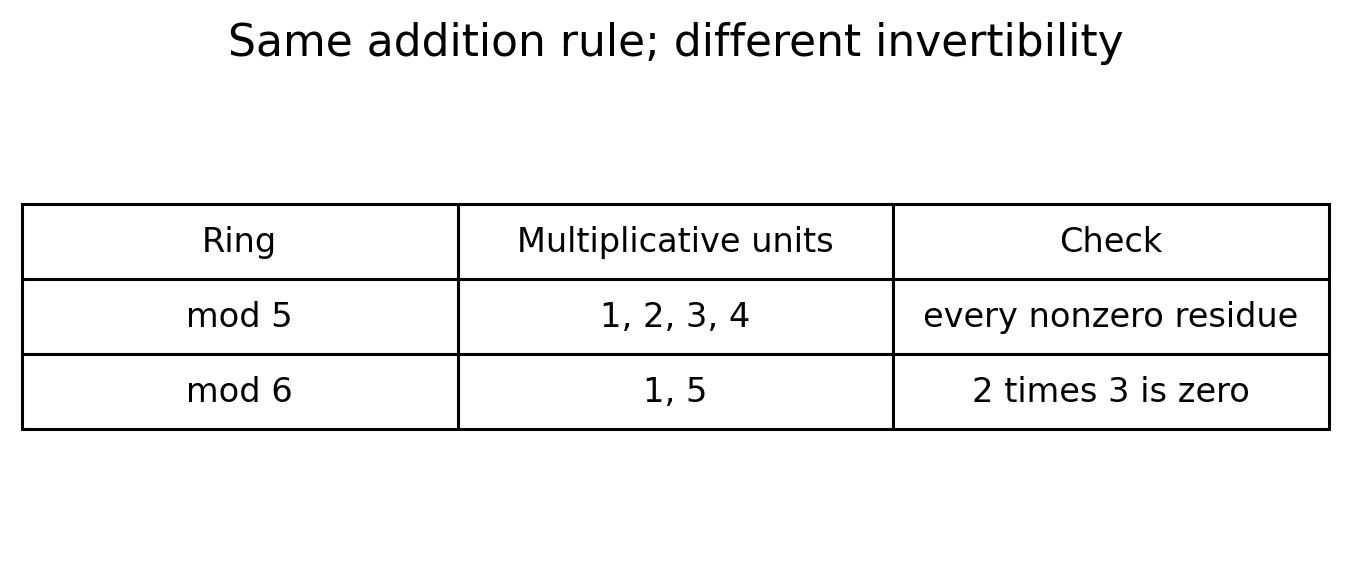
    Compare the additive groups and multiplicative structures of $\mathbb Z/5\mathbb Z$ and $\mathbb Z/6\mathbb Z$. List all multiplicative units in each. Explain why removing zero does not always leave a multiplicative group.

    Worked solution

    Both whole residue sets are additive groups: closure, associativity and identity come from integer addition, and $-a$ is an additive inverse. A multiplicative residue is a unit precisely when its greatest common divisor with the modulus is one. The units modulo five are $1,2,3,4$; modulo six they are $1,5$. Modulo six, $2\cdot3=0$ although both factors are nonzero. The nonzero set is not even closed under multiplication. Modulo five every nonzero residue has an inverse; this ring is a field. A ring, its additive group and its group of units are different structures.

    4

    Independent transfer

    The reduction map $\phi:\mathbb Z\to\mathbb Z/6\mathbb Z$ is given by $\phi(n)=[n]$. Determine its kernel, image and quotient. Solve $2x\equiv2\pmod6$ completely and explain why cancelling 2 modulo 6 fails.

    Check after attempting

    The map preserves addition and multiplication. Its kernel is $6\mathbb Z$ and its image is all six residues. The quotient identifies integers with the same remainder, so $\mathbb Z/\ker\phi\cong\mathbb Z/6\mathbb Z$. The congruence means $6\mid2(x-1)$, equivalently $3\mid x-1$. Hence $x\equiv1\pmod3$, giving residues $1$ and $4$ modulo six. Both substitute correctly. Cancelling 2 while retaining modulus six would discard 4; 2 has no multiplicative inverse there.

  • 5

    T.1 · Real analysis and topology

    5

    Scope and prerequisites

    Undergraduate GRE preparation. Local objectives within the reviewed ETS scope; this is original teaching, not an official test or score predictor.

    Prerequisites: Quantified statements, inequalities, sequences and continuous functions.

    • Apply sequence and function limit definitions
    • Distinguish compactness, connectedness and completeness
    • Use metric-space and elementary topological reasoning

    compact 紧致的: Every open cover has a finite subcover.

    supremum 上确界: The least upper bound of a set.

    Vocabulary Train
    English
    compact/kəmˈpækt/
    supremum/suːˈpreməm/
    5

    Choose and justify a method

    An epsilon–delta statement controls all sufficiently close inputs. The quantifier order matters.

    In real Euclidean space, closed and bounded sets are compact. Do not apply this equivalence to every metric space.

    Continuous images of compact sets are compact, so a real continuous function on a compact domain attains extrema.

    Connectedness rules out a separation into disjoint nonempty open parts. Continuity preserves connectedness; completeness is a separate property.

    5

    Worked reasoning

    f(x)=x on (0,1) is continuous and bounded but never equals its supremum 1. On [0,1], the same function attains its maximum at 1. The missing endpoint explains why the compact-domain theorem does not apply to the first case.

    Real analysis and topology: course example
    Original course illustration; its values belong to the worked example, not the later practice.
    5

    Conditions and counterexamples

    A theorem’s conclusion cannot be used before its hypotheses have been checked.

    5

    Guided application

    Prove continuity of $f(x)=x^2$ at 2 using an explicit epsilon–delta choice. Explain separately why it attains a minimum on $[1,3]$.

    Worked solution

    Given $\epsilon>0$, choose $\delta=\min(1,\epsilon/5)$. If $|x-2|<\delta$, then $1, so $|x+2|<5$.

    $$|x^2-4|=|x-2||x+2|<5\delta\le\epsilon.$$
    The choice depends on epsilon, not on the later input x. The interval $[1,3]$ is nonempty and compact in the ordinary real metric. Continuity gives attained extrema. Here $x^2\ge1$, with equality at 1, so the minimum is 1.

    5

    Independent transfer

    In the metric space $X=(0,1)$ with ordinary distance, is X bounded? Is it closed in itself? Is it compact or complete? Explain why “closed and bounded implies compact” cannot be used here.

    Check after attempting

    X is bounded and closed relative to itself, since its complement in X is empty. The Cauchy sequence $1/(n+2)$ has no limit in X, so X is not complete and therefore not compact as a metric space. Directly, the relative open cover $\{(1/n,1):n\ge2\}$ covers X but has no finite subcover. Heine–Borel requires closed and bounded as a subset of Euclidean space, not merely closed in an arbitrary chosen space. X is not closed in $\mathbb R$. No theorem hypothesis may change its ambient space halfway through the argument.

  • 6

    T.2 · Discrete mathematics, probability and numerical methods

    6

    Scope and prerequisites

    Undergraduate GRE preparation. Local objectives within the reviewed ETS scope; this is original teaching, not an official test or score predictor.

    Prerequisites: Finite counting, elementary probability, recurrences and derivatives.

    • Use counting, recurrences, graph reasoning and logic
    • Calculate probabilities and distribution properties
    • Apply numerical approximation and assess error

    recurrence 递推关系: A rule linking a sequence term to earlier terms.

    mutually exclusive 互斥的: Events that cannot happen together.

    Vocabulary Train
    English
    recurrence/rɪˈkʌrəns/
    mutually exclusive/ˈmjuːtʃuːəli eksˈkluːsɪv/
    6

    Choose and justify a method

    Choose the counting model first: ordered selections of r distinct objects use n(n−1)⋯(n−r+1), while unordered subsets use C(n,r). A complete simple graph on n vertices has one edge per unordered vertex pair, giving n(n−1)/2 edges; loops and multiple edges would change the model. For n lines in general position in a plane, the kth line crosses the prior k−1 lines in distinct points and adds k regions. The total is 1+n(n+1)/2; parallels or triple concurrence invalidate that count.

    Use complements to count at least one occurrence, and condition on the actual remaining population after a draw without replacement. For r iid outcomes chosen from n equally likely values, the probability that all are distinct is n(n−1)⋯(n−r+1)/n^r when r≤n. Its complement counts repeated outcomes. For a binomial count with N independent trials and fixed success probability p, mean is Np and variance Np(1−p). Identical probabilities alone do not establish independence.

    A recurrence describes later values from earlier ones and needs enough initial data to determine a sequence. Separate the index from the value: a_n=2a_(n−1) with a_0=3 gives a_n=3·2^n. Graph and algorithm arguments often establish a recurrence by identifying what a new vertex or step adds. A closed formula should satisfy both the recurrence and its initial conditions; fitting a few observed terms does not prove it for every index.

    Numerical approximation needs an error argument. Bisection preserves a sign-changing bracket for a continuous function and halves its width at each step; a zero may be absent if continuity fails. Newton’s update is x_new=x−f(x)/f′(x), requiring a nonzero derivative at the current point; convergence is not automatic from every starting value. An approximation’s residual and its error in x are different. State the method’s assumptions and a stopping criterion, rather than treating extra displayed decimals as accuracy.

    6

    Worked reasoning

    For f(x)=x²−2 and x₀=1, Newton’s step gives 1−(1−2)/2=1.5. The next value is 1.5−0.25/3=1.4167. These approximate sqrt(2), but f′(0)=0 makes zero an invalid starting point.

    Discrete mathematics, probability and numerical methods: course example
    Original course illustration; its values belong to the worked example, not the later practice.
    6

    Conditions and counterexamples

    Events with positive probabilities cannot be both independent and mutually exclusive.

    6

    Guided application

    Four labelled draws are independent and uniform from five symbols, with replacement. Find the probability that at least two draws agree. Compare the number of ordered and unordered selections of four distinct symbols.

    Worked solution

    There are $5^4$ equally likely ordered draw strings. The no-repeat strings number $5\cdot4\cdot3\cdot2=120$.

    $$P(\text{repeat})=1-\frac{5\cdot4\cdot3\cdot2}{5^4}=\frac{101}{125}.$$
    Ordered distinct selections number 120; unordered subsets number $\binom54=5$. Each subset occurs in $4!=24$ orders. Dividing by $4!$ is appropriate only for the unordered count, not the draw probability denominator.

    6

    Independent transfer

    Apply bisection to $f(x)=x^3-2$ on $[1,2]$. Give the first two retained brackets and a bound for midpoint error after ten bisections. Would a sign change alone justify bisection for $1/x$ on $[-1,1]$?

    Check after attempting

    The polynomial is continuous; $f(1)<0. The first midpoint is $1.5$ with positive value, retaining $[1,1.5]$. The next is $1.25$ with negative value, retaining $[1.25,1.5]$. After ten halvings, width is $2^{-10}$ and the midpoint of that retained bracket differs from the bracketed root by at most $2^{-11}=1/2048$. The error bound uses the bracket, not a small residual alone. For $1/x$, zero is a singularity and there is no root. Continuity on the bracket fails; opposite endpoint signs do not justify the method.

  • 7

    T.3 · Complex analysis and residues

    7

    Scope and prerequisites

    Undergraduate GRE preparation. Local objectives within the reviewed ETS scope; this is original teaching, not an official test or score predictor.

    Prerequisites: Complex arithmetic, partial derivatives, series and oriented contours.

    • Test complex differentiability
    • Use contour integrals and residues
    • Evaluate contour integrals with simple and higher-order pole residues

    analytic 解析的: Complex differentiable throughout a neighbourhood.

    residue 留数: Coefficient of (z−a)^−1 in a Laurent series.

    Vocabulary Train
    English
    analytic/ˌænəˈlɪtɪk/
    residue/ˈresɪdjuː/
    7

    Choose and justify a method

    Write f(z)=u(x,y)+iv(x,y). Complex differentiability imposes u_x=v_y and u_y=−v_x; with continuous first partials locally, the Cauchy–Riemann equations establish analyticity there. They differ from real differentiability of a two-coordinate map. The conjugate function x−iy fails these equations on every open neighbourhood, although real partial derivatives exist. State the region being checked, not only a convenient point.

    An analytic function is complex differentiable throughout a neighbourhood and has a local convergent power series. A removable singularity can be filled analytically when the function is bounded near the missing point. A pole has a finite principal part in its Laurent series; an essential singularity has infinitely many negative-power terms. The residue is the coefficient of (z−a)⁻¹, not necessarily the leading or largest negative-power term.

    For an isolated pole of order m, write f(z)=g(z)/(z−a)^m with g analytic at a. The residue is g^(m−1)(a)/(m−1)!. A simple pole uses g(a); a double pole uses g′(a). This follows by expanding g into its Taylor series. Thus e^z/(z−a)² has residue e^a, while a constant numerator over a pure double pole has zero residue. The pole order alone does not determine the contour integral.

    For a positively oriented contour enclosing isolated singularities, the residue theorem gives ∮f(z)dz=2πi times the sum of enclosed residues, provided the function is analytic on the contour and elsewhere in the required interior. Reversing orientation changes the sign. Cauchy’s derivative formula is ∮g(z)/(z−a)^(m+1)dz=2πi g^(m)(a)/m! under its analytic-domain hypotheses. A singularity on the contour prevents direct application; a singularity outside contributes nothing to this contour.

    7

    Worked reasoning

    For f(z)=conjugate(z), u=x and v=−y. Then u_x=1 but v_y=−1, so f is not complex differentiable. For 1/(z−2), a positively oriented circle |z−2|=1 encloses a simple pole of residue 1, hence the integral is 2πi.

    Complex analysis and residues: course example
    Original course illustration; its values belong to the worked example, not the later practice.
    7

    Conditions and counterexamples

    Continuity or real differentiability alone does not imply complex analyticity.

    7

    Guided application

    Use the Cauchy–Riemann equations to compare $z^2$ and $\overline z$. Find the residue of $e^z/z^2$ at zero and its integral around the counterclockwise unit circle.

    Worked solution

    For $z^2$, $u=x^2-y^2$ and $v=2xy$: $u_x=2x=v_y$ and $u_y=-2y=-v_x$. The partials are continuous everywhere, so the function is analytic everywhere. For $\overline z$, $u=x,v=-y$ and $u_x=1\ne-1=v_y$; it is nowhere complex differentiable. Since $e^z=1+z+z^2/2+\cdots$, the coefficient of $z^{-1}$ in $e^z/z^2$ is 1. Therefore the residue is 1 and the integral is $2\pi i$. The double pole does not force a zero residue.

    7

    Independent transfer

    Integrate $1/[z(z-2)]$ around $|z|=1$, first counterclockwise and then clockwise. Can the same residue-theorem argument be used on $|z|=2$?

    Check after attempting

    Only zero is inside the unit circle. Its residue is $\lim_{z\to0}1/(z-2)=-1/2$. Thus the counterclockwise integral is $-\pi i$ and the clockwise integral is $\pi i$. The pole at 2 is outside and contributes nothing. The circle $|z|=2$ passes through a pole. The ordinary contour integral is not defined by this formula; the theorem requires analyticity on the contour. An indentation or principal-value prescription would be a different, explicitly specified problem.

  • 8

    C.3 · Differential equations and initial conditions

    8

    Scope and prerequisites

    Undergraduate GRE preparation. Local objectives within the reviewed ETS scope; this is original teaching, not an official test or score predictor.

    Prerequisites: Differentiation, integration, exponentials and quadratic equations.

    • Solve separable first-order equations
    • Solve constant-coefficient second-order equations
    • Use initial conditions and uniqueness conditions

    initial condition 初始条件: A value of the solution or derivative specified at a starting point.

    characteristic root 特征根: A root of the polynomial governing exponential solutions.

    Vocabulary Train
    English
    initial condition/ɪˈnɪʃl kənˈdɪʃn/
    characteristic root/ˌkærɪktəˈrɪstɪk ruːt/
    8

    Choose and justify a method

    For y′=ky, separation and integration give y=Ce^(kt); recover the zero solution if division by y was used. An initial value determines C.

    A linear second-order constant-coefficient equation uses a characteristic polynomial. Distinct roots yield exponentials; a repeated root requires (C1+C2t)e^(rt).

    Complex roots α±iβ give e^(αt)(C1 cos βt+C2 sin βt). The real motion includes both amplitude and phase information.

    Existence and uniqueness depend on hypotheses near the initial point. A singular coefficient or a failure of local Lipschitz behaviour can defeat the familiar uniqueness conclusion.

    8

    Worked reasoning

    Solve y″+4y=0 with y(0)=3 and y′(0)=4. The characteristic roots are ±2i, so y=A cos2t+B sin2t. The first condition gives A=3; differentiating gives y′(0)=2B=4, so B=2.

    Differential equations and initial conditions: course example
    Original course illustration; its values belong to the worked example, not the later practice.
    8

    Conditions and counterexamples

    A repeated characteristic root needs the factor t; two copies of the same exponential are not independent solutions.

    8

    Guided application

    Solve $y''-4y'+4y=0$ with $y(0)=1$, $y'(0)=0$. Check both initial conditions and the equation.

    Worked solution

    The characteristic polynomial is $(r-2)^2$. Independent solutions are $e^{2t}$ and $te^{2t}$, hence $y=(C_1+C_2t)e^{2t}$. The initial value gives $C_1=1$; the derivative at zero gives $2C_1+C_2=0$, so $C_2=-2$.

    $$y(t)=(1-2t)e^{2t},\quad y'(t)=-4te^{2t},\quad y''(t)=(-4-8t)e^{2t}.$$
    Substitution gives $y''-4y'+4y=0$, and the two initial values hold. Two copies of $e^{2t}$ would not span the solution space.

    8

    Independent transfer

    Show that the initial-value problem $y'=2\sqrt{|y|}$, $y(0)=0$ has more than one solution for $t\ge0$. Identify the missing standard uniqueness hypothesis.

    Check after attempting

    One solution is identically zero. For any $a\ge0$, set $y_a(t)=0$ for $0\le t\le a$ and $y_a(t)=(t-a)^2$ for $t>a$. The derivative is zero on the first interval and $2(t-a)$ on the second; both sides have derivative zero at a. Therefore $y_a$ is differentiable and satisfies the equation and initial value. The right side is continuous but is not locally Lipschitz in y at zero: $|2\sqrt h-0|/|h|=2/\sqrt h$ is unbounded. Existence does not imply uniqueness, and division by $\sqrt y$ would lose the waiting-time solutions.

  • 9

    A.3 · Groups, cosets and quotient maps

    9

    Scope and prerequisites

    Undergraduate GRE preparation. Local objectives within the reviewed ETS scope; this is original teaching, not an official test or score predictor.

    Prerequisites: Group axioms, functions, integer divisibility and permutations.

    • Verify group structure and compute element orders and subgroup indices
    • Use kernels and images to identify quotient groups
    • Distinguish normal subgroups from arbitrary subgroups
    • Classify permutation conjugacy by cycle type

    coset 陪集: A translate of a subgroup that forms one part of the coset partition.

    normal subgroup 正规子群: A subgroup invariant under conjugation by every group element.

    Vocabulary Train
    English
    coset/ˈkɒset/
    normal subgroup/ˈnɔːml ˈsʌbɡruːp/
    9

    Choose and justify a method

    Before computing an order, check closure, associativity, an identity and an inverse for every element under the stated operation. A subset can inherit associativity yet fail closure or omit the identity. In a finite group, the order of an element is the least positive power giving the identity. In the additive group Z/nZ, it is the least positive multiple giving zero; the order of residue a is n/gcd(a,n). Lagrange's theorem says subgroup orders divide the group order. The converse is not a general existence theorem, and the order of a group is not the order of each element.

    A left coset gH is a translate of a subgroup H. Cosets have equal size and partition the group, so the index is |G|/|H| in a finite group. In an additive group write g+H. Membership in the same coset means the difference lies in H. A coset usually is not itself a subgroup because it may omit the identity.

    A homomorphism preserves the operation. Its kernel consists of elements sent to the identity, and its image consists of values actually reached. Every kernel is normal. The first isomorphism theorem identifies G/ker(phi) with im(phi); do not replace the image with the whole codomain unless the map is onto.

    Quotient multiplication is well defined only when H is normal. All subgroups of an abelian group are normal. In a nonabelian group test gHg^−1=H; a subgroup of index two is normal. For permutations compose in the stated convention, here rightmost first. Disjoint cycle lengths give the permutation order by their least common multiple. Conjugation hσh⁻¹ relabels the elements in σ’s cycles, so it preserves cycle lengths; conversely permutations with the same cycle lengths can be related by a relabelling. Thus conjugacy classes in S_n correspond to partitions of n, including fixed-point cycles. In S4 the types are 1+1+1+1, 2+1+1, 2+2, 3+1 and 4: five classes, not one class for each possible element order. The types 2+1+1 and 2+2 both have order two but are not conjugate.

    9

    Worked reasoning

    Define phi from Z/12Z to Z/3Z by reducing residues modulo 3. It is onto and preserves addition. Its kernel H is {0,3,6,9}, so |H|=4 and the index is 12/4=3. The other cosets are {1,4,7,10} and {2,5,8,11}. Thus (Z/12Z)/H is isomorphic to Z/3Z. The element 3 in the original group has order 12/gcd(3,12)=4, not 3.

    Groups, cosets and quotient maps: course example
    Original course illustration; its values belong to the worked example, not the later practice.
    9

    Conditions and counterexamples

    A quotient has one element per coset, not one per element of its kernel. A homomorphism need not be onto its stated codomain.

    9

    Guided application

    In the additive group $\mathbb Z/18\mathbb Z$, let $H=\langle6\rangle$. List H and its cosets. Determine the order of 6 and identify the quotient.

    Worked solution

    $H=\{0,6,12\}$ has size three. The six cosets are $r+H=\{r,r+6,r+12\}$ for $r=0,1,2,3,4,5$. They partition all 18 residues. The element 6 has order three, while the quotient has order six. Reduction modulo six is onto with kernel H, so $(\mathbb Z/18\mathbb Z)/H\cong\mathbb Z/6\mathbb Z$. Normality holds because the original group is abelian.

    9

    Independent transfer

    In $S_3$, let $H=\{e,(12)\}$. Check whether $H$ is normal, and decide whether coset multiplication defines a quotient group. Separately find the order of $(123)(45)$ in $S_5$.

    Check after attempting

    Conjugation by $(123)$ sends $(12)$ to $(23)$, which is outside H. Thus H is not normal. Left cosets still partition $S_3$, but multiplication of those cosets is not well defined independently of representatives. The disjoint cycles in $(123)(45)$ have lengths three and two, so its order is $\operatorname{lcm}(3,2)=6$. Element order and subgroup index are different quantities.

  • 10

    A.4 · Rings, ideals and modules

    10

    Scope and prerequisites

    Undergraduate GRE preparation. Local objectives within the reviewed ETS scope; this is original teaching, not an official test or score predictor.

    Prerequisites: Rings, fields, additive subgroups and homomorphisms.

    • Distinguish units, zero divisors and integral domains
    • Identify ideals and interpret quotient rings
    • Compare modules over rings with vector spaces over fields
    • Derive Boolean-ring properties without assuming commutativity

    ideal 理想: An additive subgroup of a ring absorbing multiplication by all ring elements.

    torsion 挠性: An element is annihilated by a nonzero scalar in the stated module.

    Vocabulary Train
    English
    ideal/aɪˈdɪəl/
    torsion/ˈtɔːʃn/
    10

    Choose and justify a method

    For the domain, ideal and quotient examples below, use a commutative ring with identity 1 distinct from 0. A source problem may specify a general ring instead; do not assume its multiplication commutes unless stated or proved. A unit has a multiplicative inverse. A nonzero zero divisor multiplies some nonzero element to zero. An integral domain has no such zero divisors; cancellation of a nonzero factor then works. A field is a domain in which every nonzero element is a unit. Z is a domain but not a field; Z/6Z is neither.

    An ideal I is an additive subgroup that absorbs multiplication by every ring element. This is stronger than being a subring. In Z, nZ is an ideal; quotient elements are integer residue classes modulo n. In a commutative ring, R/I is a field exactly when I is maximal, and it is a domain exactly when I is prime. The ideal must be proper in both statements.

    A module allows scalars from a ring instead of requiring a field. Every abelian group is a Z-module by repeated addition, but it need not have a vector-space basis. In Z/6Z as a Z-module, 6 times the nonzero residue 1 is zero; this is torsion. For a vector space over a field, a nonzero scalar is invertible and cannot annihilate a nonzero vector.

    A submodule is closed under addition and all permitted scalar actions. A linear map of modules preserves both. The kernel and image are submodules, and the quotient by the kernel is isomorphic to the image. Do not apply finite-dimensional rank-nullity to an arbitrary module without establishing an appropriate free-module setting; integer row operations and field row operations permit different divisions. In a general Boolean ring, every a satisfies a²=a. Do not assume commutativity to prove it: idempotence of a+a gives 4a=2a, hence 2a=0. Expanding (a+b)²=a+b gives ab+ba=0, and characteristic two makes −ba=ba; therefore ab=ba. Idempotence does not imply nilpotence: in F2, the nonzero element 1 satisfies 1^n=1 for every positive n.

    10

    Worked reasoning

    In Z/6Z, 2·3=0, so 2 and 3 are zero divisors. The units are 1 and 5 because their gcd with 6 is 1. In Z, the ideal 5Z gives the field Z/5Z, while 6Z gives a quotient with zero divisors. As Z-modules, the map from Z to Z/6Z has kernel 6Z; the quotient identifies integers differing by a multiple of 6, rather than producing a real vector space.

    Rings, ideals and modules: course example
    Original course illustration; its values belong to the worked example, not the later practice.
    10

    Conditions and counterexamples

    A set can be a submodule without being a vector space over the rationals. Scalar division is valid only when the scalar inverse belongs to the structure.

    10

    Guided application

    In $\mathbb Z/12\mathbb Z$, list the units and nonzero zero divisors. Is the ideal $(4)$ prime or maximal?

    Worked solution

    Units are the residues coprime to 12: $1,5,7,11$. The remaining nonzero residues $2,3,4,6,8,9,10$ are zero divisors. For each such a, $a\cdot(12/\gcd(a,12))=0$ modulo 12, with the second factor nonzero. The ideal $(4)=\{0,4,8\}$ gives quotient isomorphic to $\mathbb Z/4\mathbb Z$. This is not a domain, since $2\cdot2=0$, and is not a field. Hence the ideal is neither prime nor maximal.

    10

    Independent transfer

    As a $\mathbb Z$-module, can $\mathbb Z/6\mathbb Z$ be free? Compare the ideals $(2)$ and $(x)$ in $\mathbb Z$ and $\mathbb Q[x]$, respectively, using their quotients.

    Check after attempting

    A nonzero free $\mathbb Z$-module has no nonzero vector annihilated by a nonzero integer: examine each integer coordinate. But $6[1]=0$ in $\mathbb Z/6\mathbb Z$. It is not free; a field-style basis argument is invalid. $\mathbb Z/(2)\cong\mathbb F_2$ is a field, so $(2)$ is maximal and prime. Evaluation at zero maps $\mathbb Q[x]$ onto $\mathbb Q$ with kernel $(x)$; its quotient is a field too. Both arguments use proper ideals in commutative rings with identity.

  • 11

    A.5 · Polynomials and field extensions

    11

    Scope and prerequisites

    Undergraduate GRE preparation. Local objectives within the reviewed ETS scope; this is original teaching, not an official test or score predictor.

    Prerequisites: Polynomial division, fields and vector-space dimension.

    • Test polynomial irreducibility over the specified field
    • Construct small finite fields from irreducible polynomials
    • Use extension degrees and the tower law
    • Use cyclotomic roots and coefficient relations to compute sums and products

    irreducible polynomial 不可约多项式: A positive-degree polynomial with no factorisation into smaller positive degrees over the stated field.

    extension degree 扩张次数: The dimension of an extension field as a vector space over its base field.

    Vocabulary Train
    English
    irreducible polynomial/ɪrɪˈdjuːsɪbl ˌpɒlɪˈnəʊmɪəl/
    extension degree/ekˈstenʃn dɪˈɡriː/
    11

    Choose and justify a method

    A polynomial is irreducible over a field if it has positive degree and no factorisation into polynomials of smaller positive degrees there. A quadratic or cubic is irreducible exactly when it has no root in that field. This root test alone fails for degree four or higher; for instance (x²+1)(x²+2) has no real root but is reducible over R. Always name the base field.

    The quotient F[x]/(p) is a field when p is irreducible. Reduce powers using p(alpha)=0, where alpha is the residue class of x. If F has q elements and p has degree d, the quotient has q^d elements represented by polynomials of degree below d. Z/4Z has four elements but has zero divisors, so it is not the field with four elements.

    Over F2, p(x)=x²+x+1 has values 1 at both 0 and 1 and is irreducible. In its quotient alpha²=alpha+1 because subtraction equals addition in characteristic two. The four elements are 0,1,alpha,alpha+1. All three nonzero elements must be units; compute their products rather than treating alpha as an ordinary real number.

    For nested finite-degree fields K inside L inside M, the tower law gives [M:K]=[M:L][L:K]. The degree of an algebraic element is the degree of its minimal polynomial. A finite extension of degree two does not contain an element of degree three over the base field. Over Q, sqrt(2) has degree two; adjoining sqrt(3) as well produces a degree-four extension, since sqrt(3) is not in Q(sqrt(2)). Over C, primitive nth roots of unity have exact order n and are the roots of the cyclotomic polynomial Φ_n. For n=10, divide x⁵+1 by x+1 to exclude the order-two root −1: Φ_10=x⁴−x³+x²−x+1. Vieta’s formulas give sum 1 and product 1 of its four primitive roots. Do not sum all tenth roots, or assume every nontrivial tenth root is primitive; a root’s order must be checked. For a monic degree d polynomial, product of its roots is (−1)^d times the constant coefficient.

    11

    Worked reasoning

    In F2[alpha] with alpha²+alpha+1=0, multiply alpha(alpha+1) = alpha² + alpha = (alpha+1) + alpha = 1. Thus alpha^−1=alpha+1. Also alpha³=1 and alpha is not 1, so its multiplicative order is 3. This produces a field of four elements. By contrast 2·2=0 in Z/4Z, proving that quotient is not a field.

    Polynomials and field extensions: course example
    Original course illustration; its values belong to the worked example, not the later practice.
    11

    Conditions and counterexamples

    Polynomial reducibility changes with the coefficient field. The polynomial x²−2 is irreducible over Q but splits over R.

    11

    Guided application

    Construct $\mathbb F_2[x]/(x^2+x+1)$. List its elements and find the inverse of the residue $\alpha=[x]$.

    Worked solution

    The quadratic takes value one at both elements of $\mathbb F_2$, so it has no root and is irreducible. Its quotient is a field. Division leaves a representative of degree below two: $0,1,\alpha,1+\alpha$. The relation is $\alpha^2=\alpha+1$ in characteristic two. Consequently $\alpha(\alpha+1)=\alpha^2+\alpha=1$, so $\alpha^{-1}=\alpha+1$. This is not $\mathbb Z/4\mathbb Z$, which has a nonzero zero divisor.

    11

    Independent transfer

    Is $x^4+4$ irreducible over $\mathbb Q$? Does the absence of rational roots answer that question? Can a degree-two extension of $\mathbb Q$ contain a root of an irreducible cubic over $\mathbb Q$?

    Check after attempting

    Direct multiplication gives $x^4+4=(x^2-2x+2)(x^2+2x+2)$, so it is reducible over $\mathbb Q$ despite having no real, hence no rational, roots. The no-root test characterises irreducibility only for degree two or three over a field. If an irreducible cubic root $\beta$ belonged to a degree-two extension L, then $\mathbb Q\subset\mathbb Q(\beta)\subset L$ and the tower law would make 3 divide 2. This is impossible. The conclusion uses irreducibility, not merely a cubic equation.

  • 12

    A.6 · Congruences, divisibility and arithmetic functions

    12

    Scope and prerequisites

    Undergraduate GRE preparation. Local objectives within the reviewed ETS scope; this is original teaching, not an official test or score predictor.

    Prerequisites: Euclidean algorithm, prime factors and modular arithmetic.

    • Solve linear congruences using gcd conditions
    • Combine coprime congruences with the Chinese remainder theorem
    • Apply Euler's theorem only to invertible residues
    • Use prime-exponent divisibility to find least admissible integers

    congruence 同余: Equality of residues because the modulus divides their difference.

    totient 欧拉函数: The count of residues coprime to the positive integer modulus.

    Vocabulary Train
    English
    congruence/ˈkɒŋɡruːəns/
    totient/ˈtəʊʃənt/
    12

    Choose and justify a method

    The equation ax≡b modulo n has a solution exactly when d=gcd(a,n) divides b. If it does, divide a,b,n by d to obtain an equation with an invertible coefficient. It has one residue solution modulo n/d and d distinct solutions modulo n. Dividing the coefficient but leaving the original modulus generally loses solutions. Prime factorisation gives another divisibility tool: if n^k must be divisible by a product of prime powers p^a, each prime exponent in n must be at least ceil(a/k). These minimum exponents independently produce the least positive admissible n. For n⁴ divisible by 2⁷·3⁵, n must contain 2² and 3², so the least value is 36. This is a prime-exponent condition, not a congruence solved by modular division.

    The extended Euclidean algorithm expresses gcd(a,n) as ua+vn. When the gcd is 1, u is an inverse of a modulo n. Choose a representative in the required range after reduction. For 7 and 26, 1=15·7−4·26, so 15 is the inverse of 7 modulo 26; verify the product to catch a sign error.

    For coprime positive moduli m,n, the Chinese remainder theorem gives exactly one solution modulo mn for each pair of residue conditions. Substitute x=r+mk into the second congruence and solve for k. If the moduli are not coprime, their residue values must agree modulo gcd(m,n); when consistent, uniqueness is modulo the least common multiple, not the product.

    Euler's totient phi(n) counts residues coprime to n. For distinct prime divisors p, phi(n)=n times the product of (1−1/p). Euler's theorem gives a^phi(n)≡1 only when gcd(a,n)=1. The prime case is Fermat's little theorem. Reduce exponents only after checking this condition; a nonunit can become zero under repeated powers instead.

    12

    Worked reasoning

    Solve 6x≡9 modulo 15. The gcd is 3 and divides 9. Divide all three quantities to get 2x≡3 modulo 5; the inverse of 2 is 3, so x≡9≡4 modulo 5. The original solutions modulo 15 are 4,9,14. For x≡2 modulo 4 and x≡3 modulo 7, write x=2+4k; then 4k≡1 modulo 7, giving k≡2. Hence x≡10 modulo 28.

    Congruences, divisibility and arithmetic functions: course example
    Original course illustration; its values belong to the worked example, not the later practice.
    12

    Conditions and counterexamples

    The expression a^phi(n)≡1 is false for arbitrary a. For example 2 is not invertible modulo 8 and 2^4 is zero modulo 8.

    12

    Guided application

    Solve $8x\equiv12\pmod{20}$ completely. Find an inverse of 7 modulo 20. Explain why Euler's theorem cannot be used to replace $2^8$ by 1 modulo 20.

    Worked solution

    The gcd is four and divides 12. Dividing all three numbers gives $2x\equiv3\pmod5$, so $x\equiv4\pmod5$. Modulo 20 the four answers are $4,9,14,19$; substitution gives remainder 12 each time. Since $7\cdot3=21$, the inverse of 7 is 3. Although $\phi(20)=8$, Euler's theorem requires a unit. The gcd of 2 and 20 is two, and $2^8=256\equiv16$, not 1.

    12

    Independent transfer

    Solve $x\equiv2\pmod6$, $x\equiv5\pmod9$, or prove inconsistency. State the modulus for uniqueness. Find the least positive n such that $2^5\cdot3^7$ divides $n^3$.

    Check after attempting

    The residues agree modulo the gcd three. Put $x=2+6k$: then $6k\equiv3\pmod9$, hence $2k\equiv1\pmod3$ and $k\equiv2\pmod3$. Thus $x\equiv14\pmod{18}$. The modulus is the lcm, not 54. For the divisibility problem, write prime exponents in n. They must satisfy $3a\ge5$, $3b\ge7$, so $a\ge2$, $b\ge3$. The least n is $2^2\cdot3^3=108$; other prime factors can only increase it.

  • 13

    T.4 · Sequences, series and uniform convergence

    13

    Scope and prerequisites

    Undergraduate GRE preparation. Local objectives within the reviewed ETS scope; this is original teaching, not an official test or score predictor.

    Prerequisites: Sequence limits, supremum, continuity and numerical series.

    • Use Cauchy, monotone convergence and subsequence criteria
    • Distinguish pointwise from uniform convergence of functions
    • Check hypotheses before interchanging limits and integrals

    Cauchy sequence 柯西序列: A sequence whose sufficiently late terms are arbitrarily close to one another.

    uniform convergence 一致收敛: Convergence with one error threshold index valid at every point of the domain.

    Vocabulary Train
    English
    Cauchy sequence/ˈkɔːtʃi ˈsiːkwəns/
    uniform convergence/ˈjuːnɪfɔːm kənˈvɜːdʒəns/
    13

    Choose and justify a method

    A convergent real sequence is Cauchy, and every real Cauchy sequence converges because R is complete. In Q a Cauchy sequence can approach an irrational number and fail to converge within Q. A bounded monotone real sequence converges. A bounded sequence need not converge, but Bolzano–Weierstrass guarantees a convergent subsequence; (-1)^n has two different subsequential limits.

    For a numerical series, absolute convergence implies convergence; conditional convergence does not allow arbitrary rearrangement without affecting the sum. The alternating harmonic series converges but its absolute-value series diverges. In a ratio test, a limit below 1 proves absolute convergence and one above 1 proves divergence; a limit equal to 1 is inconclusive, as both sum 1/n and sum 1/n² demonstrate.

    Pointwise convergence chooses an index N separately for each x and tolerance. Uniform convergence chooses one N that works for every x in the domain. For real-valued functions, check the supremum of |f_n−f| over the whole domain. A continuous pointwise limit does not by itself prove uniform convergence. Domain endpoints and shrinking peaks often distinguish the two notions.

    A uniform limit of continuous functions is continuous. On a closed bounded interval, uniform convergence of Riemann-integrable functions permits exchanging limit and integral. Exchanging derivatives needs extra hypotheses; uniform convergence of the functions alone is insufficient. The Weierstrass M-test establishes uniform absolute convergence of a series of functions if each term is bounded by M_n on the whole domain and sum M_n converges.

    13

    Worked reasoning

    On [0,1], f_n(x)=x^n tends to 0 for x<1 and to 1 at x=1. The limit is discontinuous, so convergence cannot be uniform; directly, the supremum error is 1, approached below 1. On [0,a] with 0≤a<1, the limit is zero and the supremum is a^n, which tends to zero, so convergence is uniform. Changing the domain changes the conclusion.

    Sequences, series and uniform convergence: course example
    Original course illustration; its values belong to the worked example, not the later practice.
    13

    Conditions and counterexamples

    Checking several fixed x values proves neither a supremum bound nor uniform convergence. The point producing the largest error may move with n.

    13

    Guided application

    Determine pointwise and uniform convergence of $f_n(x)=x^n$ on $[0,1]$ and on $[0,a]$ for fixed $0. Compare $\sum1/n^2$ with the alternating harmonic series for absolute convergence.

    Worked solution

    On $[0,1]$, the limit is zero for $x<1$ and one at 1. This limit is discontinuous, so continuous $f_n$ cannot converge uniformly. More directly the supremum error on $[0,1)$ is one. On $[0,a]$ the supremum is $a^n\to0$, so convergence is uniform to zero. The p-series with p=2 converges absolutely. The alternating harmonic series converges by decreasing terms tending to zero, but the absolute series diverges; its convergence is conditional.

    13

    Independent transfer

    Let $g_n(x)=\sin(nx)/n$ on $\mathbb R$. Is convergence uniform? May its derivatives converge to the derivative of its limit? Use an explicit point to decide.

    Check after attempting

    $\sup_{x\in\mathbb R}|g_n(x)|=1/n\to0$, so the functions converge uniformly to zero. But $g_n'(x)=\cos(nx)$, and at $x=0$ these derivatives are all 1. The derivative of the zero limit is 0. Thus uniform convergence of the functions alone does not justify differentiating a limit; additional derivative-convergence hypotheses are needed.

  • 14

    T.5 · Open sets, compactness and connectedness

    14

    Scope and prerequisites

    Undergraduate GRE preparation. Local objectives within the reviewed ETS scope; this is original teaching, not an official test or score predictor.

    Prerequisites: Sets, relative open sets, continuous functions and sequences.

    • Compute closure, interior and boundary in a stated space
    • Apply compactness and connectedness to continuous maps
    • Distinguish relative topology from the ambient Euclidean topology

    relative topology 相对拓扑: Open subsets inherited by intersecting a subspace with ambient open sets.

    connectedness 连通性: Absence of a separation into disjoint nonempty relatively open subsets.

    Vocabulary Train
    English
    relative topology/ˈrelətɪv təˈpɒlədʒi/
    connectedness/kəˈnektɪdnəs/
    14

    Choose and justify a method

    In a metric space, an open set contains a small ball around each of its points. The interior consists of such points; the closure includes all limit points; the boundary is closure minus interior. Open and closed are not mutually exclusive labels; the empty set and the whole space are both. In R, the set [0,1) has interior (0,1), closure [0,1] and boundary {0,1}.

    In a subspace X, an open set has the form X intersected with an ambient open set. Thus [0,1) is open relative to [0,2], using intersection with (-1,1), although it is not open in R. A set may also be relatively closed without being closed in the ambient space. Always state which space defines neighbourhoods and which metric is used.

    Compactness means every open cover has a finite subcover. In Euclidean R^n, Heine–Borel makes this equivalent to closed and bounded. In a metric space, compactness is equivalent to sequential compactness; completeness and boundedness alone do not suffice in arbitrary metric spaces. A continuous image of a compact set is compact, giving attained maxima and minima for real continuous functions on a nonempty compact domain.

    Connected sets cannot be separated into two disjoint nonempty relatively open parts; connected subsets of R are precisely intervals. A continuous image of a connected set is connected, which yields the intermediate value theorem. Path connectedness implies connectedness, but not conversely in every space. A compact set need not be connected, and a connected set need not be compact; a finite two-point set and an open interval supply the contrasting cases.

    14

    Worked reasoning

    Let X=[0,1] with its usual relative topology. The set U=[0,0.5) equals X intersected with (-1,0.5), so U is open in X. Its closure in X is [0,0.5], and its boundary in X is {0.5}; zero is an interior point relative to X. For a continuous f on X with f(0)<0<f(1), connectedness ensures a zero, while compactness separately ensures attained extrema.

    Open sets, compactness and connectedness: course example
    Original course illustration; its values belong to the worked example, not the later practice.
    14

    Conditions and counterexamples

    Heine–Borel's closed-and-bounded test is a Euclidean-space theorem. Connectedness and compactness answer different questions.

    14

    Guided application

    In $X=[0,2]$ with its relative topology, find the interior, closure and boundary of $A=[0,1)$. Is A open or closed in X?

    Worked solution

    $A=X\cap(-1,1)$ is open in X, so its relative interior is A. Its closure is $[0,1]$ and its boundary is $\{1\}$. Zero is interior relative to X because a sufficiently small ball in X has no negative part. A is not closed in X: the sequence $1-1/n$ for $n\ge2$ tends to the missing point 1. In the ambient real line, interior and boundary would instead be $(0,1)$ and $\{0,1\}$.

    14

    Independent transfer

    Give a compact disconnected real set and a connected noncompact real set. Must a continuous real function on the latter attain an extreme value? Explain which property gives the intermediate value theorem.

    Check after attempting

    The finite set $\{0,2\}$ is compact but disconnected. The interval $(0,1)$ is connected but not compact. The continuous identity function on $(0,1)$ attains neither a maximum nor a minimum. Connectedness makes a continuous real image an interval and therefore supplies intermediate values. Compactness instead makes a nonempty continuous real image attain its extreme values. Neither property substitutes for the other.

  • 15

    C.4 · Taylor expansions and power-series endpoints

    15

    Scope and prerequisites

    Undergraduate GRE preparation. Local objectives within the reviewed ETS scope; this is original teaching, not an official test or score predictor.

    Prerequisites: Derivatives, geometric series and convergence tests.

    • Construct Taylor polynomials and control approximation error
    • Determine radii of convergence and test endpoints separately
    • Differentiate and integrate power series within their interval of convergence

    radius of convergence 收敛半径: The distance from the series centre inside which a power series converges absolutely.

    remainder 余项: The difference between a function and its finite approximation.

    Vocabulary Train
    English
    radius of convergence/ˈreɪdɪəs ɒv kənˈvɜːdʒəns/
    remainder/rɪˈmeɪndə/
    15

    Choose and justify a method

    The Taylor polynomial of degree m at a is the sum of f^(k)(a)(x−a)^k/k! for k from zero to m. The factorial belongs to each coefficient. If the next derivative is bounded in magnitude by M between a and x, the Lagrange remainder has magnitude at most M|x−a|^(m+1)/(m+1)!. Smoothness alone does not guarantee that the infinite Taylor series equals the function everywhere.

    A power series sum c_n(x−a)^n converges absolutely inside its radius R and diverges outside it. Ratio or root tests usually determine R, with possible values zero and infinity. At x=a−R and x=a+R the test often becomes inconclusive; substitute each endpoint into the original series. The two endpoint behaviours may differ.

    Within the open interval of convergence, termwise differentiation and integration preserve the radius. They can change whether endpoints are included. Start from the geometric series 1/(1−x)=sum x^n for |x|<1, then integrate from zero to x to obtain −ln(1−x)=sum x^n/n for n≥1. Check the integration constant and the real logarithm domain.

    Series also resolve removable limit forms. To evaluate (e^x−1−x)/x² near zero, retain the first surviving term x²/2 rather than using only e^x≈1+x. An asymptotic truncation establishes the limit; a finite-interval inequality needs a separate remainder sign or magnitude argument. Do not substitute into a series outside its convergence interval.

    15

    Worked reasoning

    For sum x^n/n with n≥1, the ratio test gives radius 1. At x=1 it is the divergent harmonic series; at x=−1 it is an alternating convergent series. Thus its real convergence interval is [−1,1). Differentiating inside gives sum x^(n−1)=1/(1−x), which converges at neither endpoint. The radius stayed 1 while the endpoint inclusion changed.

    Taylor expansions and power-series endpoints: course example
    Original course illustration; its values belong to the worked example, not the later practice.
    15

    Conditions and counterexamples

    A radius is not a complete interval of convergence. Endpoint tests and factorial coefficients must be checked explicitly.

    15

    Guided application

    Find the convergence interval of $\sum_{n=1}^{\infty}x^n/n$ and of its termwise derivative. Approximate $e^{0.1}$ by its quadratic Taylor polynomial with a justified error bound.

    Worked solution

    The ratio test gives radius one. At 1 the original harmonic series diverges; at -1 the alternating series converges. Thus the original interval is $[-1,1)$. The derivative is $\sum_{n=1}^{\infty}x^{n-1}=1/(1-x)$ only for $|x|<1$; its terms do not tend to zero at either endpoint. $P_2(0.1)=1+0.1+0.1^2/2=1.105$. On $[0,0.1]$, the third derivative is $e^x<2$. The Lagrange bound gives $|R_2|\le2(0.1)^3/6=1/3000$. The bound is deliberately conservative, not a claim of exact error.

    15

    Independent transfer

    Evaluate $\lim_{x\to0}(\cos x-1+x^2/2)/x^4$. Explain why replacing cosine by only $1-x^2/2$ cannot determine this limit.

    Check after attempting

    Taylor's theorem near zero gives $\cos x=1-x^2/2+x^4/24+O(x^6)$. Subtraction cancels the constant and quadratic terms, leaving $x^4/24+O(x^6)$. After division the limit is $1/24$. A truncation with remainder merely $o(x^2)$ gives no control after division by $x^4$; retain and bound the first surviving order.

  • 16

    C.5 · Improper integrals and geometric applications

    16

    Scope and prerequisites

    Undergraduate GRE preparation. Local objectives within the reviewed ETS scope; this is original teaching, not an official test or score predictor.

    Prerequisites: Antiderivatives, limits, comparison and geometric integration.

    • Define improper integrals by limits at each singular boundary
    • Select area, volume and arc-length formulas from the geometry
    • Separate convergence of integrals from signed cancellation

    improper integral 反常积分: An integral defined by limits at infinite or singular boundaries.

    principal value 主值: A limit using prescribed symmetric cancellation that may exist when an ordinary improper integral diverges.

    Vocabulary Train
    English
    improper integral/ɪmˈprɒpə ˈɪntɪɡrəl/
    principal value/ˈprɪnsɪpl ˈvæljuː/
    16

    Choose and justify a method

    An infinite integration endpoint is replaced by a finite bound and a limit. At a singular point inside the interval, split the integral and require both one-sided integrals to converge separately. Symmetric cancellation can define a Cauchy principal value but does not prove convergence of the ordinary improper integral. For 1/x across zero, the two sides diverge even though symmetric cutoffs cancel.

    The integral of x^(−p) from 1 to infinity converges exactly when p>1. From zero to 1 it converges exactly when p<1. The same exponent behaves differently at the two boundaries. For positive integrands, comparison transfers convergence from a larger integrable function or divergence from a smaller nonintegrable one; keep the inequality direction correct. For an integral of a maximum or minimum, solve branch crossings and check which expression dominates each interval. For max(√(1−x²),x+1) on [−1,1], the interior crossing is zero; use the semicircle on [−1,0] and the line on [0,1]. The area is π/4+3/2, not the integral of either branch over the entire interval.

    For rotation around the x-axis, disks or washers integrate π(R²−r²) dx. Cylindrical shells use 2π times radius times height and integrate in the matching variable. Select the method by the geometry and verify nonnegative radii. Area between curves integrates upper minus lower, splitting where their order changes. A signed integral is not automatically geometric area.

    For a differentiable plane curve y=f(x), arc length is the integral of sqrt(1+(f′(x))²) dx. A surface formed by rotating a nonnegative f around the x-axis has area integral 2πf sqrt(1+(f′)²) dx. These are different quantities from volume. If an interval is unbounded, the geometric formula still needs a convergence test.

    16

    Worked reasoning

    Rotate y=1/x for x≥1 around the x-axis. The disk volume is π times the integral of 1/x², so V=π. The lateral surface integrand is 2π(1/x)sqrt(1+1/x⁴), at least 2π/x; its improper integral diverges. Finite volume therefore does not imply finite surface area. This comparison avoids trying to find an unnecessary antiderivative.

    Improper integrals and geometric applications: course example
    Original course illustration; its values belong to the worked example, not the later practice.
    16

    Conditions and counterexamples

    Never count a principal value as a convergent improper integral, or infer one geometric quantity's finiteness from another.

    16

    Guided application

    For which real p does $\int_0^\infty x^{-p}\,dx$ converge? Compare the ordinary improper integral of $1/x$ on $[-1,1]$ with its symmetric principal value.

    Worked solution

    Split at 1. Near zero, convergence requires $p<1$; near infinity, it requires $p>1$. No real p meets both, and p=1 diverges logarithmically at both ends. Both one-sided parts must converge independently. For $1/x$ across zero, the negative and positive parts diverge separately, so the ordinary improper integral diverges. Symmetric cutoffs cancel to zero, yielding a principal value only. The zero is not the value of the ordinary integral.

    16

    Independent transfer

    Rotate the region under $y=1/x$, $x\ge1$, around the x-axis. Prove its volume is finite and its lateral surface area is infinite.

    Check after attempting

    Disks give $V=\pi\lim_{b\to\infty}\int_1^b x^{-2}\,dx=\pi\lim(1-1/b)=\pi$. For surface area, $y'=-1/x^2$ and

    $$S=2\pi\int_1^\infty x^{-1}\sqrt{1+x^{-4}}\,dx.$$
    Its nonnegative integrand is at least $2\pi/x$, whose integral diverges. Comparison proves infinite lateral area. This includes neither an end cap nor a claim that finite volume implies finite area.

  • 17

    C.6 · Multivariable extrema and constrained optimisation

    17

    Scope and prerequisites

    Undergraduate GRE preparation. Local objectives within the reviewed ETS scope; this is original teaching, not an official test or score predictor.

    Prerequisites: Partial derivatives, quadratic forms, compactness and constraints.

    • Classify two-variable critical points with the Hessian
    • Use Lagrange multipliers with a regular constraint
    • Compare extrema and attainable values under regular constraints

    Hessian 海森矩阵: The matrix of second partial derivatives used to study local curvature.

    Lagrange multiplier 拉格朗日乘子: A scalar relating objective and regular constraint gradients at a constrained extremum.

    Vocabulary Train
    English
    Hessian/ˈheʃn/
    Lagrange multiplier/ˈlæɡreɪndʒ ˌmʌltɪˈplaɪə/
    17

    Choose and justify a method

    For a differentiable function on an open domain, an interior local extremum has zero gradient. This condition is necessary, not sufficient. For two variables at a critical point, let D=f_xx f_yy−(f_xy)². If D>0, f_xx>0 gives a strict local minimum and f_xx<0 gives a strict local maximum; D<0 gives a saddle. These tests require suitable second-derivative regularity near the point.

    When D=0 the second-derivative test is inconclusive, not evidence of a saddle. The functions x⁴+y⁴ and x⁴−y⁴ have the same zero Hessian at the origin, but one has a strict minimum and the other changes sign. Evaluate along contrasting directions or use a direct inequality. For a quadratic form, positive definiteness gives a more general Hessian interpretation.

    On a smooth equality constraint g(x,y)=c with nonzero gradient g, solve gradient f=lambda gradient g together with g=c. These equations generate candidates; they do not classify or guarantee a global extremum. If the constraint gradient vanishes, the regularity condition fails and the multiplier equations can miss a constrained extremum. Treat such points separately. For x²+y²=a and xy=b>0, (x−y)²=a−2b shows necessity a≥2b. It is also sufficient: take s=√(a+2b), d=√(a−2b), x=(s+d)/2 and y=(s−d)/2. These real values have xy=b and x²+y²=a. A minimum condition alone needs this attainment check to establish solvability.

    A continuous function on a compact feasible set attains global extrema. To find them, compare all interior candidates and all boundary pieces, including corners and endpoints. For a rectangle, optimise the restrictions on each edge. For a disk, the circular boundary may use a parameter or multiplier. Solving only the unconstrained gradient ignores possible boundary winners.

    17

    Worked reasoning

    Minimise x²+y² subject to x+y=6. The constraint gradient is (1,1), so 2x=lambda and 2y=lambda. Thus x=y and the constraint gives x=y=3, with value 18. Completing the square on the line gives x²+(6−x)²=2(x−3)²+18, proving a global minimum. There is no maximum on this unbounded line, despite the existence of a multiplier candidate.

    Multivariable extrema and constrained optimisation: course example
    Original course illustration; its values belong to the worked example, not the later practice.
    17

    Conditions and counterexamples

    A Lagrange multiplier solution is a candidate, not automatically a maximum or minimum. Check regularity and the complete feasible set.

    17

    Guided application

    Classify the origin for $f(x,y)=x^2-y^2$ and for $g(x,y)=x^4+y^4$. State what a zero Hessian determinant permits you to conclude.

    Worked solution

    For f the Hessian is $\operatorname{diag}(2,-2)$ with determinant -4; the origin is a saddle. Along the axes the values have opposite signs. For g the Hessian at zero is zero, so the second-derivative test is inconclusive. Nevertheless $x^4+y^4\ge0$, with equality only at the origin; it is a strict global minimum. An inconclusive test is not a classification of the point.

    17

    Independent transfer

    Find all extrema of $f(x,y)=xy$ subject to $x^2+y^2=2$. Compare with minimising $x^2+y^2$ on the line $x+y=4$, including whether maxima exist.

    Check after attempting

    The circle is compact and its constraint gradient $(2x,2y)$ never vanishes there. Multipliers give $y=2\lambda x$, $x=2\lambda y$. Neither coordinate can be zero at a stationary point; hence $y=\pm x$. The four candidates $(1,1),(-1,-1),(1,-1),(-1,1)$ give global maximum 1 and minimum -1. The bound $2|xy|\le x^2+y^2=2$ checks completeness. On the line, $x^2+(4-x)^2=2(x-2)^2+8$, so the minimum is 8 at $(2,2)$. There is no maximum because the expression is unbounded. Multiplier candidates alone do not establish compactness.

  • 18

    C.7 · Coordinate changes and vector integral theorems

    18

    Scope and prerequisites

    Undergraduate GRE preparation. Local objectives within the reviewed ETS scope; this is original teaching, not an official test or score predictor.

    Prerequisites: Multiple integrals, partial derivatives and oriented boundaries.

    • Transform double and triple integrals with their Jacobians
    • Apply Green, Stokes and divergence theorems with correct orientation
    • Check domain singularities before asserting path independence

    divergence 散度: The sum of a vector field's coordinate-wise partial derivatives measuring local outward flow.

    conservative field 保守场: A vector field equal to a scalar potential gradient with path-independent line integrals.

    Vocabulary Train
    English
    divergence/daɪˈvɜːdʒəns/
    conservative field/kənˈsɜːvətɪv fiːld/
    18

    Choose and justify a method

    Changing variables scales area or volume by the absolute Jacobian determinant. Polar coordinates use r dr dtheta; cylindrical coordinates use r dr dtheta dz; spherical coordinates with phi measured from the positive z-axis use rho² sin(phi) dρ dphi dtheta. State angle conventions and transform both the integrand and the region. A missing Jacobian changes a uniform density integral into the wrong physical quantity.

    Green's theorem equates positively oriented planar boundary circulation integral P dx+Q dy with the double integral of Q_x−P_y on the region. The usual hypotheses require first derivatives continuous on an open set containing the region. A hole needs its own negatively oriented inner boundary, or another valid treatment of the missing domain. The theorem cannot integrate across a field singularity.

    Stokes' theorem equates circulation on a surface boundary with the surface integral of curl F dot the oriented normal. The right-hand rule links boundary direction to the normal. The divergence theorem equates outward flux across a closed surface with the volume integral of div F. Circulation, flux, curl and divergence are distinct; a closed surface is required for the usual divergence theorem.

    A gradient field has path-independent line integrals, determined by endpoint potential differences. A continuously differentiable curl-free field on a simply connected open domain is conservative. Curl-free alone on a domain with a hole is insufficient. For F=(−y/(x²+y²),x/(x²+y²)), the origin is excluded; unit-circle circulation is 2π, although the curl is zero wherever the field is defined.

    18

    Worked reasoning

    For F=(x,y,z), divergence is 3. The outward flux through the sphere of radius 2 is therefore 3 times its volume, or 3·(4π·2³/3)=32π. This avoids a surface parameterisation. For the planar field (−y,x), Green's theorem gives counterclockwise unit-circle circulation as integral of 1−(−1)=2 over the disk, hence 2π. Reversing the orientation changes the circulation sign.

    Coordinate changes and vector integral theorems: course example
    Original course illustration; its values belong to the worked example, not the later practice.
    18

    Conditions and counterexamples

    Zero curl is not enough when the domain has a hole. Outward flux and counterclockwise circulation use different theorems and orientation rules.

    18

    Guided application

    Evaluate $\iint_D(x^2+y^2)\,dA$ on $1\le x^2+y^2\le4$. Find the outward flux of $F=(x,y,z)$ across the unit sphere.

    Worked solution

    The annulus has polar bounds $1\le r\le2$, $0\le\theta\le2\pi$. Including the Jacobian,

    $$I=\int_0^{2\pi}\int_1^2r^3\,dr\,d\theta=15\pi/2.$$
    F is continuously differentiable on the whole ball and has divergence three. The divergence theorem gives outward flux $3(4\pi/3)=4\pi$. Inward orientation would reverse its sign.

    18

    Independent transfer

    Let $G=(-y/(x^2+y^2),x/(x^2+y^2))$ on the punctured plane. Its scalar curl is zero there. Evaluate its circulation on the counterclockwise unit circle. Explain why Green's theorem does not make it zero.

    Check after attempting

    Parameterise $r(t)=(\cos t,\sin t)$ for $0\le t\le2\pi$. Then $G(r(t))=(-\sin t,\cos t)=r'(t)$, so $G\cdot r'=1$ and the integral is $2\pi$. The field is undefined at the origin inside the disk. Green's theorem requires the needed smoothness on a neighbourhood of the region, not just on its boundary. Zero curl on a punctured domain does not establish a global potential; a closed nonexact field can circulate around its hole.

  • 19

    T.6 · Functions, inverse branches and composition

    19

    Scope and prerequisites

    Undergraduate GRE preparation. Local objectives within the reviewed ETS scope; this is original teaching, not an official test or score predictor.

    Prerequisites: Function domains, quadratic equations and composition.

    • Distinguish injectivity and surjectivity using the stated domain and codomain
    • Choose and verify an inverse branch by composing in both directions
    • Trace repeated function composition while preserving the domain

    bijection 双射: A function that is both injective and surjective between its specified sets.

    involution 对合: A function whose composition with itself is the identity on its domain.

    Vocabulary Train
    English
    bijection/baɪˈdʒekʃn/
    involution/ɪnvəˈluːʃn/
    19

    Choose and justify a method

    A function assigns exactly one output to each allowed input. Injective means equal outputs force equal inputs; surjective means every element of the stated codomain is reached. The map x↦x² from R to [0,∞) is surjective but not injective. From [0,∞) to [0,∞) it is both, hence bijective. From [0,∞) to R it remains injective but fails surjectivity. Keep domain, image and codomain separate when testing each claim.

    An inverse function reverses a bijection. Solve y=f(x) for x, then use the original domain to choose a branch. For f(x)=(x−2)²−5 on x≥2, the inverse is 2+√(y+5) on y≥−5. The minus branch would return inputs outside the chosen domain. Check f⁻¹(f(x))=x for allowed x and f(f⁻¹(y))=y for allowed y; one unchecked composition can conceal a domain error.

    The inverse graph reflects the original graph across y=x; it does not take reciprocals of output values. A self-inverse function, or involution, satisfies f(f(x))=x wherever the composition is defined. Both −x on R and 1/x on R excluding zero are involutions. A strictly increasing involution on an interval must be the identity: if f(x)>x, increasingness gives f(f(x))>f(x)>x, and the analogous argument rules out f(x)<x.

    Iteration fⁿ means repeated composition, not the power (f(x))ⁿ. Calculate the first few compositions and check their domains before looking for a period. For f(x)=1/(1−x) on R excluding 0 and 1, f²(x)=(x−1)/x and f³(x)=x. The image stays in the same allowed domain. Therefore reduce an iteration count modulo three. A displayed formula equal to x after cancellation does not restore forbidden inputs.

    19

    Worked reasoning

    For f(x)=(x−2)²−5 with x≥2, f(5)=4 and f⁻¹(4)=2+√9=5. The unrestricted quadratic would have two inputs, −1 and 5, giving output 4. For g(x)=1/(1−x), the orbit 3→−1/2→2/3→3 has period three, so g⁸(3)=2/3; the count concerns compositions, not eighth powers.

    Functions, inverse branches and composition: course example
    Original course illustration; its values belong to the worked example, not the later practice.
    19

    Conditions and counterexamples

    Changing a codomain changes surjectivity. Reflection across y=x is an inverse graph; reciprocating y-values is a different operation. Do not cancel away excluded inputs.

    19

    Guided application

    Restrict $f(x)=(x-1)^2+2$ to $x\ge1$. State its image and inverse, including domains. Verify both inverse compositions.

    Worked solution

    The image is $[2,\infty)$. Solving $y=(x-1)^2+2$ with $x\ge1$ selects $x=1+\sqrt{y-2}$. Thus $f^{-1}:[2,\infty)\to[1,\infty)$ has that formula. For allowed x, $1+\sqrt{(x-1)^2}=x$ because $x-1\ge0$. For allowed y, $(\sqrt{y-2})^2+2=y$. The negative square-root branch belongs to a different restriction, not a second inverse on this domain.

    19

    Independent transfer

    Let $h(x)=1/(1-x)$. Determine the domain of $h\circ h\circ h$ and its formula. May the simplified expression be extended to the excluded points without changing the original composite?

    Check after attempting

    The first stage requires $x\ne1$. The second requires $h(x)\ne1$, which excludes x=0. For $x\ne0,1$, $h^2(x)=(x-1)/x$. This never equals one, so the third stage adds no exclusion. Then $h^3(x)=x$ on $\mathbb R\setminus\{0,1\}$. The identity formula is defined more widely, but adding 0 or 1 defines an extension, not the original composite. Each intermediate input must be permitted before cancellation.

  • 20

    T.7 · Set images, equivalence relations and logical negation

    20

    Scope and prerequisites

    Undergraduate GRE preparation. Local objectives within the reviewed ETS scope; this is original teaching, not an official test or score predictor.

    Prerequisites: Set operations, quantifiers, functions and elementary proof.

    • Prove image identities and distinguish inclusion from equality
    • Check reflexivity, symmetry and transitivity with explicit cases
    • Negate implications and quantified statements without changing their scope

    preimage 原像: The set of inputs whose outputs lie in a specified target set.

    equivalence relation 等价关系: A relation that is reflexive, symmetric and transitive.

    Vocabulary Train
    English
    preimage/ˌpriːˈɪmɪdʒ/
    equivalence relation/ɪˈkwɪvələns rɪˈleɪʃn/
    20

    Choose and justify a method

    For f:X→Y and A⊆X, the image f(A) consists of all outputs f(a) with a in A. A point is in f(A∪B) exactly when it comes from A or B, so f(A∪B)=f(A)∪f(B). If A⊆B, then f(A)⊆f(B). For an intersection only f(A∩B)⊆f(A)∩f(B) is automatic: the same output may come from different inputs. Use f(x)=x², A={−1}, B={1}; the left image is empty while the right intersection is {1}.

    Preimages behave differently. For C⊆Y, f⁻¹(C) here denotes the set of all inputs sent into C, even if f has no inverse function. Membership in two preimages means the very same input maps into both target sets. Consequently preimages preserve unions, intersections and complements relative to the stated domain/codomain. Do not transfer a theorem about preimages to images. If f is injective, image intersections do become equal, because equal outputs then force a shared input.

    A relation R on X is reflexive when xRx for every x, symmetric when xRy implies yRx, and transitive when xRy and yRz imply xRz. All three make an equivalence relation; its classes partition X. On integers, xRy when x and y have the same remainder modulo four gives four classes. The relation |x−y|≤1 is reflexive and symmetric but not transitive: 0R1 and 1R2 while 0 is not related to 2. Checking only a diagram or two properties is insufficient.

    An implication P⇒Q is false exactly when P is true and Q false. Thus the negation of P⇒(Q∧R) is P∧(¬Q∨¬R), not ¬P⇒(¬Q∧¬R). Negating “every x has property A” gives “there exists x without A”; negating “there exists x” gives “every x does not”. A counterexample can disprove a universal claim, while examples cannot prove it. The quantifiers retain their order when individually negated: ¬(∀x∃y S(x,y)) is ∃x∀y ¬S(x,y).

    20

    Worked reasoning

    Let f map both a and b to label L. With A={a}, B={b}, f(A∩B)=∅ but f(A)∩f(B)={L}. For xRy defined by x=y or x=−y on R, reflexivity and symmetry follow directly, and two sign changes still give z=±x, proving transitivity. The classes are {x,−x}, with {0} a singleton. A false statement “every stored file has a hash” means at least one stored file has no hash; it does not mean all files lack hashes.

    Set images, equivalence relations and logical negation: course example
    Original course illustration; its values belong to the worked example, not the later practice.
    20

    Conditions and counterexamples

    f⁻¹(C) can mean a preimage set without an inverse function. A reflexive, symmetric relation may still fail transitivity. Negate the whole statement before simplifying its parts.

    20

    Guided application

    Prove $f(A\cap B)\subseteq f(A)\cap f(B)$. Give a strict-inclusion example. Under what additional assumption on f does equality follow for all A and B?

    Worked solution

    If $y=f(x)$ for $x\in A\cap B$, then x belongs to each set, so y belongs to each image. For strictness, map distinct a,b to the same c and take $A=\{a\}$, $B=\{b\}$. The left image is empty and the right intersection is $\{c\}$. If f is injective and $y=f(a)=f(b)$ with $a\in A,b\in B$, injectivity gives a=b in the intersection, proving reverse inclusion. Conversely the singleton example shows that equality for all pairs forces injectivity.

    20

    Independent transfer

    On the integers define $aRb$ when $a-b$ is divisible by 4. Prove it is an equivalence relation and describe every class. Negate: “For every integer n there exists an integer m greater than n with property P.”

    Check after attempting

    Reflexivity uses $a-a=0$; symmetry uses the negative of a multiple of four; transitivity uses the sum of two such multiples. Classes are the four residues modulo four; the class of a is $a+4\mathbb Z$. The negation is: there exists an integer n such that every integer m greater than n fails P. Equivalently $\exists n\,\forall m\,(m>n\Rightarrow\neg P(m))$. It does not assert that P fails for every integer, nor that m is at most n for every m.

  • 21

    T.8 · Conditioning, Bayesian inference and sampling error

    21

    Scope and prerequisites

    Undergraduate GRE preparation. Local objectives within the reviewed ETS scope; this is original teaching, not an official test or score predictor.

    Prerequisites: Probability tables, expectation, variance and independent sampling.

    • Separate conditional, joint and independent-event probabilities
    • Calculate posterior probabilities with a complete base-rate table
    • Use variance and sample size to determine a sample mean standard error

    posterior probability 后验概率: A probability conditional on the observed evidence after accounting for prior proportions.

    standard error 标准误: The standard deviation of a statistic across repeated samples.

    Vocabulary Train
    English
    posterior probability/pɒˈstɪərɪə ˌprɒbəˈbɪlɪti/
    standard error/ˈstændəd ˈerə/
    21

    Choose and justify a method

    For P(B)>0, P(A|B)=P(A∩B)/P(B): restrict the population to B before computing the fraction in A. Independence means P(A∩B)=P(A)P(B), equivalently P(A|B)=P(A) when the denominator is nonzero. Mutually exclusive events with positive probabilities cannot be independent, because their joint probability is zero. Sampling without replacement usually changes later probabilities; a fixed denominator for successive draws would describe a different experiment.

    Build joint probabilities by multiplying a prior category proportion by the relevant conditional probability. If D is the condition and + a positive result, P(D∩+)=P(D)P(+|D). The total positive probability is P(D)P(+|D)+P(not D)P(+|not D), because these are disjoint and cover every positive result. Bayes divides the first joint probability by this total. Sensitivity is P(+|D), while specificity is P(−|not D); the false-positive rate is one minus specificity.

    For a hypothetical test with prevalence 2%, sensitivity 90% and specificity 95%, use a population of 10,000 for clarity. Of 200 people with the condition, 180 test positive. Of 9,800 without it, 490 test positive. Therefore 180 of 670 positive results have the condition: posterior 18/67, about 26.9%. Reversing the conditional would give 90%, answering a different question. This is a mathematical model, not a recommendation about clinical decisions.

    For independent identically distributed observations with finite variance σ², the sample mean has expectation μ and variance σ²/n; its standard error is σ/√n. This is spread of repeated sample means, not the spread of individual observations. Quadrupling n halves the standard error, rather than quartering it. Normal population data give an exactly normal mean; otherwise a central-limit approximation needs adequate conditions and sample size. Correlation invalidates the simple independent variance calculation.

    21

    Worked reasoning

    Let P(A)=0.4, P(B)=0.5 and P(A∩B)=0.3. Then P(A|B)=0.6, so A and B are not independent, since 0.3≠0.4·0.5. If a variable has standard deviation 12, an independent sample of size 36 has mean standard error 2. Increasing the sample size to 144 gives 1; the individual-observation standard deviation stays 12.

    Conditioning, Bayesian inference and sampling error: course example
    Original course illustration; its values belong to the worked example, not the later practice.
    21

    Conditions and counterexamples

    Do not reverse P(+|D) into P(D|+). Include false positives in the posterior denominator. Standard deviation of individual observations and standard error of their mean have different sample-size behaviour.

    21

    Guided application

    In a stated model, 10% of devices have a defect. A test is positive for 80% of defective and 5% of nondefective devices. Find the probability of a defect given a positive result using 1000 expected devices.

    Worked solution

    Expected counts are 100 defective and 900 nondefective. Positive counts are $100(0.8)=80$ and $900(0.05)=45$, respectively. The conditioned group contains 125 positives, hence

    $$P(D\mid+)={80\over80+45}={16\over25}=0.64.$$
    Negative counts 20 and 855 check both row totals. The sensitivity 0.8 is $P(+\mid D)$, not the requested reversed condition. These are illustrative model rates, not measured performance claims.

    21

    Independent transfer

    Independent observations have variance 25. Find the standard error of their mean for n=100. If instead every distinct pair has covariance 1, find the mean's variance. Does quadrupling n necessarily halve the standard error in that second model?

    Check after attempting

    Independence gives $\operatorname{Var}(\overline X)=25/n$ and at 100 standard error $5/10=0.5$. With covariance one,

    $$\operatorname{Var}(\overline X)=\frac{25n+n(n-1)}{n^2}=1+\frac{24}{n}.$$
    At 100 it is 1.24. The standard error tends to one as n grows, rather than to zero; quadrupling n need not halve it. Covariance terms may be dropped only under justified uncorrelatedness, with independence a sufficient condition.

  • 22

    T.9 · Similarity, scaling and conic distance loci

    22

    Scope and prerequisites

    Undergraduate GRE preparation. Local objectives within the reviewed ETS scope; this is original teaching, not an official test or score predictor.

    Prerequisites: Similar triangles, distance formula and quadratic equations.

    • Match triangle vertices by equal angles before forming a side ratio
    • Apply length, area and volume scale factors to geometric changes
    • Identify conic distance conditions and retain a signed hyperbola branch

    similarity 相似: Equality of corresponding angles and a common ratio of corresponding lengths.

    focus 焦点: A fixed point used in a conic distance definition.

    Vocabulary Train
    English
    similarity/ˌsɪmɪˈlærɪti/
    focus/ˈfəʊkəs/
    22

    Choose and justify a method

    Triangles are similar when their corresponding angles agree; their corresponding side ratios are then equal. Write the vertex correspondence explicitly. If triangle APQ has angle A equal to angle A of ABC and angle P equal to angle C, its ordered correspondence is A↔A, P↔C, Q↔B. Thus AP/AC=AQ/AB=PQ/CB. The side AP lies on AB but corresponds to AC; matching by where a side lies or by the letter P can give the wrong ratio.

    With a common length scale factor k>0, lengths multiply by k, areas by k² and volumes by k³. A 30% length increase means k=1.30, hence an area increase of 1.30²−1=0.69, or 69%; it is not 60%. For similar solids with a volume ratio of 27, the length ratio is 3 and the surface-area ratio 9. Percentage changes and absolute differences are different quantities; write the new-to-old ratio before converting it to a percent.

    A circle fixes distance to one point. An ellipse fixes the sum of distances to two foci. A hyperbola fixes the absolute difference of those distances; a parabola fixes equality of distance to a focus and to a directrix. These are definitions of point sets, not sketches to memorise. For foci (−c,0) and (c,0), an ellipse uses a sum 2a with a>c. A nondegenerate hyperbola uses an absolute difference 2a with 0<a<c; a signed difference distinguishes its two branches.

    For the hyperbola with horizontal transverse axis, c²=a²+b² and the equation is x²/a²−y²/b²=1. Let r_A be distance to (−c,0) and r_B distance to (c,0). The condition r_A−r_B=2a>0 selects the right branch x≥a; the negative condition selects the left. Squaring can lose this sign, so check the original distance condition after obtaining the equation. Difference zero gives the perpendicular bisector rather than a hyperbola; a difference exceeding the focal separation is impossible by the triangle inequality.

    22

    Worked reasoning

    Let AB=10, AC=15 and BC=20. A point P on AB has AP=6, and Q on AC makes angle APQ equal to angle ACB. Then AP/AC=6/15=2/5, so PQ=8 and AQ=4. Separately, foci at (−5,0),(5,0) and distance-to-left minus distance-to-right equal to 6 give a=3, b²=25−9=16: x²/9−y²/16=1 with x≥3. The point (−3,0) satisfies the squared equation but fails the signed condition.

    Similarity, scaling and conic distance loci: course example
    Original course illustration; its values belong to the worked example, not the later practice.
    22

    Conditions and counterexamples

    Match angles before sides. Area percentages use the square of the length factor. A squared distance equation may describe both branches even when the original problem asks for only one.

    22

    Guided application

    Similar solids have surface-area ratio 9:25. Find their corresponding length and volume ratios. Explain why matching vertices matters before forming a triangle ratio.

    Worked solution

    Taking positive square roots gives length ratio 3:5. Cubing gives volume ratio 27:125. The area ratio is not itself a length scale. Corresponding vertices must match equal angles; otherwise ratios can compare unrelated sides. Similarity is an assumption here; area ratios alone do not prove that arbitrary solids are similar.

    22

    Independent transfer

    For foci $A=(-5,0)$ and $B=(5,0)$, find the locus $|PA|-|PB|=6$. Derive its standard equation, choose its branch and check the vertex in the unsquared relation. What happens if the requested difference is 12?

    Check after attempting

    Write $r_A=\sqrt{(x+5)^2+y^2}$ and $r_B=\sqrt{(x-5)^2+y^2}$. The original condition is $r_A-r_B=6$. Since $r_A^2-r_B^2=20x$, multiplying the distance difference by their sum gives $r_A+r_B=10x/3$. Hence $r_B=5x/3-3$, which must be nonnegative. Squaring this equality gives $(x-5)^2+y^2=(5x/3-3)^2$. Expanding and collecting gives $16x^2/9-y^2=16$. Thus the half focal distance is c=5, half difference is a=3, and the hyperbola is $x^2/9-y^2/16=1$, using $b^2=c^2-a^2=16$. The original positive difference selects the right branch $x\ge3$. At $(3,0)$ the distances are 8 and 2, difference six; at $(-3,0)$ the difference is negative six. Squaring alone retains this invalid branch. A difference of 12 exceeds $|AB|=10$ and is impossible by the reverse triangle inequality.

  • 23

    C.8 · Trigonometric phase and parametric curves

    23

    Scope and prerequisites

    Undergraduate GRE preparation. Local objectives within the reviewed ETS scope; this is original teaching, not an official test or score predictor.

    Prerequisites: Radian trigonometry, derivatives and curve parametrisation.

    • Distinguish amplitude, angular frequency, phase angle and horizontal shift
    • Eliminate a parameter while retaining its domain and tracing direction
    • Use parametric derivatives without assuming a vertical tangent is stationary

    phase angle 相位角: The angle offset inside a periodic function argument, defined modulo a full period.

    parametric curve 参数曲线: A curve whose coordinates are specified as functions of a shared parameter.

    Vocabulary Train
    English
    phase angle/feɪz ˈæŋɡl/
    parametric curve/ˌpærəˈmetrɪk kɜːv/
    23

    Choose and justify a method

    For y=A cos(ωx−φ) with A>0 and ω>0, amplitude is A, period is 2π/ω, and horizontal shift is φ/ω. The phase angle φ is measured inside the cosine argument; it is not itself the horizontal shift unless ω=1. Start with peak-to-peak spacing for the period and midline-to-peak distance for amplitude. To find phase, substitute a known point and check the direction of motion there. Equivalent phases differ by 2π.

    For y=−2 cos(3x), rewrite the model with positive amplitude as 2 cos(3x−π). Its amplitude is 2, period 2π/3, and phase π; the equivalent right shift is π/3. Peaks occur where 3x−π is a multiple of 2π. A graph point at x=0 and y=0 alone cannot determine phase uniquely: slopes or another point distinguish the possible angles. Units and angle conventions matter; ordinary calculus trigonometric derivatives use radians.

    A parametric curve specifies x=x(t), y=y(t). Eliminating t describes a point set but can lose restrictions and direction. For x=cos³t, y=sin³t, real cube roots give |x|^(2/3)+|y|^(2/3)=1, an astroid with cusps on the axes. As t runs from 0 to 2π it starts at (1,0), passes (0,1) at π/2 and travels counterclockwise. Restricting t to [0,π/2] gives only the first-quadrant arc, not the entire implicit locus.

    When dx/dt≠0, dy/dx=(dy/dt)/(dx/dt). A horizontal tangent generally requires dy/dt=0 and dx/dt≠0; a vertical tangent generally reverses those conditions. If both vanish, inspect a limit or the local expansion rather than taking 0/0 as a slope. For x=t²,y=t³ at t=0, the quotient for t≠0 is 3t/2 and tends to zero: the cusp has a horizontal tangent. A zero parameter velocity is not by itself a local maximum or minimum of y as a function of x.

    23

    Worked reasoning

    For y=−2 cos(3x), minima include x=0 and maxima include x=π/3. The phase representation 2 cos(3x−π) gives the same values. For x=2 cos t,y=sin t, elimination gives x²/4+y²=1; at t=π/4, dx/dt=−√2 and dy/dt=√2/2, hence slope −1/2. The full parameter interval [0,2π] traces the ellipse once counterclockwise.

    Trigonometric phase and parametric curves: course example
    Original course illustration; its values belong to the worked example, not the later practice.
    23

    Conditions and counterexamples

    Phase angle and horizontal shift differ by the frequency factor. An implicit equation can add untraced parts of a curve. If both parameter derivatives vanish, use local reasoning instead of labelling every such point an extremum.

    23

    Guided application

    For $y=-3\cos(2x)$, state amplitude, period, a positive-amplitude phase representation and the corresponding horizontal shift. Parameterise the ellipse $x^2/9+y^2/4=1$ counterclockwise.

    Worked solution

    Amplitude is three and period $2\pi/2=\pi$. Write $y=3\cos(2x-\pi)$, with phase $\pi$ and rightward shift $\pi/2$. Phase and shift are not the same. One parametrisation is $x=3\cos t,y=2\sin t$, $0\le t\le2\pi$, which begins at $(3,0)$ and initially moves upward. Eliminating t checks the ellipse equation.

    23

    Independent transfer

    For $x=t^2,y=t^3$ on $-1\le t\le1$, determine the traced locus and tangent at t=0. Does vanishing parameter velocity prove there is no tangent? Does the implicit equation alone retain the whole parameter restriction?

    Check after attempting

    Elimination gives $y^2=x^3$, with $0\le x\le1$ and both signs of y. For t nonzero, $dy/dx=3t/2\to0$. The secant slope from the origin is $y/x=t\to0$ too, so the cusp has horizontal tangent. Both parameter derivatives vanish at zero, making the raw quotient $0/0$ inconclusive, not proving absence of a tangent. The unrestricted implicit equation also has points with x>1; the interval restriction must be carried separately.

  • 24

    T.10 · Vector geometry, projections and oriented area

    24

    Scope and prerequisites

    Undergraduate GRE preparation. Local objectives within the reviewed ETS scope; this is original teaching, not an official test or score predictor.

    Prerequisites: Coordinate vectors, dot/cross products and norms.

    • Use dot products to classify angles and compute projections
    • Calculate triangle area and orientation using a cross product
    • Construct or rule out planar dot-product sign configurations

    orthogonal 正交: Having a zero dot product in a real inner-product space.

    cross product 叉积: An oriented perpendicular vector in three dimensions whose magnitude is spanned parallelogram area.

    Vocabulary Train
    English
    orthogonal/ɔːˈθɒɡənl/
    cross product/krɒs ˈprɒdʌkt/
    24

    Choose and justify a method

    For nonzero real vectors u,v, u·v=|u||v| cos θ. A positive, zero or negative dot product corresponds to an acute, right or obtuse smaller angle. The scalar projection of v along u is (v·u)/|u|; its vector projection is ((v·u)/(u·u))u. The difference from this projection is orthogonal to u. Do not confuse a projected vector with its signed scalar component. The zero vector is orthogonal to every vector but has no defined angle direction.

    For three-dimensional vectors, u×v is perpendicular to both with length |u||v| sin θ. Coordinate calculation uses (u₂v₃−u₃v₂, u₃v₁−u₁v₃, u₁v₂−u₂v₁). This length is the parallelogram area, so a triangle from two edge vectors has half that area. Reversing their order reverses the cross product but preserves area. Build both edge vectors from the same vertex; crossing two unrelated position vectors generally measures the wrong triangle.

    The plane through a point p with nonzero normal n has equation n·(x−p)=0. Distance from q to the plane is |n·(q−p)|/|n|; the denominator normalises the scale of the equation. A scalar triple product u·(v×w) gives signed parallelepiped volume; its absolute value is geometric volume. Zero triple product means dependence of the three edge vectors, not necessarily that each pair is perpendicular or parallel.

    For four planar vectors, there are six unordered dot products. The configuration e₁,−e₁,e₂,−e₂ has two negative products and four zeros; e₁,e₁,e₂,e₂ has two positive products and four zeros. Four nonzero vectors cannot have every pairwise dot product negative. Order their directions around the circle: each consecutive angular gap would have to exceed 90°, forcing the sum of four gaps above 360°. A zero vector cannot rescue a strict-negative requirement, because its dot products vanish.

    24

    Worked reasoning

    With p=(0,0,0), q=(2,0,0), r=(0,3,0), the edges are u=(2,0,0), v=(0,3,0). Their cross product is (0,0,6), giving triangle area 3. For w=(3,4) and u=(1,0), the vector projection is (3,0) and the orthogonal remainder is (0,4). The plane 2x−y+2z=6 has normal length 3, so its distance from the origin is 6/3=2.

    Vector geometry, projections and oriented area: course example
    Original course illustration; its values belong to the worked example, not the later practice.
    24

    Conditions and counterexamples

    A cross-product magnitude is parallelogram area, so halve it for a triangle. Dot-product zero is an algebraic orthogonality statement even for a zero vector. Plane distance must divide by normal length.

    24

    Guided application

    Project $v=(2,3,6)$ onto $u=(1,0,2)$. Find the area of the triangle with vertices O, u and v. Check the projection residual is orthogonal to u.

    Worked solution

    $v\cdot u=14$ and $u\cdot u=5$, so the vector projection is $(14/5)u=(14/5,0,28/5)$. The residual is $(-4/5,3,2/5)$, whose dot product with u is zero. The cross product is $u\times v=(-6,-2,3)$ with norm seven. Triangle area is half the parallelogram area, or $7/2$. Both edge vectors start at O; crossing unrelated position vectors would not generally compute the requested triangle.

    24

    Independent transfer

    Can four nonzero vectors in $\mathbb R^2$ have all six pairwise dot products strictly negative? Give a proof. How does allowing zero products change the possibilities?

    Check after attempting

    Order their directions around the circle. Every consecutive gap must exceed $\pi/2$: if a gap were at most $\pi/2$, that pair would have nonnegative dot product. Four such gaps would sum to more than $2\pi$, impossible. Therefore not all six products can be strictly negative. With nonpositive products, $e_1,e_2,-e_1,-e_2$ works: consecutive pairs are perpendicular and opposite pairs have negative products. A zero vector cannot satisfy strict negativity.

  • 25

    C.9 · Integrating factors and nonhomogeneous differential equations

    25

    Scope and prerequisites

    Undergraduate GRE preparation. Local objectives within the reviewed ETS scope; this is original teaching, not an official test or score predictor.

    Prerequisites: First-order product rule, exponentials and characteristic equations.

    • Solve first-order linear equations using an integrating factor
    • Construct the homogeneous and particular parts of a constant-coefficient solution
    • Handle resonance and verify the result in the original equation

    integrating factor 积分因子: A multiplier that turns a first-order linear equation into a product derivative.

    particular solution 特解: One solution supplying the specified nonhomogeneous forcing.

    Vocabulary Train
    English
    integrating factor/ˈɪntɪɡreɪtɪŋ ˈfæktə/
    particular solution/pəˈtɪkjʊlə səˈluːʃn/
    25

    Choose and justify a method

    A first-order linear equation has the form y′+p(x)y=q(x) on an interval where its coefficients are continuous. It need not be separable. Set μ(x)=exp(∫p(x)dx). Since μ′=pμ, multiplying gives (μy)′=μq, hence y=μ⁻¹(∫μq dx+C). Choose any convenient antiderivative for p; its integration constant only rescales μ and cancels from the solution. Apply initial data after integration, and keep any singular coefficient points outside the chosen interval.

    For y′+2xy=x with y(0)=1, μ=e^(x²). Then (e^(x²)y)′=x e^(x²), whose integral is e^(x²)/2+C. Thus y=1/2+C e^(−x²), and the initial condition gives C=1/2. Direct substitution checks y′+2xy=x. The integrating factor makes the left side a product derivative; it is not an extra factor that remains multiplying the original right side in the final answer.

    For ay″+by′+cy=r(x) with a nonzero, solve the characteristic equation aλ²+bλ+c=0 for the homogeneous part. Distinct real roots give two exponentials; a repeated root λ gives (C₁+C₂x)e^(λx); roots α±iβ give e^(αx)(C₁ cos βx+C₂ sin βx). The complete solution is y_h+y_p. A polynomial forcing suggests a polynomial particular trial; an exponential or sine/cosine forcing suggests the corresponding family, with enough coefficients to account for differentiation.

    If a particular trial duplicates a homogeneous solution, it cannot produce the forcing: multiply by x once for a simple root, twice for a repeated root. For y″−3y′+2y=e^x, the naive Ke^x is annihilated. Trying Kxe^x gives −Ke^x, so y_p=−xe^x. Initial conditions determine the homogeneous constants only after adding y_p. Substitute the final function into the original equation to check signs and forcing; an initial-value check alone cannot verify the differential equation.

    25

    Worked reasoning

    For y″−3y′+2y=4, the characteristic roots are 1 and 2. A constant particular solution y_p=2 gives 2y_p=4, so y=C₁e^x+C₂e^(2x)+2. For y′+2xy=x and y(0)=1, the separate first-order solution is y=(1+e^(−x²))/2. These illustrate distinct methods; neither equation becomes homogeneous just because its left side is linear.

    Integrating factors and nonhomogeneous differential equations: course example
    Original course illustration; its values belong to the worked example, not the later practice.
    25

    Conditions and counterexamples

    Keep the particular solution. A resonant trial needs an x factor. The integrating-factor derivation applies on a valid coefficient interval and should not divide by y or silently discard zero solutions.

    25

    Guided application

    Solve $y'+2y=e^x$, $y(0)=1$, by an integrating factor. Check the answer directly.

    Worked solution

    The coefficients are continuous everywhere. The integrating factor is $\mu=e^{2x}$. Multiplication gives $(e^{2x}y)'=e^{3x}$. Integration gives $y=e^x/3+Ce^{-2x}$. The initial condition yields C=2/3, so $y=e^x/3+2e^{-2x}/3$. Differentiation gives $y'=e^x/3-4e^{-2x}/3$; adding 2y gives $e^x$, and y(0)=1.

    25

    Independent transfer

    Solve $y''-2y'+y=e^x$ with $y(0)=0,y'(0)=0$. Explain why neither $Ke^x$ nor $Kxe^x$ is a sufficient particular trial.

    Check after attempting

    The homogeneous root is 1 with multiplicity two, so $y_h=(C_1+C_2x)e^x$. Both suggested trials already belong to that homogeneous space and are annihilated. Put $y=e^xv$; then $y''-2y'+y=e^xv''$. Therefore $v''=1$ and $v=x^2/2+C_2x+C_1$. The two initial conditions give $C_1=C_2=0$, hence $y=x^2e^x/2$. This substitution also checks the forcing without relying only on initial values.

  • 26

    T.11 · Weak compositions, loop invariants and flowchart tracing

    26

    Scope and prerequisites

    Undergraduate GRE preparation. Local objectives within the reviewed ETS scope; this is original teaching, not an official test or score predictor.

    Prerequisites: Binomial coefficients, complements and assignment tracing.

    • Count indistinguishable allocations with nonnegative or positive constraints
    • Trace a flowchart in statement order with correct reset behaviour
    • Use a loop invariant and a progress measure to justify an algorithm

    weak composition 弱组合分拆: An ordered allocation of a total into nonnegative integer parts.

    loop invariant 循环不变量: A property preserved before and after each iteration of a loop.

    Vocabulary Train
    English
    weak composition/wiːk ˌkɒmpəˈzɪʃn/
    loop invariant/luːp ɪnˈveərɪənt/
    26

    Choose and justify a method

    The number of nonnegative integer solutions of x₁+⋯+x_k=n is C(n+k−1,k−1), for n≥0 and k≥1. Represent n identical stars separated into k named boxes by k−1 bars; adjacent bars and end bars allow zero entries. Boxes are distinguishable, objects are not. Counting distinct tokens would instead assign each token independently, giving k^n before other constraints. Decide the model from what the objects and recipients represent, not from a familiar-looking binomial coefficient.

    For positive allocations x_i≥1, put z_i=x_i−1; the remaining total is n−k, giving C(n−1,k−1) when n≥k. More general lower bounds x_i≥a_i are handled by subtracting each a_i. At least one zero is the complement of every entry positive: subtract C(n−1,k−1) from the nonnegative total. Overlapping cases such as exactly two empty boxes need a different count; subtracting each empty-box case independently double-counts their intersections.

    Trace a flowchart one executed statement at a time, recording variables in a table. Distinguish assignment from a mathematical equality test; the right side of an assignment uses the old value before replacement. Record which branch executes next and which variables reset. A new outer-loop candidate may reset an inner sum without resetting the candidate itself. For a process that adds 1,3,5,… to S from zero, after m additions S=m² and the next addend is 2m+1.

    A loop invariant is true before and after each iteration. The square-sum invariant holds initially at m=0 and is preserved because m²+(2m+1)=(m+1)². An invariant alone does not prove termination. To test whether an integer N≥0 is square by adding odd numbers until S≥N, S grows without bound; equivalently m increases and must reach a bound such as N. At exit, equality means square and overshoot means nonsquare. A printed value must be reached on an actual execution path; a plausible numerical pattern alone is not a trace.

    26

    Worked reasoning

    Distribute 11 identical tokens among 4 named boxes. Nonnegative allocations number C(14,3)=364; all-positive allocations number C(10,3)=120. Therefore 244 allocations have at least one empty box. For the odd-sum test with N=10, S progresses 0,1,4,9,16; it overshoots and rejects 10. For N=9 it exits at S=9 after three additions. The next addends are 1,3,5,7,9; sum and next-addend columns must not be confused.

    Weak compositions, loop invariants and flowchart tracing: course example
    Original course illustration; its values belong to the worked example, not the later practice.
    26

    Conditions and counterexamples

    Identical objects and distinct objects use different models. At least one empty box is not the same as exactly one. In a flowchart, preserve update order and reset only variables that the executed path actually resets.

    26

    Guided application

    Count nonnegative solutions of $a+b+c=8$ with $a\ge2$. How many also have $b,c\ge1$? How many of the first set have at least one of b,c equal to zero?

    Worked solution

    Put $u=a-2$. Then $u+b+c=6$ has $\binom82=28$ nonnegative solutions. Requiring b,c positive and subtracting one from each gives total four in three nonnegative variables, counted by $\binom62=15$. The complement count is $28-15=13$. Directly b=0 gives seven, c=0 gives seven, and both zero is counted twice, giving $7+7-1=13$.

    26

    Independent transfer

    Trace this algorithm for N=15 and N=16: initialise S=0, k=1; while S<N, execute S=S+k, then k=k+2; report whether S=N. State an invariant, and justify termination for integer $N\ge0$.

    Check after attempting

    After m iterations, $S=m^2$ and $k=2m+1$. The trace pairs (S,k) are $(0,1),(1,3),(4,5),(9,7),(16,9)$. Thus 15 is rejected by overshoot and 16 accepted. The invariant holds initially and is preserved since $m^2+(2m+1)=(m+1)^2$. The sum grows without bound, so it eventually reaches or exceeds N; for example m=N suffices when N is positive. For N=0 the loop is skipped and equality holds. An invariant alone would not establish termination.

  • 27

    C.10 · Implicit differentiation and the inverse Jacobian

    27

    Scope and prerequisites

    Undergraduate GRE preparation. Local objectives within the reviewed ETS scope; this is original teaching, not an official test or score predictor.

    Prerequisites: Chain rule, matrix inversion and local inverse hypotheses.

    • Differentiate a coupled implicit system as a linear system
    • Use a nonzero Jacobian determinant to justify a local inverse
    • Distinguish inverse partial derivatives from scalar reciprocal rules

    Jacobian matrix 雅可比矩阵: The matrix of first partial derivatives of a vector-valued map.

    local inverse 局部逆映射: An inverse defined on neighbourhoods of a particular input and output point.

    Vocabulary Train
    English
    Jacobian matrix/dʒæˈkəʊbɪən ˈmeɪtrɪks/
    local inverse/ˈləʊkl ɪnˈvɜːs/
    27

    Choose and justify a method

    For a differentiable map F(u,v)=(x,y)=(f(u,v),g(u,v)), its Jacobian is J=[[f_u,f_v],[g_u,g_v]]. Small changes satisfy [dx,dy] (transpose)=J[du,dv] (transpose) to first order. To find u_x while holding y fixed, differentiate both defining equations with respect to x: f_u u_x+f_v v_x=1 and g_u u_x+g_v v_x=0. These are a coupled linear system, not two independent scalar inverse rules.

    If f and g are continuously differentiable near the point and det J=f_u g_v−f_v g_u is nonzero there, the inverse-function theorem supplies a differentiable local inverse. Its derivative is J⁻¹=(1/det J)[[g_v,−f_v],[−g_u,f_u]]. Thus u_x=g_v/det J, u_y=−f_v/det J, v_x=−g_u/det J and v_y=f_u/det J. Evaluate every derivative at the corresponding point. A local inverse need not extend to a global one.

    For implicit equations H(u,v,x,y)=0 and K(u,v,x,y)=0, differentiate while fixing the requested independent coordinate. Solve [[H_u,H_v],[K_u,K_v]][u_x,v_x] (transpose)=−[H_x,K_x] (transpose). The determinant in the unknown variables u,v must be nonzero to use the usual implicit-function theorem. Signs on the right come from moving known derivatives to the other side. If the determinant vanishes, this theorem is inconclusive; it does not by itself prove no inverse or no implicit solution exists.

    The scalar shortcut du/dx=1/(dx/du) holds for a one-variable inverse with nonzero derivative, but usually fails for a coupled system because v changes to keep y fixed. For x=u+v,y=u+2v, J=[[1,1],[1,2]] has determinant 1 and inverse [[2,−1],[−1,1]]. Therefore u_x=2 while 1/f_u=1. An inverse Jacobian transforms differential sensitivities; a change-of-variables integral instead uses the absolute determinant for area or volume scaling, not a selected inverse entry.

    27

    Worked reasoning

    Take x=u²+v and y=u−v. At (u,v)=(1,0), the output is (1,1), and J=[[2,1],[1,−1]] has determinant −3. The inverse is [[1/3,1/3],[1/3,−2/3]], so u_x=1/3 and v_y=−2/3 there. Multiplying J by this inverse gives the identity. The reciprocal 1/f_u=1/2 is not u_x because changing u also requires changing v to keep y fixed.

    Implicit differentiation and the inverse Jacobian: course example
    Original course illustration; its values belong to the worked example, not the later practice.
    27

    Conditions and counterexamples

    Differentiate both equations and state which output is held fixed. Nonzero determinant guarantees a local inverse under the regularity hypotheses; zero determinant is not a proof of impossibility. Use an inverse entry for sensitivities and an absolute determinant for integration.

    27

    Guided application

    Let $x=u^2+v,y=u-v$. At $(u,v)=(1,0)$, find the inverse Jacobian and the four inverse partial derivatives. Check by multiplication.

    Worked solution

    The corresponding output is $(1,1)$. The Jacobian is $J=\begin{pmatrix}2&1\\1&-1\end{pmatrix}$ with determinant -3, nonzero. Continuous partials give a differentiable local inverse. Thus

    $$J^{-1}=\begin{pmatrix}1/3&1/3\\1/3&-2/3\end{pmatrix}.$$
    Read rows as (u_x,u_y) and (v_x,v_y), all at output (1,1). Multiplication gives the identity. In particular $u_x=1/3$, not $1/x_u=1/2$: v changes to keep y fixed.

    27

    Independent transfer

    For $F(u,v)=(u^2-v^2,2uv)$, decide whether its derivative is invertible away from the origin and whether F is globally injective on the punctured plane. What does a zero determinant at the origin establish by itself?

    Check after attempting

    $\det DF=4(u^2+v^2)>0$ away from zero, so the inverse-function theorem supplies a local inverse at each such point. But $F(u,v)=F(-u,-v)$, so it is not globally injective on the punctured plane. A vanishing determinant at zero means this theorem cannot guarantee a differentiable local inverse there. It is not, by itself, a general proof that no local set-theoretic inverse can exist for any map; for example the scalar cube map is bijective despite derivative zero at zero.

  • 28

    A.7 · LU factorisation and nullity of composed maps

    28

    Scope and prerequisites

    Undergraduate GRE preparation. Local objectives within the reviewed ETS scope; this is original teaching, not an official test or score predictor.

    Prerequisites: Row operations, triangular systems and rank-nullity.

    • Solve a factored linear system by forward and backward substitution
    • Apply row permutations consistently when pivoting is required
    • Bound the kernel dimension of a composition using image-kernel intersections

    forward substitution 前代: Solving a lower triangular system from its first equation downward.

    nullity 零度: The dimension of the kernel of a linear map.

    Vocabulary Train
    English
    forward substitution/ˈfɔːwəd ˌsʌbstɪˈtjuːʃn/
    nullity/ˈnʌlɪti/
    28

    Choose and justify a method

    A factorisation A=LU expresses a square matrix as lower triangular L and upper triangular U. With unit diagonal L, forward substitution is especially simple. An invertible matrix need not admit this form without row exchanges: a zero leading pivot can require a permutation. For PA=LU, solve Ly=Pb, then Ux=y. The permutation acts on the right side as well as the coefficient matrix. Nonzero leading principal pivots justify the usual no-exchange elimination, not invertibility alone.

    In Ly=b, compute y from top to bottom, subtracting terms already known; divide by the current diagonal unless it is one. In Ux=y, compute x from bottom to top. For each equation substitute back into the original row as a check. Reusing LU for many right sides avoids repeating the elimination: dense factorisation takes cubic-order work in dimension, while each triangular solve takes quadratic-order work. Exact arithmetic can check small examples; numerical pivoting reduces some roundoff problems but cannot remove inherent ill-conditioning.

    For B:V→W and A:W→Z, ker B is contained in ker(A∘B), but the latter can be larger. Extra vectors are those mapped by B into ker A. Restrict B to ker(A∘B): its image is im B∩ker A and its kernel is ker B. Rank-nullity on this restricted map gives dim ker(A∘B)=dim ker B+dim(im B∩ker A). The intersection, not the whole kernel of A, determines the extra nullity.

    For endomorphisms of R⁶ with nullity A=2 and nullity B=3, rank B=3 and the intersection dimension can range from 0 to 2. Thus nullity of A∘B ranges from 3 to 5. Bounds depend on the common intermediate space: for subspaces of dimensions r and s in an m-dimensional space, their intersection has dimension between max(0,r+s−m) and min(r,s). Reversing the composition can change its nullity, even though AB and BA are both defined. Choose compatible spaces before applying these formulas.

    28

    Worked reasoning

    Let L=[[1,0,0],[2,1,0],[−1,3,1]], U=[[2,1,−1],[0,3,2],[0,0,4]], and b=(−1,−1,12). Forward substitution gives y=(−1,1,8). Back substitution gives x₃=2, x₂=(1−4)/3=−1, and x₁=(−1−(−1)+2)/2=1. Therefore x=(1,−1,2). Multiplying Ux gives y and multiplying Ly gives b, independently checking the factor order.

    LU factorisation and nullity of composed maps: course example
    Original course illustration; its values belong to the worked example, not the later practice.
    28

    Conditions and counterexamples

    Solve with L first and U second, and permute b if PA=LU. A composition’s nullity is not automatically the sum of the two nullities; only the image-kernel intersection adds to nullity B.

    28

    Guided application

    Let $L=\begin{pmatrix}1&0\\2&1\end{pmatrix}$, $U=\begin{pmatrix}3&1\\0&2\end{pmatrix}$ and $b=(5,12)^T$. Solve LUx=b and verify in the multiplied matrix. For PA=LU, where does P act when solving Ax=b?

    Worked solution

    First solve Ly=b: $y_1=5$, $2y_1+y_2=12$, so $y_2=2$. Then Ux=y gives $x_2=1$ and $3x_1+1=5$, hence $x_1=4/3$. The product matrix is $A=\begin{pmatrix}3&1\\6&4\end{pmatrix}$; applying it to $(4/3,1)^T$ gives $(5,12)^T$. If PA=LU, multiply the original equation by P and solve Ly=Pb, followed by Ux=y. Omitting P on b solves a different system.

    28

    Independent transfer

    Let A and B be endomorphisms of $\mathbb R^5$ with nullities two and three, respectively. Find all possible nullities of AB, and justify both the bound and attainability.

    Check after attempting

    Rank B is two. Restrict B to $\ker(AB)$ to get

    $$\dim\ker(AB)=\dim\ker B+\dim(\operatorname{im}B\cap\ker A).$$
    The two subspaces in the intersection both have dimension two in five dimensions, so intersection dimension may be zero, one or two. Thus nullity is 3, 4 or 5. To realise each, take $\ker A=\operatorname{span}(e_1,e_2)$ and image B respectively $\operatorname{span}(e_3,e_4)$, $\operatorname{span}(e_1,e_3)$ or $\operatorname{span}(e_1,e_2)$. Choose any rank-two B onto that image. These constructions prove attainability rather than only a loose interval bound.

  • 29

    C.11 · Integration by parts, order reversal and symmetry

    29

    Scope and prerequisites

    Undergraduate GRE preparation. Local objectives within the reviewed ETS scope; this is original teaching, not an official test or score predictor.

    Prerequisites: Product rule, improper limits and planar integration regions.

    • Derive integration-by-parts reductions with valid endpoint limits
    • Reverse a double integral by reconstructing its region
    • Use reflection symmetry while checking removable endpoint behaviour

    integration by parts 分部积分: An integration identity derived from the product rule with a boundary term.

    reflection symmetry 反射对称: A relation between integrand values at points mirrored across an interval midpoint.

    Vocabulary Train
    English
    integration by parts/ˌɪntɪˈɡreɪʃn baɪ pɑːts/
    reflection symmetry/rɪˈflekʃn ˈsɪmətri/
    29

    Choose and justify a method

    Integration by parts comes from the product rule: ∫u dv=uv−∫v du. For definite integrals include the boundary term at both ends. With I_n(x)=∫₁ˣ(ln t)^n dt, choose u=(ln t)^n and dv=dt. For n≥1 the lower boundary vanishes, giving I_n=x(ln x)^n−n I_(n−1). A plus sign would violate the differentiated identity. Keep the same lower limit in a recurrence; changing it changes the constants.

    For improper integrals first apply the identity on finite endpoints, then justify the limiting boundary and remaining integral. If ∫₋∞^∞e^(−x²)dx=√π, set u=x and dv=x e^(−x²)dx for ∫x²e^(−x²)dx. Since v=−e^(−x²)/2 and x e^(−x²)→0 at both infinities, the full second moment is √π/2. Evenness gives the positive-half-line moment √π/4. The vanished boundary is part of the argument, not an automatic property of every improper integral.

    To reverse ∫₀¹∫ₓ¹F(x,y)dy dx, describe the triangle 0≤x≤y≤1, then rewrite it as ∫₀¹integral from 0 to yF(x,y)dx dy. Both the outer interval and inner bounds change; swapping symbols alone changes the region. For F=e^(y²), integrating over x first gives ∫₀¹y e^(y²)dy=(e−1)/2. Continuity on this compact triangle makes order reversal valid; singular or conditionally convergent cases require stronger care.

    If an integrable function on [a,b] satisfies f(a+b−x)=−f(x), reflection makes its integral equal to its negative, hence zero. For sin(2mx)/sin x on [0,π] with positive integer m, reflection x↦π−x changes the numerator sign and preserves the denominator. The apparent endpoint singularities are removable: limits are 2m at zero and −2m at π. Check these limits before invoking symmetry; cancellation is not a substitute for integrability.

    29

    Worked reasoning

    For I₂(x)=∫₁ˣ(ln t)²dt, the recurrence gives x(ln x)²−2I₁(x), with I₁(x)=x ln x−x+1. Therefore I₂=x[(ln x)²−2ln x+2]−2. The constant −2 ensures I₂(1)=0. Separately, reversing the triangular e^(y²) integral produces a factor y from the inner x-length; dropping that factor would restore the original difficulty and change the value.

    Integration by parts, order reversal and symmetry: course example
    Original course illustration; its values belong to the worked example, not the later practice.
    29

    Conditions and counterexamples

    Improper integration by parts needs endpoint limits. Reconstruct the region before reversing order. An odd-looking reflected integrand must be integrable, including any removable endpoints.

    29

    Guided application

    Evaluate $\int_0^1\int_x^1 e^{y^2}\,dy\,dx$ by reversing order. Describe the region before and after reversal. Derive a formula for $I_2(x)=\int_1^x(\ln t)^2\,dt$, $x>0$.

    Worked solution

    The region is $0\le x\le y\le1$. In the reversed order, y ranges from zero to one and x from zero to y. Continuity on the compact triangle permits order reversal, giving $\int_0^1 ye^{y^2}\,dy=(e-1)/2$. Integration by parts with $u=(\ln t)^2$, $dv=dt$ gives $I_2=x(\ln x)^2-2I_1$. Since $I_1=x\ln x-x+1$,

    $$I_2=x[(\ln x)^2-2\ln x+2]-2.$$
    Differentiation checks the integrand; substituting x=1 checks the constant.

    29

    Independent transfer

    For positive integer m, evaluate $\int_0^{\pi}\sin(2mx)/\sin x\,dx$. Justify endpoint integrability before invoking symmetry.

    Check after attempting

    The endpoint limits are 2m at zero and -2m at pi, by the first-order sine limit. Both singularities are removable, so the continuously extended integrand is integrable. Reflection $x\mapsto\pi-x$ preserves the denominator and reverses the numerator. The integral equals its negative and therefore is zero. Symmetric cancellation would not establish convergence for a genuinely divergent endpoint; the removable limits are essential.

  • 30

    C.12 · Related rates and removable quotient limits

    30

    Scope and prerequisites

    Undergraduate GRE preparation. Local objectives within the reviewed ETS scope; this is original teaching, not an official test or score predictor.

    Prerequisites: Chain rule, circular cross-sections and limits.

    • Translate a geometric rate into a derivative of the relevant quantity
    • Derive and differentiate a spherical-cap volume formula
    • Separate continuous quotient extension from differentiable extension

    related rate 相关变化率: A rate obtained by differentiating the relationship between changing quantities.

    removable limit 可去极限: A finite nearby limit used to fill in a missing function value continuously.

    Vocabulary Train
    English
    related rate/rɪˈleɪtɪd reɪt/
    removable limit/rɪˈmuːvəbl ˈlɪmɪt/
    30

    Choose and justify a method

    For a quantity V depending on a changing depth h(t), the chain rule gives dV/dt=V′(h) dh/dt. A draining tank has dh/dt<0, so signed dV/dt is negative; an outflow magnitude is its negative. Draw the geometry and name the instantaneous depth before substituting numbers. Do not treat the rate as a static volume divided by elapsed time unless the situation actually specifies a constant average rate.

    A spherical tank of radius R has cross-section radius squared R²−(R−h)²=2Rh−h² at depth h from the bottom. Integrating these circular areas gives the cap volume V(h)=π(Rh²−h³/3), for 0≤h≤2R. Its derivative π(2Rh−h²) is the current cross-sectional area. At R=3,h=1,dh/dt=−1/4, signed volume rate is −5π/4 and outflow magnitude 5π/4. The formula works for both shallow and deep caps within the stated range.

    If f and g are continuously differentiable near zero, f(0)=g(0)=0 and g′(0)≠0, then f(x)/g(x) tends to f′(0)/g′(0). This follows from f(x)=f′(0)x+o(x) and g(x)=g′(0)x+o(x); continuity of g′ keeps the quotient defined nearby except at zero. Filling in this limit gives a continuous extension. The argument does not require f′(0) nonzero, and it does not prove the extended quotient differentiable.

    For f(x)=x|x| and g(x)=x, both are continuously differentiable, f(0)=g(0)=0 and g′(0)=1. Their quotient for x≠0 is |x|, which extends continuously at zero but has unequal one-sided derivatives there. For (f²−f)/(2g−g³), factor to (f/g)(f−1)/(2−g²); its removable limit is −f′(0)/(2g′(0)). Additional factors approach −1 and 2. Distinguish the limit of the quotient from the derivative of its extension.

    30

    Worked reasoning

    For a sphere with R=3 and depth h=1, cross-sectional area is π(6−1)=5π. A depth decrease of 1/4 per time unit therefore removes volume at magnitude 5π/4 per time unit. For f(x)=sin(2x),g(x)=3x, the quotient extends at zero with value 2/3. This limit says nothing about the size of a tank and should not be substituted as a derivative rate without identifying the dependent quantities.

    Related rates and removable quotient limits: course example
    Original course illustration; its values belong to the worked example, not the later practice.
    30

    Conditions and counterexamples

    Use instantaneous cross-section area, not total tank surface area. Report a signed volume change or a positive outflow as requested. A finite removable quotient limit establishes continuity, not differentiability of the filled-in quotient.

    30

    Guided application

    A spherical tank has radius 2 m and water depth h measured from its bottom. Derive V(h). At h=1 m and $dh/dt=-0.1\ \mathrm{m/min}$, find signed volume change and outflow magnitude.

    Worked solution

    At depth s, the cross-sectional radius obeys $r(s)^2=2Rs-s^2$. Integrating disks gives $V(h)=\pi(Rh^2-h^3/3)$ for $0\le h\le2R$.

    $$\frac{dV}{dt}=\pi(2Rh-h^2)\frac{dh}{dt}.$$
    $$\frac{dV}{dt}=\pi[2(2\ \mathrm m)(1\ \mathrm m)-(1\ \mathrm m)^2](-0.1\ \mathrm{m/min})=-0.3\pi\ \mathrm{m^3/min}.$$
    The outflow magnitude is $0.3\pi\ \mathrm{m^3/min}$. The sign describes loss of stored water, not negative physical outflow.

    30

    Independent transfer

    Suppose f,g are continuously differentiable near zero, $f(0)=g(0)=0$, $f'(0)=4$, $g'(0)=2$. Find the removable limit of $(f^2-f)/(2g-g^3)$. Do these assumptions imply differentiability of the extended quotient? Give a counterexample to that general implication.

    Check after attempting

    Since g'(0) is nonzero, the denominator is nonzero near zero except at zero. Factor the expression as $(f/g)(f-1)/(2-g^2)$. Its limit is $(4/2)(-1)/2=-1$. First-order differentiability gives $f/g\to f'(0)/g'(0)$; it does not give second-order control. For a counterexample preserving these derivatives, take $f(x)=4x+x|x|$ and $g(x)=2x$. They are continuously differentiable. For nonzero x the quotient becomes $(2+|x|/2)(-1+4x+x|x|)/(2-4x^2)$. Its expansion is $-1+4x-|x|/4+O(x^2)$, giving different one-sided derivatives. Thus the extension is continuous but not differentiable.

  • 31

    T.12 · Metric completeness and closure from a basis

    31

    Scope and prerequisites

    Undergraduate GRE preparation. Local objectives within the reviewed ETS scope; this is original teaching, not an official test or score predictor.

    Prerequisites: Metric axioms, Cauchy sequences and topology from a basis.

    • Check a pullback metric using the properties of its defining map
    • Decide completeness through the image of an isometry
    • Determine closure using every basic neighbourhood instead of Euclidean intuition

    complete metric space 完备度量空间: A metric space in which every Cauchy sequence converges to a point of that space.

    neighbourhood basis 邻域基: Basic neighbourhoods sufficient to test local topological properties.

    Vocabulary Train
    English
    complete metric space/kəmˈpliːt ˈmetrɪk speɪs/
    neighbourhood basis/ˈneɪbəhʊd ˈbeɪsɪs/
    31

    Choose and justify a method

    For an injective map h:X→R, d(x,y)=|h(x)−h(y)| is a metric: symmetry and the triangle inequality come from R, and injectivity ensures d(x,y)=0 only when x=y. The map h is an isometry onto its image h(X). If h is not injective, this construction may be only a pseudometric. Bounded distances do not prove a space complete, and a familiar set of points can have very different Cauchy behaviour under different metrics.

    The pullback metric is complete exactly when the image h(X) is complete in the ordinary real distance. A closed subset of R is complete. For h(x)=arctan x on R, the image is (−π/2,π/2), which omits its endpoints. The sequence n is Cauchy in the pullback metric because arctan n→π/2, but no real x has arctan x=π/2, so the metric is incomplete. For h(x)=x³, the image is all R and the pullback metric is complete. Topological equivalence alone does not preserve completeness.

    In a topology with a basis, x lies in the closure of A when every basic open neighbourhood of x meets A. This is a membership test, not automatically a Euclidean endpoint operation. The basis must cover the space, and for a point in two basis sets there must be a smaller basis set containing it within their intersection. A point can lie in the closure of a singleton even when it is not the singleton’s own point; that possibility depends on the topology.

    On X={2,3,4,…}, take basic sets U_k={n in X: n divides k}, for k≥2. They cover X since x∈U_x; intersections are U_gcd(k,l) when the gcd is at least 2, or empty. A point x lies in closure of {n} exactly when every k divisible by x is also divisible by n: equivalently n divides x. More directly, the smallest basic neighbourhood U_x contains n precisely when n divides x, and every other neighbourhood containing x includes these divisors. Thus closure of {8} consists of positive multiples of 8, not the divisors of 8.

    31

    Worked reasoning

    Under d(x,y)=|arctan x−arctan y|, the integer sequence goes toward a missing image endpoint rather than a point of R, so it is Cauchy without convergence in that space. In the divisor basis, 16 lies in closure of {8}, since any basic set containing 16 also contains 8. But 4 does not: U_4={2,4} is a neighbourhood of 4 missing 8. This explicitly separates multiples from divisors.

    Metric completeness and closure from a basis: course example
    Original course illustration; its values belong to the worked example, not the later practice.
    31

    Conditions and counterexamples

    A Cauchy limit must belong to the same space. Completeness is a metric property, not just a topological one. For closure, test every neighbourhood of the candidate point, rather than every neighbourhood of the singleton value.

    31

    Guided application

    On $\mathbb R$ compare $d_1(x,y)=|x^3-y^3|$ and $d_2(x,y)=|\arctan x-\arctan y|$. Prove they are metrics and decide completeness.

    Worked solution

    Both defining maps are injective, giving positive separation; absolute distance gives symmetry and the triangle inequality. Each map is an isometry onto its real image. The cube map has image all of $\mathbb R$, a complete space, so d1 is complete. The arctangent image is the open interval $(-\pi/2,\pi/2)$, which is incomplete. The sequence n is d2-Cauchy because arctan n tends to pi/2, but no real point has that image, so it has no d2-limit. Bounded metric values do not imply completeness.

    31

    Independent transfer

    On $X=\{2,3,4,\ldots\}$ use the divisor basis $U_k=\{n\in X:n\mid k\}$. Find the closure of $\{6\}$ and the interior of $\{6\}$. Verify the basis conditions, including empty intersections.

    Check after attempting

    Every x belongs to Ux. An intersection is $U_{\gcd(k,l)}$ if the gcd is at least two, and is empty for gcd one. Thus a point in an intersection has a basic neighbourhood within it. The smallest basic neighbourhood of x is Ux, contained in every Uk that contains x. It meets {6} exactly when $6\mid x$. Therefore the closure is $\{6,12,18,\ldots\}$, the multiples of six. The point six is not interior to its singleton because U6 also contains two and three. No other point is in that singleton, so its interior is empty. This closure calculation uses all basic neighbourhoods, not Euclidean intuition.

Log in or create account

IGCSE, A-Level & AP