Skip to content

Data

AP Computer Science Principles · Topic 2

Train
2.1

Binary Numbers

Syllabus
Enduring UnderstandingLearning ObjectiveEssential Knowledge

DAT-1
The way a computer represents data internally is different from the way the data are interpreted and displayed for the user. Programs are used to translate data into a representation more easily understood by people.

DAT-1.A
Explain how data can be represented using bits. [Skill 3.C]

  • DAT-1.A.1 Data values can be stored in variables, lists of items, or standalone constants and can be passed as input to (or output from) procedures.
  • DAT-1.A.2 Computing devices represent data digitally, meaning that the lowest-level components of any value are bits.
  • DAT-1.A.3 Bit is shorthand for binary digit and is either 0 or 1.
  • DAT-1.A.4 A byte is 8 bits.
  • DAT-1.A.5 Abstraction is the process of reducing complexity by focusing on the main idea. By hiding details irrelevant to the question at hand and bringing together related and useful details, abstraction reduces complexity and allows one to focus on the idea.
  • DAT-1.A.6 Bits are grouped to represent abstractions. These abstractions include, but are not limited to, numbers, characters, and color.
  • DAT-1.A.7 The same sequence of bits may represent different types of data in different contexts.
  • DAT-1.A.8 Analog data have values that change smoothly, rather than in discrete intervals, over time. Some examples of analog data include pitch and volume of music, colors of a painting, or position of a sprinter during a race.
  • DAT-1.A.9 The use of digital data to approximate real-world analog data is an example of abstraction.
  • DAT-1.A.10 Analog data can be closely approximated digitally using a sampling technique, which means measuring values of the analog signal at regular intervals called samples. The samples are measured to figure out the exact bits required to store each sample.

DAT-1.B
Explain the consequences of using bits to represent data. [Skill 1.D]

  • DAT-1.B.1 In many programming languages, integers are represented by a fixed number of bits, which limits the range of integer values and mathematical operations on those values. This limitation can result in overflow or other errors.
  • DAT-1.B.2 Other programming languages provide an abstraction through which the size of representable integers is limited only by the size of the computer's memory; this is the case for the language defined in the exam reference sheet.
  • DAT-1.B.3 In programming languages, the fixed number of bits used to represent real numbers limits the range and mathematical operations on these values; this limitation can result in round-off and other errors. Some real numbers are represented as approximations in computer storage.
    • Exclusion statement: Specific range limitations for real numbers are outside the scope of this course and the AP Exam.

DAT-1.C
For binary numbers:
a. Calculate the binary (base 2) equivalent of a positive integer (base 10) and vice versa. [Skill 2.B]
b. Compare and order binary numbers. [Skill 2.B]

  • DAT-1.C.1 Number bases, including binary and decimal, are used to represent data.
  • DAT-1.C.2 Binary (base 2) uses only combinations of the digits zero and one.
  • DAT-1.C.3 Decimal (base 10) uses only combinations of the digits $0 - 9$.
  • DAT-1.C.4 As with decimal, a digit's position in the binary sequence determines its numeric value. The numeric value is equal to the bit's value (0 or 1) multiplied by the place value of its position.
  • DAT-1.C.5 The place value of each position is determined by the base raised to the power of the position. Positions are numbered starting at the rightmost position with 0 and increasing by 1 for each subsequent position to the left.

Source: College Board AP Course and Exam Description

Computers store everything as bits – each a 0 or 1. A group of 8 bits is a byte 字节. Numbers are stored in binary 二进制 (base 2), where each place is a power of two ($1, 2, 4, 8, 16, \dots$) instead of the powers of ten in decimal 十进制. For example, binary 1011 is $8+2+1=11$.
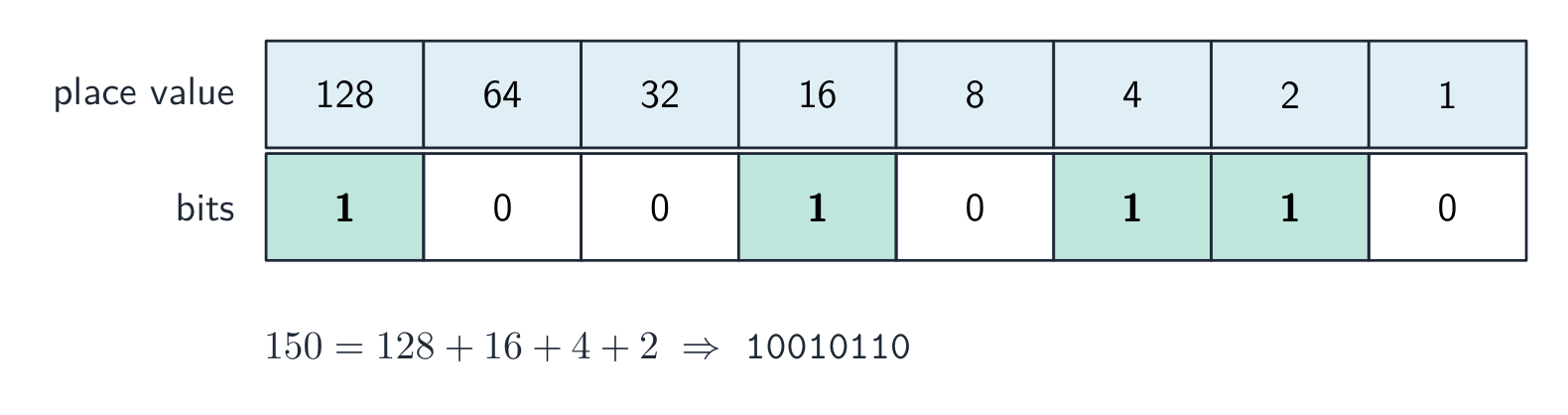
An 8-bit place-value chart: the 1s sit under the values that add to the number An 8-bit place-value chart: the 1s sit under the values that add to the number

Worked example. To convert binary 1101 to decimal, write the place values 8 4 2 1 under the bits 1 1 0 1 and add the ones that have a 1: $8+4+0+1=13$. Going the other way, convert 19 to binary by subtracting the largest power of two that fits: $19-16=3$, then $3-2=1$, then $1-1=0$, so the bits sit at the 16, 2, and 1 places $\rightarrow$ 10011 (check: $16+2+1=19$).

Because a computer has a finite number of bits, it can represent only a limited range of values. This causes two effects tested on the exam:

  • Overflow error 溢出错误: a number too large for the available bits cannot be stored correctly.
  • Round-off (rounding) error 舍入错误: numbers with decimals (real numbers) can only be approximated, because infinitely many real values must map onto finitely many bit patterns.

All data – text, images, sound – is ultimately encoded as binary. An image is a grid of pixels 像素, each stored as numbers for its colors; sound is stored as numbers sampled many times per second.

Explore

Convert between binary and decimal

Computers store numbers in binary (base 2). Each bit is a power of two; add the place values of the 1-bits to read the decimal number.

Vocabulary Train
English Chinese Pinyin
bits wèi
byte 字节 zì jié
binary 二进制 èr jìn zhì
decimal 十进制 shí jìn zhì
Overflow error 溢出错误 yì chū cuò wù
Round-off (rounding) error 舍入错误 shě rù cuò wù
pixels 像素 xiàng sù
2.2

Data Compression

Syllabus
Enduring UnderstandingLearning ObjectiveEssential Knowledge

DAT-1
The way a computer represents data internally is different from the way the data are interpreted and displayed for the user. Programs are used to translate data into a representation more easily understood by people.

DAT-1.D
Compare data compression algorithms to determine which is best in a particular context. [Skill 1.D]

  • DAT-1.D.1 Data compression can reduce the size (number of bits) of transmitted or stored data.
  • DAT-1.D.2 Fewer bits does not necessarily mean less information.
  • DAT-1.D.3 The amount of size reduction from compression depends on both the amount of redundancy in the original data representation and the compression algorithm applied.
  • DAT-1.D.4 Lossless data compression algorithms can usually reduce the number of bits stored or transmitted while guaranteeing complete reconstruction of the original data.
  • DAT-1.D.5 Lossy data compression algorithms can significantly reduce the number of bits stored or transmitted but only allow reconstruction of an approximation of the original data.
  • DAT-1.D.6 Lossy data compression algorithms can usually reduce the number of bits stored or transmitted more than lossless compression algorithms.
  • DAT-1.D.7 In situations where quality or ability to reconstruct the original is maximally important, lossless compression algorithms are typically chosen.
  • DAT-1.D.8 In situations where minimizing data size or transmission time is maximally important, lossy compression algorithms are typically chosen.

Source: College Board AP Course and Exam Description

Compression 压缩 reduces the number of bits needed to store or send data. Two kinds:

Compression methods: lossless versus lossy, with common examples Compression methods: lossless versus lossy, with common examples

  • Lossless compression 无损压缩 lets you restore the exact original data (used for text and programs, where every bit matters).
  • Lossy compression 有损压缩 throws away some data to shrink the size further (used for photos, music, video, where a small quality loss is acceptable).

Choosing between them trades size against fidelity: lossless keeps everything but saves less; lossy saves more but loses detail permanently. Prefer lossless when the data must be exact.

Explore

Compress a run of repeats

Run-length encoding is a lossless compression: a long run of the same symbol is replaced by the symbol and a count, shrinking the data with no information lost.

Vocabulary Train
English Chinese Pinyin
Compression 压缩 yā suō
Lossless compression 无损压缩 wú sǔn yā suō
Lossy compression 有损压缩 yǒu sǔn yā suō
2.3

Extracting Information from Data

Syllabus
Enduring UnderstandingLearning ObjectiveEssential Knowledge

DAT-2
Programs can be used to process data, which allows users to discover information and create new knowledge.

DAT-2.A
Describe what information can be extracted from data. [Skill 5.B]

  • DAT-2.A.1 Information is the collection of facts and patterns extracted from data.
  • DAT-2.A.2 Data provide opportunities for identifying trends, making connections, and addressing problems.
  • DAT-2.A.3 Digitally processed data may show correlation between variables. A correlation found in data does not necessarily indicate that a causal relationship exists. Additional research is needed to understand the exact nature of the relationship.
  • DAT-2.A.4 Often, a single source does not contain the data needed to draw a conclusion. It may be necessary to combine data from a variety of sources to formulate a conclusion.

DAT-2.B
Describe what information can be extracted from metadata. [Skill 5.B]

  • DAT-2.B.1 Metadata are data about data. For example, the piece of data may be an image, while the metadata may include the date of creation or the file size of the image.
  • DAT-2.B.2 Changes and deletions made to metadata do not change the primary data.
  • DAT-2.B.3 Metadata are used for finding, organizing, and managing information.
  • DAT-2.B.4 Metadata can increase the effective use of data or data sets by providing additional information.
  • DAT-2.B.5 Metadata allow data to be structured and organized.

DAT-2.C
Identify the challenges associated with processing data. [Skill 5.D]

  • DAT-2.C.1 The ability to process data depends on the capabilities of the users and their tools.
  • DAT-2.C.2 Data sets pose challenges regardless of size, such as:
    • the need to clean data
    • incomplete data
    • invalid data
    • the need to combine data sources
  • DAT-2.C.3 Depending on how data were collected, they may not be uniform. For example, if users enter data into an open field, the way they choose to abbreviate, spell, or capitalize something may vary from user to user.
  • DAT-2.C.4 Cleaning data is a process that makes the data uniform without changing their meaning (e.g., replacing all equivalent abbreviations, spellings, and capitalizations with the same word).
  • DAT-2.C.5 Problems of bias are often created by the type or source of data being collected. Bias is not eliminated by simply collecting more data.
  • DAT-2.C.6 The size of a data set affects the amount of information that can be extracted from it.
  • DAT-2.C.7 Large data sets are difficult to process using a single computer and may require parallel systems.
  • DAT-2.C.8 Scalability of systems is an important consideration when working with data sets, as the computational capacity of a system affects how data sets can be processed and stored.

Source: College Board AP Course and Exam Description

Data 数据 becomes useful when we extract information 信息 from it – patterns, trends, and answers to questions. Large data sets can reveal correlations a small one cannot, but data must be cleaned (fixing errors and inconsistencies) and often transformed or filtered first. A correlation 相关性 between two things does not prove that one causes the other – a key caution. Metadata 元数据 (data about data, like a photo's date and location) helps organize and search large collections.

Vocabulary Train
English Chinese Pinyin
Data 数据 shù jù
information 信息 xìn xī
correlation 相关性 xiāng guān xìng
Metadata 元数据 yuán shù jù
2.4

Using Programs with Data

Syllabus
Enduring UnderstandingLearning ObjectiveEssential Knowledge

DAT-2
Programs can be used to process data, which allows users to discover information and create new knowledge.

DAT-2.D
Extract information from data using a program. [Skill 2.B]

  • DAT-2.D.1 Programs can be used to process data to acquire information.
  • DAT-2.D.2 Tables, diagrams, text, and other visual tools can be used to communicate insight and knowledge gained from data.
  • DAT-2.D.3 Search tools are useful for efficiently finding information.
  • DAT-2.D.4 Data filtering systems are important tools for finding information and recognizing patterns in data.
  • DAT-2.D.5 Programs such as spreadsheets help efficiently organize and find trends in information.
  • DAT-2.D.6 Some processes that can be used to extract or modify information from data include the following:
    • transforming every element of a data set, such as doubling every element in a list, or adding a parent's email to every student record
    • filtering a data set, such as keeping only the positive numbers from a list, or keeping only students who signed up for band from a record of all the students
    • combining or comparing data in some way, such as adding up a list of numbers, or finding the student who has the highest GPA
    • visualizing a data set through a chart, graph, or other visual representation

DAT-2.E
Explain how programs can be used to gain insight and knowledge from data. [Skill 5.B]

  • DAT-2.E.1 Programs are used in an iterative and interactive way when processing information to allow users to gain insight and knowledge about data.
  • DAT-2.E.2 Programmers can use programs to filter and clean digital data, thereby gaining insight and knowledge.
  • DAT-2.E.3 Combining data sources, clustering data, and classifying data are parts of the process of using programs to gain insight and knowledge from data.
  • DAT-2.E.4 Insight and knowledge can be obtained from translating and transforming digitally represented information.
  • DAT-2.E.5 Patterns can emerge when data are transformed using programs.

Source: College Board AP Course and Exam Description

Programs process data at scales humans cannot. Common operations are filtering 过滤 (keeping only rows that meet a condition), cleaning (removing errors), and visualizing 可视化 (charts and graphs that make patterns visible). Combining data from multiple sources can reveal more, but raises privacy 隐私 concerns. Interactive tools and visualizations let people explore data and draw their own conclusions.

Exam skill: be able to explain how a program helps find information in a large data set, and why correlation shown in the data does not establish causation.

Vocabulary Train
English Chinese Pinyin
filtering 过滤 guò lǜ
visualizing 可视化 kě shì huà
privacy 隐私 yǐn sī
2.4

Exam tips

  • Convert confidently between binary, decimal, and (where asked) hexadecimal — practise until it is quick.
  • Remember a bit is one binary digit and a byte is 8 bits; $n$ bits represent $2^n$ values.
  • Explain that all data — numbers, text, images, sound — is stored as binary, and that finite bits cause overflow and round-off.
  • Distinguish lossless from lossy compression and when each is appropriate.
  • Show the analog-to-digital idea: sampling turns a continuous signal into discrete values.

Log in or create account

IGCSE & A-Level