Bernoulli and flow meters: the coefficient carries the device
導入済み| English | 意味 |
|---|---|
| Bernoulli | The energy equation along a streamline for steady, incompressible, frictionless flow: pressure head plus velocity head plus height is constant. |
| streamline | A line drawn everywhere tangent to the velocity of a flow; in steady flow it is the path a particle follows. |
| continuity/kɒntɪˈnjuːɪti/ | The mass balance for a flow: what enters a control volume must leave it, so Q = VA stays constant for a liquid. |
| discharge coefficient | The ratio of actual to ideal flow through a meter, correcting Bernoulli for friction and contraction of the stream. |
| Torricelli's law | The rule that liquid leaves an opening a depth h below a free surface at the square root of 2gh. |
| cavitation | The formation and violent collapse of vapour bubbles where a liquid's pressure falls to its vapour pressure. |
Measuring flow without touching it
- A venturi in the loop and a pitot tube in an air duct measure flow from a pressure difference. Both are Bernoulli 伯努利方程 with a correction factor, and the factor is where the engineering is.
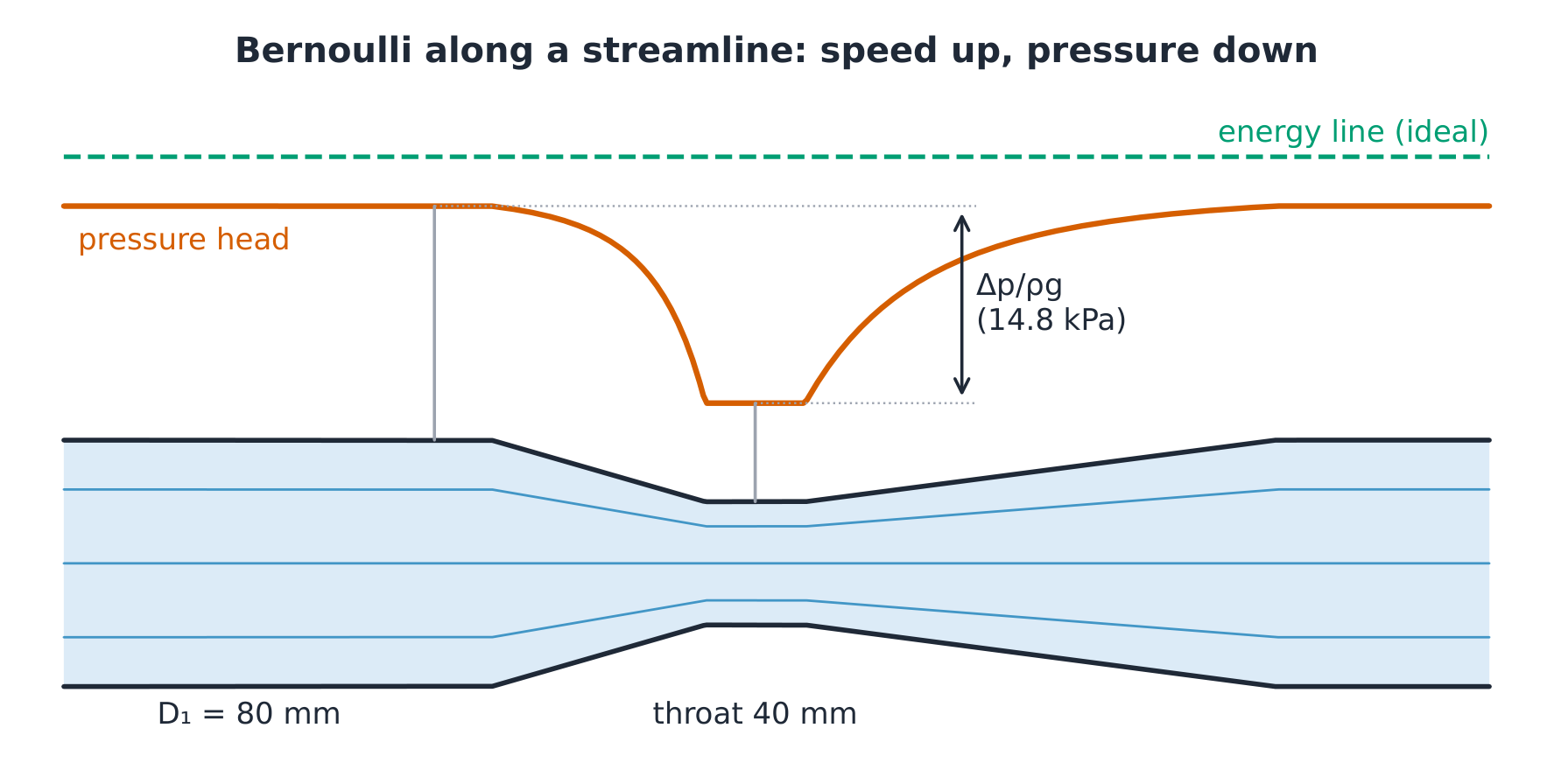
- Along a streamline 流线, for steady, incompressible, frictionless flow with no pump: $p/\rho g + V^2/2g + z$ is constant. Speed up, and the pressure falls.
Bernoulli can be applied straight across a pump.
難易度 1/5 · 100 コイン + 今日初回達成時の小ボーナス
A pump adds shaft work; add its head to the energy equation.
The venturi equation
- Continuity 连续性方程 gives $V_1 = V_2\beta^2$ with $\beta = D_2/D_1$. Put it into Bernoulli: $Q = C_d A_2\sqrt{2\Delta p/\rho(1 - \beta^4)}$.
- The discharge coefficient 流量系数 $C_d$ absorbs friction and the vena contracta: about 0.98 for a venturi, about 0.61 for a sharp orifice plate.
Can Bernoulli be used here?
Decide which Bernoulli assumption each situation breaks, if any.
At beta = 0.5, what is 1 - beta^4 (four decimals)?
難易度 2/5 · 140 コイン + 今日初回達成時の小ボーナス
0.5 to the fourth is 0.0625.
A sharp orifice plate and a venturi give the same reading. The orifice flow is:
難易度 1/5 · 100 コイン + 今日初回達成時の小ボーナス
Its discharge coefficient is near 0.61 against 0.98.
The loop's venturi
- 80 mm narrows to 40 mm, so $\beta = 0.5$ and $1 - \beta^4 = 0.9375$; the manometer reads $\Delta p = 14.8$ kPa.
- Ideal: $Q_i = 1.257 \times 10^{-3}\sqrt{2 \times 14\,803/(998 \times 0.9375)} = \mathbf{7.07}$ L/s.
- Measured, with $C_d = 0.98$: $Q = \mathbf{6.93}$ L/s.
Ideal venturi flow, 40 mm throat, beta = 0.5, dp = 14.8 kPa (two decimals, L/s)?
難易度 2/5 · 140 コイン + 今日初回達成時の小ボーナス
A2 times root of 2 dp over rho (1 - beta^4).
The same with C_d = 0.98 (two decimals, L/s)?
難易度 2/5 · 140 コイン + 今日初回達成時の小ボーナス
C_d times the ideal flow.
The pitot tube
- At the tip the air stops, so the stagnation-minus-static reading is $\Delta p = \tfrac12\rho V^2$. A reading of 450 Pa gives $V = \sqrt{2 \times 450/1.204} = \mathbf{27.3}$ m/s.
- That is about Mach 0.08, well under the 0.3 where incompressible Bernoulli starts to fail.
Pitot reading 450 Pa in air, rho = 1.204 kg/m3: speed (one decimal, m/s)?
難易度 2/5 · 140 コイン + 今日初回達成時の小ボーナス
Root of 2 dp over rho.
Draining a tank
- Bernoulli from the free surface to a jet $h$ below it, both at atmospheric pressure, gives Torricelli's law 托里拆利定律 $V = \sqrt{2gh}$: at $h = 2$ m, $\mathbf{6.26}$ m/s.
- Through a 20 mm sharp orifice ($C_d = 0.61$): $Q = 0.61 \times 3.142 \times 10^{-4} \times 6.26 = \mathbf{1.20}$ L/s. The coefficient again carries the real device.
Jet speed from an orifice 2 m below the free surface (two decimals, m/s)?
難易度 2/5 · 140 コイン + 今日初回達成時の小ボーナス
$\sqrt{2 \times 9.81 \times 2} = 6.26$ m/s.
Through a 20 mm orifice with $C_d = 0.61$: flow rate (two decimals, L/s)?
難易度 2/5 · 140 コイン + 今日初回達成時の小ボーナス
$0.61 \times \pi \times 0.01^2 \times 6.26 = 1.20 \times 10^{-3}$ m³/s.
Worked example: when the throat boils
- The venturi's throat is its lowest pressure. If it falls to water's vapour pressure, 2.34 kPa at 20°C, the water flashes to vapour. That is cavitation 空化: bubbles form and collapse, eroding metal and spoiling the reading.
- With 120 kPa absolute upstream, the largest usable $\Delta p$ is $117.7$ kPa. Flow goes as $\sqrt{\Delta p}$, so the meter reads up to $6.93\sqrt{117.7/14.8} = \mathbf{19.5}$ L/s before it cavitates.
6.93 L/s at 14.8 kPa; the throat may drop at most 117.7 kPa. Largest flow before cavitation (one decimal, L/s)?
難易度 2/5 · 140 コイン + 今日初回達成時の小ボーナス
$Q \propto \sqrt{\Delta p}$: $6.93 \times \sqrt{117.7/14.8} = 19.5$ L/s.
Three Bernoulli slips
- Across a pump or a lossy region. Bernoulli's four assumptions must hold first.
- Forgetting $1 - \beta^4$. That is a 3% error at $\beta = 0.5$, and larger as $\beta$ grows.
- $C_d = 1$ for an orifice. The real value is near 0.61.
Recap
- $p/\rho g + V^2/2g + z$ constant along a streamline, under four assumptions.
- Venturi: $Q = C_dA_2\sqrt{2\Delta p/\rho(1 - \beta^4)}$, 6.93 L/s here.
- Pitot: $V = \sqrt{2\Delta p/\rho}$, 27.3 m/s at 450 Pa.