Your learning plan · Continue · Review →
保存した位置はこのブラウザに留まります。再開してもImplementedの完了や回答にはなりません。
A polite question can contain a statement-order clause
- Your goal: build a complete sentence or question from supplied pieces, then explain how its clauses fit. Start with subjects, articles and clause order. ETS describes Build a Sentence as arranging words or phrases; these originally authored reorder cards are local practice, and their layout may differ from the test screen.
- In The registrar / sent / the revised timetable / to every student, build the core The registrar sent the timetable, then attach details. In Could you tell me when the workshop begins?, identify an outer question and an inner clause before ordering. A missing verb may need a search party, but it still needs to be found.
Build the shortest grammatical core first, then attach details without separating a verb from what it needs.
Arrange the cards into one complete sentence about a campus timetable.
難易度 3/5 · 200 コイン + 今日初回完了時に小ボーナス付与
The registrar is the subject; sent is the verb; the revised timetable is the object; the final phrase names the recipients.
Keep a dependent clause attached to its main clause
- Although the library was closed sets up a contrast but does not complete this message. Add the main clause: the return box remained available outside. A comma after the opening clause helps show the boundary.
- If the laboratory reopens tomorrow states a condition; the class will meet there gives its consequence. The ordinary future condition here uses if + present, not a mechanical will after every future time word. Other main-clause choices, such as can, can express a different consequence.
Arrange the contrast clause and the main clause.
難易度 3/5 · 200 コイン + 今日初回完了時に小ボーナス付与
Although creates an incomplete contrast. The return box remained available outside supplies the main claim despite the closure.
Arrange a possible future condition and its result.
難易度 3/5 · 200 コイン + 今日初回完了時に小ボーナス付与
The if-clause states the condition in the present tense; the main clause uses will meet for the consequence.
A question can contain a statement-order clause
- Compare When does the workshop begin? with Could you tell me when the workshop begins? The whole second sentence is a question, with Could you in its outer frame. The inner clause has the workshop begins, without an extra does.
- Find the outer frame and the clause inside it. The final question mark does not turn every clause into a direct question. Read the completed sentence aloud as a check, then explain the structure rather than trusting sound alone.
Arrange a polite question with an embedded clause.
難易度 3/5 · 200 コイン + 今日初回完了時に小ボーナス付与
Could you is the outer question. Inside it, when the workshop begins uses statement order, with no extra does.
Do not let a description steal the verb
- In The samples that were collected yesterday are stored in a locked cabinet, the samples is the subject. That were collected yesterday identifies the samples; are stored makes the main claim. The past verb in the description does not force the main verb into the past.
- Compare The list of students is ready: list controls is, although students is nearer. Identify the subject of the particular clause instead of choosing agreement from the closest noun.
Arrange a sentence whose subject contains a relative clause.
難易度 3/5 · 200 コイン + 今日初回完了時に小ボーナス付与
That were collected yesterday modifies samples. The main claim is that the samples are stored in a locked cabinet.
Make the final read a meaning check
- The tutor asked whether the draft had been submitted reports a question but is a statement, so it ends with a period. Had been submitted places the possible submission before the tutor’s past question; it does not claim the submission definitely happened.
- Preserve the intended message, supplied words, capitalisation and punctuation. The checker compares the intended card sequence. Some other sequences can be grammatical while expressing a different message; a failed match is not a judgement about every English use of those words.
Task description checked on 19 October 2026: ETS TOEFL Writing overview. All situations and sentences here are original teaching practice, not ETS questions or score predictions.
Arrange the report of a tutor's question.
難易度 3/5 · 200 コイン + 今日初回完了時に小ボーナス付与
This is a statement reporting a question, so it ends with a period. Had been submitted locates the possible action before the asking.
An inner clause keeps its own word order
- Could you tell me when the workshop begins? is a question as a whole; its inner the workshop begins does not need another does.
- Compare the direct When does the workshop begin? and the statement I know when the workshop begins. Clause structure explains the change better than memorising one shuffled card set.

View this diagram at full size
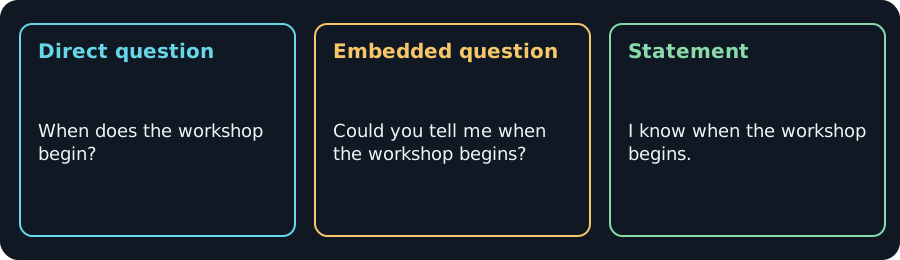
A sentence can contain more than one finite verb. Identify which clause each belongs to before choosing the main claim.
Match the three distinctions from the worked case.
難易度 2/5 · 140 コイン + 今日初回完了時に小ボーナス付与
Compare the direct question “When does the workshop begin?” and the statement “I know when the workshop begins.” Clause structure explains the change better than memorising one shuffled card set.
Which phrase fits “Could you tell me…”?
難易度 1/5 · 100 コイン + 今日初回完了時に小ボーナス付与
“Could you tell me when the workshop begins?” is a question as a whole. Inside it, the workshop begins uses statement order. The outer could does not require another does. Compare the direct question “When does the workshop begin?” and the statement “I know when the workshop begins.” Clause structure explains the change better than memorising one shuffled card set.
Complete the worked-case label: Direct question → ____. Use the phrase in the diagram.
難易度 1/5 · 100 コイン + 今日初回完了時に小ボーナス付与
Build the core, identify clause boundaries, attach details and read the complete message.
Three contrasts that explain the order
- Relative clause: The tutor who teaches the evening class lives nearby. Who teaches the evening class describes the tutor; lives is the main verb. Embedded question: Do you know whether the doors are locked? The inner clause is the doors are locked, not are the doors locked.
- Condition and result: If the lift is working, visitors can use the upper entrance. The if clause supplies a condition; the main clause supplies an available action. Keep each clause’s subject and verb together instead of letting one question mark or time word control the whole sentence.
Guided practice: find each clause’s job
- Use the hints to identify the subject, the finite verb and the boundary between clauses. A relative clause can sit inside a long subject; an embedded question still needs its own subject–verb relationship.
- Arrange every card once and preserve the supplied punctuation. Read the result as a message. After feedback, identify the exact misplaced relationship before retrying; moving cards randomly cannot explain the repair.
Original task: Arrange a statement whose subject contains a relative clause. The adviser helps new students and works in the office. Use every card once and preserve the supplied punctuation.
難易度 3/5 · 200 コイン + 今日初回完了時に小ボーナス付与
Intended message: The adviser who helps new students works in the office. Who helps new students describes the adviser; works is the main verb. Do not treat the relative-clause verb as the entire sentence’s main claim.
Original task: Arrange a polite question about the location of the keys. Keep the inner clause in statement order. Use every card once and preserve the supplied punctuation.
難易度 3/5 · 200 コイン + 今日初回完了時に小ボーナス付与
Intended message: Could you tell me where the keys are? Could you forms the outer question. The inner clause is where the keys are, with its subject before are.
Original task: Arrange a future condition and the action it permits: the hall may reopen, allowing the group to practise there. Use every card once and preserve the supplied punctuation.
難易度 3/5 · 200 コイン + 今日初回完了時に小ボーナス付与
Intended message: If the hall reopens tomorrow, the group can practise there. The opening condition uses present reopens for this possible future event. The main clause can practise describes the permitted action; will is not required for every consequence.
Original task: Arrange a statement about a singular schedule that contains several events. Use every card once and preserve the supplied punctuation.
難易度 3/5 · 200 コイン + 今日初回完了時に小ボーナス付与
Intended message: The schedule of events has changed since Tuesday. Schedule is the main subject, so has belongs to it. Of events does not make that subject plural. Since Tuesday locates the starting point of the change.
Original task: Arrange a statement reporting a question about whether the parcel arrived before the manager asked. Use every card once and preserve the supplied punctuation.
難易度 3/5 · 200 コイン + 今日初回完了時に小ボーナス付与
Intended message: The manager asked whether the parcel had arrived. This is a statement reporting a question. The inner clause is the parcel had arrived; had places the possible arrival before the past asking, without guaranteeing that it occurred.
Original task: Arrange the contrast, beginning with Although: the gate was locked, yet a side entrance was open. Use every card once and preserve the supplied punctuation.
難易度 3/5 · 200 コイン + 今日初回完了時に小ボーナス付与
Intended message: Although the gate was locked, a side entrance was open. Although introduces the dependent contrast. The main clause supplies the remaining fact; no additional but is needed in this clause pair.
In “The files that the tutor requested are ready”, which is the main clause’s finite verb?
難易度 1/5 · 100 コイン + 今日初回完了時に小ボーナス付与
Are makes the main claim about the files. Requested belongs to the relative clause identifying the files. Find the clause boundary before choosing the main verb.
Which inner clause fits the polite question “Could you tell me … ?” about a seminar location?
難易度 1/5 · 100 コイン + 今日初回完了時に小ボーナス付与
Where the seminar is uses subject–verb order inside this question. The outer Could you already supplies the question frame; adding direct-question inversion inside it changes the structure incorrectly here.
Which completion fits “A box of spare cables … missing” in this ordinary singular-box statement?
難易度 1/5 · 100 コイン + 今日初回完了時に小ボーナス付与
Box is the singular head of this subject, so is fits. Of spare cables describes what is in the box; the nearby plural is not the subject head.
Which statement describes the clause roles in “If the office opens, we can collect the forms”?
難易度 1/5 · 100 コイン + 今日初回完了時に小ボーナス付与
The first explains the relationship. The ordinary future condition here uses opens, while can collect states an available consequence. A future meaning does not mechanically require will in both clauses.
Independent sentences: preserve the intended message
- The fresh tasks below give a communicative goal without the structural hints. Build the requested message using the supplied cards, capitalisation and punctuation. Do not add or replace words to repair a sequence.
- These complete reorder tasks test the taught structures in local practice; their count is not a TOEFL score. If an order seems plausible, compare its meaning with the requested message as well as its grammar.
Original task: State that the assistant who checks the forms works upstairs. Use every card once; preserve the supplied capitalisation and punctuation.
難易度 3/5 · 200 コイン + 今日初回完了時に小ボーナス付与
Intended message: The assistant who checks the forms works upstairs. Who checks the forms identifies the assistant; works is the main verb. Keep the description attached to its noun. This check compares the requested message, not every possible use of the cards.
Original task: Ask whether the reader remembers the meeting’s starting time. Use every card once; preserve the supplied capitalisation and punctuation.
難易度 3/5 · 200 コイン + 今日初回完了時に小ボーナス付与
Intended message: Do you remember when the meeting starts? Do you remember is the outer question. When the meeting starts is the inner clause; no extra does belongs inside it. This check compares the requested message, not every possible use of the cards.
Original task: State that the documents you requested have arrived. Use every card once; preserve the supplied capitalisation and punctuation.
難易度 3/5 · 200 コイン + 今日初回完了時に小ボーナス付与
Intended message: The documents that I requested have arrived. That I requested describes the documents. Have arrived is the main present-perfect claim about those plural documents. This check compares the requested message, not every possible use of the cards.
Original task: Give a condition beginning with If: the group can meet in the room if it is available. Use every card once; preserve the supplied capitalisation and punctuation.
難易度 3/5 · 200 コイン + 今日初回完了時に小ボーナス付与
Intended message: If the room is available, we can meet there. The if-clause supplies the availability condition; we can meet there is the main claim. Keep each verb with its own subject. This check compares the requested message, not every possible use of the cards.
Original task: Report that a teacher asked whether students had finished before the asking. Use every card once; preserve the supplied capitalisation and punctuation.
難易度 3/5 · 200 コイン + 今日初回完了時に小ボーナス付与
Intended message: The teacher asked whether the students had finished. The statement reports a question; it does not use direct-question inversion. Had finished places the possible completion before the past question. This check compares the requested message, not every possible use of the cards.
Original task: Identify these as the notes that Maya shared. Use every card once; preserve the supplied capitalisation and punctuation.
難易度 3/5 · 200 コイン + 今日初回完了時に小ボーナス付与
Intended message: These are the notes that Maya shared. These are forms the main clause; that Maya shared identifies the notes. The relative clause follows the noun it describes. This check compares the requested message, not every possible use of the cards.
Original task: Begin with Although and state a contrast: the printer was working but the scanner was unavailable. Use every card once; preserve the supplied capitalisation and punctuation.
難易度 3/5 · 200 コイン + 今日初回完了時に小ボーナス付与
Intended message: Although the printer was working, the scanner was unavailable. The opening dependent clause contrasts with the main clause about the scanner. Swapping which device worked would change the requested message. This check compares the requested message, not every possible use of the cards.
Original task: Ask politely for an explanation of the timetable change. Use every card once; preserve the supplied capitalisation and punctuation.
難易度 3/5 · 200 コイン + 今日初回完了時に小ボーナス付与
Intended message: Could you explain why the timetable has changed? Could you explain is the outer question. The inner subject the timetable comes before has changed; why does not require a second inversion inside this frame. This check compares the requested message, not every possible use of the cards.
Original task: State that a singular set of spare keys is missing from the drawer. Use every card once; preserve the supplied capitalisation and punctuation.
難易度 3/5 · 200 コイン + 今日初回完了時に小ボーナス付与
Intended message: A set of spare keys is missing from the drawer. Set is the singular subject head, so is agrees with it. The drawer phrase gives the location from which that set is missing. This check compares the requested message, not every possible use of the cards.
Original task: State that the students who missed the seminar need its handout. Use every card once; preserve the supplied capitalisation and punctuation.
難易度 3/5 · 200 コイン + 今日初回完了時に小ボーナス付与
Intended message: The students who missed the seminar need the handout. The relative clause identifies the students. Need is the main verb and agrees with the plural students; missed belongs to another clause. This check compares the requested message, not every possible use of the cards.
Original task: State that you do not know the place to which the parcel was delivered. Use every card once; preserve the supplied capitalisation and punctuation.
難易度 3/5 · 200 コイン + 今日初回完了時に小ボーナス付与
Intended message: I do not know where the parcel was delivered. This is a negative statement with an embedded location clause. The parcel was delivered keeps subject–verb order inside that clause. This check compares the requested message, not every possible use of the cards.
Original task: Ask whether the coordinator has confirmed the room booking. Use every card once; preserve the supplied capitalisation and punctuation.
難易度 3/5 · 200 コイン + 今日初回完了時に小ボーナス付与
Intended message: Has the coordinator confirmed the room booking? Has precedes the subject in this direct yes/no question. Confirmed completes the verb phrase, followed by the object the room booking. This check compares the requested message, not every possible use of the cards.
Original task: State a requirement: the report must be submitted before the meeting begins. Use every card once; preserve the supplied capitalisation and punctuation.
難易度 3/5 · 200 コイン + 今日初回完了時に小ボーナス付与
Intended message: The report must be submitted before the meeting begins. Must be submitted is the main passive verb phrase. The before-clause supplies the time boundary; keep it separate from the report’s required action. This check compares the requested message, not every possible use of the cards.
Original task: State that the committee’s decision remains unclear. Use every card once; preserve the supplied capitalisation and punctuation.
難易度 3/5 · 200 コイン + 今日初回完了時に小ボーナス付与
Intended message: What the committee decided remains unclear. What the committee decided is the subject of remains unclear. It is not a direct question and does not require did. This check compares the requested message, not every possible use of the cards.
Original task: State that the tutor who designed the course has retired. Use every card once; preserve the supplied capitalisation and punctuation.
難易度 3/5 · 200 コイン + 今日初回完了時に小ボーナス付与
Intended message: The tutor who designed the course has retired. Who designed the course describes the tutor. Has retired is the main claim about that singular person. This check compares the requested message, not every possible use of the cards.
Original task: State that beginning is possible after everyone has received the instructions. Use every card once; preserve the supplied capitalisation and punctuation.
難易度 3/5 · 200 コイン + 今日初回完了時に小ボーナス付与
Intended message: We can begin after everyone has received the instructions. We can begin is the main clause. The after-clause supplies the preceding condition in time, with everyone as its singular subject. This check compares the requested message, not every possible use of the cards.
Original task: Ask whether there is a reason for the lecture’s cancellation. Use every card once; preserve the supplied capitalisation and punctuation.
難易度 3/5 · 200 コイン + 今日初回完了時に小ボーナス付与
Intended message: Is there a reason why the lecture was cancelled? Is there forms the direct question. Why the lecture was cancelled identifies the reason sought and keeps its own subject–verb order. This check compares the requested message, not every possible use of the cards.
Original task: State that the room the reader booked is on the second floor. Use every card once; preserve the supplied capitalisation and punctuation.
難易度 3/5 · 200 コイン + 今日初回完了時に小ボーナス付与
Intended message: The room that you booked is on the second floor. That you booked identifies the room. Is makes the main location claim; do not move it into the relative clause. This check compares the requested message, not every possible use of the cards.
Original task: Report that she asked you to check whether the file was complete. Use every card once; preserve the supplied capitalisation and punctuation.
難易度 3/5 · 200 コイン + 今日初回完了時に小ボーナス付与
Intended message: She asked me to check whether the file was complete. Asked me to check states the requested action. The embedded whether-clause supplies what needs checking, with the file before was. This check compares the requested message, not every possible use of the cards.
Original task: Ask politely which door leads to the courtyard. Use every card once; preserve the supplied capitalisation and punctuation.
難易度 3/5 · 200 コイン + 今日初回完了時に小ボーナス付与
Intended message: Can you tell me which door leads to the courtyard? Can you tell me is the outer question. Which door is the subject of leads inside it; do not insert a second auxiliary or separate that subject from its verb. This check compares the requested message, not every possible use of the cards.
Write and revise without cards
- Compose the two requested messages before opening their models. Several sentences can express the same meaning; the checklist asks about clause relationships and clarity rather than matching the model word for word.
- Your draft stays in the current page, so copy it before leaving. Recording self-review stores reflection, not an automatic grammar judgement. Revise one identified relationship and explain what changed.
Write one polite question to an office asking whether a step-free route to the exhibition is available for your group. Use an outer request and an inner clause, not a list of keywords. Draft before opening the model, then revise one clause relationship. Your draft stays in this page; copy it before leaving.
Compare the intended message and clause relationships, not identical wording. Several responses can meet the checklist. Recording self-review is reflection, not automatic grammar assessment or a TOEFL score.
Revise this original draft into one complete contrast sentence: “Although the workshop was full, but the organiser offered a second session.” Keep both facts. Then write one sentence explaining your change. Draft before opening the model. Your draft stays in this page; copy it before leaving.
Compare the intended message and clause relationships, not identical wording. Several responses can meet the checklist. Recording self-review is reflection, not automatic grammar assessment or a TOEFL score.
Transfer from a familiar structure to a fresh message
- Try the two new reorder tasks without reopening the examples. An indirect question and a report can use similar clause order while making different kinds of message.
- Next, choose a separately authored ten-sentence practice set. That set has its own original items and deterministic review; it is ordinary practice, not a reserved assessment or official score.
Original task: Ask politely whether the return desk is open. Use every card once and preserve the supplied punctuation.
難易度 3/5 · 200 コイン + 今日初回完了時に小ボーナス付与
Intended message: Could you confirm whether the return desk is open? The outer question is Could you confirm; the inner clause is the return desk is open.
Original task: State that the books that arrived this morning belong in the reading room. Use every card once and preserve the supplied punctuation.
難易度 3/5 · 200 コイン + 今日初回完了時に小ボーナス付与
Intended message: The books that arrived this morning belong in the reading room. That arrived this morning identifies the books. Belong is the main verb for those plural books.
Return later and explain one decision
- On another day, try the review orders before looking at models. Retrieve the clause relationship, not a remembered screen position: cards are shuffled when the page opens.
- Explain why one verb belongs to its particular subject or clause. If that explanation is unclear, revisit the grammar foundation, then attempt another fresh sentence. A correct familiar reorder alone does not establish independent writing proficiency.
Original task: Ask politely when the next tutorial starts. Use every card once and preserve the supplied punctuation.
難易度 3/5 · 200 コイン + 今日初回完了時に小ボーナス付与
Intended message: Could you tell me when the next tutorial starts? Retrieve the outer question and inner statement-order clause; the next tutorial starts needs no extra does.
Original task: State that the list of workshop materials is complete. Use every card once and preserve the supplied punctuation.
難易度 3/5 · 200 コイン + 今日初回完了時に小ボーナス付与
Intended message: The list of workshop materials is complete. Retrieve the subject head list. Of workshop materials does not make that main subject plural.