Your learning plan · Continue · Review →
保存した位置はこのブラウザに留まります。再開してもImplementedの完了や回答にはなりません。
An app helps updates but a visitor may have no battery
-
Your goal: contribute a relevant position, support it and develop an actual viewpoint. Start with Writing orientation and connected sentences. The building-map discussion below has two real needs, not two names to sprinkle into an answer.
-
You are shown a professor's question and two students' replies, and you add your own post.
-
You are joining a discussion: make a clear, supported contribution that connects to the discussion. You may develop a student’s idea or introduce a different relevant line of reasoning. Paragraph count is not a scoring rule.
A single paragraph does not improve by dressing up as a five-page essay.
Four moves to plan a useful post
- Make your position clear and explain why you hold it. Support the reasoning with a relevant example, consequence or evidence. You can place concise context before the position; this is a planning aid, not a compulsory sentence order.
- Connect to the discussion by developing an existing viewpoint or a different relevant line of reasoning. A name can identify an idea, but merely naming a student adds no reasoning. Your post need not follow four sentences or a fixed paragraph count.
Match each of the four moves to what it does.
難易度 2/5 · 140 コイン + 今日初回完了時に小ボーナス付与
These four moves are a planning aid. A strong post makes a clear claim, supports it and answers a real viewpoint.
Develop the discussion beyond repetition
- Read the professor's question and both student posts before drafting. You need to know which idea your post develops or challenges.
- I agree with Mei that … but I would add that … can introduce specific development. You may build on an existing idea or offer a relevant new one; novelty alone does not decide quality. Our models demonstrate direct engagement as one approach, not a compulsory name-check.
Your practice goal is to build on one classmate’s viewpoint. Your draft states a position and example but never connects them to that idea. What would meet this practice goal?
難易度 1/5 · 100 コイン + 今日初回完了時に小ボーナス付与
For this exercise’s goal, connect your reasoning to the actual idea and develop it. Merely adding a name does not make that connection. In the full task, a supported new line of reasoning can also contribute; there is no universal rule to name a classmate or introduce a completely new idea.
Try a brief planning pause
- As a study method, try about thirty seconds for position, reason, example and which idea you will answer; this is not an official fixed planning allowance. Then draft and leave time to read it back.
- Avoid spending your opening on a long restatement of the professor's question; the reader already knows it. Prefer a specific first sentence to a memorised opener such as With the development of society.
Original discussion: should universities make lecture recordings available? One student values replaying difficult explanations; another worries about reduced attendance. Which opening states a relevant position with a defensible reason?
難易度 1/5 · 100 コイン + 今日初回完了時に小ボーナス付与
The third gives a relevant position and a reason. It describes possible support, not a guarantee that every student can use a course. Restatement and vague background contribute less here. A useful opening is a choice, not an official first-sentence rule; develop the reason and engage with the attendance concern.
What a strong post looks like
- Relevant, specific and clear about its position. Make the position easy to identify; it need not occupy the first line. A conditional position can work when you explain what it depends on and why. The explanation need not be in the same sentence; a bare “it depends” leaves the decision unclear.
- Precision beats decoration: cost fell sharply after 2015 makes a clearer claim than there was a considerable diminution. The cost sentence is a wording example, not factual evidence for this task. Task description checked on 19 October 2026 against the ETS Writing overview and ETS researchers’ explanation of contribution strategies. All examples and tasks here are original practice material, not ETS questions, rated responses or score predictions.
A bare “It depends on the situation”, without any further explanation, gives a clear conditional position.
難易度 1/5 · 100 コイン + 今日初回完了時に小ボーナス付与
Name the relevant condition and explain its consequence. This can span sentences; there is no same-sentence scoring rule.
Worked example: finding a library room
Professor's question. Should a university replace paper building maps with a phone app?
Ana. Yes. An app can show which rooms have changed and give students an updated route.
Ravi. No. A phone battery can die, and visitors may not have the app.
I would keep a small number of paper maps and use an app for current routes. Ana is right that an app can be updated when a room moves; a printed map might send students to yesterday's seminar room. Ravi's concern also matters. A visitor whose phone has no battery still needs to find the library desk. I would put a clear paper map beside each main entrance and let the app handle temporary changes. This costs more than choosing one format, but it gives people a reliable starting point and a way to check last-minute changes. The app should help visitors find the room, not become the room's best-kept secret.
The first sentence gives a decision. The response then extends Ana's point, takes Ravi's objection seriously and proposes a workable division of roles. It does not invent survey results or merely repeat either post.
Why does the library-map model keep some paper maps while using an app?
難易度 1/5 · 100 コイン + 今日初回完了時に小ボーナス付与
The app can update routes; entrance maps still guide visitors whose phones fail or lack the app. The response develops both viewpoints.
Extend another view with a workable limit
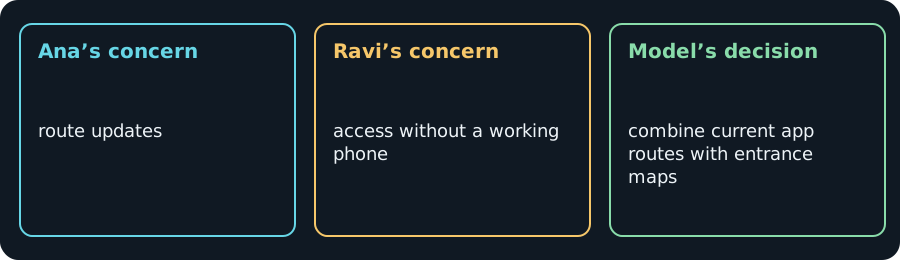
- In the app-and-paper-map discussion, Ana values updates and Ravi worries about phone access. The model allocates current routes to the app and a reliable entrance map to paper.
- To extend it, add a practical limit: “The entrance map should also name a help desk, since temporary signs may change before a visitor downloads the app.” This contributes a consequence rather than restating both posts.

View this diagram at full size
- Agreement alone does not develop a reason. Naming another student is useful only when you respond to the idea they actually offered.
- State a position, explain it and contribute a specific development or qualification.
- Try the transfer checks below before returning to the explanation. These are original self-checks, with no official score conversion.
Match the three distinctions from the worked case.
難易度 2/5 · 140 コイン + 今日初回完了時に小ボーナス付与
To extend it, add a practical limit: “The entrance map should also name a help desk, since temporary signs may change before a visitor downloads the app.” This contributes a consequence rather than restating both posts.
Which addition develops the discussion rather than repeating it?
難易度 1/5 · 100 コイン + 今日初回完了時に小ボーナス付与
In the app-and-paper-map discussion, Ana values updates and Ravi worries about phone access. The model allocates current routes to the app and a reliable entrance map to paper. To extend it, add a practical limit: “The entrance map should also name a help desk, since temporary signs may change before a visitor downloads the app.” This contributes a consequence rather than restating both posts.
Complete the worked-case label: Ana’s concern → ____. Use the phrase in the diagram.
難易度 1/5 · 100 コイン + 今日初回完了時に小ボーナス付与
State a position, explain it and contribute a specific development or qualification.
Extend, qualify or challenge the actual idea
- Extend: “Nora wants more trees for shade. Placing benches under those trees could also make the courtyard usable for outdoor study.” Qualify: “If space beside the paths is limited, smaller planting areas could preserve access.” Each adds a reason or practical implication rather than repeating “Trees provide shade.”
- Challenge: “Shade matters, but spending the entire courtyard budget on planting could leave damaged paths unrepaired.” This questions a spending priority, not Nora’s intelligence. A conditional or opposing position can contribute when its reasoning is clear. A student’s name is not a ticket that lets an unsupported opinion into the discussion.
Guided decisions: find the new reasoning
- Identify the question, the viewpoint and the specific job asked in each check. A sentence can be on topic but merely repeat what has already been said. Look for a relevant explanation, consequence, example or limit.
- Distinguish a disagreement with an idea from an attack on its speaker. Keep hypothetical examples hypothetical; do not invent research percentages to make a preference sound established. A clear reason needs a connection to the claim, not a ceremonial linking word.
Original discussion context: Professor: should a campus add shaded seats? Nora says shade makes outdoor study more comfortable.
Which addition extends Nora’s idea rather than repeating it?
難易度 1/5 · 100 コイン + 今日初回完了時に小ボーナス付与
The second adds a practical use linked to comfort. The first repeats the original point; naming Nora alone adds nothing. State what the proposed change could enable.
Original discussion context: Professor: should attendance at guest lectures be compulsory? A student values meeting specialists; another has a work shift during the event.
Which position makes a relevant condition clear?
難易度 1/5 · 100 コイン + 今日初回完了時に小ボーナス付与
The first names a condition tied to the actual conflict. A bare depends is not developed; a definition avoids the decision. Explain what changes your recommendation and why.
Original discussion context: Professor: should a university provide loan laptops? Ali says students without reliable computers could use them for assignments.
Which sentence adds relevant support without inventing a study?
難易度 1/5 · 100 コイン + 今日初回完了時に小ボーナス付与
The third gives a hypothetical case that explains the use. It neither guarantees grades nor invents data. Use an example to connect the resource to the proposed benefit.
Original discussion context: Professor: should group projects receive one shared mark? Bea says a common mark encourages teamwork.
Which reply challenges the idea rather than attacking Bea?
難易度 1/5 · 100 コイン + 今日初回完了時に小ボーナス付与
The first gives a relevant limitation and a possible response. The personal attack supplies no argument; the last sentence merely reports the view. Address the claim and its consequence.
Original discussion context: Professor: should campus notices move entirely online? Chen says digital notices can be updated quickly.
Which response fairly represents Chen’s claim?
難易度 1/5 · 100 コイン + 今日初回完了時に小ボーナス付与
The second keeps the claim limited to updates and adds an access issue. The others replace it with claims Chen did not make. Engage with the actual wording.
Original discussion context: Professor: should seminars include peer feedback? A student says it helps writers notice unclear passages.
Which explanation connects that benefit to the practice?
難易度 1/5 · 100 コイン + 今日初回完了時に小ボーナス付与
The third explains how feedback can support revision. Circular praise and naming the topic do not supply the mechanism. Ask how the proposed action could produce the benefit.
Original discussion context: Professor: should a campus café remove all quiet tables to create group seating? One student values conversation.
Which reply gives a developed qualification?
難易度 1/5 · 100 コイン + 今日初回完了時に小ボーナス付与
The third identifies a division of use and explains whom it serves. Merely naming two values does not justify an arrangement. Turn a trade-off into a reasoned choice.
Original discussion context: Professor: should universities subsidise buses? A student says cheaper travel could help commuters.
Which claim should be narrowed?
難易度 1/5 · 100 コイン + 今日初回完了時に小ボーナス付与
The first guarantees a much broader result than the proposal supports. Cost is one possible barrier, not every barrier. Narrow the claim to the benefit you can explain.
Original discussion context: Professor: should a course replace a final exam with a portfolio? One student values showing work over time.
Which example supports that reason?
難易度 1/5 · 100 コイン + 今日初回完了時に小ボーナス付与
The second connects the format with evidence across time. The library fact is unrelated, and the general comparison adds no support. Explain what the format would show.
Original discussion context: A discussion contribution begins with a brief example, then states a clear position and develops a classmate’s idea.
Must it fail simply because the position is not the first sentence?
難易度 1/5 · 100 コイン + 今日初回完了時に小ボーナス付与
The first preserves the communication goal. A fixed sentence order is not the criterion taught here. Judge relevance, support and engagement, not an invented placement requirement.
Independent choices before complete writing
- The fresh situations below ask you to judge relevance, development, qualification and engagement. Use the supplied wording; do not replace a student’s limited claim with a stronger one that is easier to reject.
- These are short writing-support decisions, not a measure of complete-post performance. Draft the two full contributions that follow before opening their models. Your draft stays in this page: copy it before leaving. The saved self-review event is reflection, not an automatic correctness judgement.
Original discussion context: Professor: should the library open later? Ava says late hours help students who work during the day.
Which addition develops Ava’s reason?
難易度 1/5 · 100 コイン + 今日初回完了時に小ボーナス付与
The third supplies a specific access situation and a bounded service. Restatement or calling the question interesting adds no explanation. Show how the policy could help the intended group.
Original discussion context: Professor: should a campus print fewer course handouts? Ben says digital copies reduce waste.
Which reply addresses a limit without misrepresenting Ben?
難易度 1/5 · 100 コイン + 今日初回完了時に小ボーナス付与
The first retains the waste argument while introducing an access constraint. The alternatives invent extreme motives or conclusions. Qualify the actual proposal.
Original discussion context: Professor: should all tutorials be online? Cara values avoiding travel.
Which reply gives a reasoned alternative?
難易度 1/5 · 100 コイン + 今日初回完了時に小ボーナス付与
The second proposes a distinction based on what the session needs. Naming a person or defining the term adds little. Explain why different cases merit different arrangements.
Original discussion context: Professor: should all courses require group assessment? Dan says collaboration is useful preparation for work.
Which sentence overstates what that reason establishes?
難易度 1/5 · 100 コイン + 今日初回完了時に小ボーナス付与
The third guarantees an outcome for everyone from one experience. The reason supports an opportunity to practise, not assured competence. Narrow the claim to the proposed learning activity.
Original discussion context: Professor: should a student art exhibition be free? Esme says a fee helps cover display costs.
Which reply adds relevant reasoning for free entry?
難易度 1/5 · 100 コイン + 今日初回完了時に小ボーナス付与
The first addresses the cost objection and supplies a possible funding route. The other sentences only identify the topic. Explain how an alternative meets a real constraint.
Original discussion context: Professor: should language courses offer conversation partners? Farah says speaking to another learner can reduce anxiety.
Which hypothetical example fits?
難易度 1/5 · 100 コイン + 今日初回完了時に小ボーナス付与
The second illustrates a plausible rehearsal opportunity without claiming universal results. Invented research or an unsupported universal adds false certainty. Keep the example hypothetical.
Original discussion context: Professor: should a university garden focus on vegetables? Gio values learning where food comes from.
Which contribution offers a relevant qualification?
難易度 1/5 · 100 コイン + 今日初回完了時に小ボーナス付与
The third keeps the learning goal and develops a complementary use. Restatement and unrelated background do not justify a choice. Add a connection that answers the question.
Original discussion context: Professor: should first-year students choose all their modules immediately? Hana values independence.
Which reply challenges the timing rather than Hana personally?
難易度 1/5 · 100 コイン + 今日初回完了時に小ボーナス付与
The second gives a reason for guided timing while retaining choice. The first attacks the speaker and the last repeats the view. Critique the decision and explain an alternative.
Original discussion context: Professor: should cafeterias use reusable containers? Ivan says this could reduce discarded packaging.
Which addition explains a practical condition?
難易度 1/5 · 100 コイン + 今日初回完了時に小ボーナス付与
The first ties success to a relevant implementation condition. Definitions and attribution alone add no reasoning. State the condition and its consequence.
Original discussion context: Professor: should lecture slides be available before class? Jia says advance access helps preparation.
Which reply distorts Jia’s claim?
難易度 1/5 · 100 コイン + 今日初回完了時に小ボーナス付与
The third turns a preparation benefit into an unsupported rejection of attendance. Respond to what the view says rather than a stronger substitute. Acknowledging one benefit does not prove every other activity is unnecessary.
Original discussion context: Professor: should a course include local field visits? Kai says visits connect theory with practice.
Which sentence develops that connection?
難易度 1/5 · 100 コイン + 今日初回完了時に小ボーナス付与
The first explains what students could compare and learn. Circular praise or repeating the question does not support the policy. Make the relationship between activity and learning explicit.
Original discussion context: Professor: should university sports clubs welcome beginners? Lina says inclusive entry can broaden participation.
Which contribution adds a practical response to safety concerns?
難易度 1/5 · 100 コイン + 今日初回完了時に小ボーナス付与
The second proposes preparation relevant to safe participation. The other statements add nothing or invent a motive. Address the objection with a workable step.
Original discussion context: Professor: should universities lend musical instruments? Malik values access for students who cannot buy one.
Which qualification remains relevant to the access goal?
難易度 1/5 · 100 コイン + 今日初回完了時に小ボーナス付与
The third develops how scarce equipment could remain usable and shared. Naming the topic or circular approval supplies no design reasoning. Connect access with how the service works.
Original discussion context: Professor: should a department publish anonymous student questions? Nina says this can help hesitant students speak up.
Which sentence attacks the speaker rather than the proposal?
難易度 1/5 · 100 コイン + 今日初回完了時に小ボーナス付与
The second judges Nina personally rather than addressing anonymity or learning. The other options engage with the proposal. Replace personal judgement with a relevant reason or limitation.
Original discussion context: Professor: should a college require reusable water bottles? Owen says the change could reduce disposable plastic.
Which reply makes the requirement conditional for a clear reason?
難易度 1/5 · 100 コイン + 今日初回完了時に小ボーナス付与
The first names a condition and explains its practical role. A bare depends or empty wording leaves the decision unclear. State what must be true for your judgement to hold.
Original discussion context: Professor: should a university fund a free evening shuttle? Pia says it could help students returning from late activities.
Which claim introduces invented evidence?
難易度 1/5 · 100 コイン + 今日初回完了時に小ボーナス付与
The third presents unsupported research as a fact. Hypotheses and proposed evidence collection are different from an invented finding. Use a reason you can explain or label a scenario as hypothetical.
Original discussion context: Professor: should students assess their own participation? Quinn values reflection.
Which reply develops reflection while addressing accuracy?
難易度 1/5 · 100 コイン + 今日初回完了時に小ボーナス付与
The second explains an evidence-based process and another perspective. Repetition adds no method; the last option falsely assigns a motive. Develop how the idea could work.
Original discussion context: Professor: should universities allow student-run repair events? Rosa values learning practical skills.
Which reply gives a relevant limitation?
難易度 1/5 · 100 コイン + 今日初回完了時に小ボーナス付与
The first links the activity to competence and a realistic scope. Attribution or a definition does not address the implementation problem. Qualify the proposal with a reasoned boundary.
Original discussion context: Professor: should a university museum extend opening hours? Sami says weekend hours would let families visit together.
Which sentence merely repeats Sami rather than developing the idea?
難易度 1/5 · 100 コイン + 今日初回完了時に小ボーナス付与
The second repeats the supplied benefit. The others add a reason or a way to examine implementation. Agreement can begin a post, but a contribution needs further development.
Original discussion context: Professor: should all new students attend a campus tour? Talia values knowing where essential services are.
Which alternative connects to that same goal?
難易度 1/5 · 100 コイン + 今日初回完了時に小ボーナス付与
The third proposes another way to locate services for those missing the tour. The first two identify the topic without developing it. Judge the alternative against the actual goal.
Write a contribution about study-room access
- Professor: should university study rooms require advance booking? Lena: bookings help groups plan and avoid arriving to find every room occupied. Omar: spontaneous groups need places too, and some students do not know their schedules early enough to book.
- Write a complete contribution with a clear position, developed support and a response to an actual viewpoint. You may favour booking, walk-in access or a justified combination. Draft before comparing the model; then revise one weak connection in your own post. No sentence count, rated response or official score is supplied by this lesson.
Original discussion. Professor: should university study rooms require advance booking? Lena: bookings help groups plan and avoid finding every room occupied. Omar: spontaneous groups need rooms too, and some students do not know their schedules early. Write a complete contribution with a clear position, developed support and engagement with an actual viewpoint. Choose a defensible approach before opening the model, then revise one weak connection. This lesson assigns no official score. Your draft stays in this page; copy it before leaving.
Compare the work your sentences do, not matching phrases. Several positions can answer the task. A self-review event records reflection; it is not an independent judgement of writing quality.
Write and revise a position on community service
- Professor: should a university require every student to do community service? Priya: a requirement would help students meet people outside the campus and understand local needs. Daniel: students with paid work or caring duties may find fixed extra hours difficult.
- Write a complete contribution, support your position and engage with a stated idea. Then compare the weaker post, improved post and a full alternative taking another position. A different judgement can work when its reasons answer the question. Your draft stays in this page; copy it before leaving.
Original discussion. Professor: should every university student be required to do community service? Priya: a requirement would help students meet people outside campus and understand local needs. Daniel: fixed extra hours can be difficult for students with paid work or caring duties. Write a complete supported contribution that engages with a stated idea. Draft before opening the comparison, then revise one specific weakness. This lesson assigns no official score. Your draft stays in this page; copy it before leaving.
Use the contrasts to identify repetition, a missing decision or an unsupported link. Do not copy a complete response or assume the model establishes an official score. If your revision changes your position, check that the rest of the post remains consistent.
Transfer the method to a new trade-off
- Now judge new views about recording access and transport. Explain what an objection would change, rather than answering it with a name or an unrelated advantage.
- After the checks, rewrite one assertion from your own draft as a supported reason or explicit condition. A useful revision could narrow an overbroad claim; adding words alone does not prove improvement. Ask a reader whether the connection is clearer if one is available.
Original discussion context: Professor: should recorded classes replace every in-person session? One student values replay; another points to practical equipment that cannot be used at home.
Which contribution engages with that trade-off?
難易度 1/5 · 100 コイン + 今日初回完了時に小ボーナス付与
The first divides roles according to the stated needs and explains why. Restatement adds no decision; a personal attack avoids the equipment issue. Transfer the same support-and-qualification method.
Original discussion context: Professor: should a city offer free bus travel to students? One writer values lower costs, while another notes that some neighbourhoods have no bus service.
Which sentence addresses the access limit?
難易度 1/5 · 100 コイン + 今日初回完了時に小ボーナス付与
The third keeps the cost benefit within its scope and addresses geographic access. A lower price cannot by itself create a missing route. Qualify the claim and explain what else is needed.
Return later and explain the connection
- Try the review checks on another day before rereading models. Retrieve position → support → actual viewpoint, while remembering that this is a reasoning routine rather than a fixed sentence order.
- Reopen a draft, identify one unsupported statement and revise it. Then try an unfamiliar Academic Discussion task in Writing practice. Use sentence construction if the grammatical relationship between your ideas is unclear. Lesson self-review does not produce an ETS mark or a validated learning outcome.
Original discussion context: A post clearly states a position after a short relevant example, supports it and responds to a classmate’s actual idea.
Should its sentence order alone make it unacceptable?
難易度 1/5 · 100 コイン + 今日初回完了時に小ボーナス付与
The second retrieves the communication principle. Sentence placement is a planning choice; judge whether the position, support and engagement are clear. Do not recreate a position rule from a model’s layout.
Original discussion context: A student writes “I agree with Amir” and then repeats Amir’s entire idea in new words.
What would most improve the contribution?
難易度 1/5 · 100 コイン + 今日初回完了時に小ボーナス付与
The first adds reasoning beyond paraphrase. Names and repeated context do not supply new support. Explain the relationship between your addition and the idea you are answering.