Your learning plan · Continue · Review →
保存した位置はこのブラウザに留まります。再開してもImplementedの完了や回答にはなりません。
The blue folder can carry two different corrections
-
Emphasising BLUE corrects the colour; emphasising SENT corrects the action. Outcome: record a meaningful contrast, choose one repair from actual sound, compare two takes and carry the feature into a fresh spoken answer. Start with Speaking format.
-
IELTS Speaking is assessed across four equally weighted criteria: fluency and coherence, vocabulary, grammatical range and accuracy, and pronunciation. Clear, understandable speech matters; a particular national accent is not required. This lesson gives you a recording routine, not a band prediction. The text checks below can test what you notice about speech, but they cannot measure the sounds you make.
-
Record here or use your own recorder. Listen once for meaning, then once for one feature. Trying to repair every sound at once usually turns a sentence into a queue of interruptions.
The microphone is an honest friend: it remembers the consonant you were sure you said.
A correct typed answer on this page proves that your pronunciation is clear.
難易度 1/5 · 100 コイン + 今日初回完了時に小ボーナス付与
Typed answers test knowledge about speech; only listening to actual speech can show how it sounds. This page does not award a Speaking band.
Hear the ending, not just the word
- Say this pair into your recorder: I walk to class. / I walked to class. Listen for the past-form contrast in walked, whose regular ending is /t/. Then try the bag / the bags and listen for /z/. A final /t/ may have little audible release in connected speech; do not force a separate vowel or an exaggerated burst. Keep the sentences at a natural speed. Do not add an extra vowel after a final consonant just to make it audible.
- If you cannot hear the difference on playback, slow down once, make the contrast clear, then return to a comfortable speed. This is a self-check, not a claim about your score. The endings matter because they can carry tense or number. Practice them in short sentences, where the listener has to understand the meaning.
Which regular past-tense ending does walked have in the taught pronunciation?
難易度 1/5 · 100 コイン + 今日初回完了時に小ボーナス付与
The regular ending is /t/. A final stop can have little audible release in connected speech; practise recognisable meaning without adding a vowel or forcing an exaggerated burst.
Put the stress on the right syllable
- Compare a REcord (noun) with to reCORD (verb). Say: Keep a REcord. / Please reCORD the answer. The stronger syllable is usually longer and clearer; the other syllable is quieter. Merely shouting the whole word does not create stress.
- Next try a PHOtograph and phoTOGraphy. Check a reliable dictionary's audio when learning an unfamiliar word, then imitate and record it. Work with two words per session. A long list is good for collecting mistakes and poor for hearing one change.
Which version stresses the verb correctly?
難易度 1/5 · 100 コイン + 今日初回完了時に小ボーナス付与
The verb record stresses its second syllable. The noun in 'a REcord' stresses the first.
Make thought groups the listener can follow
- Read aloud: After the meeting | we checked the figures | and changed the plan. The bars suggest thought groups for this drill, not compulsory pauses or words you should say aloud.
- Compare the breathless version with one that stops after every word. Try a comfortable pace with grouping that helps the listener follow the meaning. You need not pause at every boundary in a short sentence. Record the line twice. On playback, ask whether a listener could write down the linked stages in order: meeting, checking, changing.
Even a good sentence needs a place to breathe; it should not need its own emergency exit.
Which version uses the optional three-group practice markings taught here?
難易度 1/5 · 100 コイン + 今日初回完了時に小ボーナス付与
These groups organise linked stages for this drill. A fluent speaker need not pause at every marked boundary; an unbroken short sentence is not automatically unclear.
Stress can correct a misunderstanding
- If the listener asks “Did you send the red folder?”, I sent the BLUE folder corrects the colour. If they say “You kept the blue folder”, I SENT the blue folder corrects the action. The words are identical, but the listener receives different information. Record both versions. If they sound the same, give the important word a little more length and prominence; do not flatten the other words into silence.
- If you lose a word during a real conversation, paraphrase and continue: the folder with the blue cover. Clear repair is more useful than repeating the same unclear word three times.
A listener asks “Did you send the red folder?” You reply “I sent the BLUE folder.” What does the emphasis correct?
難易度 1/5 · 100 コイン + 今日初回完了時に小ボーナス付与
In this exchange, BLUE contrasts the folder’s colour with red. Context establishes the misunderstanding; capital letters only indicate intended emphasis.
A three-minute practice loop
- Thirty seconds: answer a familiar question naturally and record it.
- One minute: replay and choose one target: final endings, word stress, or thought groups. Write down one example you heard.
- One minute: repeat two short sentences that contain that target, recording the second attempt.
- Thirty seconds: replay both attempts. Note whether the target became easier to hear. If you are unsure, ask a trusted teacher or partner to listen; do not award yourself an IELTS band.
- Repeat on another day with a new question. Improvement means a listener needs less effort to understand you across different topics, not that one rehearsed answer sounds polished.
- Source checked on 19 October 2026: IELTS Speaking format and four criteria. The drills and examples above are original practice material, not official scoring instructions.
Put the self-check routine in order.
難易度 3/5 · 200 コイン + 今日初回完了時に小ボーナス付与
The loop isolates one audible change. Repeat it with new questions; a text exercise cannot replace listening.
Changed emphasis changes what you are correcting
- Original exchanges: after “You sent the red folder”, “I sent the BLUE folder” corrects the colour. After “You kept the blue folder”, “I SENT the blue folder” corrects the action. The words are the same, but emphasis highlights different information.
- Record both, then ask a partner which misunderstanding each seems to correct. If they sound identical, try length and prominence while keeping the surrounding words audible.

View the original emphasis case at full size
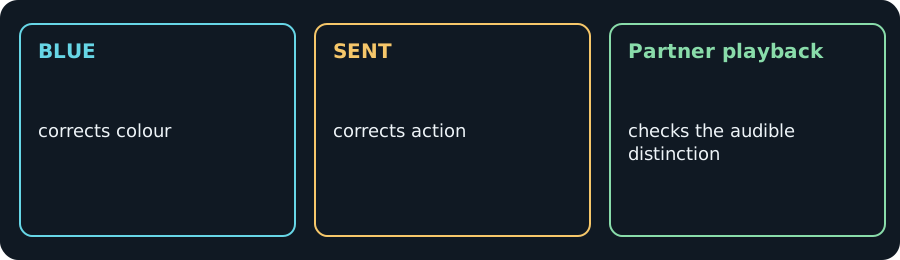
- Capital letters only mark intended emphasis on this page. They are not evidence of a sound you actually produced.
- Use a recording to check one feature, then carry it into a fresh spoken answer.
- Apply the distinction to the transfer check below. These are original teaching cases, not official items or band predictions.
Match the distinctions in this worked case.
難易度 2/5 · 140 コイン + 今日初回完了時に小ボーナス付与
Record both, then ask a partner which misunderstanding each seems to correct. If they sound identical, try length and prominence while keeping the surrounding words audible.
A listener says “You kept the blue folder.” You reply “I SENT the blue folder.” What is being corrected?
難易度 1/5 · 100 コイン + 今日初回完了時に小ボーナス付与
SENT contrasts with kept in this exchange. The same emphasis may do another job in a different context, so read the exchange and check actual delivery with audio.
Record an ending that carries meaning
- Use the two guided contrasts below to record a baseline, replay and choose one priority, then record a retake. After two valid takes, My recording plays the latest and Previous recording plays the one before it. Compare both; the fact that you recorded again does not prove it is clearer.
- The page keeps only those two takes. A third valid take replaces the oldest; Clear recordings removes both, while saved self-review history remains. Audio is not uploaded and disappears on reload. If the microphone is unavailable, practise with your own recorder; no external attempt is certified here. Written cues describe intended sounds, not sounds the page has heard you produce.
Original guided recording: Past meaning in a short contrast. Say these original sentences in one recording: “I walk to class.” “I walked to class.” Use the second to mean a completed past journey.
Record a first take and replay it. Choose one priority, record again, then compare My recording with Previous recording. Open the written guidance after your first take if useful. No source/model audio or automatic assessment is supplied.
Written cues state an intended feature. Recordings and a listener are needed to check actual speech; this self-review supplies no automatic correctness or band.
Original guided recording: One object or more than one. Say “I carried the bag.” Then say “I carried the bags.” Make the second refer to more than one bag.
Record a first take and replay it. Choose one priority, record again, then compare My recording with Previous recording. Open the written guidance after your first take if useful. No source/model audio or automatic assessment is supplied.
Written cues state an intended feature. Recordings and a listener are needed to check actual speech; this self-review supplies no automatic correctness or band.
Keep the stressed word inside its sentence
- Record the noun/verb record contrast below. Check a reliable dictionary recording if you are unsure of the intended stress, then practise the complete sentence rather than shouting the whole word.
- Replay both takes to compare the contrast and the surrounding words. Different valid accents can have different vowels; copying every detail of one dictionary speaker is not a requirement. Written stress marks and successful playback alone cannot establish pronunciation quality.
Original guided recording: Use word stress in context. Say “Keep a record of the date.” Then say “Please record the answer.” Treat record as a noun in the first and a verb in the second.
Record a first take and replay it. Choose one priority, record again, then compare My recording with Previous recording. Open the written guidance after your first take if useful. No source/model audio or automatic assessment is supplied.
Written cues state an intended feature. Recordings and a listener are needed to check actual speech; this self-review supplies no automatic correctness or band.
Give the listener a route through the stages
- Record the new preparation sentence below at a comfortable pace. On replay, identify whether the linked actions are understandable. Choose one grouping repair only if the first take gives a reason; pausing after every word is not a general route to clarity.
- Record the whole line again and compare both takes. Group boundaries are practice choices, not compulsory silent intervals. Ask a listener to tell you the stages if you cannot decide whether the grouping helps.
Original guided recording: Keep the linked stages understandable. Read the original line naturally: “Before the lesson, I opened my notes, checked the examples and marked one question to ask.”
Record a first take and replay it. Choose one priority, record again, then compare My recording with Previous recording. Open the written guidance after your first take if useful. No source/model audio or automatic assessment is supplied.
Written cues state an intended feature. Recordings and a listener are needed to check actual speech; this self-review supplies no automatic correctness or band.
Make the intended correction audible
- Record both folder replies in one take, using the misunderstanding to choose the prominent word. In the retake, change one feature such as length or prominence while keeping the surrounding words understandable.
- Compare the two recordings rather than the capital letters on the page. A partner can identify which reply seems to correct colour and which corrects action. The page does not listen or decide that for you; these are production contrasts, not audio-recognition questions.
Original guided recording: Correct the intended misunderstanding. Record two replies. After “You sent the red folder”, say “I sent the BLUE folder”. After “You kept the blue folder”, say “I SENT the blue folder”. Capitals mark intended prominence; do not say the word “capital”.
Record a first take and replay it. Choose one priority, record again, then compare My recording with Previous recording. Open the written guidance after your first take if useful. No source/model audio or automatic assessment is supplied.
Written cues state an intended feature. Recordings and a listener are needed to check actual speech; this self-review supplies no automatic correctness or band.
Keep meaning when a word is missing
- The guided tool description asks you to explain function and location without a particular noun. Record your own wording first. A useful paraphrase helps the listener recover the meaning; it need not copy the guidance sentence.
- Replay, simplify one unclear connection if needed, then record again. More advanced vocabulary is not automatically clearer, and repeating an unidentified “thing” may leave the listener doing a small detective investigation without any clues.
Original guided recording: Repair a missing word without losing the message. You want to tell a classmate where you left a tool but cannot recall “stapler”. Describe the object and its location without using that word. Use this original situation: it is on the desk beside the printer.
Record a first take and replay it. Choose one priority, record again, then compare My recording with Previous recording. Open the written guidance after your first take if useful. No source/model audio or automatic assessment is supplied.
Written cues state an intended feature. Recordings and a listener are needed to check actual speech; this self-review supplies no automatic correctness or band.
Choose one priority from fresh spoken answers
- Three independent prompts concern a routine and recent event, a useful object and a changed arrangement. Respond without a script, then choose a feature from your actual playback. The prompts do not tell you which sound you must have got wrong.
- Make one retake and compare both recordings. A speech feature may carry into a new answer, remain unclear or become less clear when you concentrate on something else. Keep that information; completion records self-review rather than an automatically improved performance.
Original routine and recent event prompt: Explain how you usually prepare for a class or another regular activity, then describe one thing you prepared differently on a recent occasion.
Answer aloud without reading a prepared script. Record, replay and choose one priority from your own speech; make a retake and compare both recordings before confirming self-review. This is self-paced practice, without automatic timing or pronunciation judgement.
Fresh speech checks whether a feature carries into a new response. Page completion records self-review, not independent listener understanding, pronunciation accuracy or proficiency.
Original useful object prompt: Describe an object you use regularly and explain one way it helps you.
Answer aloud without reading a prepared script. Record, replay and choose one priority from your own speech; make a retake and compare both recordings before confirming self-review. This is self-paced practice, without automatic timing or pronunciation judgement.
Fresh speech checks whether a feature carries into a new response. Page completion records self-review, not independent listener understanding, pronunciation accuracy or proficiency.
Original a changed arrangement prompt: Describe a small change to a plan and explain what you did instead.
Answer aloud without reading a prepared script. Record, replay and choose one priority from your own speech; make a retake and compare both recordings before confirming self-review. This is self-paced practice, without automatic timing or pronunciation judgement.
Fresh speech checks whether a feature carries into a new response. Page completion records self-review, not independent listener understanding, pronunciation accuracy or proficiency.
Carry the feature into a wider explanation
- The transfer prompt changes from a personal account to why someone might learn with another person. Choose fresh relevant content while carrying one useful speech feature into the response. A polished repetition of the object answer would miss this new demand.
- Review content and delivery separately: does the explanation connect, and is a chosen feature easier for a listener to follow? Use question scope and follow-ups for the first problem and actual audio or a trusted listener for the second.
Original fresh explanation prompt: Explain why someone might prefer learning a skill with another person rather than alone.
Answer aloud without reading a prepared script. Record, replay and choose one priority from your own speech; make a retake and compare both recordings before confirming self-review. This is self-paced practice, without automatic timing or pronunciation judgement.
Fresh speech checks whether a feature carries into a new response. Page completion records self-review, not independent listener understanding, pronunciation accuracy or proficiency.
Return later with a fresh advice question
- On another day, record the final advice prompt before reopening the examples. Replay, choose one priority, make a retake and compare both. Use Clear recordings when you want to remove the local audio; it does not erase your saved practice status.
- Continue with fresh long turns or familiar answers and discussion. Ask a trusted teacher or partner when you cannot judge a contrast. No fixed number of drills, clear transcript or completed page establishes a Speaking band.
Sources checked on 19 October 2026: official IELTS Speaking criteria, Cambridge’s indexed record pronunciation entry, and British Council regular past-ending guidance. All new sentences and scenarios are originally authored. Dictionary audio is not copied into this lesson; written guidance supplies no model voice or pronunciation assessment.
Original later advice prompt: On another day, give a friend practical advice about preparing for a new class or activity and explain why your suggestion could help.
Answer aloud without reading a prepared script. Record, replay and choose one priority from your own speech; make a retake and compare both recordings before confirming self-review. This is self-paced practice, without automatic timing or pronunciation judgement.
Fresh speech checks whether a feature carries into a new response. Page completion records self-review, not independent listener understanding, pronunciation accuracy or proficiency.