Your learning plan · Continue · Review →
Relative clauses — defining and non-defining
導入済み保存した位置はこのブラウザに留まります。再開してもImplementedの完了や回答にはなりません。
Identifying and supplementary information
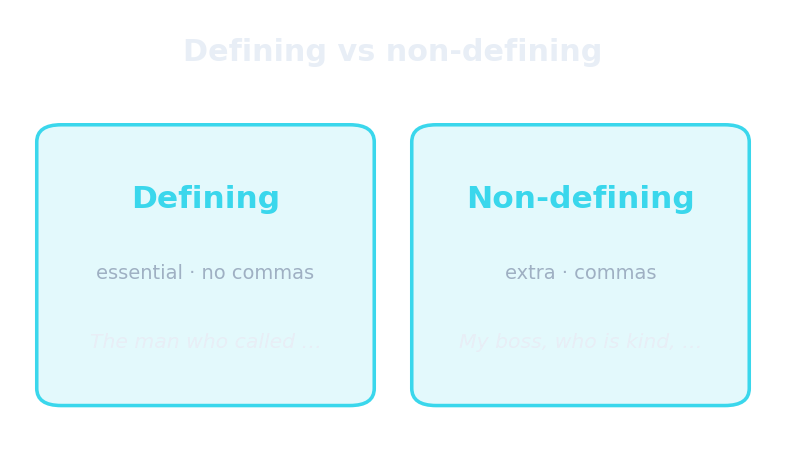
- A defining relative clause helps specify the person, thing or group meant. A non-defining clause presents a separate supplementary comment about an identified referent.
- The distinction concerns the intended message, not whether the added fact is important in real life. Commas signal the supplementary reading in writing.
- Outcome: choose a clause and punctuation that preserve the intended group and information. Start with relative-clause roles. Starting check: does students who registered necessarily mean all students? The clause selects the registered group.
The cat, which ignores instructions, ate the note that explained the rules.
Defining — which person, thing or group?
- The man who called you is my boss identifies the man through the call. A defining clause has no separating commas.
- Compare The volunteers who arrived early opened the room: it selects the early arrivals. It does not say that all volunteers arrived early.
- Removing a defining clause can still leave a grammatical sentence, but change its reference or scope. The deletion test alone cannot decide the intended meaning.
Non-defining — a supplementary comment
- The volunteers, who arrived early, opened the room presents early arrival as a supplementary fact about the already identified volunteers as a group.
- A clause inside the sentence is set off on both sides: My boss, who is very kind, called me. At the end, one introductory comma is enough: I called my boss, who was very kind.
- A unique name or a family relationship does not mechanically choose punctuation. Use the context and intended information; do not infer someone’s family structure from a comma exercise.
Do the commas matter here?
Read whether the written relative clause selects a referent/subset or adds supplementary information. Punctuation marks that intended relation; deletion alone is not a reliable test.
In standard writing, how is a supplementary (non-defining) relative clause separated from the main clause?
難易度 1/5 · 100 コイン + 今日初回完了時に小ボーナス付与
It is set off with commas: one before a final supplementary clause, or a pair when the clause is inside the sentence. This signals its information status, not that the fact is unimportant.
Translate into one English sentence using a non-defining who-clause to add the description: 我老板人很好,他给我打了电话。
難易度 3/5 · 200 コイン + 今日初回完了時に小ボーナス付与
One solution is “My boss, who is very kind, called me.” The task requests that supplementary construction; it is not the only natural way to translate the Chinese.
More than who and which
- Standard non-defining clauses can use who, whom, whose or which, as appropriate: Nora, whose bike was stolen, took the bus. They do not use relative that, and their relative word is not omitted.
- Supplementary location and time clauses also occur: We returned to the hall, where the meeting had begun. Choose the form for the relation you mean.
- In a defining clause, an object relative may be omitted; a subject relative may not: the book I bought but the book that fell. “Defining” does not mean that every relative word is optional.
Complete the non-defining clause: My phone, ___ is new, broke. (for a thing)
難易度 1/5 · 100 コイン + 今日初回完了時に小ボーナス付与
Non-defining + a thing → which (never “that”): “My phone, which is new, …”.
Is this correct? “My boss, that is kind, called me.”
難易度 1/5 · 100 コイン + 今日初回完了時に小ボーナス付与
Non-defining clauses can't use “that”: use “who”: “My boss, who is kind, …”.
Repair the intended scope
- My mother who lives in Beijing is kind should not be marked wrong solely because the noun is mother. In ordinary contexts a supplementary description is likely: My mother, who lives in Beijing, is kind. Identify the intended reading rather than asserting a universal family rule.
- He failed, which surprised us can use which to refer to the whole preceding fact. He failed, it surprised us needs a sentence boundary or a coordinating construction in standard writing.
- Near miss: if only two of five parcels are damaged, The parcels, which are damaged, need replacing wrongly presents damage as a fact about the whole identified group. The parcels which are damaged need replacing selects the damaged subset.
Match each sentence to its clause type.
難易度 2/5 · 140 コイン + 今日初回完了時に小ボーナス付与
The first clause identifies which man; the second adds a description of the identified boss. In the third, which refers to the fact that he was late. A grammatical sentence after deletion does not by itself prove that an original clause was non-defining.
Is this correct? “My boss, that is kind, called me.”
難易度 1/5 · 100 コイン + 今日初回完了時に小ボーナス付与
Non-defining clauses never take that → My boss, who is kind, called me.
- Ask what the relative clause selects or adds, then punctuate that intended message.
- Do not use relative that or omit the relative word in standard non-defining clauses. Whose/whom/where/when are not excluded merely because the clause is supplementary.
- Later recall: invent a group and describe only a selected subset; then write a different sentence adding a fact about the whole group. Explain the change. Continue with contrast linkers to connect those facts without changing their scope.
Usage checked 2026-10-20: Cambridge, defining and non-defining clauses and relative pronouns. Local source checks; independent language, answer and learner review pending.
Write one English sentence adding a supplementary description with who or which. Use a non-defining relative clause and appropriate comma punctuation.
難易度 3/5 · 200 コイン + 今日初回完了時に小ボーナス付与
Example: “Shanghai, which is a huge city, has great food.” A final supplementary clause is also possible: “We visited Shanghai, which has great food.” One introductory comma is sufficient when the clause ends the sentence.
Five bikes are in a rack; only two have broken lights. A mechanic writes, “The bikes which have broken lights need repair.” Which reading fits the defining clause as written?
難易度 1/5 · 100 コイン + 今日初回完了時に小ボーナス付与
Without separating commas, which have broken lights selects the relevant subset. The source says only two have that fault; do not expand the claim to all five. Deleting the clause leaves a grammatical sentence but loses the selection. If you expanded the group, mark the qualifying words and state exactly which bikes they select.
A club has eight members. Three booked the early train; the other five will travel later. Write an English message selecting just the three early travellers for a 7:00 meeting. Then add a separate sentence giving a supplementary fact about the already identified organiser, Mina, using a non-defining relative clause. Invent that extra fact. Compare and revise one scope or punctuation issue.
Compare the intended meaning and the relevant clause/form choices. Revise one supported issue; this local self-review does not award correctness or proficiency.