Your learning plan · Continue · Review →
Present perfect — past meets now
導入済み保存した位置はこのブラウザに留まります。再開してもImplementedの完了や回答にはなりません。
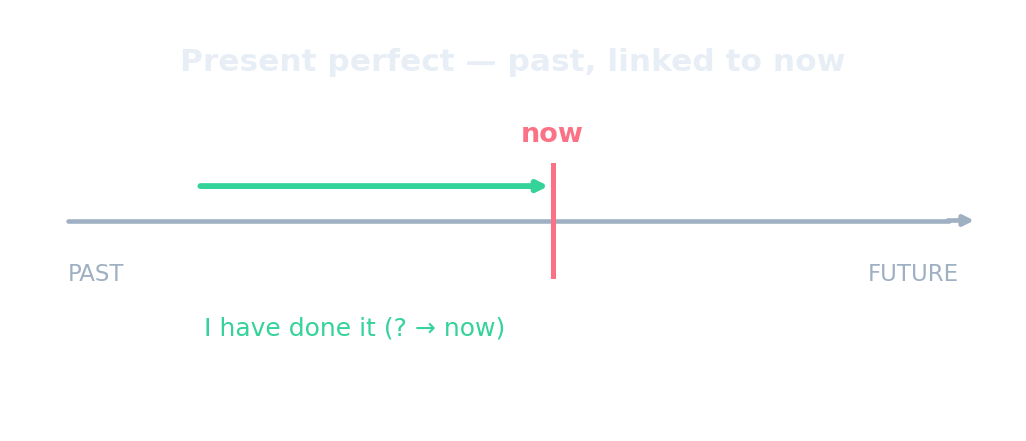
Linking the past to now
-
The present perfect connects earlier events, states or periods with now.
-
I have finished my homework reports completion with present relevance; it does not by itself prove that I have no other work.
-
It can describe experience up to now, a present result or a situation continuing from an earlier time. I have known Jo since 2012 is not limited to a recent event. Outcome: preserve the time and intended connection to now. Start with past simple; does since nine o'clock give a specific starting time? Yes, and it can occur with the present perfect.
-
Allow about 45–60 minutes across sessions, including later review. This is a study suggestion, not a test timer or a proficiency estimate.
I have finished my homework; the sofa is delighted.
Form: have / has + past participle
- have / has + past participle (he / she / it → has).
- I have seen it. She has gone home.
- Past participle: regular forms follow learned spelling patterns; irregular examples include do → done, see → seen, eat → eaten, be → been, go → gone.
- Put not after have/has for a negative: She hasn’t finished. Put have/has before the subject for a yes/no question: Has she finished? Matching short replies are Yes, she has / No, she hasn’t. Do not add do/does to this frame.
Which sentence is in the present perfect?
難易度 1/5 · 100 コイン + 今日初回完了時に小ボーナス付与
Present perfect = have/has + past participle: “has lost”.
Complete: I have ___ (do) my homework.
難易度 1/5 · 100 コイン + 今日初回完了時に小ボーナス付与
The past participle of “do” is “done”: I have done.
Use has + a past participle with she. Choose the complete present-perfect statement.
難易度 1/5 · 100 コイン + 今日初回完了時に小ボーナス付与
She takes has, followed by participle eaten. Have does not agree here, and ate is the past-simple form rather than this participle. Next try: use they instead.
ever, never, just, already, yet
- In these experience examples, ever means at any time and never means at no time. These words also occur with other tenses; do not choose a tense from one word alone.
- Just often marks a recent event. Already means before now or before a relevant time, sometimes earlier than expected. Both can also appear with past simple in suitable contexts, especially in American English.
- In the ordinary questions and negatives here, yet often goes at the end: Have you finished yet? I haven't finished yet. This is a useful pattern, not a rule for every meaning or position of yet.
- Have you ever been to London? I've just eaten. He hasn't finished yet.
Choose the complete question using have before the subject and participle finished.
難易度 1/5 · 100 コイン + 今日初回完了時に小ボーナス付与
Have you finished yet? uses the requested perfect-question frame. Do have finished mixes frames; finish is not the participle here. Next try: give a short negative reply.
for and since
- for + a length of time → for three years.
- since + a starting point → since 2020.
- I have lived here for five years. We've known each other since 2018. Compare I lived there for five years before moving: a duration does not automatically require the present perfect.
for or since?
Use 'for' with a length of time, 'since' with a starting point.
Choose the correct word: I have lived here ___ 2019.
難易度 1/5 · 100 コイン + 今日初回完了時に小ボーナス付与
2019 is a starting point → use “since”. Use “for” with a length of time.
Translate into English, describing residence that continues here now: 我在这里住了五年了。
難易度 3/5 · 200 コイン + 今日初回完了時に小ボーナス付与
I have lived here for five years and I have been living here for five years can both express this continuing residence. The supplied context establishes still here now; for alone is not an automatic tense selector.
The year 2020 marks the start of knowing Jo. Complete: We have known Jo ___ 2020.
難易度 1/5 · 100 コイン + 今日初回完了時に小ボーナス付与
Since 2020 gives the starting point. For takes a duration in this contrast, and during does not give the intended starting-point link. Next try: replace the year with a duration using for.
Common mistakes
- For an ordinary report of a meeting in the finished period yesterday, use I saw him yesterday. An exact starting point is different: I have been here since nine is natural. An unfinished period can also fit: I have answered three emails this morning, said while it is still morning.
- To describe ten years of residence continuing now, use I have lived here for ten years or I have been living here for ten years. I live here states present residence but does not itself express that elapsed duration.
- After have, use a participle, not went. Have you ever been to Beijing? asks about a visit. Have you ever gone to Beijing by train? can naturally ask about that travel experience; do not ban every experience use of gone.
Match the verb to its past participle (the have/has form).
難易度 2/5 · 140 コイン + 今日初回完了時に小ボーナス付与
These learned participles follow have/has: do–did–done, see–saw–seen, eat–ate–eaten and be–was/were–been. Was/were are past-simple be forms; been is the participle used in this match.
Tom has left for the bank and has not returned here. Complete this departure update: He has ___ to the bank.
難易度 1/5 · 100 コイン + 今日初回完了時に小ボーナス付与
Gone gives the intended departure/not-returned reading in this supplied context. Been to can describe a completed visit, but Tom’s absence alone would not have proved which trip happened. Gone can also occur naturally in experience questions such as Have you ever gone there by train?; do not generalise this one contrast into a ban.
For residence continuing here now, which choice can express the same five-year duration?
難易度 1/5 · 100 コイン + 今日初回完了時に小ボーナス付与
Have lived and have been living can both express continuing residence for five years. The other pairs change whether residence continues or add an unstated duration. Next try: contrast a period explicitly completed before moving.
- Present perfect links past → now.
- Form: have / has + past participle.
- for + a length of time; since + a starting point. Later recall: describe one new experience and a continuing situation, then contrast a finished past event. Continue with future forms. Choose the meaning and complete verb frame; one time word is not a complete tense rule.
Write one English present-perfect sentence about a place you have visited. You may use have/has been to, have/has visited or another natural experience expression.
難易度 3/5 · 200 コイン + 今日初回完了時に小ボーナス付与
Example: “I have been to Shanghai.” (have + been)
The context says Lea left for the shop and has not returned from that trip. Complete the departure update: Lea has ___ to the shop.
難易度 1/5 · 100 コイン + 今日初回完了時に小ボーナス付与
Gone fits the supplied departure/not-returned update. Been to commonly gives a completed visit, and go is not the participle. The trip must come from context, not absence alone. Next try: report a visit after Lea returns.
Three worked contrasts
- Continuing and completed duration: I have lived here for three years, and I still live here gives continuing residence. I lived there for three years before moving away reports an earlier completed period. Near miss: For always requires the present perfect misreads a duration as a tense rule. Choose the intended period; continuing residence can also use have been living.
- Finished event time and an open period: I visited the gallery yesterday is an ordinary dated past report. At eleven this morning, I have answered four emails this morning can count work so far in the still-open morning. Near miss: An exact time cannot appear with the perfect wrongly rejects I have been here since nine. Since nine gives a starting point, not a finished event time for the whole situation.
- Departure and completed visit: For a person who left for the clinic and has not returned from that trip, Mara has gone to the clinic gives a departure update. Mara has been to the clinic and is back here reports a completed visit. Near miss: Mara is absent, so she must have gone to the clinic invents the trip. Ask for evidence; Have you ever gone there by train? is also a natural travel-experience question.
Independent decisions
- Try the fresh situations without reopening the examples. Check the complete verb frame, whether the time is finished or connected to now, and what the evidence actually establishes. Do not choose solely from for, since, just or already.
- After feedback, identify a form, time-meaning or unsupported-inference error. Repair it, then make a different example. Written decisions do not measure spoken fluency or guarantee independent mastery.
Choose the complete present-perfect statement about a plural subject.
難易度 1/5 · 100 コイン + 今日初回完了時に小ボーナス付与
Plural visitors takes have with participle arrived. Has gives singular agreement here; arrive does not complete the perfect frame. Next try: describe one visitor.
Choose the complete present-perfect question about Jo.
難易度 1/5 · 100 コイン + 今日初回完了時に小ボーナス付与
Has Jo finished? puts has before Jo and keeps the participle. The other choices mix auxiliaries or leave finish in its base form. Next try: give a matching short yes reply.
Choose the complete present-perfect negative.
難易度 1/5 · 100 コイン + 今日初回完了時に小ボーナス付与
Hasn’t gone keeps not after has and uses participle gone. Does has mixes frames; went is not the participle used here. Next try: turn it into a question.
Choose the participle in the complete frame: We have ___ lunch.
難易度 1/5 · 100 コイン + 今日初回完了時に小ボーナス付与
Eaten is the participle after have. Ate is past simple; eat is the base form. Next try: make a negative using haven’t eaten.
Choose the participle in this experience report: I have ___ that film before.
難易度 1/5 · 100 コイン + 今日初回完了時に小ボーナス付与
Seen is the participle after have. Saw and see do not complete this perfect frame. Next try: ask whether a friend has seen it.
Choose the complete present-perfect report.
難易度 1/5 · 100 コイン + 今日初回完了時に小ボーナス付与
Have done pairs plural we with have and participle done. Did is not the participle; has does not agree here. Next try: ask whether the repairs are finished.
A friend asks, “Has Mia arrived?” You know she has not. Choose the matching short reply.
難易度 1/5 · 100 コイン + 今日初回完了時に小ボーナス付与
No, she hasn’t matches the has-question. Didn’t answers another frame, and she not arrived does not form this short reply. Next try: give a full negative sentence.
Complete the duration phrase: We have worked together ___ two years.
難易度 1/5 · 100 コイン + 今日初回完了時に小ボーナス付与
For two years states a length of time. Since takes a starting point in this contrast; from alone does not supply the intended duration link. Next try: give a starting-point phrase instead.
Complete the starting-point phrase: Jo has lived here ___ Monday.
難易度 1/5 · 100 コイン + 今日初回完了時に小ボーナス付与
Since Monday identifies the beginning. For Monday and during Monday do not express this intended starting-point link. Next try: use a length of time with for.
At noon, a learner says, “I have been here since nine o’clock.” Which judgment fits?
難易度 1/5 · 100 コイン + 今日初回完了時に小ボーナス付与
Since nine gives a starting point for the continuing situation. Exact starting points are compatible with the perfect; the sentence does not report leaving before nine. Next try: express the duration at noon.
A completed job lasted two weeks last summer. Which ordinary past report preserves that completed period?
難易度 1/5 · 100 コイン + 今日初回完了時に小ボーナス付与
Worked gives the ordinary finished-past report. For supplies a duration without automatically requiring the perfect. The alternatives mismatch the requested finished-period frame. Next try: describe a job continuing now separately.
Choose the ordinary dated past report of a visit yesterday.
難易度 1/5 · 100 コイン + 今日初回完了時に小ボーナス付与
Visited fits the ordinary finished-time report requested. Have visited does not fit this use of yesterday; visits also has agreement trouble with I. This does not ban every exact starting point from a perfect sentence. Next try: make an experience statement without dating that visit.
It is still morning. A note says, “I have answered three emails this morning.” Which interpretation stays within it?
難易度 1/5 · 100 コイン + 今日初回完了時に小ボーナス付与
The note counts three completed answers in the current morning. It does not say every email needing a reply is finished, and it does not leave those same three unanswered. Next try: ask whether any more emails need answering.
A learner says only, “I have finished my science homework.” What does that establish?
難易度 1/5 · 100 コイン + 今日初回完了時に小ボーナス付与
The completion concerns the named science homework. Other assignments are not specified; calling that science homework unfinished contradicts the statement. Next try: ask whether anything else remains rather than assuming free time.
A person says, “I have never visited Rome.” Which interpretation fits this experience statement?
難易度 1/5 · 100 コイン + 今日初回完了時に小ボーナス付与
Never in this experience frame concerns the period up to now. It does not guarantee the future, and a past visit contradicts the statement. Next try: ask about a future plan separately.
An American English speaker says, “I just finished the report.” Which judgment is defensible?
難易度 1/5 · 100 コイン + 今日初回完了時に小ボーナス付与
Past simple with just can be natural, particularly in American English. Just is not an automatic perfect-tense selector, and finished does not mean unfinished. Next try: give the present-perfect alternative.
A note says, “I have already sent the form.” What does already establish here?
難易度 1/5 · 100 コイン + 今日初回完了時に小ボーナス付与
Already can mark completion before now without proving anyone’s expectations. It also does not instruct another sending tomorrow. Next try: ask when it was sent if that detail matters.
Choose the complete ordinary present-perfect question using yet.
難易度 1/5 · 100 コイン + 今日初回完了時に小ボーナス付与
Have they finished yet? uses have before they and the participle. The other options mix frames or omit the participle form. This useful final-yet pattern is not a rule for every use of yet. Next try: write the matching negative.
Mara visited the clinic and is now back here. Choose the present-perfect update explicitly describing a completed visit.
難易度 1/5 · 100 コイン + 今日初回完了時に小ボーナス付与
Has been to ... and is back reports the supplied completed visit. Has go breaks the frame; the not-returned departure update contradicts the stated return. Next try: contrast an explicit not-returned departure.
A friend asks, “Have you ever gone to the island by boat?” Which judgment is defensible?
難易度 1/5 · 100 コイン + 今日初回完了時に小ボーナス付与
Gone can fit this travel-experience question. It is not universally forbidden, and asking about experience does not locate the friend now. Next try: ask about a completed visit using been to.
Transfer: a club update
- Turn the notes into English sentences about continuing membership, visits so far in the current month and a dated past visit. Keep the three time meanings distinct; do not invent another visit or turn membership into an activity already finished.
- Attempt before opening the model, then compare facts, full verb frames and time phrases. Revise a real mismatch, or explain why none is present. A natural contraction or different word order can preserve the same facts.
A club note records continuing membership for three years and two visits so far this month. The month is still in progress. Which summary preserves those facts?
難易度 1/5 · 100 コイン + 今日初回完了時に小ボーナス付与
The summary with continuing membership and two visits so far preserves the facts. The other choices invent an ended membership or turn the count so far into a guaranteed final total. Next try: ask when the latest visit happened rather than inventing its date.
Club notes about you: membership—three years and still current; visits this month—two so far; most recent visit—last Saturday. Write three English sentences: a present-perfect statement for continuing membership, a present-perfect count for this month, and an ordinary past-simple report of the dated visit. Do not invent a date or another visit. Compare and revise.
Compare your English with the facts and checklist. Repair one real form or meaning mismatch, or explain why none is present. Several answers can fit. Self-review does not automatically mark correctness or establish proficiency.
Return later
- Tomorrow, recall the form, one continuing situation and one finished past report before rereading. Try the later-review decisions and the new note-based writing task. An unanswered experience question does not establish that a visit happened.
- Continue with future forms. A writing comparison supports study; it is not automatic correctness, a proficiency score or evidence of listening/speaking ability.
Usage guidance checked 2026-10-20: British Council, present perfect, British and American English and Cambridge, present perfect simple. Local source checks; independent language, answer and learner review pending.
Review later: choose the starting-point phrase in this sentence: We have known each other ___ 2021.
難易度 1/5 · 100 コイン + 今日初回完了時に小ボーナス付与
Since 2021 gives the starting point of the continuing relationship. For takes a duration in this contrast; during does not supply the intended starting-point link. Next try: give a duration without inventing an exact length.
Review later: “Jo has been to the museum twice so far this year” is the only evidence. Which conclusion fits?
難易度 1/5 · 100 コイン + 今日初回完了時に小ボーナス付与
The count is two so far in the current year. It does not locate Jo now or prohibit another visit. Next try: ask about a future plan separately.
Return later without rereading. Notes about Jo (she): residence—here, start in 2021, still here now; museum visits—none up to now; visits to the old castle—unknown. Write two English present-perfect fact sentences, then a present-perfect experience question about the old castle. The continuing residence may also use the present perfect continuous. Leave the unknown answer open. Compare and revise.
Compare your English with the facts and checklist. Repair one real form or meaning mismatch, or explain why none is present. Several answers can fit. Self-review does not automatically mark correctness or establish proficiency.