Plant cell structure, xylem and phloem
導入済み 9:48
単元 2: 細胞、発生、生物多様性と保全
あなたは一つの受精卵から始めました。この単元では、その分裂や、コピーが組み換えられ减半されて生殖细胞になる過程、同一遺伝子が…如何なるかを説明します。
英語のナレーション・英語と中国語の字幕を切り替え可能
このレッスンの内容
| English | 意味 |
|---|---|
| cell wall/sel wɔːl/ | A supportive layer outside the cell membrane in plants, fungi and many microorganisms. |
| plasmodesmata/ˌplæzməʊdˈsmɑːtə/ | Channels through plant cell walls that connect the cytoplasm of neighbouring cells. |
| microfibrils/ˈmaɪkrəʊfɪbrəlz/ | Fine bundles of cellulose chains that provide strength to plant cell walls. |
| Xylem/ˈzaɪləm/ | The plant tissue carrying water and minerals up from the roots. |
| Phloem/ˈfləʊɪm/ | The plant tissue carrying dissolved food from source to sink. |
A tree can be 100 m tall without a skeleton
- The tallest trees lift water over 100 m and stand up to storms for centuries.
- Their strength and their plumbing both come from the structure of their cells and cell walls.
What plant cells have that animal cells do not
- A cellulose cell wall 细胞壁, joined to neighbouring cells by the middle lamella. Thin channels called plasmodesmata 胞间连丝 cross the walls and link the cytoplasm of neighbouring cells.
- Chloroplasts for photosynthesis, amyloplasts that store starch, and a large vacuole surrounded by a membrane called the tonoplast.
Match each plant cell structure to its job.
難易度 2/5 · 140 コイン + 今日初回達成時の小ボーナス
These are all found in plant cells but not animal cells.
Starch and cellulose
- Both are polymers of glucose. Starch is made of α-glucose: its chains coil or branch, so it is compact and good for storage.
- Cellulose is made of β-glucose. Every other glucose is flipped, so the chains are straight and lie side by side, joined by many hydrogen bonds into microfibrils 微纤维 with great strength.
Why is cellulose strong?
難易度 1/5 · 100 コイン + 今日初回達成時の小ボーナス
Starch coils; cellulose forms straight, cross-linked chains.
Xylem: water transport and support
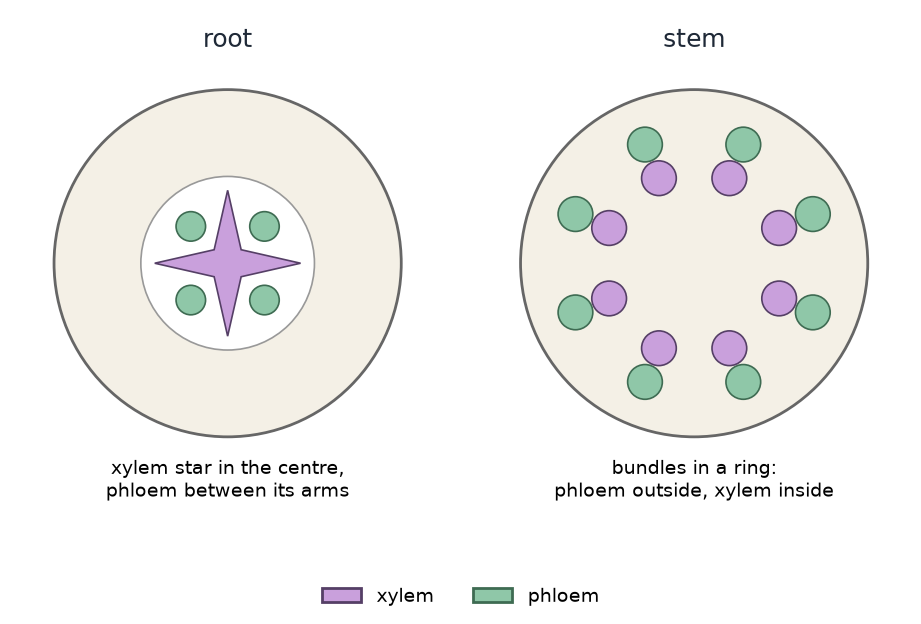
- Xylem 木质部 vessels are dead, hollow cells joined end to end into long tubes. Their walls contain lignin, which makes them strong and waterproof; pits let water move sideways.
- Xylem carries water and mineral ions up from the roots and helps support the plant.
Phloem and sclerenchyma
- Phloem 韧皮部 is living tissue: sieve tube elements with perforated end walls (sieve plates), each with a companion cell that supplies its energy. It carries sugars around the plant.
- Sclerenchyma fibres are long dead cells with thick lignified walls. They give support but do not transport anything.
Match each tissue to its description.
難易度 2/5 · 140 コイン + 今日初回達成時の小ボーナス
Only xylem and phloem transport substances.
Phloem sieve tube elements are alive.
難易度 1/5 · 100 コイン + 今日初回達成時の小ボーナス
They depend on companion cells for energy.
Core practicals 7 and 8
- CP7: cut a thin section of a stem, stain it (for example with toluidine blue), and use a microscope to find the positions of xylem, phloem and sclerenchyma.
- CP8: measure the tensile strength of plant fibres by hanging masses from a fibre until it breaks. Keep the fibre length the same and repeat with several fibres.
Worked example: comparing fibre strength. Fibre A breaks with 450 g attached; fibre B breaks with 300 g. Both are the same length.
- Force = mass × g. For A: 0.450 kg × 9.8 N/kg = 4.4 N. For B: 0.300 × 9.8 = 2.9 N.
- To compare fairly, divide by the area of each fibre's cross-section, because a thicker fibre will hold more.
A fibre breaks when 0.250 kg is hung from it. Using g = 9.8 N/kg, what force broke it, in newtons?
難易度 2/5 · 140 コイン + 今日初回達成時の小ボーナス
0.250 × 9.8 = 2.45 N.
In core practical 8, which should be kept the same when comparing fibres?
難易度 2/5 · 140 コイン + 今日初回達成時の小ボーナス
The type of plant is the variable being tested.
Xylem vessels are dead; phloem sieve tubes are alive. Xylem cells die and lose their contents to form empty tubes. Sieve tube elements stay alive, but rely on their companion cells.
Plant cells have cellulose walls, plasmodesmata, chloroplasts, amyloplasts and a vacuole with a tonoplast. Starch (α-glucose) is compact for storage; cellulose (β-glucose) forms strong microfibrils. Xylem is dead, lignified and carries water and ions; phloem is living and carries sugars; sclerenchyma fibres give support. Find them in stained sections, and test fibre strength with hanging masses.
Explain how the structure of xylem vessels suits them for carrying water.
Give each feature and its use.
何が問題でしたか?この内容はサイトの運営チームだけが確認します。