Why the heart can starve
- Cardiovascular disease 心血管疾病 (CVD) causes about one death in three worldwide. Most heart attacks and many strokes start the same way: an artery slowly narrows, then a blood clot blocks it.
- This lesson follows that chain step by step: damage → atheroma 动脉粥样斑块 → clot → blocked blood supply. Then it shows how risk is measured and how drugs lower it. Unit 1 papers test every link.
Step 1: the lining is damaged
- The inside of an artery is lined by the endothelium 内皮: one thin layer of cells. It must stay smooth so that blood flows easily.
- High blood pressure, chemicals from cigarette smoke and high blood sugar can damage it. The damage starts an inflammatory response 炎症反应: white blood cells move into the artery wall.
Step 2: atheroma, then plaque
- Cholesterol (carried as LDL 低密度脂蛋白) and white blood cells build up under the damaged lining. This fatty swelling is an atheroma.
- Calcium salts and fibrous tissue then harden it into a plaque 斑块. The wall loses its elasticity and the lumen 管腔 gets narrower. This whole process is atherosclerosis 动脉粥样硬化.
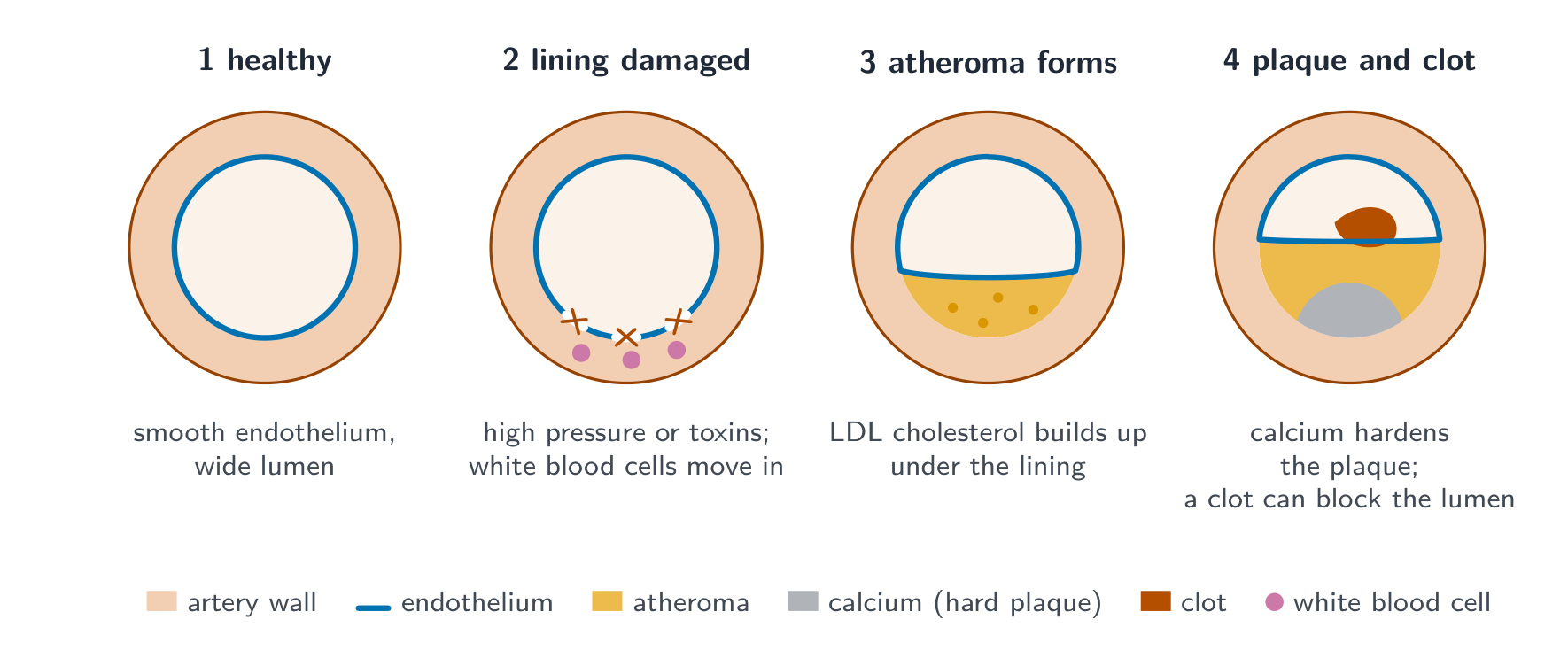
Put the stages of atherosclerosis in order.
難易度 3/5 · 200 コイン + 今日初回達成時の小ボーナス
Damage comes first; everything else is the body's response to it. The last step leads back to the first, because higher pressure damages more endothelium.
A vicious circle
- A narrow lumen raises the blood pressure in that artery. Higher pressure damages more endothelium, so more atheroma forms: positive feedback 正反馈.
- Exam point: atherosclerosis happens in arteries, not veins, because the pressure in arteries is high.
Atherosclerosis is most common in veins, because blood flows slowly there.
難易度 1/5 · 100 コイン + 今日初回達成時の小ボーナス
It develops in arteries. Their blood is at high pressure, and high pressure is what damages the endothelium. Veins carry blood at low pressure.
Step 3: a blood clot forms
- A rough plaque can break the lining open. Platelets 血小板 stick to the damaged surface and release thromboplastin 凝血活酶.
| Step | What happens |
|---|---|
| 1 | Thromboplastin (with calcium ions) converts prothrombin 凝血酶原 into thrombin 凝血酶. |
| 2 | Thrombin (an enzyme) converts soluble fibrinogen 纤维蛋白原 into insoluble fibrin 纤维蛋白. |
| 3 | Fibrin threads form a mesh that traps red blood cells and platelets: a clot 血凝块. |
- Trap: prothrombin and fibrinogen are both carried in the plasma. The substrate of thrombin is fibrinogen; fibrin is its product.
Match each substance to its role in clotting.
難易度 2/5 · 140 コイン + 今日初回達成時の小ボーナス
Two enzymes act one after the other. Thromboplastin makes thrombin; thrombin makes fibrin. Calcium ions are needed for the first step.
Step 4: from clot to heart attack or stroke
- A clot in a coronary artery 冠状动脉 cuts the blood supply to part of the heart muscle. Without oxygen those cells cannot respire aerobically and they die: a myocardial infarction 心肌梗死 (heart attack).
- A clot (or a piece of one) in an artery to the brain causes a stroke 中风. Narrow coronary arteries without a full block cause chest pain called angina 心绞痛.
Why does a blocked coronary artery damage the heart muscle?
難易度 1/5 · 100 コイン + 今日初回達成時の小ボーナス
Heart muscle gets its oxygen from the coronary arteries, not from the blood inside the chambers. Beyond the block the cells are starved of oxygen and die.
Risk factors
| Risk factor | How it raises the risk |
|---|---|
| high blood pressure | damages the endothelium |
| smoking | toxins damage the endothelium; carbon monoxide lowers oxygen transport |
| high LDL cholesterol (diet high in saturated fat) | more cholesterol to build atheroma |
| inactivity and obesity | linked to high blood pressure and high LDL |
| age, sex and genes | cannot be changed; risk rises with age, and is higher in men before middle age |
- Correlation 相关性 is not causation. A study can show that two variables change together. Only a controlled experiment, or a known mechanism, shows that one causes the other.
A study finds that people who eat more salt have more heart attacks. Which statement is the best conclusion?
難易度 1/5 · 100 コイン + 今日初回達成時の小ボーナス
A study like this shows a correlation only. Other variables, such as blood pressure or a diet high in processed food, might explain it.
Worked example: reading a risk study
A study of 10 000 adults finds that smokers had 26 heart attacks per 1000 people and non-smokers had 10 per 1000.
- Calculate: the risk for smokers is $\frac{26}{10} = 2.6$ times the risk for non-smokers. As a percentage increase: $\frac{26 - 10}{10} \times 100 = 160\%$.
- Judge the study: a large sample makes it more reliable. Check that age, sex, blood pressure and diet were similar in both groups; otherwise those variables, not smoking, could explain the difference.
- Conclude carefully: the data show a correlation. Together with the known mechanism (toxins damage the endothelium), they support smoking as a cause.
In a study, 18 per 1000 people with high blood pressure had a stroke, against 6 per 1000 with normal blood pressure. How many times greater is the risk with high blood pressure?
難易度 2/5 · 140 コイン + 今日初回達成時の小ボーナス
$\dfrac{18}{6} = 3$, so the risk is three times greater (a $200\%$ increase).
Measuring the body: BMI and waist-to-hip ratio
- BMI 体重指数 $= \dfrac{\text{mass in kg}}{(\text{height in m})^2}$. A BMI of 25 to 29.9 counts as overweight, and 30 or more as obese.
- Waist-to-hip ratio $= \dfrac{\text{waist}}{\text{hip}}$. Fat around the waist is more strongly linked to CVD, so a high ratio (above about 0.9 for men, 0.85 for women) means a higher risk.
- Energy budget: if energy taken in from food is greater than energy used, the extra is stored as fat and mass increases.
A man has a mass of 92 kg and a height of 1.75 m. Calculate his BMI to 1 decimal place.
難易度 2/5 · 140 コイン + 今日初回達成時の小ボーナス
$\dfrac{92}{1.75^2} = \dfrac{92}{3.0625} = 30.0$. A BMI of 30 or more is classed as obese.
Treatments: benefits and risks
| Drug | How it works | Possible side effect |
|---|---|---|
| antihypertensives (diuretics, beta-blockers, ACE inhibitors) | lower blood pressure | dizziness, fainting, kidney problems |
| statins 他汀类药物 | block an enzyme in the liver, so less LDL cholesterol is made | muscle pain; must be taken for life |
| anticoagulants (warfarin, heparin) | slow down clotting | dangerous bleeding |
| platelet inhibitors (aspirin, clopidogrel) | stop platelets sticking together | stomach bleeding, allergic reactions |
- Every treatment is a balance: benefit (fewer clots or less atheroma) against risk (side effects). In an exam, give one of each.
Match each patient to the most suitable drug.
難易度 2/5 · 140 コイン + 今日初回達成時の小ボーナス
Each drug acts on one link in the chain. Statins lower LDL, antihypertensives lower pressure, and anticoagulants and platelet inhibitors reduce clotting.
Explain how a high level of LDL cholesterol in the blood can lead to a heart attack. (5 marks)
Each mark is one link in the chain. Name the coronary artery, and end with what happens to the heart muscle cells.
Endothelium damage → inflammation → LDL cholesterol builds an atheroma → calcium hardens it into a plaque → the lumen narrows and pressure rises. A torn plaque starts clotting: thromboplastin turns prothrombin into thrombin, and thrombin turns fibrinogen into fibrin. A clot in a coronary artery causes a heart attack; in the brain, a stroke. Reduce the risk by lowering blood pressure, LDL and clotting, and by not smoking.