| English | 意味 |
|---|---|
| capacitance/kəˈpæsɪtəns/ | 静電容量 |
| parallel/ˈpærəlel/ | 並列 |
| farad/ˈfæræd/ | ファラド |
| dielectric/ˌdaɪɪˈlektrɪk/ | 絶縁体(誘電体) |
| series/ˈsɪəriːz/ | 直列 |
A store that fills up and then stops
- Connect a capacitor to a battery and charge flows for a moment, then stops completely, even though the battery is still connected.
- It stops because the two plates are not joined. Electrons leave one plate and arrive at the other through the battery, and the flow ceases when the p.d. across the gap has grown to match the battery's.
- So the capacitor is left holding $+Q$ on one plate and $-Q$ on the other, always equal and opposite, and the device as a whole is still neutral.
- This lesson is capacitance 电容, what sets it, and how capacitors combine.
Defining capacitance
- The capacitance of a capacitor, or of any isolated conductor, is the charge per unit potential difference:
- The two-mark definitions differ slightly. For a parallel-plate capacitor: the charge on one plate per unit potential difference between the plates. For an isolated sphere: the charge on the conductor per unit potential.
- The unit is the farad 法拉, $1\ \text{F} = 1\ \text{C/V}$. A farad is enormous, so real capacitors run from picofarads to millifarads.

Two plates, an insulator between, and charge that cannot cross
静電容量
Q = C·V
蓄えられる電荷は電圧に 比例 しており、その傾きが静電容量Cです。
静電容量とは、単位あたりに蓄えられる電荷のことです:
難易度 1/5 · 100 コイン + 今日初回完了時に小ボーナス付与
$C = \dfrac{Q}{V}$ — ボルトあたりの電荷、単位はファラッド。
コンデンサに $0.012\ \text{C}$ が $4.0\ \text{V}$ で蓄えられている。その静電容量は mF 単位でいくつ인가?
難易度 2/5 · 140 コイン + 今日初回完了時に小ボーナス付与
$C = \dfrac{Q}{V} = \dfrac{0.012}{4.0} = 0.0030\ \text{F} = 3.0\ \text{mF}$.
帯電したコンデンサは片側の極板に+Q、もう片側に-Qを持っており、コンデンサ全体としては中性です。
難易度 1/5 · 100 コイン + 今日初回完了時に小ボーナス付与
電子はバッテリーを通じて一方の極板から他方へ移動するため、電荷は常に等しく正反対になります。蓄えられる電荷Qとは、片側の極板の電荷を指します。
What sets the capacitance
- $C$ is a constant for a given capacitor. Double the charge and the p.d. doubles too, so the ratio does not change. That is why $Q$ against $V$ is a straight line through the origin.
- For parallel plates, $C$ is proportional to the plate area and inversely proportional to the separation: halve the gap and the capacitance doubles. Replacing the air with a dielectric 电介质 raises it further.
- For an isolated sphere of radius $r$, $V = Q/(4\pi\varepsilon_0 r)$, so $C = 4\pi\varepsilon_0 r$: the capacitance depends only on its size.
コンデンサの電荷を倍にすると電圧も倍になりますが、静電容量はそのままです。
難易度 1/5 · 100 コイン + 今日初回完了時に小ボーナス付与
$C = \dfrac{Q}{V}$はコンデンサのサイズと誘電体によって固定されている——$Q$と$V$は共に上昇する。
Worked example: the charged sphere
- An isolated metal sphere of radius $15\ \text{cm}$ is charged to $9.0 \times 10^3\ \text{V}$. Find its capacitance and its charge.
- $C = 4\pi\varepsilon_0 r = \dfrac{0.15}{8.99 \times 10^9} = 1.7 \times 10^{-11}\ \text{F}$, which is $17\ \text{pF}$.
- $Q = CV = (1.67 \times 10^{-11})(9.0 \times 10^3) = 1.5 \times 10^{-7}\ \text{C}$.
- Useful shortcut: since $4\pi\varepsilon_0 = 1/(8.99 \times 10^9)$, the capacitance of a sphere is simply $r/(8.99 \times 10^9)$ with $r$ in metres. Nine thousand volts stores only a seventh of a microcoulomb, because a sphere is a very poor capacitor.
Capacitors in parallel
- Capacitors in parallel all have the same p.d. across them, so each stores $C_nV$ and the charges add:
- The combination has a larger capacitance than any one of them, because the effect is like enlarging the plate area.
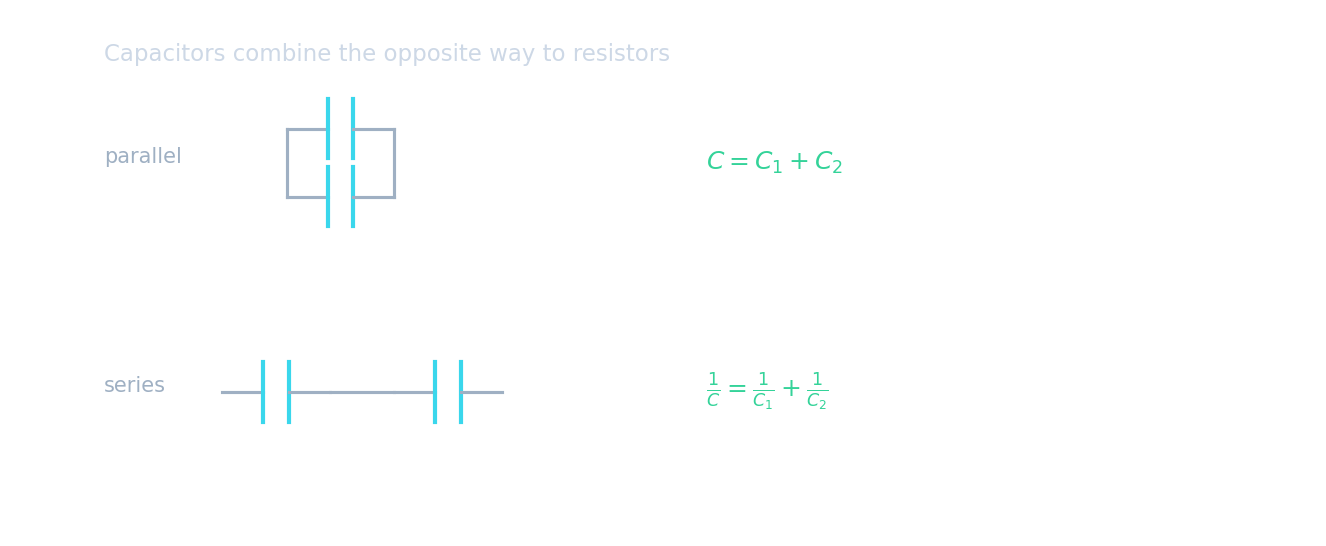
Parallel adds capacitance; series reduces it
$2.0\ \mu\text{F}$ と $3.0\ \mu\text{F}$ のコンデンサが並列接続されています。合計静電容量は何µFですか?
難易度 2/5 · 140 コイン + 今日初回完了時に小ボーナス付与
並列接続では静電容量は加算される:$2.0 + 3.0 = 5.0\ \mu\text{F}$。
並列接続された2つのコンデンサの合成静電容量は:
難易度 1/5 · 100 コイン + 今日初回完了時に小ボーナス付与
並列コンデンサは加算される($C_1 + C_2$) — 抵抗器が直列接続で加算されるのと逆です。
半径0.15 mの孤立球体の静電容量は C = 4 pi eps0 r です。これをピコファラドで求めよ。(1/4 pi eps0 = 8.99e9)
難易度 2/5 · 140 コイン + 今日初回完了時に小ボーナス付与
C = r / 8.99e9 = 0.15 / 8.99e9 = 1.7e-11 F = 17 pF。球体は非常に性能の悪いコンデンサであり、9000 Vでも約0.15マイクロクーロンしか蓄えられません。
Capacitors in series
- Capacitors in series all carry the same charge, since the charge pushed onto one plate must come off the plate joined to it. The p.d.s add, so $V = Q/C_1 + Q/C_2$ and:
- The combination has a smaller capacitance than any one of them, as though the plate separation had increased.
- This is the opposite way round to resistors, and stating the reason, same p.d. for parallel and same charge for series, is what a "derive" question is asking for.
各コンデンサの配置と、その合成公式の根拠となる事実を対応させなさい。
難易度 2/5 · 140 コイン + 今日初回完了時に小ボーナス付与
これらの2つの事実こそが「公式を導く」問題で求められるものであり、これが抵抗器の規則と逆になっている理由でもあります。
並列接続のコンデンサは加算され、これは抵抗器の規則の ____ です。
難易度 1/5 · 100 コイン + 今日初回完了時に小ボーナス付与
抵抗器は直列で加算され並列で逆数を用いますが、コンデンサはその逆です。これらを見間違えることが、このサブトピックで最も一般的な誤りです。
Worked example: combining three
- A $2.0\ \mu\text{F}$ and a $3.0\ \mu\text{F}$ capacitor are connected in parallel, and that combination is joined in series with a $5.0\ \mu\text{F}$ capacitor. Find the total capacitance.
- The parallel pair first: $C_{\text{p}} = 2.0 + 3.0 = 5.0\ \mu\text{F}$.
- Then in series with $5.0\ \mu\text{F}$: $\dfrac{1}{C} = \dfrac{1}{5.0} + \dfrac{1}{5.0} = \dfrac{2}{5.0}$, so $C = 2.5\ \mu\text{F}$.
- Work from the inside outwards, exactly as with resistors, but with the two rules swapped. The final answer must be smaller than either part of the series pair, which is the check.
2.0 µF と 3.0 µF のコンデンサが並列接続され、さらに 5.0 µF のコンデンサと直列接続されています。合計静電容量は何µFですか?
難易度 2/5 · 140 コイン + 今日初回完了時に小ボーナス付与
並列部分の合計は5.0 µFとなり、それに5.0 µFを直列接続すると: 1/C = 1/5 + 1/5 なので、C = 2.5 µF。結果は直列要素のいずれかよりも小さくなければなりません。
Marks that slip away
- Parallel capacitors add; series capacitors use the reciprocal rule. This is the reverse of resistors and is the single commonest error here.
- The definition is charge per unit potential difference, and for plates it is the charge on one plate.
- The charges on the two plates are equal and opposite, so the capacitor is neutral overall. Never write $2Q$.
- $C$ is fixed by the capacitor's geometry. Charging it more does not change $C$; it changes $Q$ and $V$ together.
You've got it
- capacitance is charge per unit p.d., $C = Q/V$, in farads; for plates it is the charge on one plate
- $C$ depends on geometry: plate area over separation for a capacitor, and $C = 4\pi\varepsilon_0 r$ for an isolated sphere
- parallel: same p.d., charges add, $C = C_1 + C_2$, a larger capacitance
- series: same charge, p.d.s add, $\dfrac{1}{C} = \dfrac{1}{C_1} + \dfrac{1}{C_2}$, a smaller capacitance, the opposite of resistors