| English | 意味 |
|---|---|
| escape velocity/eˈskeɪp vəˈlɒsɪti/ | 脱出速度 |
| gravitational potential/ˌɡrævɪˈteɪʃənl pəˈtenʃl/ | 重力ポテンシャル |
| infinity/ɪnˈfɪnɪti/ | 無限遠 |
| gravitational potential energy/ˌɡrævɪˈteɪʃənl pəˈtenʃl ˈenədʒi/ | 重力位置エネルギー |
| tightly bound/ˈtaɪtli baʊnd/ | 密に束縛されている |
永遠に脱出するにはどれだけの速さか?
- ボールを投げると戻ってくる。 sufficiently fast で投げれば、二度と戻ってこない。
- その「二度と戻ってこない」速さが脱出速度である。
- これを求めるには重力ポテンシャルが必要である。
重力ポテンシャル
- $\phi$ は無限遠から小さな試験質量をある点まで運ぶために単位質量あたりに行われる仕事である: $\phi = \dfrac{W}{m}$。単位:$\dfrac{\text{J}}{\text{kg}}$。
- 無限遠をゼロと定義するため、$\phi = -\dfrac{GM}{r}$ はそれ以外の場所ではすべて負である。
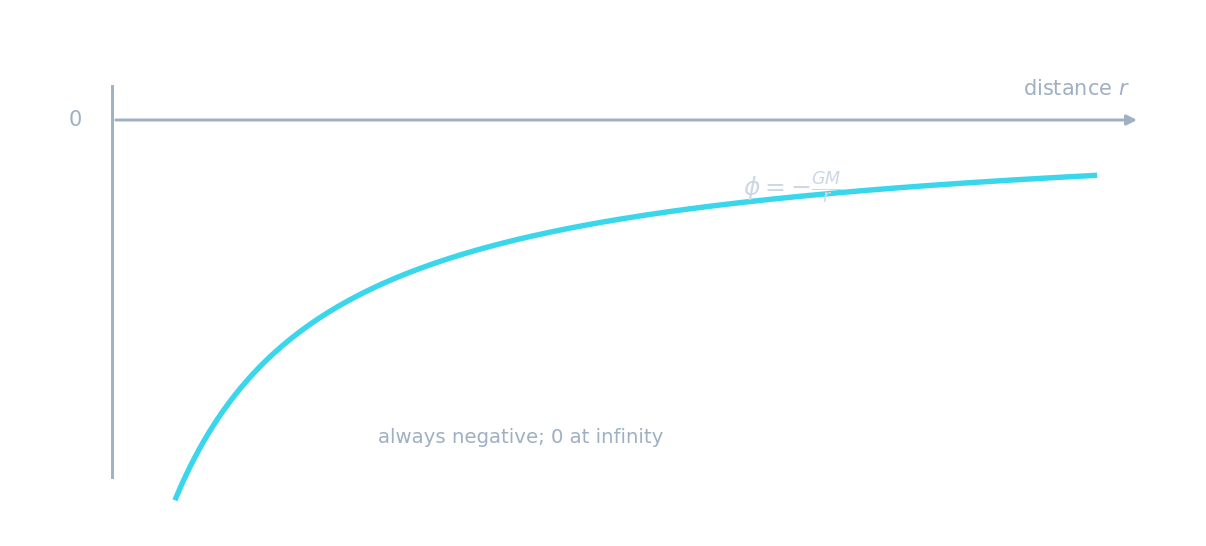
Gravitational potential
V = −GM / r
Potential ∝ −1/r — deep near the mass, flattening with distance.
Gravitational potential is:
難易度 1/5 · 100 コイン + 今日初回完了時に小ボーナス付与
Gravity does the work as a mass falls in, so $\phi = -\dfrac{GM}{r}$ is negative, reaching zero only at infinity.
Gravitational potential is taken to be zero at ____.
難易度 1/5 · 100 コイン + 今日初回完了時に小ボーナス付与
That choice makes the potential negative everywhere a mass actually is.
重力位置エネルギー
- 質量 $m$ がポテンシャル $\phi$ の位置にあるとき、ポテンシャルエネルギーは $E_{\text{P}} = m\phi = -\dfrac{GMm}{r}$ である。
- これは負であり、より近い質量ほどポテンシャルは負の値が大きく、より強く束縛されていることを示す。

重力が惑星を円軌道上に保つための向心力を提供している
Two masses closer together have a more negative (lower) gravitational potential energy.
難易度 1/5 · 100 コイン + 今日初回完了時に小ボーナス付与
$E_{\text{P}} = -\dfrac{GMm}{r}$ — smaller $r$ gives a more negative value, i.e. a more tightly bound pair.
Match each term to the definition the examiner marks.
難易度 2/5 · 140 コイン + 今日初回完了時に小ボーナス付与
Two of these are per unit mass and one is per unit mass of WORK. That single word is what separates potential from field strength.
と $mg\Delta h$ の関係
- 地表付近の小さい高さの変化については、$r$ はほとんど変化しないため、$\Delta E_{\text{P}} \approx mg\Delta h$ となる。
- 大きい変化(衛星の昇軌など)については、各半径における $-\dfrac{GMm}{r}$ を用いて引き算を行う。
The simple formula $\Delta E_{\text{P}} = mg\Delta h$ is valid when:
難易度 1/5 · 100 コイン + 今日初回完了時に小ボーナス付与
It assumes a uniform field. For big changes in $r$, use $-\dfrac{GMm}{r}$ at each radius instead.
Why is gravitational potential always negative? Select all that apply.
難易度 2/5 · 140 コイン + 今日初回完了時に小ボーナス付与
"Because gravity attracts" on its own is not the marked answer. The mark needs the work argument: zero at infinity, and the field doing the work on the way in.
worked example: マーリス表面でのポテンシャル
火星の質量は $6.4 \times 10^{23}\ \text{kg}$、半径は $3.4 \times 10^{6}\ \text{m}$ である。その表面における重力ポテンシャルと、質量 $1\ \text{kg}$ を表面から無限遠へ移動させるのに必要なエネルギーを求めよ。
- ポテンシャル: $\phi = -\dfrac{GM}{R} = -\dfrac{6.67 \times 10^{-11} \times 6.4 \times 10^{23}}{3.4 \times 10^{6}} = -1.3 \times 10^{7}\ \dfrac{\text{J}}{\text{kg}}$。
- 単位を問われている: ポテンシャルは単位質量あたりのエネルギーであるため、ジュール毎キログラム (J/kg) である。
- 単位質量あたりの脱出エネルギー: $\phi$ から無限遠のゼロまで上昇するには、kg あたり $+1.3 \times 10^{7}\ \text{J}$ が必要である。
- 確認: 負の符号は任意ではない。これは質量を取り除くためには質量に対して仕事を行わなければならないことを意味し、質量は深さ $1.3 \times 10^{7}\ \dfrac{\text{J}}{\text{kg}}$ の「穴」の中に存在する。
The Moon has mass $7.35 \times 10^{22}\ \text{kg}$ and radius $1.74 \times 10^{6}\ \text{m}$. What is the gravitational potential at its surface, as a multiple of $10^{6}\ \dfrac{\text{J}}{\text{kg}}$? (Include the sign.)
難易度 2/5 · 140 コイン + 今日初回完了時に小ボーナス付与
$\phi = -\dfrac{GM}{R} = -\dfrac{6.67 \times 10^{-11} \times 7.35 \times 10^{22}}{1.74 \times 10^{6}} = -2.8 \times 10^{6}\ \dfrac{\text{J}}{\text{kg}}$ — about a twentieth of the Earth's, which is why leaving the Moon is easy.
脱出速度
- 無限遠に到達するためには、運動エネルギーが穴の深さと等しくなければならない: $\tfrac{1}{2}mv_{\text{esc}}^{2} = \dfrac{GMm}{r}$。
- 地球表面における $v_{\text{esc}} = \sqrt{\dfrac{2GM}{r}} \approx 11\ \dfrac{\text{km}}{\text{s}}$ は物体の質量に依存しない。
Roughly, what is the escape velocity from the Earth's surface, in km/s?
難易度 2/5 · 140 コイン + 今日初回完了時に小ボーナス付与
$v_{\text{esc}} = \sqrt{\dfrac{2GM}{r}} \approx 11\ \dfrac{\text{km}}{\text{s}}$ for Earth.
Escape velocity depends on the mass of the escaping object.
難易度 1/5 · 100 コイン + 今日初回完了時に小ボーナス付与
The object mass cancels: $v_{\text{esc}} = \sqrt{\dfrac{2GM}{r}}$ depends only on the planet and the distance.
A planet has GM/r = 6.3e7 J/kg at its surface. What is its escape speed, in km/s?
難易度 2/5 · 140 コイン + 今日初回完了時に小ボーナス付与
v = sqrt(2GM/r) = sqrt(1.26e8) = 1.12e4 m/s = 11.2 km/s, the Earth's value. Note the factor of 2 and that the mass of the escaping object cancels out entirely.
worked example: 衛星の昇軌
質量 $500\ \text{kg}$ の衛星を地球表面($R = 6.37 \times 10^{6}\ \text{m}$)から半径 $7.0 \times 10^{6}\ \text{m}$ の軌道へ昇轨する。地球の質量は $5.97 \times 10^{24}\ \text{kg}$ である。ポテンシャルエネルギーの増分を求め、$mg\Delta h$ と比較せよ。
- 2つのポテンシャルの差: $\Delta E_{\text{P}} = GMm\left(\dfrac{1}{R} - \dfrac{1}{r}\right)$。
- 代入: $6.67 \times 10^{-11} \times 5.97 \times 10^{24} \times 500 \times \left(\dfrac{1}{6.37 \times 10^{6}} - \dfrac{1}{7.0 \times 10^{6}}\right) = 2.8 \times 10^{9}\ \text{J}$。
- おおよその方法: $mg\Delta h = 500 \times 9.81 \times 6.3 \times 10^{5} = 3.1 \times 10^{9}\ \text{J}$ — 約 $10\%$ 大きすぎる。なぜなら $g$ は高度とともに減少するが、$mg\Delta h$ は一定であると仮定しているからである。
- 確認: 増分は正である—ポテンシャルはどちらも負の数値であるにもかかわらず、最終的なポテンシャルは初期値よりも負の値が小さくなり、束縛が弱くなる。
ポテンシャルは 負 であり、遠ざかるにつれてゼロに 近づく。「得られたエネルギー」は最終値から初期値を引いたものだが、符号を含めて 計算する: $-1.3 \times 10^{7} \to -0.9 \times 10^{7}$ は kg あたり $0.4 \times 10^{7}$ の増加である。 $mg\Delta h$ は $\Delta h \ll R$ に対してのみ適用される。 $\phi$ の単位は $\dfrac{\text{J}}{\text{kg}}$ であり、ジュールと書くと失点する。
Which statements about gravitational potential are correct? Select all that apply.
難易度 2/5 · 140 コイン + 今日初回完了時に小ボーナス付与
Potential is energy per unit mass, so its unit is joules per kilogram. It is negative, rises towards zero with distance, and its gradient gives the field: $g = -\dfrac{\Delta\phi}{\Delta r}$.
ポテンシャルグラフからの場強
- 場強はポテンシャル-距離グラフの傾きである: $g = -\dfrac{\Delta\phi}{\Delta r}$。
- $\phi$ グラフが急な場所(質量に近い場所)では場が強いため、遠方ではグラフが平坦になり、場は弱くなる。
- 負の符号は、場がポテンシャル勾配に沿って下向きに指していることを示しており、質量がある方向へ向かっています。この地点で $\phi$ が最も負の値をとります。
理解できましたか
- 重力ポテンシャル $\phi = -\dfrac{GM}{r}$ は $\dfrac{\text{J}}{\text{kg}}$ に存在します(負の値であり、無限遠ではゼロです)。 $g = -\dfrac{\Delta\phi}{\Delta r}$
- 重力位置エネルギー $E_{\text{P}} = -\dfrac{GMm}{r}$ は、より負の値であるほど結合が強く、大きな変化には $GMm\left(\dfrac{1}{r_1} - \dfrac{1}{r_2}\right)$ を用います。
- 脱出速度 $v_{\text{esc}} = \sqrt{\dfrac{2GM}{r}}$ は質量に依存せず、地球においては $\approx 11\ \dfrac{\text{km}}{\text{s}}$ です。