English
What this practice supplement is
This supplement gives original classroom practice for all three tasks in the TOEFL Writing section: Build a Sentence, Write an Email and Write for an Academic Discussion. Every task, prompt and model here is invented for practice. Nothing here is an ETS question, and nothing here states official timings or scores.
Work in this order. First build four sentences yourself. Then read the explained answers. Then study one complete discussion model and two model emails. Finally, fix two weak sentences. Write your own answer before you read each explanation. Your attempt shows you which words are hard for you. The explanation then helps with that exact problem.
Sentence building practice
Each task gives you a fixed start and a fixed end. You must copy both exactly. Between them you place the chunks 词块, small groups of words. The chunks are printed in a mixed order, so you must find the correct order yourself.
Rules for every task:
- Use each chunk exactly once.
- Keep the fixed start and the fixed end exactly as given.
- Put nothing between the fixed parts except the chunks.
Task 1: A polite question
- Fixed start: Could you tell me where
- Chunks, in a mixed order: is / the library
- Fixed end: ?
- Requirement: The finished sentence must be one ordinary written English question.
Task 2: Which notice?
- Fixed start: The notice
- Chunks, in a mixed order: posted / that / the tutor
- Fixed end: explains the new room rules.
- Requirement: The finished sentence must be one ordinary written English statement 陈述句.
Task 3: A reason with because
- Fixed start: The class moved to Room 12 because
- Chunks, in a mixed order: was broken / the projector
- Fixed end: .
- Requirement: The finished sentence must be one ordinary written English statement that keeps the stated cause.
Task 4: A required action
- Fixed start: The draft
- Chunks, in a mixed order: be / must / submitted
- Fixed end: by Friday.
- Requirement: The finished sentence must be one ordinary written English statement. This is normal English, not a rule made only for tests.
Answers and explanations
Write all four sentences before you read this section. Compare your sentences with the answers, then read why each order is correct.
Task 1 answer
Could you tell me where the library is?
By itself, the question would put the verb 动词 before the subject: Where is the library? Inside this polite request, the order changes. After the question word 疑问词 where, the subject 主语 comes before the verb: the library is. This subject-before-verb order is the normal one inside a polite request. Each chunk is used once, and nothing else is added.
Task 2 answer
The notice that the tutor posted explains the new room rules.
The word that opens a relative clause 定语从句. This clause modifies 修饰 the given noun 名词 notice: it tells you which notice the sentence is about. Inside the clause, the subject comes before the verb: the tutor posted. After the clause, the fixed predicate 谓语 explains the new room rules completes the sentence.
Task 3 answer
The class moved to Room 12 because the projector was broken.
Because introduces the cause of the action in the main clause 主句. The cause keeps its own subject before its verb: the projector was broken. The stated cause stays complete, and no extra word is added between the fixed parts.
Task 4 answer
The draft must be submitted by Friday.
Must is a modal verb 情态动词. After it, be and the past participle 过去分词 submitted build the passive voice 被动语态: must + be + submitted. This order is fixed. The sentence is ordinary written English, and the fixed parts, the subject and the deadline by Friday, stay unchanged.
Join an academic discussion
The discussion task gives you a professor's question and two classmates' replies. Your job is to add your own reply to that discussion. The prompt below is invented for practice, and it states its own invented details.
Professor: Our campus must choose one plan: keep the library open longer, or buy more e-books. For this discussion, imagine two invented details: the library now closes at 9 p.m., and each e-book licence might allow only one reader at a time. These details are made up for practice; your real campus may differ. Which plan would help students more, and why?
Mei: I support longer library hours. Many of us study best at night in a quiet place. If the library closed at midnight, students could work there after evening classes instead of going back to a noisy flat.
Daniel: I prefer more e-books. Students can read them anywhere, at any hour, even when the building is closed. An e-book collection can also grow without new rooms, while printed books can only sit on one shelf.
A complete model reply
The reply below is one complete answer to the professor. Read it after you have written your own.
I support longer library hours, and I agree with Mei that a quiet place at night matters when you revise. Suppose the library stayed open until midnight during exam weeks. Students who share a noisy flat could revise there, and those who finish classes late would still find time to study. Daniel's point about reading anywhere is a real strength of e-books, but a screen is not a desk: long hours of reading tire my eyes, and a licence might allow only one reader at a time. If the campus could do both, that would be best; choosing one plan, I would pick the hours, because a quiet desk in the building solves a problem a download cannot. For students who need that desk late at night, the hours matter more.
Why this model works
The model states its position first, then agrees with Mei and develops the point with its own example and reason. Suppose marks the example as hypothetical 假设的, so the model claims nothing about how busy the real library is, or about real costs. It admits Daniel's point is partly right before answering it, so this reply answers a classmate as well as stating its own view. These are choices in this one reply, not rules for every answer: a different reply may agree with Daniel instead, or speak to only one classmate. The licence point keeps might, so the one-reader limit stays a possibility, not a fact. The last sentence names one clear group, students who need a quiet desk late at night, instead of claiming that longer hours help every reader. The model reply is in English, and it states no official timing, minimum or scale.
Write an email
The email task gives you a situation and a short list of things your email must do. Write your own email first, then compare it with the model. These prompts and their details are invented for practice.
Email 1: to an office
Situation: You borrowed a camera from your university's media centre for a class project. At home, you found that the battery charger was not in the bag. Write an email to the media centre. Explain the problem, say what you need, and ask what you should do when you return the camera.
A complete model email
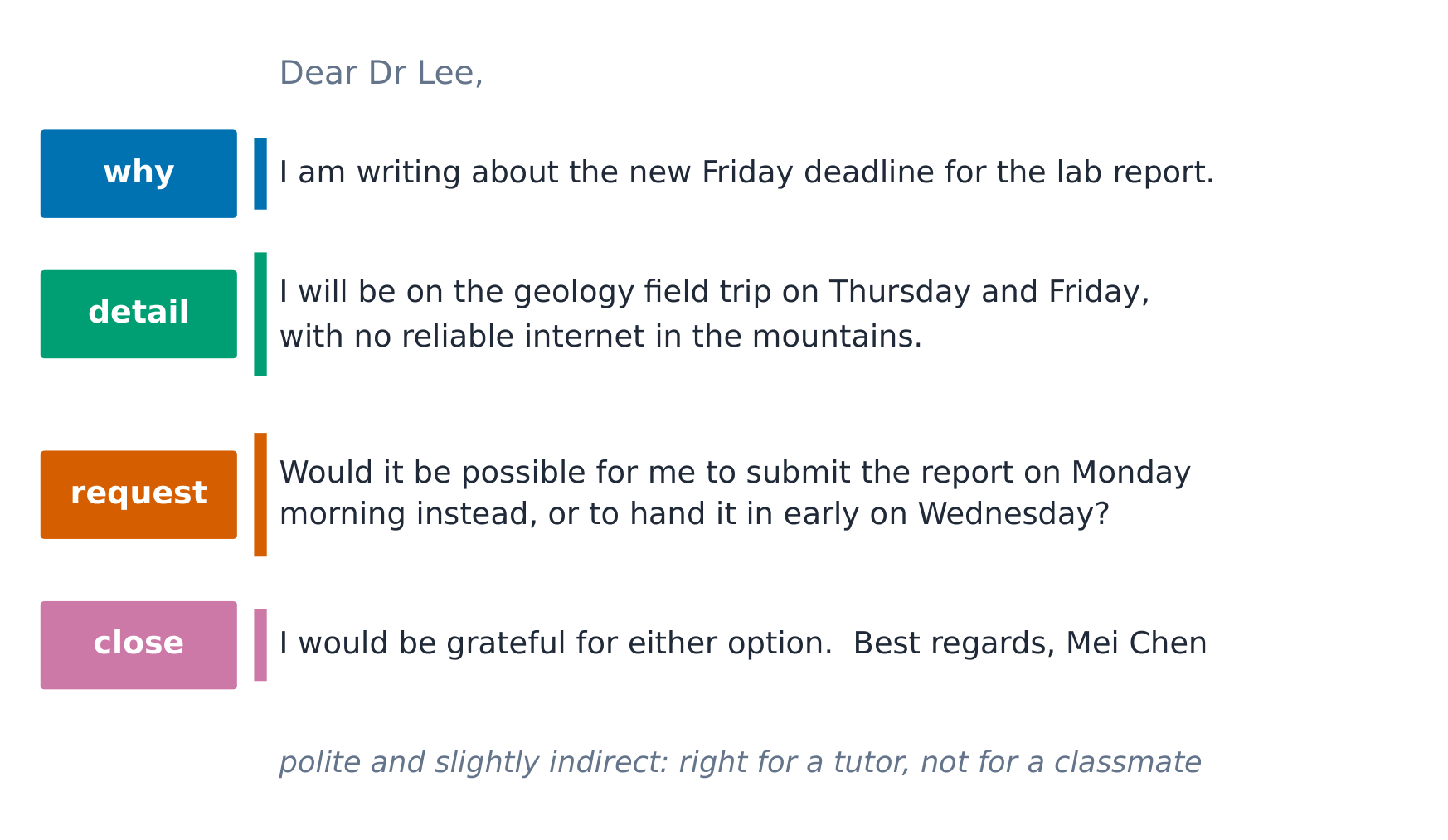
Dear Media Centre staff,
I borrowed a camera (number 14) yesterday for a film project in my media studies class. When I opened the bag at home, I found that the battery charger was not inside, and the battery is now almost empty. Would it be possible to collect a charger tomorrow morning? I need to film on Thursday afternoon. Also, when I return the camera next week, should I bring it to the front desk or to the equipment room?
Thank you for your help.
Best regards,
Leo Wang
Why this model works. It does the three jobs in the order the prompt gives them: the problem (the charger was not inside), the need (collect a charger tomorrow morning, with the reason: filming on Thursday), and the question about the return. The small details, the camera number and the day, help the reader act quickly. The tone is polite and slightly indirect (Would it be possible), right for an office, and it does not blame anyone: was not inside, not you forgot the charger.
Email 2: to a classmate
Situation: Your classmate Sara missed today's seminar because she was ill. Write to her. Tell her what the seminar covered, tell her about a change to next week's homework, and offer to help.
A complete model email
Hi Sara,
Sorry you were ill. I hope you're feeling better! Today's seminar was about how cities plan bike lanes, and we looked at two case studies, one from Copenhagen and one from Bogotá. One change: the reading for next week is now chapter 5, not chapter 4, and the short reflection is due on Tuesday instead of Monday. If you like, I can send you my notes tonight, or we could meet in the library on Friday to go through them.
See you soon,
Ana
Why this model works. It does the same three-job work with a different reader. To a classmate the register is direct and warm: Hi, Sorry you were ill, If you like, See you soon. The homework change gives both the old and the new detail (chapter 5, not chapter 4), so Sara cannot misread it. The offer gives her two choices, which is friendlier than one.
Check your own email
- Did you do every job the prompt lists, in a sensible order?
- Would the reader know exactly what to do next?
- Does the greeting, the tone and the close fit this reader: an office, a professor or a classmate?
- Did you check articles, plurals and verb tenses before you finished?
Fix two weak sentences
Each pair shows one weak sentence and one improved sentence with the same meaning. Cover the improved sentence and write your own correction first.
Pair 1: a or an?
- Weak: She will attend an university interview next week.
- Improved: She will attend a university interview next week.
Choose a or an by the first sound, not the first letter. University begins with a /j/ sound, like the word you. So the article 冠词 before it is a, not an. The meaning of the sentence does not change.
Pair 2: although and but
- Weak: Although the email was short, but it answered both requests.
- Improved: Although the email was short, it answered both requests.
One contrast 转折 word is enough here. Although already marks the contrast, so but is not needed as well. Keep although and drop but, or drop although and keep but: The email was short, but it answered both requests. The meaning stays the same.
Check yourself
- Can you rebuild each sentence and say why the order is correct?
- Can you find the position, the agreement with Mei, the marked example and the answer to Daniel in the model reply?
- Can you name the three jobs in each email prompt, and say why one email starts Dear and the other Hi?
- Can you explain both corrections without looking back?