Skip to content · ⁨コンテンツへスキップ⁩
Subjects · ⁨科目⁩
  • 1 The verb to be · ⁨be動詞⁩
    1.1

    am / is / are

    English

    The verb "to be" means "is / am / are." It changes according to the subject and has three forms:

    • I → am
    • he / she / it → is
    • you / we / they → are

    我I 是am 一名a 学生student.

    I am a student.

    她She 是is 开心happy.

    She is happy.

    他们They (是)are 来自from 中国China.

    They are from China.

    Note: Common spoken contractions: I'm, you're, he's, she's, it's, we're, they're.

    日本語
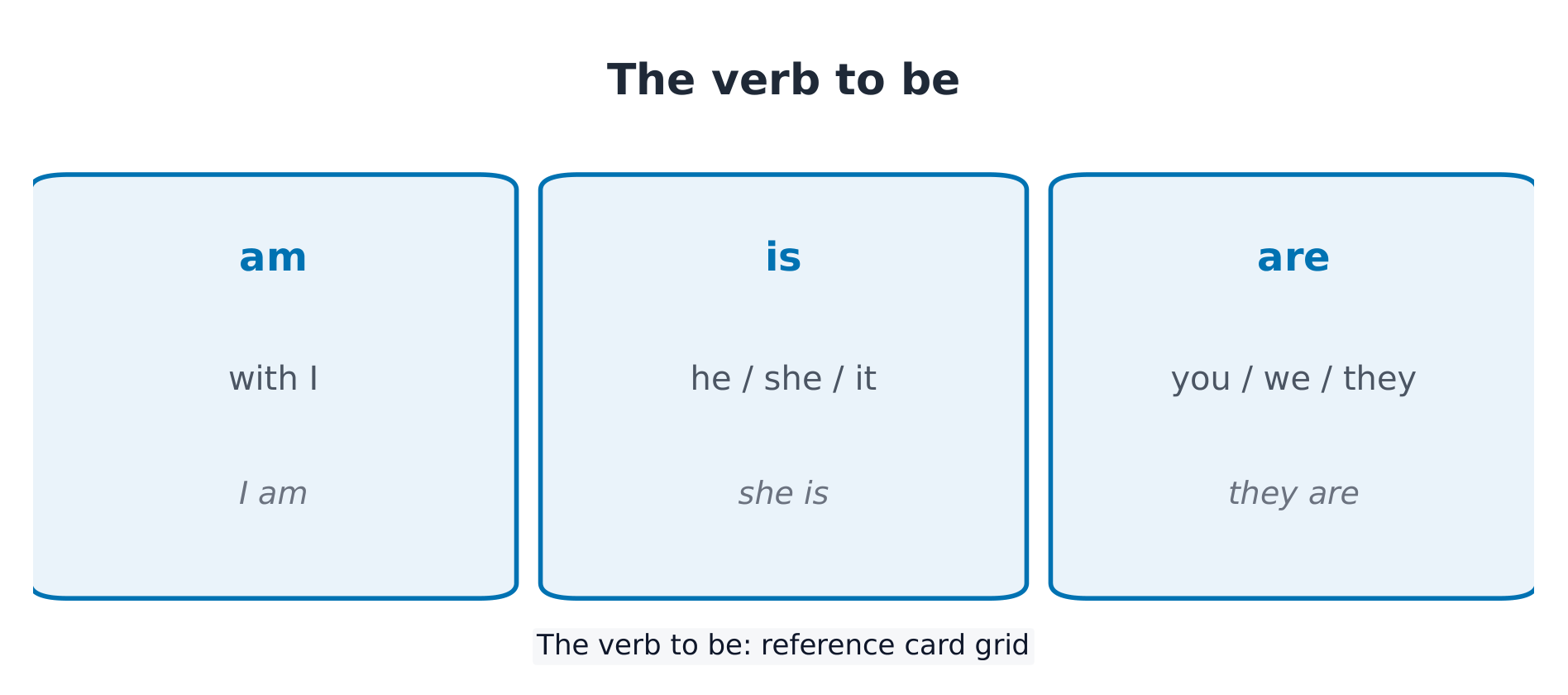
    be verbs: am / is / are change with the subject

    The verb "to be" means "is / am / are." It changes according to the subject and has three forms:

    • I → am
    • he / she / it → is
    • you / we / they → are

    我I 是am 一名a 学生student.

    I am a student.

    她She 是is 开心happy.

    She is happy.

    他们They (是)are 来自from 中国China.

    They are from China.

    Note: Common spoken contractions: I'm, you're, he's, she's, it's, we're, they're.
    1.2

    Negation and Interrogative

    English

    Negation: Add not after the be verb (often contracted).

    他He 不是is not 一名a 老师teacher.

    He is not a teacher. (= He isn't a teacher.)

    Interrogative: Place the be verb before the subject.

    (是吗)Are 你you 准备好ready?

    Are you ready?

    Short answers: Yes, I am. / No, I'm not.

    Note: Negative contractions: is not → isn't, are not → aren't; but am not is only contracted to I'm not (there is no ~~amn't~~).

    Common Errors

    • ❌ ~~He busy.~~ → ✓ He is busy. — In Chinese, "He is very busy" can exist without a verb, but an English sentence must have a verb. Use be to link when the predicative is an adjective or noun and there are no other verbs in the sentence (He is busy); do not add be if the sentence already contains an ordinary verb (I go to school).
    • ❌ ~~I am go to school.~~ → ✓ I go to school. — Do not use be and ordinary verbs together; "go" alone suffices for "to go."
    • ❌ ~~They is my friends.~~ → ✓ They are my friends. — Plural subjects (you / we / they) take are.
    • ❌ ~~I am agree.~~ → ✓ I agree. — agree is itself a verb; do not add am before it.
    • ❌ ~~Are you ready? — Yes, I'm.~~ → ✓ Yes, I am. — Contractions cannot be used at the end of affirmative short answers (say Yes, I am); however, negative short answers typically end with a negative contraction (No, he isn't / No, I can't; first person is No, I'm not, as there is no amn't).
    日本語

    Negation: Add not after the be verb (often contracted).

    他He 不是is not 一名a 老师teacher.

    He is not a teacher. (= He isn't a teacher.)

    Interrogative: Place the be verb before the subject.

    (是吗)Are 你you 准备好ready?

    Are you ready?

    Short answers: Yes, I am. / No, I'm not.

    Note: Negative contractions: is not → isn't, are not → aren't; but am not is only contracted to I'm not (there is no ~~amn't~~).

    Common Errors

    • ❌ ~~He busy.~~ → ✓ He is busy. — In Chinese, "He is very busy" can exist without a verb, but an English sentence must have a verb. Use be to link when the predicative is an adjective or noun and there are no other verbs in the sentence (He is busy); do not add be if the sentence already contains an ordinary verb (I go to school).
    • ❌ ~~I am go to school.~~ → ✓ I go to school. — Do not use be and ordinary verbs together; "go" alone suffices for "to go."
    • ❌ ~~They is my friends.~~ → ✓ They are my friends. — Plural subjects (you / we / they) take are.
    • ❌ ~~I am agree.~~ → ✓ I agree. — agree is itself a verb; do not add am before it.
    • ❌ ~~Are you ready? — Yes, I'm.~~ → ✓ Yes, I am. — Contractions cannot be used at the end of affirmative short answers (say Yes, I am); however, negative short answers typically end with a negative contraction (No, he isn't / No, I can't; first person is No, I'm not, as there is no amn't).
  • 2 Subject pronouns · ⁨主格代名詞⁩
    2.1

    I, you, he, she, it, we, they

    English

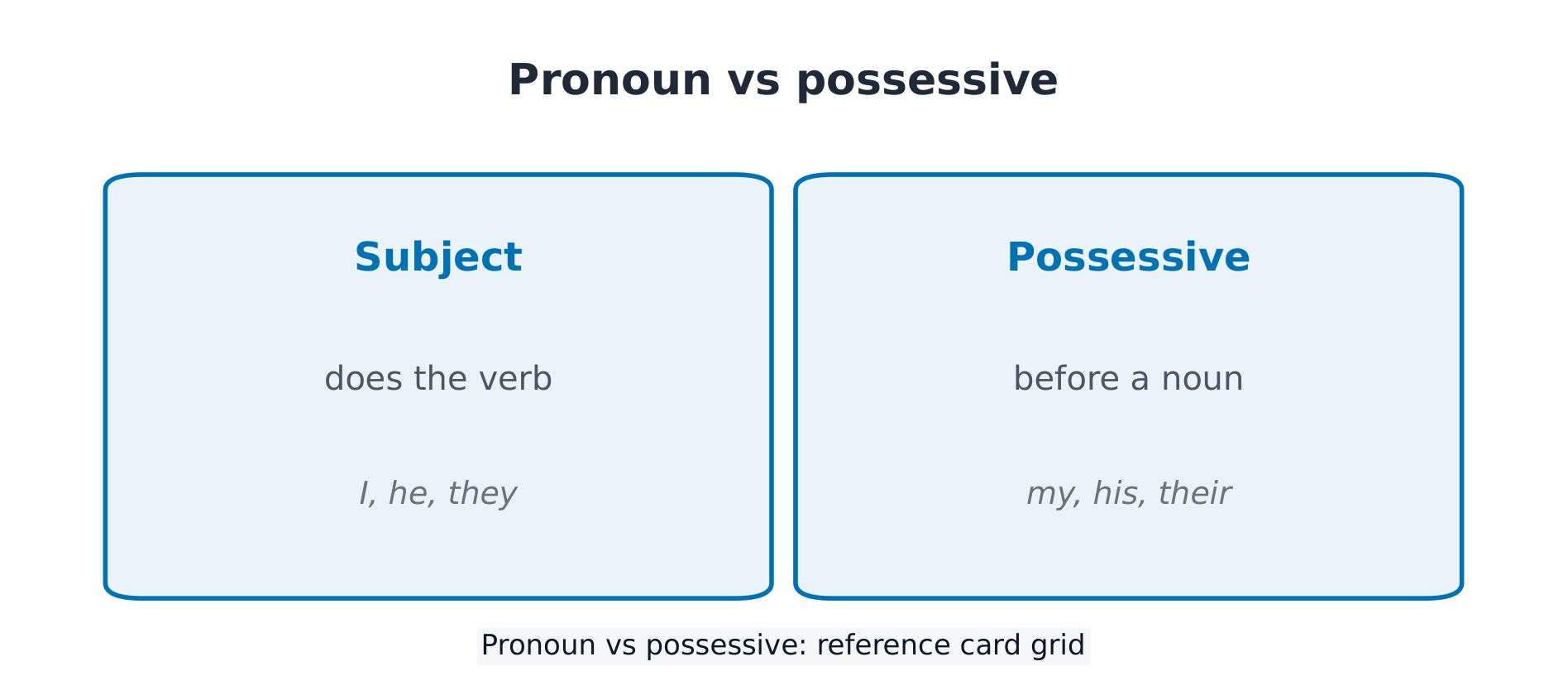
    Subject pronouns replace the subject and are placed before the verb:

    • I(I), you(you), he(he), she(she)
    • it(it), we(we), they(they)

    他He 是is 我的my 哥哥brother.

    He is my brother.

    我们We 喜欢like 音乐music.

    We like music.

    Key Usage Points:

    • I is always capitalized, regardless of its position in the sentence.
    • Things and animals commonly use it: This is my bag. It is new.(This is my bag. It is new.)*
    • Plural people or things both use they: The books are here. They are mine.(The books are here. They are mine.)*

    Note: Subject pronouns are followed by verbs; do not confuse them with object pronouns (me, him, her...) which will be learned later.

    Common Errors

    • ❌ ~~My mother is a doctor. He is very kind.~~ → ✓ She is very kind. — In colloquial Chinese, "he/she" sounds identical, but in English, he and she must be clearly distinguished.
    • ❌ ~~Me am a student.~~ → ✓ I am a student. — Use I for the subject, not me.
    • ❌ ~~My friend he is tall.~~ → ✓ My friend is tall. — The subject needs to be mentioned only once; avoid repeating "noun + pronoun" (the Chinese habit of saying "my friend he..." does not apply in English).
    • ❌ ~~Is raining.~~ → ✓ It is raining. — English sentences must have a subject; weather, time, and dates begin with it.
    日本語
    主格代名詞と所有代名詞

    主格代名詞 (subject pronouns) は主語を表すために用いられ、動詞の前に置きます:

    • I(私)、you(あなた/あなたたち)、he(彼)、she(彼女)
    • it(それ)、we(私たち)、they(彼ら/それら)

    他He 是is 我的my 哥哥brother.

    私たちは音楽が好きです。

    我们We 喜欢like 音乐music.

    使用上のポイント:

    使用上のポイント:

    • I は文末でも文中でも必ず大文字で書きます。
    • 物や動物には主に it を使います:This is my bag. It is new.(これは私の鞄です。それは新しいです。)
    • 複数の人や物はすべて they を使います:The books are here. They are mine.(本はこちらにあります。それらは私のものです。)

    注意 主格代名詞の後に動詞が続きます。後で学ぶ目的格代名詞(me、him、her…)と混同しないでください。

    よくある間違い

    • ❌ ~~My mother is a doctor. He is very kind.~~ → ✓ She is very kind. — 中国語の口語では「彼/彼女」は同じ音ですが、英語では he と she を明確に区別する必要があります。
    • ❌ ~~Me am a student.~~ → ✓ I am a student. — 主語にする場合は I を使い、me を使いません。
    • ❌ ~~My friend he is tall.~~ → ✓ My friend is tall. — 主語は一度述べるだけで十分です。「名詞+代名詞」の重複は避けます(中国語の「私の友達は彼は…」という習慣を英語に持ち込まないでください)。
    • ❌ ~~Is raining.~~ → ✓ It is raining. — 英語の文には必ず主语が必要です;天気、時間、日付は it で始めます。
  • 3 Possessive adjectives · ⁨所有形容詞⁩
    3.1

    my, your, his, her, our, their

    English

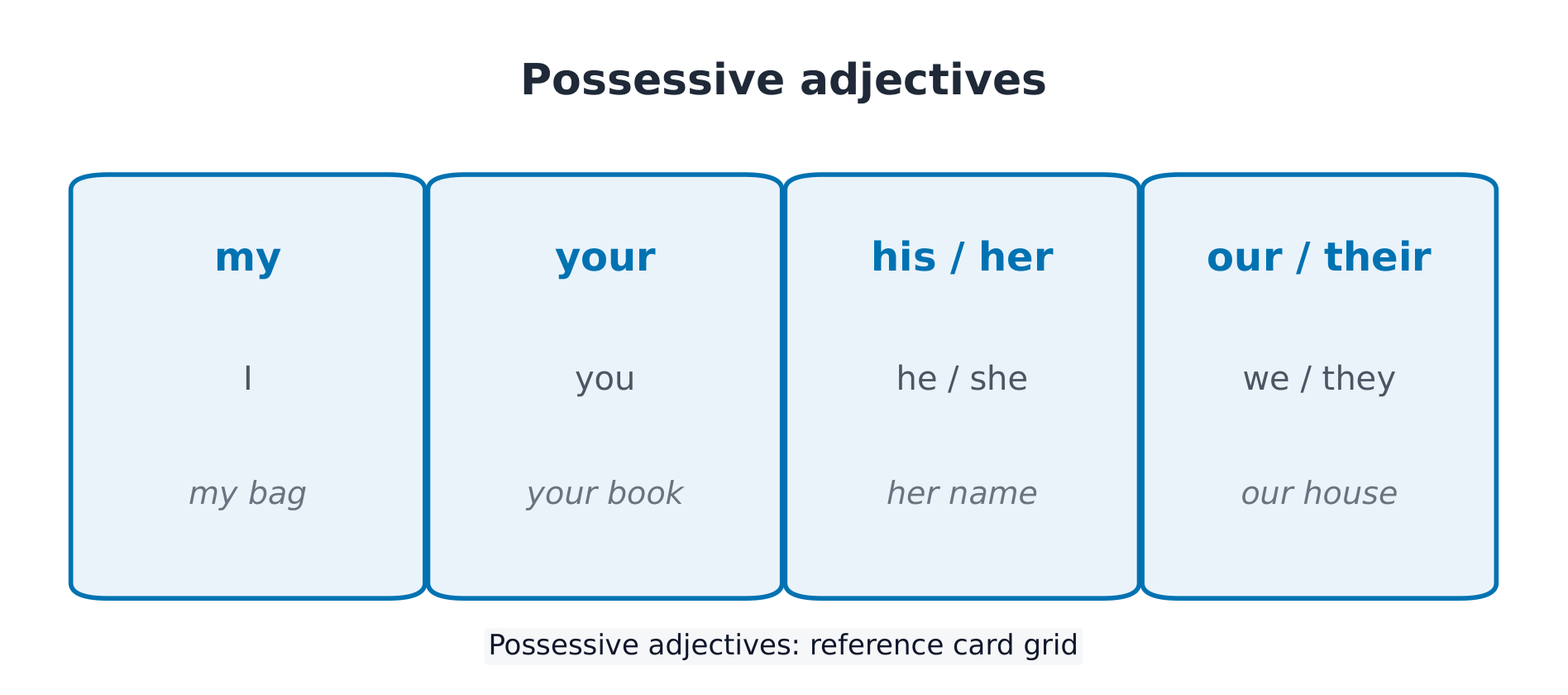
    Possessive adjectives indicate "whose" and are placed before the noun:

    • I → my(my), you → your(your), he → his(his)
    • she → her(her), it → its(its), we → our(our), they → their(their)

    这This 是is 我的my 包bag.

    This is my bag.

    她的Her 名字name 是is 露西Lucy.

    Her name is Lucy.

    Key Usage Points:

    • Possessive adjectives are always followed by a noun: my book, their house.
    • They do not change with noun number: my book, my books(my remains unchanged).

    Note: Be careful to distinguish its (its, no apostrophe) and it's (= it is). For example: The dog wags its tail.(The dog wags its tail.)*

    Common Errors

    • ❌ ~~This is she book.~~ → ✓ This is her book. — A possessive form must precede a noun: he → his, she → her.
    • ❌ ~~He is me friend.~~ → ✓ He is my friend. — The possessive form of I is my.
    • ❌ ~~The dog wags it's tail.~~ → ✓ …wags its tail. — it's = it is; "its" (possessive) has no apostrophe.
    • ❌ ~~Their is a park near here.~~ → ✓ There is a park near here. — their (their) and there (there/here) sound identical; do not mix them up in writing.
    日本語
    所有限定詞:my / your / his / her

    所有限定詞 (possessive adjectives) は「誰のものか」を表し、名詞の前に置きます:

    • I → my(私の)、you → your(あなたの)、he → his(彼の)
    • she → her(彼女の)、it → its(その)、we → our(私たちの)、they → their(彼らの)

    这This 是is 我的my 包bag.

    彼女の名字はルシーです。

    她的Her 名字name 是is 露西Lucy.

    これは私の携帯電話です。(近い場所)

    使用上のポイント:

    • 所有限定詞の後に必ず名詞が続きます:my book, their house。
    • 名詞の単复数に変化しません:my book, my books(my は変わりません)。

    注意 its(その、無印记)と it's(= it is)を慎重に区別してください。例:The dog wags its tail.(犬は尾を振っています。)

    よくある間違い

    • ❌ ~~This is she book.~~ → ✓ This is her book. — 名詞の前には所有形を使う必要があります:he → his, she → her。
    • ❌ ~~He is me friend.~~ → ✓ He is my friend. — I の所有形は my です。
    • ❌ ~~The dog wags it's tail.~~ → ✓ …wags its tail. — it's = it is;「そのもの」は its で、印记はありません。
    • ❌ ~~Their is a park near here.~~ → ✓ There is a park near here. — their(彼らの)と there(そこにある/あちら)は発音が同じですが、書き間違いに注意してください。
  • 4 this, that, these, those
    4.1

    this と that

    English

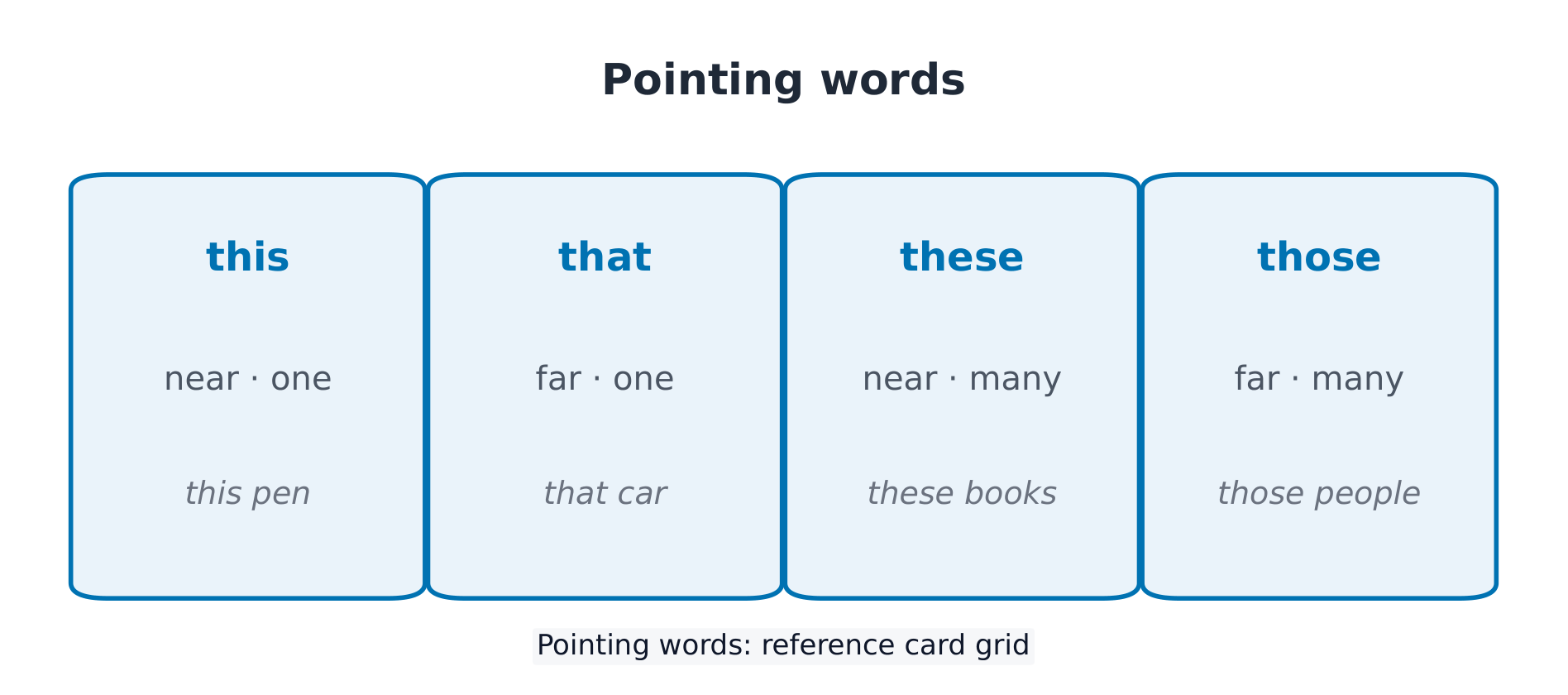
    Demonstratives point out "which one." Use this and that for singular:

    • this(this): Close to the speaker.
    • that(that): Far from the speaker.

    这This 是is 我的my 手机phone.

    This is my phone. (Close)

    那That 是is 你的your 车car.

    That is your car. (Far)

    日本語
    近・遠 × 単数・複数:this / that / these / those

    指示代名詞 (demonstratives) は「どれか」を指し示します。単数には this と that を使います:

    • this(これ):話し手から近い位置。
    • that(あれ):話し手から遠い位置。

    这This 是is 我的my 手机phone.

    あなただけの車ですね。(遠い場所)

    那That 是is 你的your 车car.

    これらは私の本です。

    4.2

    these と those

    English

    Use these and those for plural:

    • these(these): Close. those(those): Far.

    这些These 是are 我的my 书books.

    These are my books.

    那些Those 是are 她的her 朋友friends.

    Those are her friends.

    Contrastive Memory:

    • Near → this (singular) / these (plural).
    • Far → that (singular) / those (plural).

    Note: These / those are followed by plural nouns: these books, not ~~these book~~.

    Common Errors

    • ❌ ~~these book~~ → ✓ these books — Plural nouns must follow these / those.
    • ❌ ~~This books are mine.~~ → ✓ These books are mine. — If the noun is plural, the demonstrative must also be plural.
    • ❌ When introducing yourself on the phone, say ~~I am Tom.~~ → ✓ This is Tom. — In English, introduce yourself on the phone using this is.
    • Remember pairs: Near this / these are often used with here; far that / those are often used with there.
    日本語

    複数には these と those を使います:

    • these(これら):近い。those(あれら):遠い。

    这些These 是are 我的my 书books.

    あれらは彼女的朋友です。

    那些Those 是are 她的her 朋友friends.

    対比記憶:

    私はペンを持っています。

    • 近い → this(単数)/ these(複数)。
    • 遠い → that(単数)/ those(複数)。

    注意 these や those の後には複数名詞が続きます:these books, ~~these book~~ ではありません。

    よくある間違い

    • ❌ ~~these book~~ → ✓ these books — these や those の後には必ず複数名詞が続きます。
    • ❌ ~~This books are mine.~~ → ✓ These books are mine. — 名詞が複数の場合、指示代名詞も複数形にする必要があります。
    • ❌ 電話で名前を告げる際、~~I am Tom.~~ → ✓ This is Tom. — 英語では電話での自己紹介には this is を使います。
    • 組み合わせを覚えてください:近い場所の this / these は here とセットで使うことが多く、遠い場所の that / those は there とセットで使うことが多いです。
  • 5 a, an and plurals · ⁨不定冠詞 a, an と複数形⁩
    5.1

    a and an

    English

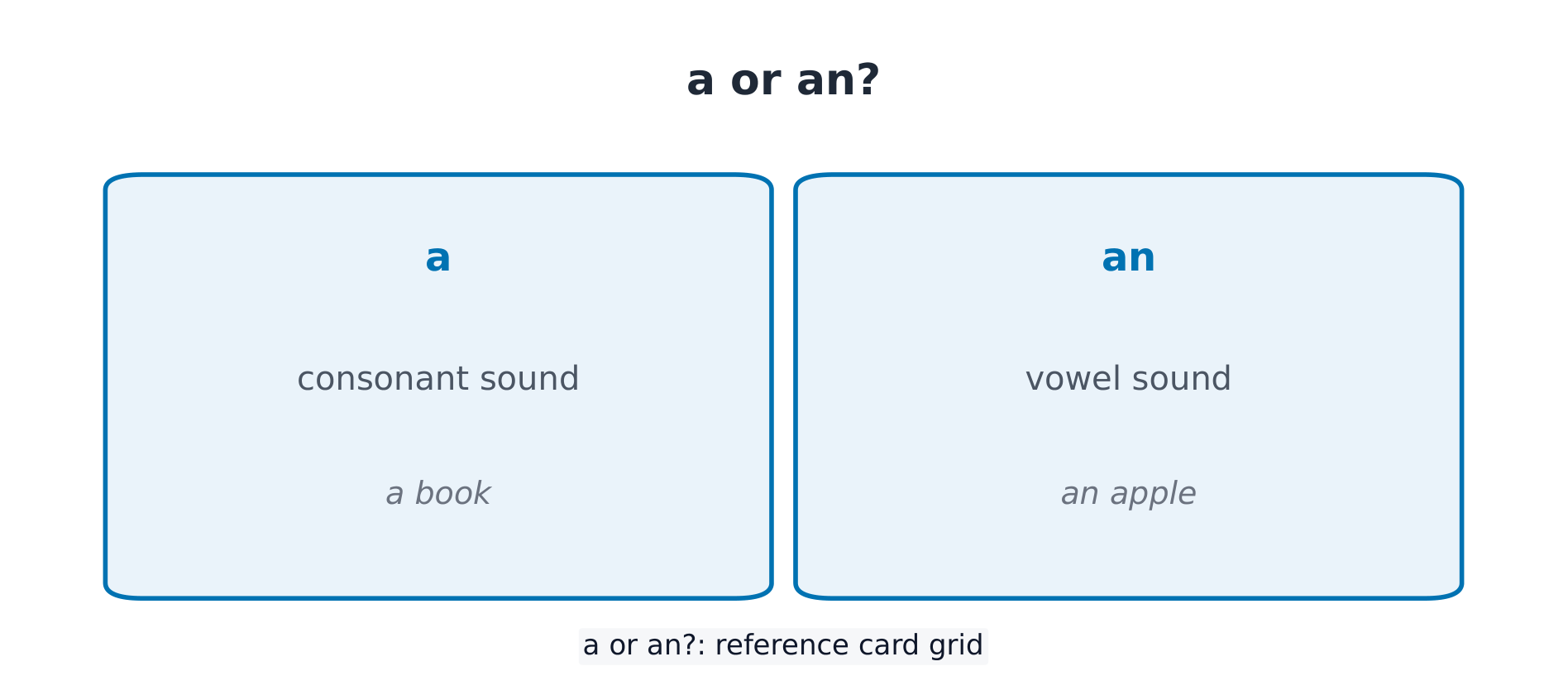
    a and an mean "one" and are used before singular countable nouns. How to choose depends on pronunciation:

    • a + consonant sound: a book, a dog, a cat.
    • an + vowel sound: an apple, an egg, an orange.

    我I 有have 一个a 笔pen.

    I have a pen.

    她She 吃eats 一个an 苹果apple.

    She eats an apple.

    Note: Look at the sound, not the letter: an hour (h is silent), a university (pronounced "yu-").

    日本語
    a / an: Look at pronunciation (consonant vs. vowel)

    a and an mean "one" and are used before singular countable nouns. How to choose depends on pronunciation:

    • a + consonant sound: a book, a dog, a cat.
    • an + vowel sound: an apple, an egg, an orange.

    我I 有have 一个a 笔pen.

    I have a pen.

    她She 吃eats 一个an 苹果apple.

    She eats an apple.

    Note: Look at the sound, not the letter: an hour (h is silent), a university (pronounced "yu-").

    5.2

    Plural Nouns

    English

    To indicate "more than one," use the plural form of the noun, usually adding -s:

    • Generally add -s: book → books, car → cars.
    • Words ending in -s / -sh / -ch / -x add -es: bus → buses, box → boxes.
    • Consonant + y ending: change y to i and add -es: baby → babies, city → cities.

    我I 有have 两two 猫cats.

    I have two cats.

    Irregular plurals (must memorize):

    • man → men, woman → women, child → children.
    • foot → feet, tooth → teeth, person → people.

    Note: Do not use a / an before plural nouns: ~~a books~~ ✗ → books / two books ✓.

    Common Errors

    • ❌ ~~I have dog.~~ → ✓ I have a dog. — In Chinese you can say "I have dogs," but singular countable nouns in English must have a / an (or my, the, etc.) before them.
    • ❌ ~~an university~~ → ✓ a university; ❌ ~~a hour~~ → ✓ an hour — Look at pronunciation, not spelling: university starts with a consonant sound /j/, and h is silent in hour.
    • ❌ ~~two book~~ → ✓ two books — Chinese nouns do not change for plurality, but nouns after numbers in English require -s; this is easily forgotten.
    • ❌ ~~three childs~~ → ✓ three children — Irregular plurals must be memorized separately: men, women, children, feet, teeth, people.
    • ❌ ~~a people~~ → ✓ a person (one person) / people (many people) — people is inherently plural.
    日本語

    To indicate "more than one," use the plural form of the noun, usually adding -s:

    • Generally add -s: book → books, car → cars.
    • Words ending in -s / -sh / -ch / -x add -es: bus → buses, box → boxes.
    • Consonant + y ending: change y to i and add -es: baby → babies, city → cities.

    我I 有have 两two 猫cats.

    I have two cats.

    Irregular plurals (must memorize):

    • man → men, woman → women, child → children.
    • foot → feet, tooth → teeth, person → people.

    Note: Do not use a / an before plural nouns: ~~a books~~ ✗ → books / two books ✓.

    Common Errors

    • ❌ ~~I have dog.~~ → ✓ I have a dog. — In Chinese you can say "I have dogs," but singular countable nouns in English must have a / an (or my, the, etc.) before them.
    • ❌ ~~an university~~ → ✓ a university; ❌ ~~a hour~~ → ✓ an hour — Look at pronunciation, not spelling: university starts with a consonant sound /j/, and h is silent in hour.
    • ❌ ~~two book~~ → ✓ two books — Chinese nouns do not change for plurality, but nouns after numbers in English require -s; this is easily forgotten.
    • ❌ ~~three childs~~ → ✓ three children — Irregular plurals must be memorized separately: men, women, children, feet, teeth, people.
    • ❌ ~~a people~~ → ✓ a person (one person) / people (many people) — people is inherently plural.
  • 6 there is and there are · ⁨there is と there are⁩
    6.1

    Singular and Plural

    English

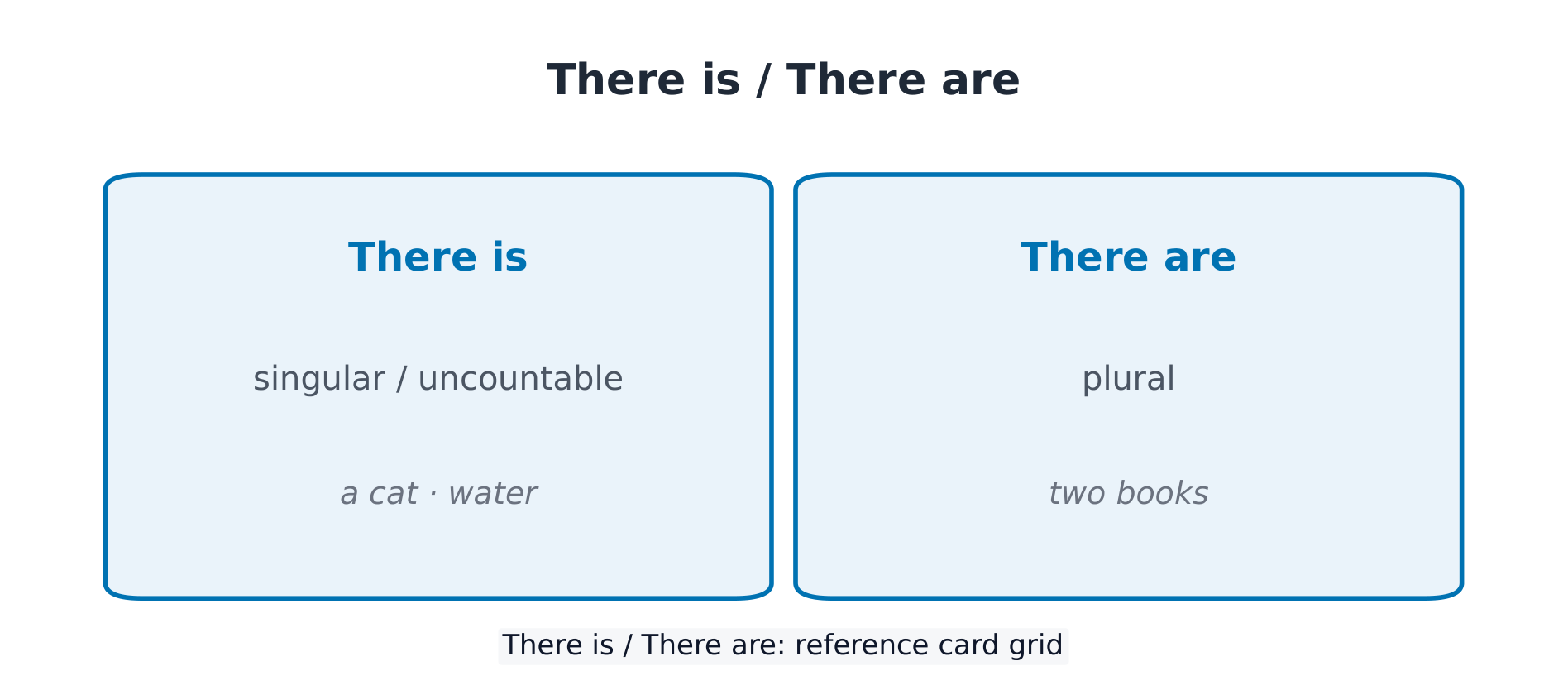
    there is / there are means "there exists" (something exists somewhere).

    • There is + singular / uncountable noun: There is a book.
    • There are + plural noun: There are two books.

    (有)There 有is 一只a 猫cat 在on (冠词)the 沙发上sofa.

    There is a cat on the sofa.

    (有)There 有are 三three 书books 在on (冠词)the 桌上desk.

    There are three books on the table.

    Note: In spoken English, there is is often contracted to there's: There's a problem.

    日本語
    There is (singular) / There are (plural)

    there is / there are means "there exists" (something exists somewhere).

    • There is + singular / uncountable noun: There is a book.
    • There are + plural noun: There are two books.

    (有)There 有is 一只a 猫cat 在on (冠词)the 沙发上sofa.

    There is a cat on the sofa.

    (有)There 有are 三three 书books 在on (冠词)the 桌上desk.

    There are three books on the table.

    Note: In spoken English, there is is often contracted to there's: There's a problem.

    6.2

    Negation and Interrogative

    English

    Negative: there is not / there are not (contracted as there isn't / there aren't).

    (有)There 没有isn't 任何any 牛奶milk.

    There is no milk left.

    Question: Move is / are to the front of there.

    (有吗)Is (有)there 一家a 银行bank 附近near 这里here?

    Is there a bank nearby?

    Short answer: Yes, there is. / No, there isn't.

    Note: Use any frequently in negative / question sentences: Is there any water? (Is there any water?)

    Common Errors

    • ❌ ~~Here has many people.~~ → ✓ There are many people here. — The "have" in the Chinese "There are many people here" indicates existence; use there is / there are in English, do not translate literally as have.
    • ❌ ~~There have a book on the desk.~~ → ✓ There is a book on the desk. — Use is / are after there; there have does not exist.
    • ❌ ~~There is two cats.~~ → ✓ There are two cats. — If the following noun is plural, use are.
    • ❌ ~~There are a milk.~~ → ✓ There is some milk. — milk is uncountable: use there is + some, do not use a.
    日本語

    Negative: there is not / there are not (contracted as there isn't / there aren't).

    (有)There 没有isn't 任何any 牛奶milk.

    There is no milk left.

    Question: Move is / are to the front of there.

    (有吗)Is (有)there 一家a 银行bank 附近near 这里here?

    Is there a bank nearby?

    Short answer: Yes, there is. / No, there isn't.

    Note: Use any frequently in negative / question sentences: Is there any water? (Is there any water?)

    Common Errors

    • ❌ ~~Here has many people.~~ → ✓ There are many people here. — The "have" in the Chinese "There are many people here" indicates existence; use there is / there are in English, do not translate literally as have.
    • ❌ ~~There have a book on the desk.~~ → ✓ There is a book on the desk. — Use is / are after there; there have does not exist.
    • ❌ ~~There is two cats.~~ → ✓ There are two cats. — If the following noun is plural, use are.
    • ❌ ~~There are a milk.~~ → ✓ There is some milk. — milk is uncountable: use there is + some, do not use a.
  • 7 have got
    7.1

    have got / has got

    English

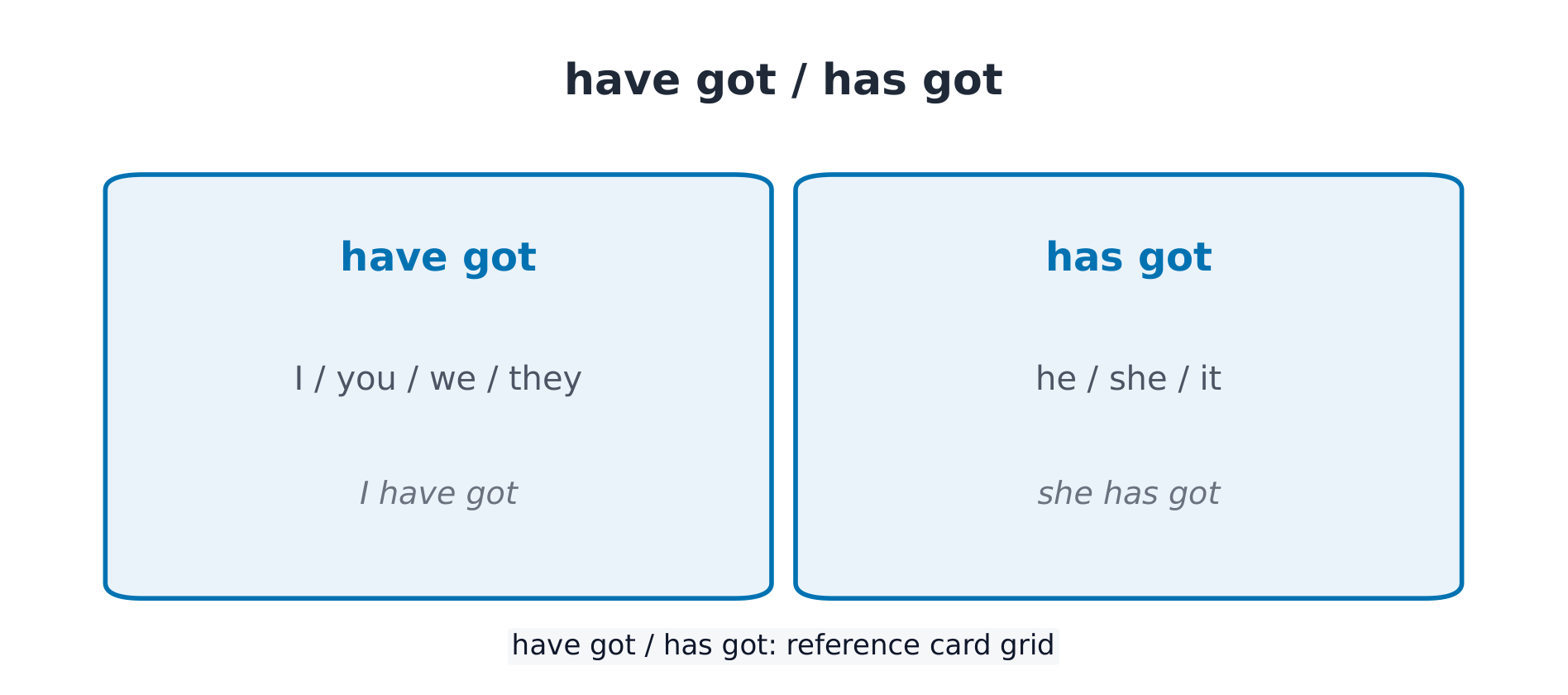
    have got means "to possess" (= have), common in British English.

    • I / you / we / they → have got
    • he / she / it → has got

    我I 有have got 一个a 兄弟brother.

    I have a brother. (= I have a brother.)

    她She 有has got 蓝色blue 眼睛eyes.

    She has blue eyes.

    Note: Often contracted in spoken language: I've got, she's got, they've got. Same meaning as have / has.

    日本語
    have got / has got

    have got は「所有する (= have)」を表し、イギリス英語で一般的です。

    • I / you / we / they → have got
    • he / she / it → has got

    我I 有have got 一个a 兄弟brother.

    私は兄弟がいる。(= I have a brother.)

    她She 有has got 蓝色blue 眼睛eyes.

    彼は車を持っていません。

    注意 口語では I've got、she's got、they've got と省略されることが多いです。意味は have / has と同じです。

    7.2

    否定文と疑問文

    English

    Negative: haven't got / hasn't got.

    他He 没有hasn't got 一辆a 车car.

    He doesn't have a car.

    Question: Move Have / Has to the front of the subject.

    (有吗)Have 你you 有got 一支a 笔pen?

    Do you have a pen?

    Short answer: Yes, I have. / No, I haven't.

    Note: have got is mostly used for current possession; for past or habits, use regular have / had.

    Common Errors

    • ❌ ~~She have got long hair.~~ → ✓ She has got long hair. — Use has got for he / she / it.
    • ❌ ~~I have got not a car.~~ → ✓ I haven't got a car. — Place not after have / has, then contract.
    • ❌ ~~Do you have got a pen?~~ → ✓ Have you got a pen? / Do you have a pen? — Both question forms are correct, but never mix them.
    • ❌ ~~Yes, I have got.~~ → ✓ Yes, I have. — Short answers end at have / has, without got.
    日本語

    否定: haven't got / hasn't got。

    他He 没有hasn't got 一辆a 车car.

    ペンは持っていますか?

    疑問文: Have / Has を主語の前に置きます。

    (有吗)Have 你you 有got 一支a 笔pen?

    あなたはペンを持っていますか?

    短縮回答: Yes, I have. / No, I haven't.

    注意 have got は「所有している」という現在の状態を表すのに多く使われます。過去や習慣については、通常の have / had を使います。

    よくある間違い

    • ❌ ~~She have got long hair.~~ → ✓ She has got long hair. — he / she / it には has got を使います。
    • ❌ ~~I have got not a car.~~ → ✓ I haven't got a car. — not は have / has の後に置き、その後省略します。
    • ❌ ~~Do you have got a pen?~~ → ✓ Have you got a pen? / Do you have a pen? — 両方の表現が正しいですが、混在させてはいけません。
    • ❌ ~~Yes, I have got.~~ → ✓ Yes, I have. — 短縮回答は have / has までで、got は含みません。
  • 8 Present simple · ⁨現在単純法⁩
    8.1

    Habits and Third Person -s

    English

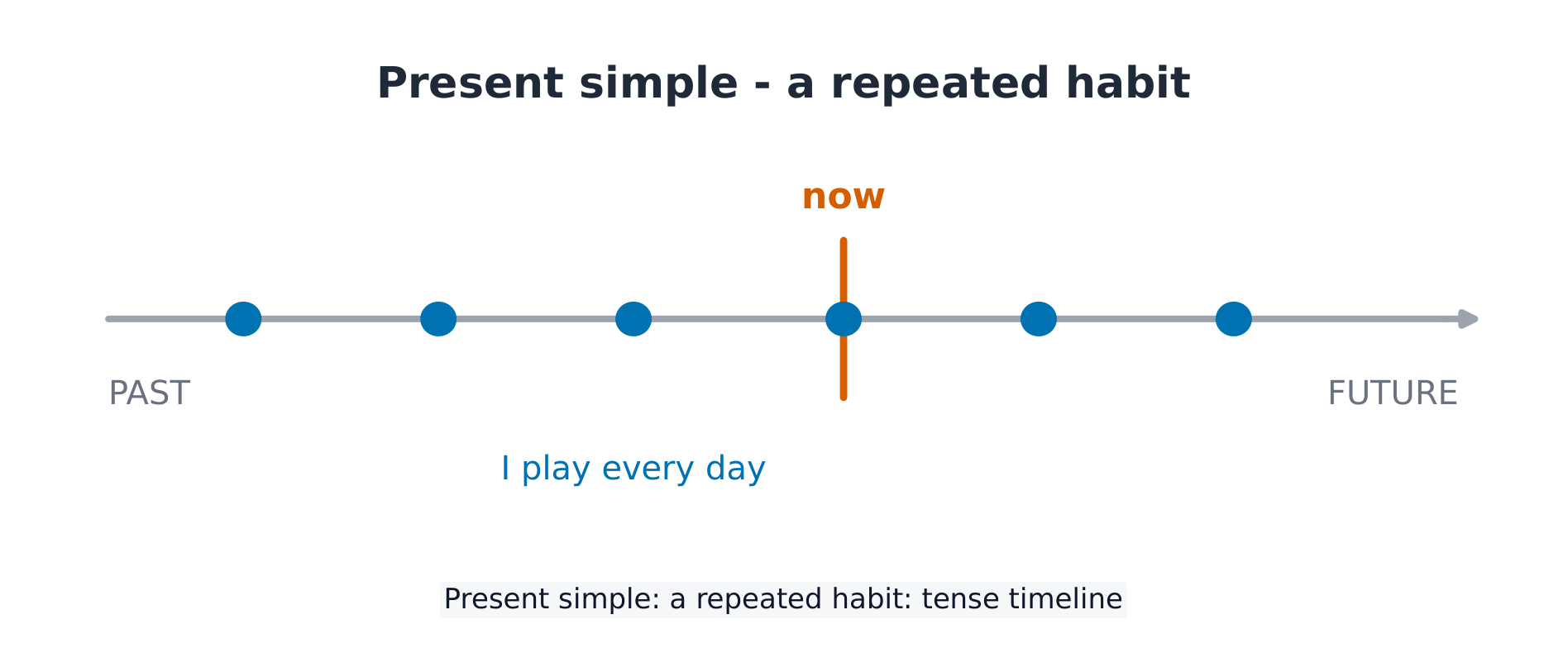
    Present simple (present simple) describes habits and facts. The base form is the infinitive (base verb).

    我I 喜欢like 茶tea.

    I like tea.

    When the subject is he / she / it, add -s to the verb:

    他He 踢plays 足球football.

    He plays football.

    Spelling rules:

    • Generally add -s: like → likes.
    • Words ending in -s / -sh / -ch / -x / -o add -es: go → goes, watch → watches.
    • Consonant + y ending: change y to i and add -es: study → studies.

    Note: Only he / she / it take -s; I / you / we / they use the base form: They like tea.

    日本語
    Present Simple: Repeated habits

    Present simple (present simple) describes habits and facts. The base form is the infinitive (base verb).

    我I 喜欢like 茶tea.

    I like tea.

    When the subject is he / she / it, add -s to the verb:

    他He 踢plays 足球football.

    He plays football.

    Spelling rules:

    • Generally add -s: like → likes.
    • Words ending in -s / -sh / -ch / -x / -o add -es: go → goes, watch → watches.
    • Consonant + y ending: change y to i and add -es: study → studies.

    Note: Only he / she / it take -s; I / you / we / they use the base form: They like tea.

    8.2

    Negation and Interrogative

    English

    For negatives and questions, use auxiliary verbs do / does (does for he / she / it).

    Negative: Subject + don't / doesn't + base verb.

    我I 不don't 喜欢like 咖啡coffee.

    I don't like coffee.

    Question: Do / Does + Subject + base verb ?

    (助动词)Does 她she 住live 这里here?

    Does she live here?

    Note: When using do / does, the verb returns to its base form (no -s): ~~Does she lives~~ ✗ → Does she live ✓.

    Common Errors

    • ❌ ~~He go to school by bus.~~ → ✓ He goes to school by bus. — Forgetting to add -s in third person singular is the most frequent error; check your work afterwards.
    • ❌ ~~She doesn't likes coffee.~~ → ✓ She doesn't like coffee. — When using does / doesn't, the verb returns to its base form.
    • ❌ ~~I very like English.~~ → ✓ I like English very much. — "Very much" in Chinese cannot be translated literally; very cannot directly modify a verb.
    • ❌ ~~You like tea?~~ → ✓ Do you like tea? — Questions must start with do / does; rising intonation alone is insufficient.
    日本語
    Daily routine: I have breakfast every morning.

    For negatives and questions, use auxiliary verbs do / does (does for he / she / it).

    Negative: Subject + don't / doesn't + base verb.

    我I 不don't 喜欢like 咖啡coffee.

    I don't like coffee.

    Question: Do / Does + Subject + base verb ?

    (助动词)Does 她she 住live 这里here?

    Does she live here?

    Note: When using do / does, the verb returns to its base form (no -s): ~~Does she lives~~ ✗ → Does she live ✓.

    Common Errors

    • ❌ ~~He go to school by bus.~~ → ✓ He goes to school by bus. — Forgetting to add -s in third person singular is the most frequent error; check your work afterwards.
    • ❌ ~~She doesn't likes coffee.~~ → ✓ She doesn't like coffee. — When using does / doesn't, the verb returns to its base form.
    • ❌ ~~I very like English.~~ → ✓ I like English very much. — "Very much" in Chinese cannot be translated literally; very cannot directly modify a verb.
    • ❌ ~~You like tea?~~ → ✓ Do you like tea? — Questions must start with do / does; rising intonation alone is insufficient.
  • 9 can
    9.1

    能力と依頼

    English

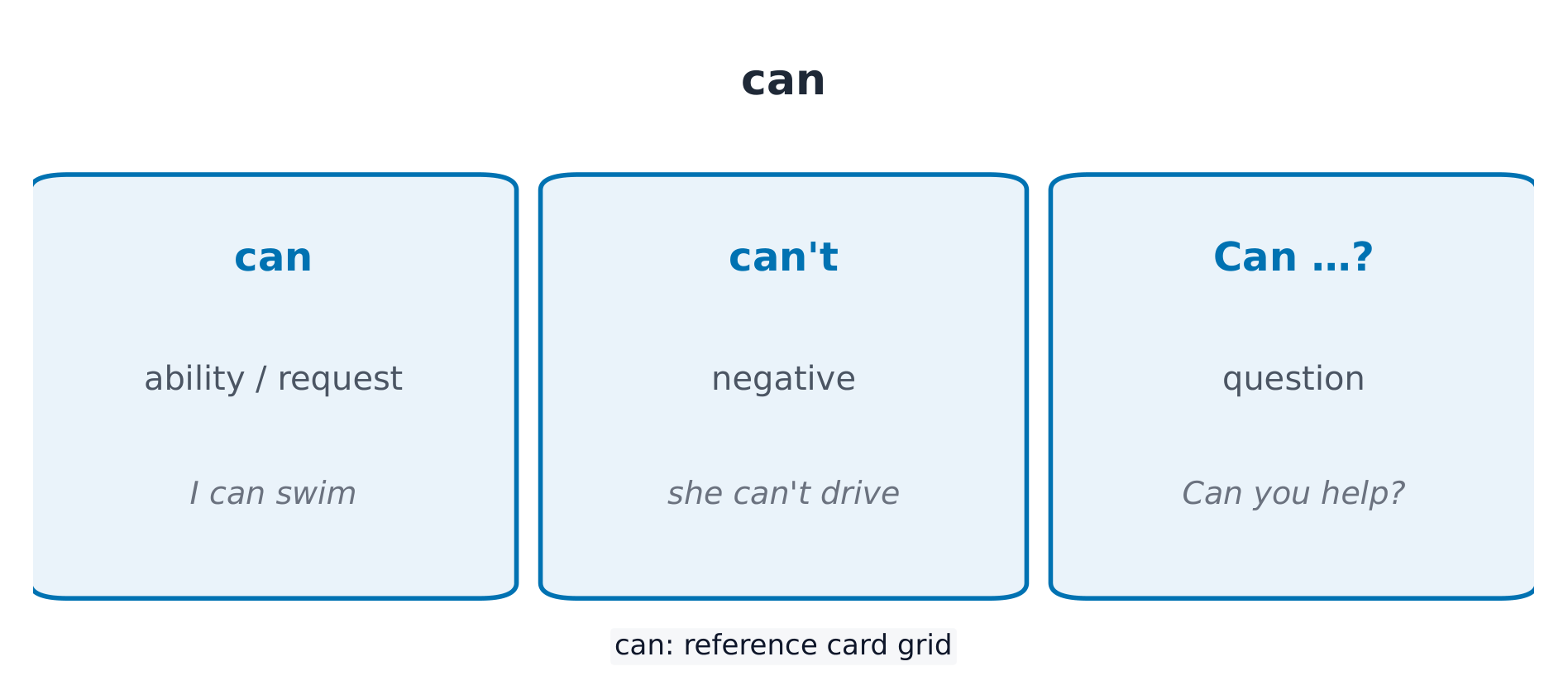
    can expresses ability ("know how to / be able to") or is used for requests. It is followed by the base form of the verb, and remains the same for all persons.

    我I 会can 游泳swim.

    I can swim.

    能Can 你you 帮help 我me?

    Can you help me?

    Note: Use the base form after can: ~~can to swim~~ ✗, ~~can swims~~ ✗ → can swim ✓.

    日本語
    can: 能力、否定、疑問文

    can は能力(「できる/上手だ」)を表したり、依頼に使われたりします。その後には動詞の原形を置き、人称によらず同じ形です。

    我I 会can 游泳swim.

    少し手伝ってもらえますか?

    能Can 你you 帮help 我me?

    彼女は運転できません。

    注意 can の後には原形を使います: ~~can to swim~~ ✗、~~can swims~~ ✗ → can swim ✓。

    9.2

    否定文と疑問文

    English

    Negative: cannot (abbreviation can't) + base form of the verb.

    她She 不会can't 开车drive.

    She cannot drive.

    Question: Place Can before the subject.

    能Can 他he 做饭cook?

    Can he cook?

    Short answer: Yes, I can. / No, I can't.

    Note: can has no -s and does not use do/does: ask directly with Can he…?, not ~~Does he can…?~~

    Common Errors

    • ❌ ~~She cans drive.~~ → ✓ She can drive. — can has no third-person singular -s; it is the same for all persons.
    • ❌ ~~I don't can swim.~~ → ✓ I can't swim. — The negative of can is formed directly with not (can't), without using don't.
    • ❌ ~~He can sings very good.~~ → ✓ He can sing very well. — Use the base form of the verb after can; use the adverb well to modify a verb, not good.
    • ❌ ~~You can help me?~~ → ✓ Can you help me? — When making a request, place can before the subject.
    日本語

    否定: cannot (省略形 can't) + 動詞の原形。

    她She 不会can't 开车drive.

    彼は料理ができますか?

    疑問文: Can を主語の前に置きます。

    能Can 他he 做饭cook?

    彼は料理ができますか?

    短縮回答: Yes, I can. / No, I can't.

    注意 can には -s も do / does もありません。疑問文はそのまま Can he…? とし、~~Does he can…?~~ とはしません。

    よくある間違い

    • ❌ ~~She cans drive.~~ → ✓ She can drive. — can には三人称単数の -s がなく、すべての人称で同じ形です。
    • ❌ ~~I don't can swim.~~ → ✓ I can't swim. — can の否定は直接 not を付けて can't とし、don't は使いません。
    • ❌ ~~He can sings very good.~~ → ✓ He can sing very well. — can の後は動詞の原形を使います。動詞を修飾するには副詞の well を使い、good は使いません。
    • ❌ ~~You can help me?~~ → ✓ Can you help me? — 他人に依頼する際は、can を主語の前に置きます。
  • 10 Imperatives · ⁨命令法⁩
    10.1

    命令と指示

    English

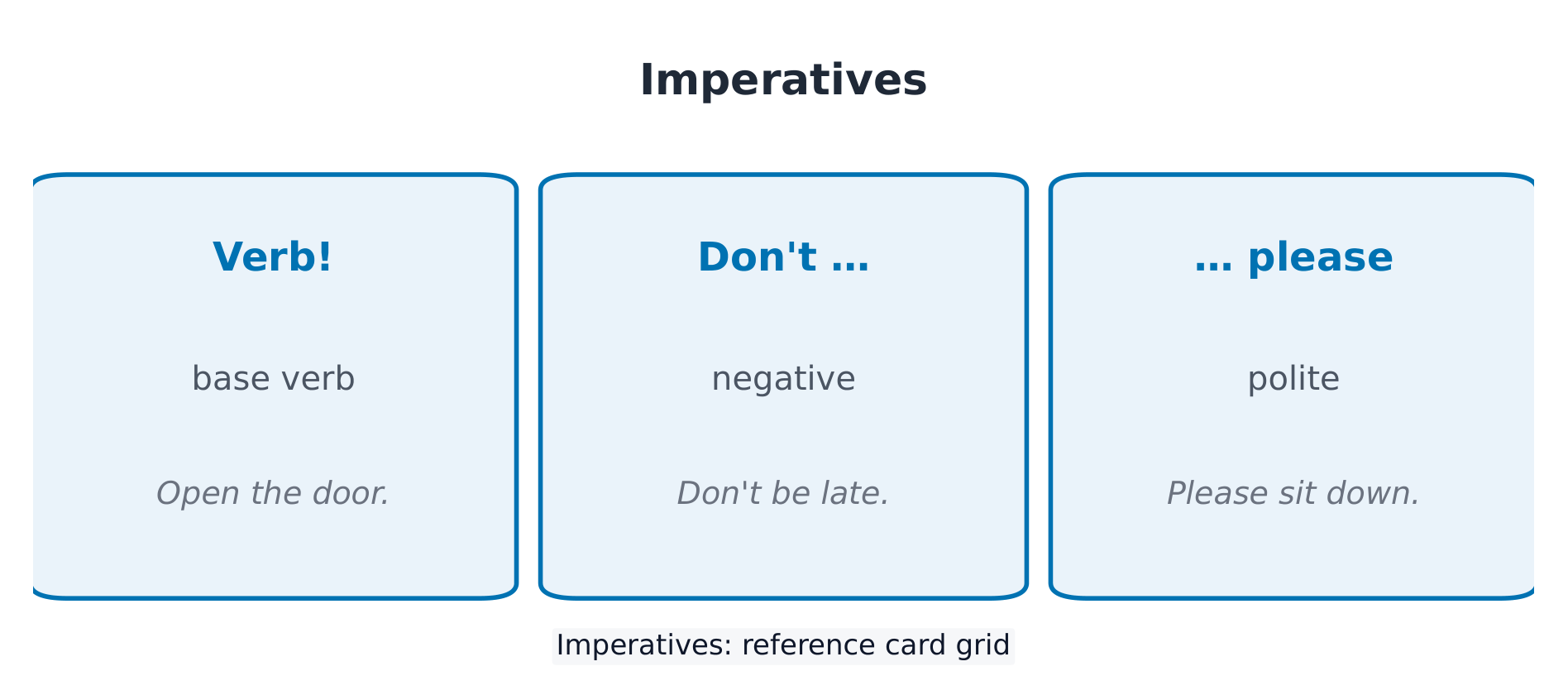
    Imperatives are used to give commands, provide instructions, or make requests. Start directly with the base form of the verb, without a subject.

    打开Open (冠词)the 门door 请, please.

    Please open the door.

    坐Sit 下down.

    Sit down.

    Negative: Add Don't at the beginning.

    不要Don't (是)be 迟到late.

    Don't be late.

    Key Usage Points:

    • Add please to be more polite: Please come in.
    • Also used for directions and instructions: Turn left. Mix the eggs.

    Note: Do not write a subject in imperatives: ~~You open the door~~ (for a command) → Open the door.

    Common Errors

    • ❌ ~~Please open door.~~ → ✓ Please open the door. — Articles must still be included in imperatives.
    • ❌ ~~Don't to touch it.~~ → ✓ Don't touch it. — Follow don't directly with the base form of the verb; do not add to.
    • ❌ ~~No talk in class!~~ → ✓ Don't talk in class! / No talking! — To prohibit an action, use don't + base form; after no, use -ing or a noun.
    • ❌ ~~You sit down!~~ → ✓ Sit down, please. — Adding you to a command sounds angry; add please for politeness, or change to Can you…?
    日本語
    祈使文:命令、否定、依頼

    命令文 (imperatives) は命令、指示、または依頼に使います。動詞の原形で始め、主語は書きません。

    打开Open (冠词)the 门door 请, please.

    座ってください。

    坐Sit 下down.

    遅刻しないでください。

    否定: 前に Don't を置きます。

    不要Don't (是)be 迟到late.

    遅刻しないでください。

    使用上のポイント:

    • please を加えるとより丁寧です: Please come in.(お入りください。)
    • また、ルート案内や手順説明にも使います: Turn left.(左へ折れ。) Mix the eggs.(卵を混ぜる。)

    注意 命令文では主語を書きません: ~~You open the door~~(命令の場合) → Open the door。

    よくある間違い

    • ❌ ~~Please open door.~~ → ✓ Please open the door. — 命令文でも冠詞は必須です。
    • ❌ ~~Don't to touch it.~~ → ✓ Don't touch it. — don't の後は directly 動詞の原形を置き、to は加えません。
    • ❌ ~~No talk in class!~~ → ✓ Don't talk in class! / No talking! — 禁止する際は don't + 原形を使います。no の後には -ing 形や名詞を使います。
    • ❌ ~~You sit down!~~ → ✓ Sit down, please. — you を加えた命令は怒っているように聞こえます。丁寧にしたい場合は please を加えるか、Can you…? と問い changing してください。
  • 11 Question words · ⁨疑問詞⁩
    11.1

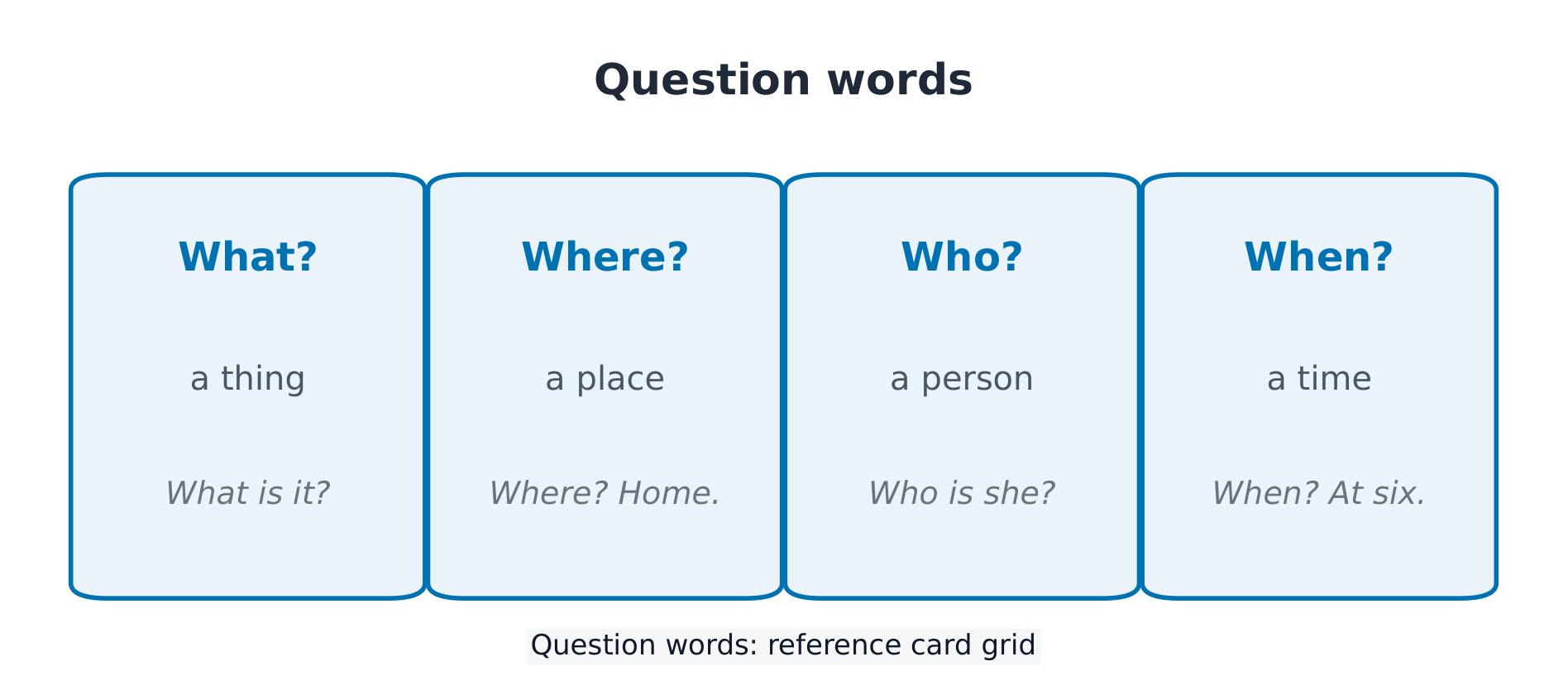
    what, where, who

    English

    Question words are placed at the beginning of a question to ask for specific information.

    • what (what), where (where), who (who)

    什么What 是is 你的your 名字name?

    What's your name?

    哪里Where (助动词)do 你you 住live?

    Where do you live?

    谁Who 是is 那个that 男人man?

    Who is that man?

    Note: A be verb or auxiliary do/does often follows the question word: Where do you work?

    日本語
    疑問詞:物/場所/人/時間への質問

    疑問詞 (question words) は問文の冒頭に置き、具体的な情報を尋ねます。

    • what(何)、where(どこ)、who(誰)

    什么What 是is 你的your 名字name?

    あなたはどこに住んでいますか?

    哪里Where (助动词)do 你you 住live?

    あの男性は誰ですか?

    谁Who 是is 那个that 男人man?

    パーティーはいつですか?

    注意 疑問詞の後にbe動詞または助動詞do/doesが来ることが多いです:Where do you work?(あなたはどこで働いていますか?)

    11.2

    when, why, how

    English
    • when (when), why (why), how (how / in what way)

    什么时候When 是is (冠词)the 派对party?

    When is the party?

    为什么Why (是)are 你you 难过sad?

    Why are you sad?

    怎么How (助动词)do 你you 拼写spell 它it?

    How do you spell this?

    Note: how can also combine with adjectives to ask about degree: How old are you? How much is it?

    Common Errors

    • ❌ ~~Where you live?~~ → ✓ Where do you live? — After the question word, you still need do/does or be; you cannot follow directly with the subject.
    • ❌ ~~What means this word?~~ → ✓ What does this word mean? — mean is an ordinary verb: question word + does + subject + base form.
    • ❌ ~~Why you are late?~~ → ✓ Why are you late? — When there is a be verb in the sentence, move be before the subject.
    • ❌ ~~How to spell it?~~ → ✓ How do you spell it? — A literal translation of "How to spell?" loses the subject and auxiliary verb; these must be added.
    日本語
    • when(いつ)、why(なぜ)、how(どうやって/どのように)

    什么时候When 是is (冠词)the 派对party?

    なぜ悲しいのですか?

    为什么Why (是)are 你you 难过sad?

    この言葉はどう書きますか?

    怎么How (助动词)do 你you 拼写spell 它it?

    鍵はかばんの中にあります。

    注意 how は形容詞と組み合わせて程度を問うこともできます:How old are you?(何歳ですか?)How much is it?(いくらですか?)

    よくある間違い

    • ❌ ~~Where you live?~~ → ✓ Where do you live? — 疑問詞の後に主語を直接置かず、do/doesまたはbeが必要です。
    • ❌ ~~What means this word?~~ → ✓ What does this word mean? — meanは普通動詞です:疑問詞 + does + 主語 + 原形。
    • ❌ ~~Why you are late?~~ → ✓ Why are you late? — 文中にbe動詞がある場合、beを主語の前に持ってきます。
    • ❌ ~~How to spell it?~~ → ✓ How do you spell it? — 中国語の「どう書きますか」を直訳すると主語と助動詞が欠けるため、補完する必要があります。
  • 12 Prepositions of place · ⁨場所の前置詞⁩
    12.1

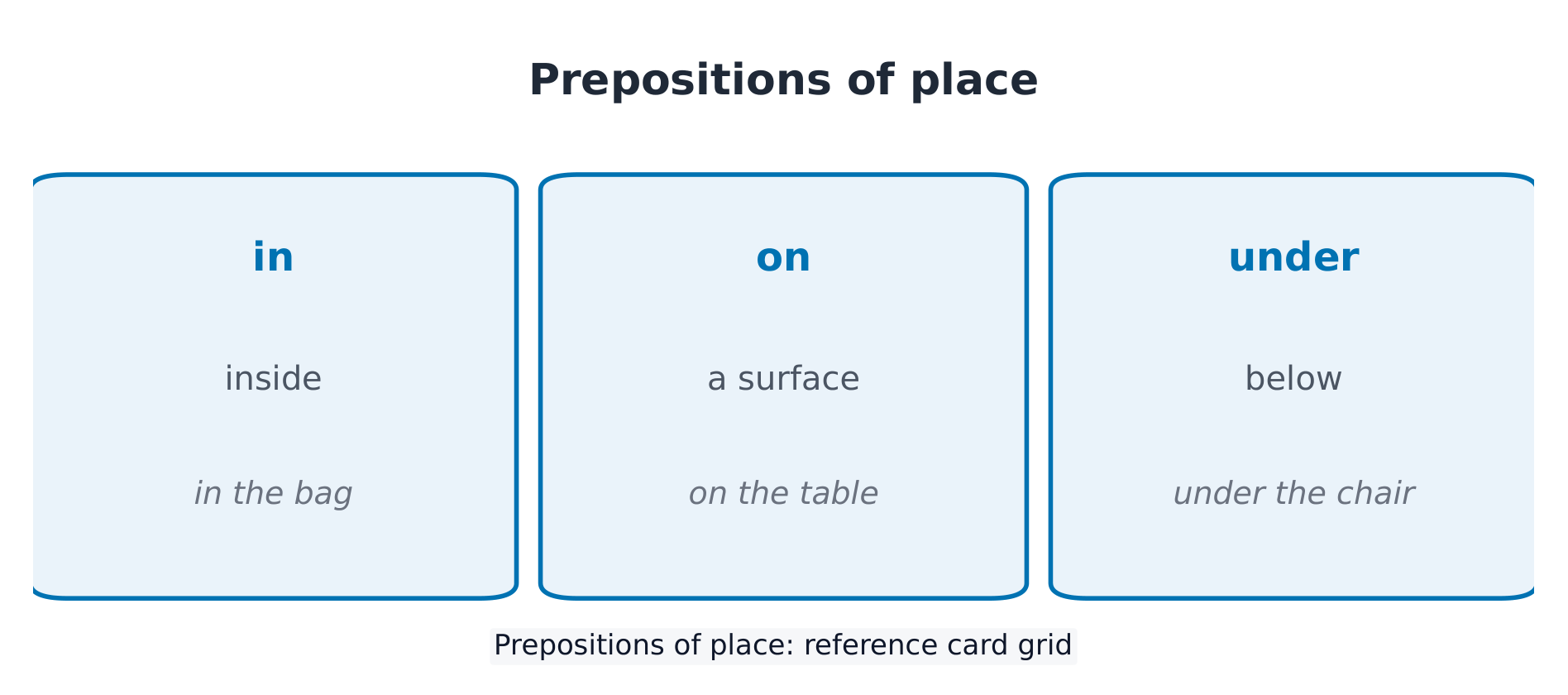
    in, on, under

    English

    Prepositions of place indicate where something is located.

    • in (inside...), on (on top of... / surface), under (below...)

    (冠词)The 钥匙keys 在are 在...里in (冠词)the 包里bag.

    The key is in the bag.

    (冠词)The 书book 在is 在...上on (冠词)the 桌上table.

    The book is on the table.

    (冠词)The 猫cat 在is 在...下under (冠词)the 椅子下chair.

    The cat is under the chair.

    日本語
    Prepositions of place: in / on / under

    Prepositions of place indicate where something is located.

    • in (inside...), on (on top of... / surface), under (below...)

    (冠词)The 钥匙keys 在are 在...里in (冠词)the 包里bag.

    The key is in the bag.

    (冠词)The 书book 在is 在...上on (冠词)the 桌上table.

    The book is on the table.

    (冠词)The 猫cat 在is 在...下under (冠词)the 椅子下chair.

    The cat is under the chair.

    12.2

    next to, between, behind

    English
    • next to (beside...), between (between...), behind (behind...), in front of (in front of...)

    (冠词)The 商店shop 在is 旁边next to (冠词)the 银行bank.

    The shop is next to the bank.

    她She 坐sits 之间between 汤姆Tom 和and 萨姆Sam.

    She sits between Tom and Sam.

    Note: between means "between two," and is usually followed by A and B: between the door and the window.

    Common Errors

    • ❌ ~~The picture is in the wall.~~ → ✓ The picture is on the wall. — Hanging "on" the wall involves surface contact, so use on.
    • ❌ ~~I read it on the book.~~ → ✓ ...in the book. — Content "inside" a book uses in; people in photos also use in the photo.
    • ❌ ~~The shop is next the bank.~~ → ✓ next to the bank — next to is two words; to cannot be omitted.
    • ❌ ~~between the door with the window~~ → ✓ between the door and the window — between takes the fixed collocation A and B.
    日本語
    • next to (beside...), between (between...), behind (behind...), in front of (in front of...)

    (冠词)The 商店shop 在is 旁边next to (冠词)the 银行bank.

    The shop is next to the bank.

    她She 坐sits 之间between 汤姆Tom 和and 萨姆Sam.

    She sits between Tom and Sam.

    Note: between means "between two," and is usually followed by A and B: between the door and the window.

    Common Errors

    • ❌ ~~The picture is in the wall.~~ → ✓ The picture is on the wall. — Hanging "on" the wall involves surface contact, so use on.
    • ❌ ~~I read it on the book.~~ → ✓ ...in the book. — Content "inside" a book uses in; people in photos also use in the photo.
    • ❌ ~~The shop is next the bank.~~ → ✓ next to the bank — next to is two words; to cannot be omitted.
    • ❌ ~~between the door with the window~~ → ✓ between the door and the window — between takes the fixed collocation A and B.

Log in or create account · ⁨ログインまたはアカウント作成⁩

IGCSE, A-Level & AP