Randomness and simulation · ランダム性とシミュレーション
This page needs a recent browser (with SharedArrayBuffer support). Please update Chrome, Edge, Firefox or Safari to the latest version. · このページには最新のブラウザ(SharedArrayBuffer対応)が必要です。Chrome、Edge、Firefox、Safariを最新バージョンに更新してください。
What we'll do
- Some programs need chance, like games or experiments.
- Python can make random numbers for us.
- We will also build a tiny simulation (a model of something real).
Import random
- The random tools live in a module named
random. - Write
import randomat the top of your program. - Then you can use its functions, like
random.randint.
import random

number = random.randint(1, 6)
print(number)
random.randint(a, b)
random.randint(a, b)gives a whole number fromatob.- Both ends are included:
randint(1, 6)can be1,6, or anything between. - Run it again and you may get a different number.
import random

for i in range(3):
    print(random.randint(1, 6))
Same numbers with a seed
- A seed sets the random start point.
- With the same seed, you get the same numbers every time.
- This is useful for testing, so results can be repeated.
import random

random.seed(42)
print(random.randint(1, 6))
print(random.randint(1, 6))
A tiny simulation
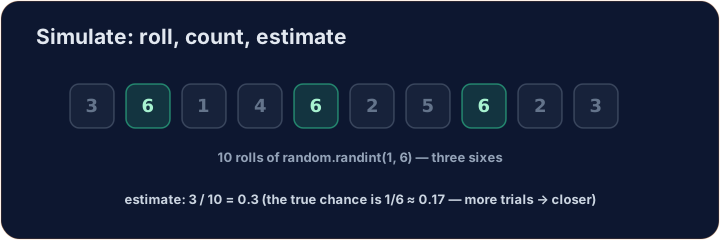
- A simulation models a real process with code.
- Here we model flipping a coin many times and counting heads.
- Running many trials helps us see the long-run pattern.
import random

random.seed(1)
heads = 0
for i in range(10):
    flip = random.randint(0, 1)   # 0 = tails, 1 = heads
    if flip == 1:
        heads = heads + 1
print(heads)
In AP CSP pseudocode
- The exam writes random numbers with
RANDOM. RANDOM(a, b)gives a whole number fromatob, the same idea asrandom.randint(a, b).
roll ← RANDOM(1, 6)
DISPLAY(roll)
Common mistakes
- A simulation uses random values to model chance.
- Run it many times to see the overall pattern.
Now you try
- Some tasks check a property (like "the roll is between 1 and 6").
- Some tasks use a seed so the output is the same every time.
- Press Check answer to test your code.
Write roll_die() (no parameters) that returns a random whole number from 1 to 6 using random.randint. Remember import random. · roll_die() (パラメータなし)を記述し、random.randint を使って1 から 6 までのランダムな整数を返してください。import random を思い出してください。
Click Run to see the output here. · 実行ボタンをクリックして出力を確認してください。
Write roll_two() that rolls two dice (each 1 to 6) and returns their total. The total is always between 2 and 12. · 2つ のサイコロ(それぞれ1〜6)を振り、その 合計 を 返す roll_two() を書きます。合計は常に2から12の間になります。
Click Run to see the output here. · 実行ボタンをクリックして出力を確認してください。
Copy this exactly: set random.seed(7), then flip a coin 20 times with random.randint(0, 1) (1 means heads), count the heads, and print the count. With this seed the answer is always the same. · これをそのままコピーしてください: random.seed(7) をセットし、 random.randint(0, 1) でコインを 20回 投げ(1が表)、表の数を数えて、 print します。このシードを使うと答えはいつも同じです。
Click Run to see the output here. · 実行ボタンをクリックして出力を確認してください。