Inheritance: extends, super, and overriding
This page needs a recent browser (with SharedArrayBuffer support). Please update Chrome, Edge, Firefox or Safari to the latest version. · このページには最新のブラウザ(SharedArrayBuffer対応)が必要です。Chrome、Edge、Firefox、Safariを最新バージョンに更新してください。
Inheritance: building on a class
- Inheritance lets one class reuse another class's fields and methods.
- The class you build on is the superclass (parent); the new class is the subclass (child).
- A subclass is-a kind of its superclass: a
Dogis anAnimal.
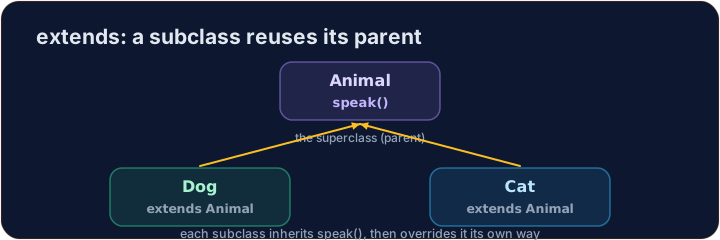
extends and super
- Write
class Dog extends Animalto makeDoga subclass ofAnimal. Dogautomatically gets every public method ofAnimal, likegetName().- The subclass constructor calls the superclass constructor first with
super(...).
public class Main {
    public static void main(String[] args) {
        Dog d = new Dog("Rex");
        System.out.println(d.getName());   // Rex   (inherited from Animal)
        System.out.println(d.speak());     // Woof  (Dog's own version)
    }
}

class Animal {
    private String name;
    public Animal(String name) { this.name = name; }
    public String getName() { return this.name; }
    public String speak() { return "some sound"; }
}

class Dog extends Animal {
    public Dog(String name) {
        super(name);          // run Animal's constructor
    }
    public String speak() {   // override Animal's speak()
        return "Woof";
    }
}
Overriding a method
- A subclass can override an inherited method: give it the same signature, a new body.
Dog'sspeak()replacesAnimal'sspeak()forDogobjects.- Methods it does not override (like
getName()) are still inherited unchanged.
super.method() — extend, don't replace
- Sometimes you want the parent's work plus a little more.
- Inside an override,
super.describe()runs the superclass version of the method. - Then you add to its result instead of rewriting it from scratch.
public class Main {
    public static void main(String[] args) {
        Bird b = new Bird("Tweety");
        System.out.println(b.describe());
        // I am an animal named Tweety, and I can fly
    }
}

class Animal {
    private String name;
    public Animal(String name) { this.name = name; }
    public String describe() { return "I am an animal named " + this.name; }
}

class Bird extends Animal {
    public Bird(String name) { super(name); }
    public String describe() {
        return super.describe() + ", and I can fly";   // reuse, then add
    }
}
is-a: a subclass fits where its superclass is expected
- Because a
Dogis anAnimal, you can writeAnimal a = new Dog("Spot");. - The variable's type is
Animal, but the object is really aDog. - This "is-a" rule is what makes the next lesson — polymorphism — possible.
Common mistakes
super(...)must be the first line of a subclass constructor.- Add
@Overrideso the compiler catches a wrong signature.
Now you try
- Each task gives you a finished
Animalsuperclass. Write or complete the subclass below it. - A hidden Harness builds your object and checks both inherited and new behaviour.
- Press Run to compile, then Check answer. Your code runs on the server, so even the first run is fast.
Below the finished Animal, write a class Cat that extends Animal. Give it a constructor Cat(String name) that passes the name up with super(name). Add nothing else — Cat should inherit getName() for free.
Click Run to see the output here. · 実行ボタンをクリックして出力を確認してください。
Complete the class Cow (it already extends Animal). Override speak() so a Cow returns "Moo" instead of the default. getName() must still work (inherited).
Click Run to see the output here. · 実行ボタンをクリックして出力を確認してください。
Complete the class Fish (it already extends Animal). Override describe() so it returns the Animal description plus ", and I can swim". Reuse the parent's work by calling super.describe() — do not rewrite the whole sentence.
Click Run to see the output here. · 実行ボタンをクリックして出力を確認してください。