Supply chains: independence is the fuel
Diperkenalkan| English | Makna |
|---|---|
| lead time/liːd taɪm/ | the time from placing an order to receiving it |
| risk pooling | holding stock centrally so that independent demand variations partly cancel |
| square-root law | independent variances add, so pooled variability grows with the square root of n |
| postponement | holding product in generic form and differentiating it after demand is seen |
The site does not make buns; it makes buns out of a chain
- Mills, a bakery, two depots. Every chain choice trades cost against service against risk - and the trade is arithmetic.
- The question in three parts: one supplier or two, local or distant, stock at each depot or pooled.
The cheap mill that was not cheap
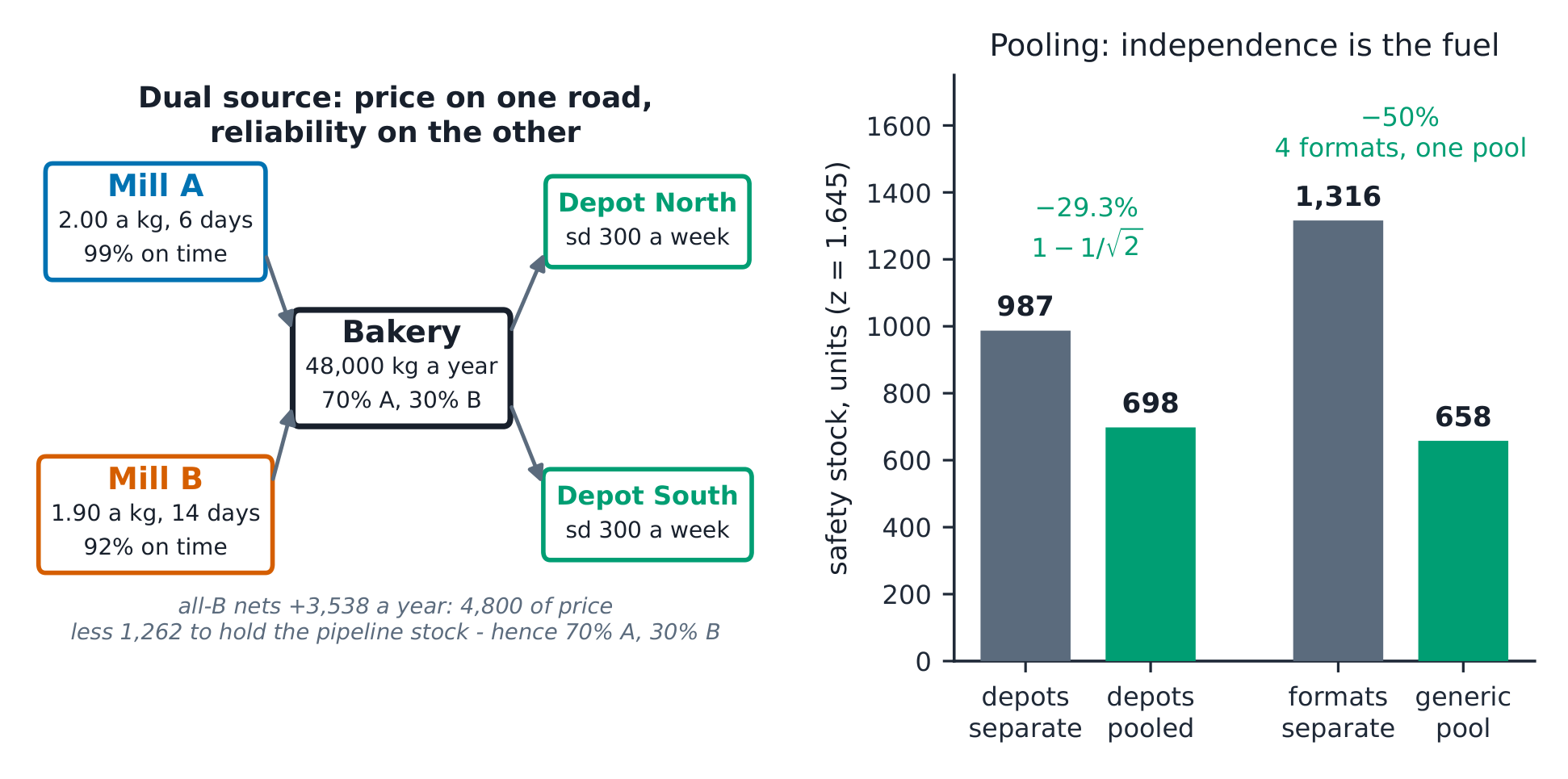
- Mill B bids 1.90 against A's 2.00: $0.10 \times 48{,}000 = 4{,}800$ a year. But B's lead time 交货期 is 14 days against 6: eight extra days of pipeline stock, $8 \times 131.5 = 1{,}052$ kg at 1.20 = 1,262 to hold. Net still +3,538.
- The risk column: B is on time 92% against A's 99%, single-sourced and harvest-exposed; one missed 14-day drop stops the line. Decision: dual-source, 70% A, 30% B.
Mill B saves 4,800 on price but adds 1,052 kg of pipeline stock at 1.20 a kg. Net annual saving?
Kesulitan 2/5 · 140 koin + bonus kecil pada penyelesaian pertama hari ini
4,800 - 1,262 = 3,538.
Mill B nets +3,538 a year. What still argues for dual sourcing?
Kesulitan 1/5 · 100 koin + bonus kecil pada penyelesaian pertama hari ini
One missed 14-day delivery exhausts the eight days of pipeline cover and stops the line.
Pooling in space
- Each depot: weekly demand sd 300, independent, 95% service, one-week lead - safety stock $1.645 \times 300 = 494$ each, 987 together.
- Risk pooling 风险共担 at one central store: $\sigma = \sqrt{300^2 + 300^2} = 424.3$, safety stock 698 - saving 289, exactly $1 - 1/\sqrt{2} = 29.3\%$. That is the square-root law 平方根法则.
Two depots, each weekly sd 300 and independent, z = 1.645. Pooled safety stock, to the nearest unit?
Kesulitan 2/5 · 140 koin + bonus kecil pada penyelesaian pertama hari ini
$1.645 \times \sqrt{300^2+300^2} = 1.645 \times 424.3 = 698$.
The pooling saving for two equal independent depots, in % (one decimal)?
Kesulitan 2/5 · 140 koin + bonus kecil pada penyelesaian pertama hari ini
$1 - 1/\sqrt{2} = 29.3\%$.
Why does pooling cut safety stock?
Kesulitan 1/5 · 100 koin + bonus kecil pada penyelesaian pertama hari ini
sigma of a sum of independent demands is the root of the summed variances.
The combined sd of two independent depots each with sd 300 is 600.
Kesulitan 1/5 · 100 koin + bonus kecil pada penyelesaian pertama hari ini
Variances add: sqrt(300^2 + 300^2) = 424.3, not 600.
Pooling in time: postponement
- Four pack formats each need $1.645 \times 200 = 329$ of finished safety stock, 1,316 together. Ship generic buns and label at the depot: one pool of $1.645 \times 400 = 658$ - half.
- Postponement 延迟策略 costs a depot packing line (18,000); write-offs fall by about 600 buns a week at 0.50 = 15,600 a year - payback 14 months.
Which chain lever is this?
Sort each decision: pooling in space, pooling in time, a cost-service-risk trade, or a resilience measure.
Four independent formats each sd 200, z = 1.645. Safety stock for one generic pool?
Kesulitan 2/5 · 140 koin + bonus kecil pada penyelesaian pertama hari ini
$1.645 \times \sqrt{4 \times 200^2} = 1.645 \times 400 = 658$.
Match each term to its example.
Kesulitan 2/5 · 140 koin + bonus kecil pada penyelesaian pertama hari ini
Two are the square-root law; two are the priced trade.
Three chain slips
- Adding standard deviations. Variances add; the square root does the work.
- Sourcing on price after the pipeline check. Lead time is inventory in disguise.
- Calling a chain resilient with no number. Days of cover and per cent on time.
Recap
- $\sigma_{sum} = \sqrt{\sum \sigma_i^2}$: pooling and postponement both live on independence.
- Two depots pooled: 987 to 698; four formats postponed: 1,316 to 658.
- Cost, service, risk - price all three, then choose.