Processes and capacity: find the constraint
Diperkenalkan| English | Makna |
|---|---|
| bottleneck/ˈbɒtəlnek/ | the slowest part of a process, which sets the capacity of the whole line |
| throughput/ˈθruːpʊt/ | the rate at which a process actually produces output |
| cycle time | the time between successive outputs - the inverse of bottleneck capacity |
| Little's law | the identity that work in progress equals throughput times flow time |
| capacity utilisation/kəˈpæsɪti ˌjuːtɪlaɪˈzeɪʃn/ | Current output as a percentage of the maximum output a firm could make. |
| work in progress | units inside a process that are started but not finished |
The line is as fast as its slowest station
- The festival contract promises 3,840 buns a day. Whether the site delivers is not effort - it is arithmetic on four stations, and the answer lives at one of them.
- Capacity per station is 60 x slots / minutes a batch. The smallest number is the line.
Four stations, four capacities
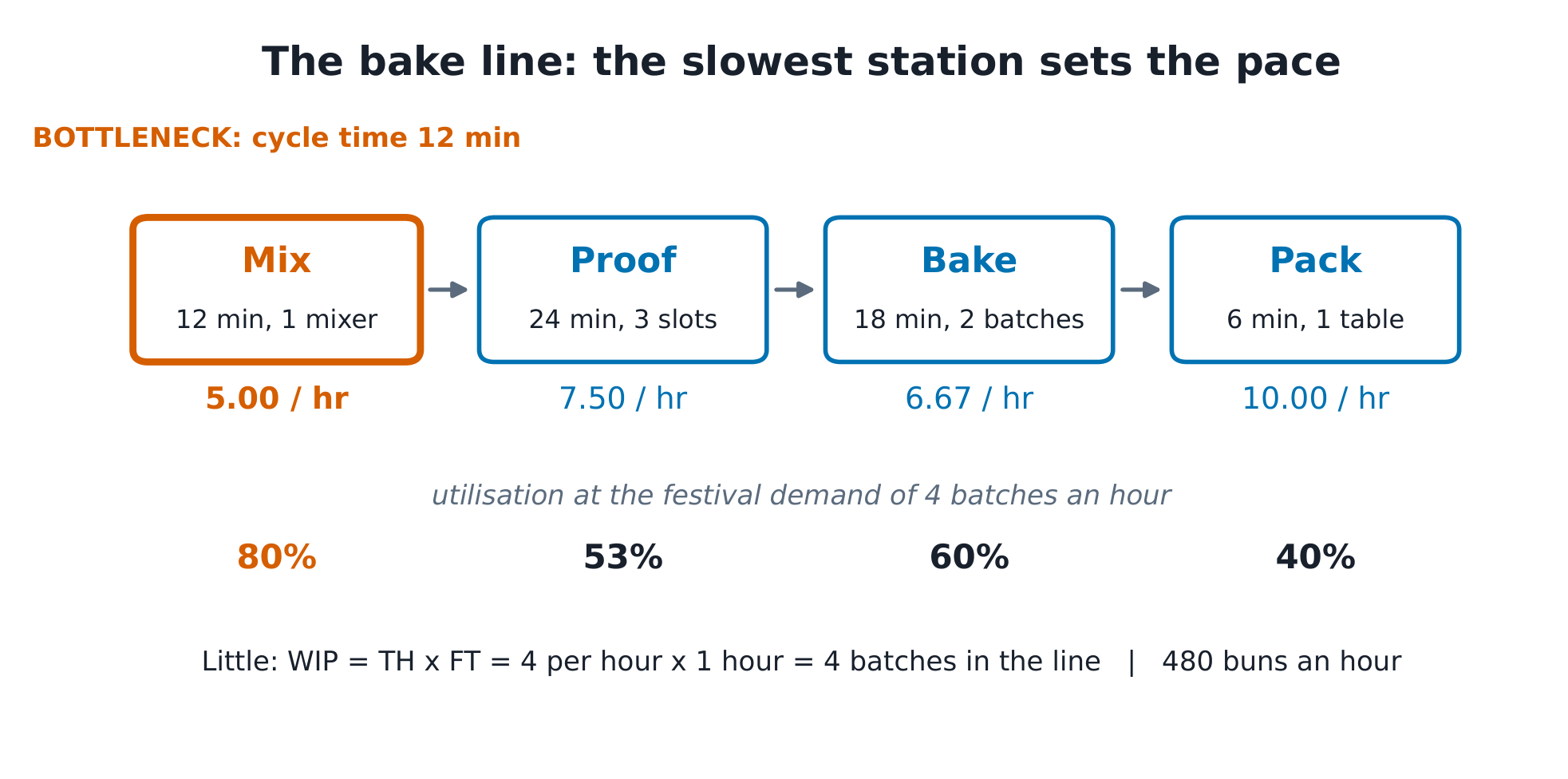
- Mix 12 min with one mixer: 5.00 batches an hour. Proof 24 min in three slots: 7.50. Bake 18 min, two batches at once: 6.67. Pack 6 min: 10.00.
- Mix is the bottleneck 瓶颈 - the line's throughput 产出率 can never exceed 5 batches = 600 buns an hour, and the cycle time 周期时间 between batches is 12 minutes.
Proof takes 24 minutes a batch in three slots. Capacity in batches an hour?
Kesulitan 2/5 · 140 koin + bonus kecil pada penyelesaian pertama hari ini
$60 \times 3 / 24 = 7.5$.
Line capacity in buns an hour with one mixer (120 buns a batch)?
Kesulitan 2/5 · 140 koin + bonus kecil pada penyelesaian pertama hari ini
5.00 batches x 120 = 600.
The cycle time of the line with one mixer?
Kesulitan 1/5 · 100 koin + bonus kecil pada penyelesaian pertama hari ini
Cycle time is the inverse of the bottleneck capacity: 60 / 5 = 12 min.
Match each station to its capacity.
Kesulitan 2/5 · 140 koin + bonus kecil pada penyelesaian pertama hari ini
60 x slots / minutes: 60/12, 180/24, 120/18, 60/6.
Utilisation and Little's law
- At the festival demand of 4 batches an hour, capacity utilisation 产能利用率 = throughput / capacity: mix 80%, proof 53%, bake 60%, pack 40%.
- Flow time through the line is 12 + 24 + 18 + 6 = 60 min. Little's law 利特尔法则: $WIP = TH \times FT = 4 \times 1 = 4$ batches of work in progress 在制品 - exactly what a walk down the line counts.
At 4 batches an hour, utilisation of Bake (capacity 6.67), in %?
Kesulitan 2/5 · 140 koin + bonus kecil pada penyelesaian pertama hari ini
$4 / 6.67 = 60\%$.
Throughput 4 batches an hour, flow time 1 hour. Work in progress by Little's law?
Kesulitan 2/5 · 140 koin + bonus kecil pada penyelesaian pertama hari ini
$WIP = TH \times FT = 4 \times 1 = 4$.
Where an hour is won
- Speeding pack (40% busy) moves the line nowhere. A second mixer lifts mix to 10.00 - and the bottleneck moves to bake at 6.67, so the line gains only 1.67 batches (200 buns) an hour.
- Saturday needs 6 an hour for 8 hours: 8 batches short with one mixer. Bake ahead two hours on Friday at 5 an hour: a buffer of $5 \times 2 = 10$ batches, the same rate-times-time law.
Does this move the line?
Sort each proposal: raises line capacity, changes nothing, or builds a buffer.
After a second mixer (mix 10.00), where is the bottleneck?
Kesulitan 1/5 · 100 koin + bonus kecil pada penyelesaian pertama hari ini
The constraint moves to the next-slowest station - bake at 6.67.
Speeding Pack from 6 to 3 minutes raises line capacity.
Kesulitan 1/5 · 100 koin + bonus kecil pada penyelesaian pertama hari ini
Pack is not the constraint; the line still waits on Mix at 5.00.
Three capacity slips
- Balancing to raise average utilisation. Raise the bottleneck instead.
- Quoting capacity in buns before checking the batch size. 5 batches is 600 buns only at 120 a batch.
- Confusing flow time with cycle time. One hour through; 12 minutes between outputs.
Recap
- Capacity = the slowest station; cycle time is its inverse.
- Little's law ties WIP, throughput and flow time: 4 = 4 x 1.
- Fix the constraint or buffer around it - in that order.