Ethics: the gate before the send button
Diperkenalkan| English | Makna |
|---|---|
| informed consent/ɪnˈfɔːmd kənˈsent/ | Voluntary agreement to participate after receiving and understanding information about what participation involves and its relevant risks. |
| dark patterns | dark patterns |
The campaign's final asset is trust
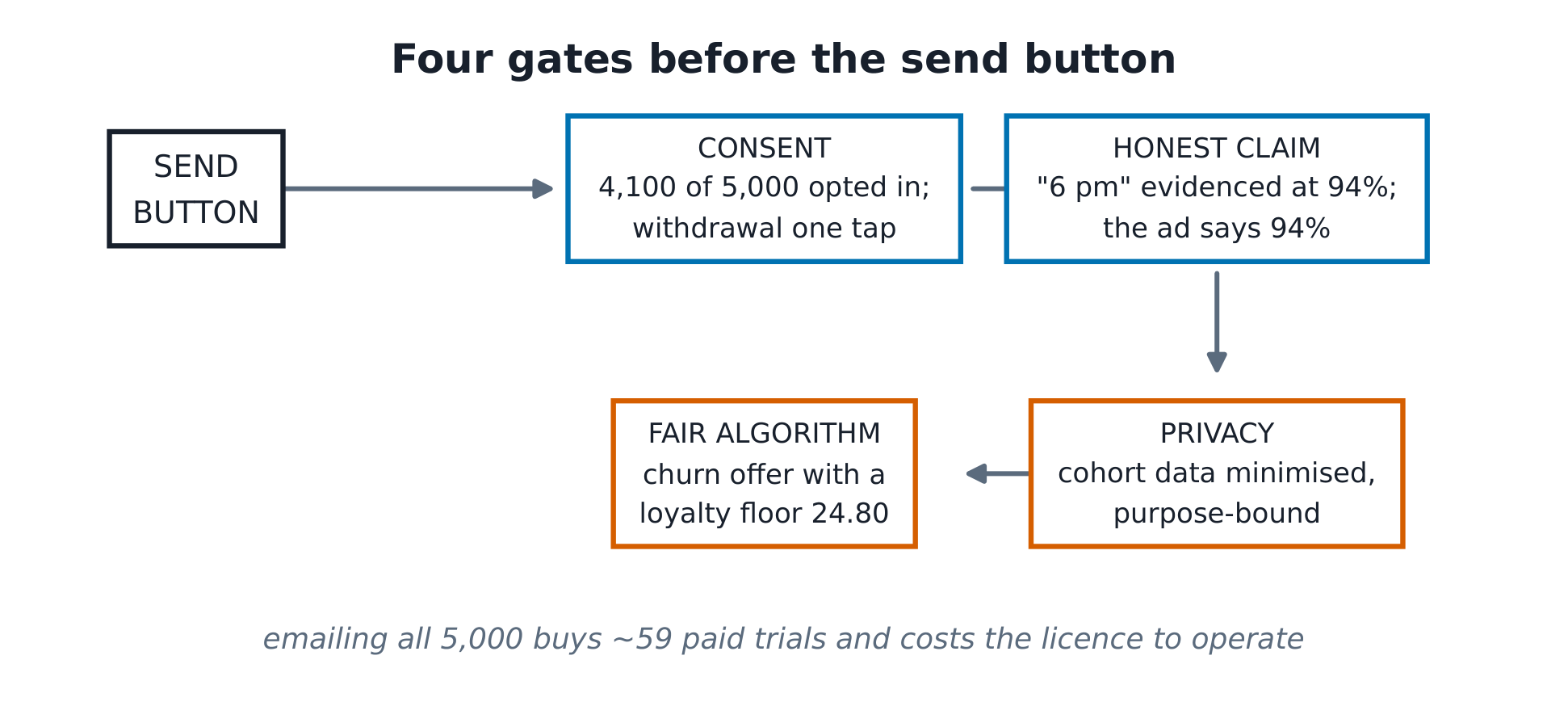
- The list has 5,000 addresses; 4,100 consented to marketing. Contacting all 5,000 buys ~59 extra paid trials — and spends the licence to operate.
- Ethics here is not a compliance appendix; it is the gate before the send button, and its evidence sits on the same sheet as the funnel.
Consent, withdrawable in one tap
- Informed consent 知情同意: opt-in, informed, withdrawable — and the withdrawal must be as easy as the sign-up. The 900 non-consenting addresses are not a rounding error; they are 18% of the list.
- The arithmetic of the gate: ~84 extra trials × 69.9% ≈ 59 paid, call it £1,000 of cohort contribution — against regulator exposure, list poisoning and the one-word review that outlives the campaign.
Of 5,000 addresses, 4,100 consented. The non-consent share, in % (nearest whole)?
Kesulitan 2/5 · 140 koin + bonus kecil pada penyelesaian pertama hari ini
$900/5{,}000 = 18\%$ - not a rounding error: a fifth of the list the campaign has no licence to touch.
If the 900 non-consenting were mailed: about how many EXTRA paid subscribers (62% intent x 15% trial x 69.9% of 900)?
Kesulitan 2/5 · 140 koin + bonus kecil pada penyelesaian pertama hari ini
$900 \times 0.62 \times 0.15 \times 0.699 \approx 58$ - a thousand pounds of cohort contribution against the licence to operate. The gate is cheaper than it looks.
Claims the evidence can carry
- The ad draft says "always delivered by 6 pm"; operations delivers 94% by 6 pm. Run it and one 6:15 delivery makes the ad false.
- The honest fix is not the cautious claim — it is the one the evidence carries: "delivered by 6 pm, 94% of the time". The number itself signals honesty.
Which gate does this practice fail?
Route practices past the four gates - consent, honest claims, fair algorithms, privacy - and price the violation.
Operations delivers 94% by 6 pm. Which ad line is right?
Kesulitan 1/5 · 100 koin + bonus kecil pada penyelesaian pertama hari ini
An absolute claim plus one 6:15 delivery equals a false ad. The honest claim is not the cautious one; it is the substantiable one - and the rate itself signals candour.
A four-taps-deep cancel flow improves retention honestly.
Kesulitan 1/5 · 100 koin + bonus kecil pada penyelesaian pertama hari ini
It is a dark pattern: churn deferred, trust spent - and the reviews name it. The withdrawal must be as easy as the sign-up.
Match each practice to its gate.
Kesulitan 2/5 · 140 koin + bonus kecil pada penyelesaian pertama hari ini
Four gates, one send button - and every gate has its evidence line on the sheet.
Fair algorithms, designed in
- The churn model flags 72 subscribers for a £10 retention offer. Sending only to the flagged punishes the loyal, trains customers that threatening to leave pays, and the quietly mis-flagged never know.
- Fairness fix: a loyalty floor (never worse than a new customer gets), an offer budget open to all at some level, a human read of the model's misses.
The churn-flagged 72 get 10 off; the loyal never see an offer. The fairest repair?
Kesulitan 1/5 · 100 koin + bonus kecil pada penyelesaian pertama hari ini
Targeting is efficient; fairness designs the guard-rails - never a worse offer than a new customer, some offer for everyone, humans on the edge cases.
"Collect what the purpose needs, use it for that purpose" names which principles?
Kesulitan 1/5 · 100 koin + bonus kecil pada penyelesaian pertama hari ini
The 142-name cohort file serves retention math; meal-by-meal lifetime storage "just in case" fails both halves.
The people the ethics gate PROTECTED belong in the campaign's accounting.
Kesulitan 1/5 · 100 koin + bonus kecil pada penyelesaian pertama hari ini
Trust compounds in the retention line: the un-spammed 4,100 stay a measurable asset. Measuring only the campaign that ran counts the cost of ethics as zero and its benefit as zero - both wrong.
Privacy: collect what the purpose needs
- Dark patterns 暗黑模式 — the hard cancel, the sneaky basket — are churn deferred, not saved. Data minimisation and purpose limitation keep the cohort file defensible.
Three ethics slips
- Treating consent as a tick-box. It is withdrawable — as easily as granted.
- Confusing legal with right. The law is the floor, not the standard.
- Measuring only the campaign that ran. The people the gate protected are in the denominator of trust.
Recap
- Consent is the licence; claims must be substantiable — at their real rate.
- Fairness is designed into offers and algorithms, not audited in afterwards.
- Trust compounds in the retention line.