Motion — speed, acceleration and graphs
Diperkenalkan| English | Makna |
|---|---|
| speed/spiːd/ | kecepatan |
| velocity/vəˈlɒsɪti/ | kecepatan |
| acceleration/əkˌseləˈreɪʃn/ | percepatan |
| deceleration/dɪˌseləˈreɪʃn/ | perlambatan |
| gradient/ˈɡreɪdɪənt/ | kemiringan |
| free fall/friː fɔːl/ | jatuh bebas |
| air resistance/eə rɪˈzɪstəns/ | hambatan udara |
| terminal velocity/ˈtɜːmɪnl vəˈlɒsɪti/ | kecepatan terminal |
How fast, and how quickly does it speed up?
- A cheetah sprints at about $30\ \text{m/s}$; a passenger jet cruises near $250\ \text{m/s}$.
- Motion is about two ideas: how fast something goes (its speed 速率), and how quickly its speed changes (its acceleration).
- This lesson gives the formulas for both and shows how to read them from distance–time and speed–time graphs, the most common exam questions in this topic.
Speed and velocity 速度
- Speed is the distance travelled each second:
- Average speed uses the whole journey: $\dfrac{\text{total distance}}{\text{total time}}$.
- Velocity is speed in a given direction. Two cars at 20 m/s, one going north and one going south, have the same speed but different velocities.
- Units: distance in m, time in s, speed in m/s. Change km/h to m/s by dividing by 3.6 (72 km/h = 20 m/s).
Speed, acceleration & graphs
v = u + at
On a speed–time graph the gradien is the acceleration and the luas underneath is the distance travelled.
A runner covers $100\ \text{m}$ in $8.0\ \text{s}$. What is the average speed, in m/s?
Kesulitan 2/5 · 140 koin + bonus kecil pada penyelesaian pertama hari ini
$v = \dfrac{s}{t} = \dfrac{100}{8.0} = 12.5\ \text{m/s}$.
Acceleration 加速度
- Acceleration is how much the velocity changes each second:
- $\Delta v$ means "the change in velocity".
- Units: m/s². An acceleration of 2 m/s² means the velocity rises by 2 m/s every second.
- Slowing down is a deceleration 减速: a negative acceleration. A car going from 20 m/s to 5 m/s in 3 s has a = (5 − 20) ÷ 3 = −5 m/s².
A car speeds up from rest to $20\ \text{m/s}$ in $4.0\ \text{s}$. What is its acceleration, in m/s²?
Kesulitan 2/5 · 140 koin + bonus kecil pada penyelesaian pertama hari ini
$a = \dfrac{\Delta v}{\Delta t} = \dfrac{20 - 0}{4.0} = 5.0\ \text{m/s}^2$.
A train slows from 30 m/s to 12 m/s in 6.0 s. What is its acceleration, in m/s²? (Give the sign.)
Kesulitan 2/5 · 140 koin + bonus kecil pada penyelesaian pertama hari ini
a = (12 − 30) ÷ 6.0 = −18 ÷ 6.0 = −3.0 m/s². The minus sign shows a deceleration of 3.0 m/s².
Distance–time graphs
| Shape of the line | What the object is doing |
|---|---|
| flat (horizontal) | at rest |
| straight, sloping up | constant speed; steeper = faster |
| curving upwards (getting steeper) | accelerating |
| curving over (getting less steep) | decelerating |
- The gradient 斜率 of a straight section is the speed: gradient = rise ÷ run = distance ÷ time.
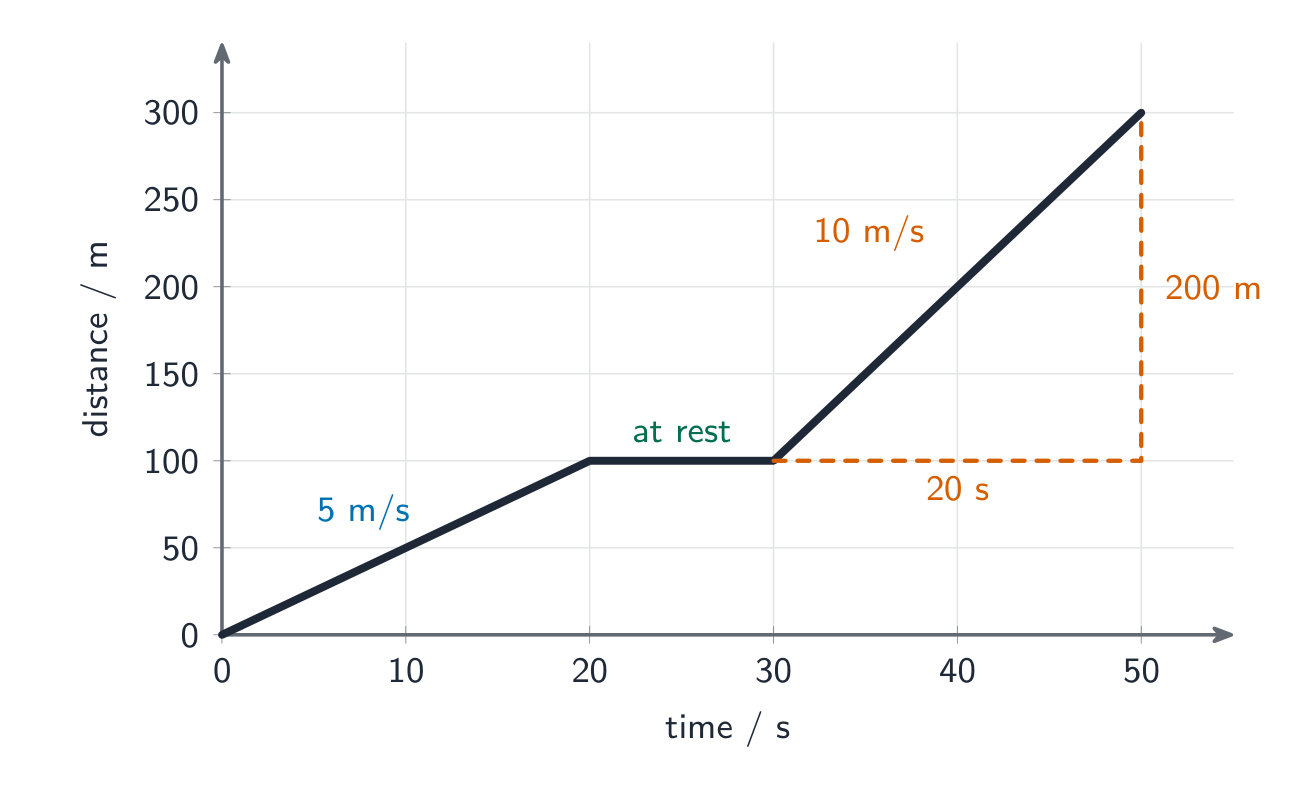
Worked example. Use the cyclist's graph.
- 0–20 s: speed = gradient = 100 m ÷ 20 s = 5 m/s.
- 20–30 s: the line is flat, so the cyclist is at rest.
- 30–50 s: rise = 300 − 100 = 200 m, run = 50 − 30 = 20 s, so speed = 200 ÷ 20 = 10 m/s. The line is steeper, so the cyclist is faster.
- Average speed for the whole trip = total distance ÷ total time = 300 m ÷ 50 s = 6 m/s. The stop counts in the total time.
On a distance–time graph, a flat (horizontal) line means the object is:
Kesulitan 1/5 · 100 koin + bonus kecil pada penyelesaian pertama hari ini
A flat distance–time line means the distance is not changing — the object is at rest.
On a distance–time graph, a straight section goes from (10 s, 40 m) to (25 s, 160 m). What is the speed, in m/s?
Kesulitan 2/5 · 140 koin + bonus kecil pada penyelesaian pertama hari ini
Gradient = rise ÷ run = (160 − 40) ÷ (25 − 10) = 120 ÷ 15 = 8 m/s.
A bus travels 3.0 km in 5 minutes, waits at a stop for 1 minute, then travels 1.8 km in 4 minutes. What is its average speed for the whole trip, in m/s?
Kesulitan 2/5 · 140 koin + bonus kecil pada penyelesaian pertama hari ini
Total distance = 4800 m. Total time = 10 minutes = 600 s, including the stop. Average speed = 4800 ÷ 600 = 8 m/s.
Speed–time graphs
| Shape of the line | What the object is doing |
|---|---|
| flat | constant speed |
| straight, sloping up | constant acceleration |
| straight, sloping down | constant deceleration |
| curved | changing acceleration |
- Gradient = acceleration. Area under the line = distance travelled.
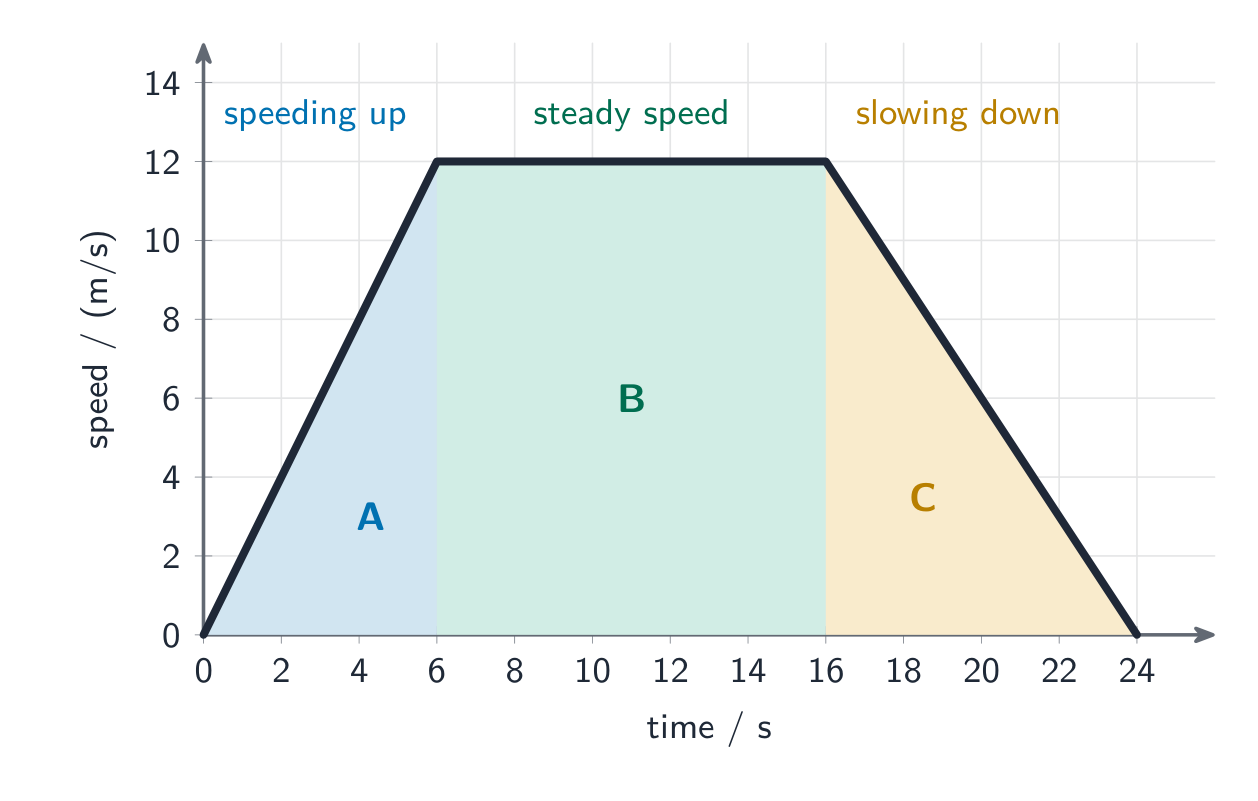
Exam question. The graph shows a bus moving between two stops.
(a) Calculate the acceleration in section A. [2]
- a = change in speed ÷ time = (12 − 0) ÷ 6 = 2 m/s² (2)
(b) Calculate the acceleration in section C. [2]
- a = (0 − 12) ÷ (24 − 16) = −12 ÷ 8 = −1.5 m/s² (2). The minus sign shows a deceleration of 1.5 m/s².
(c) Calculate the total distance between the stops. [3]
- A (triangle): ½ × 6 × 12 = 36 m. B (rectangle): 10 × 12 = 120 m. C (triangle): ½ × 8 × 12 = 48 m (2).
- Total = 36 + 120 + 48 = 204 m (1).
- Mark-scheme reasoning: most lost marks come from using the gradient for distance, or from reading 16 s instead of 16 − 6 = 10 s as the width of B. Write each area separately so the examiner can credit your method.
On a speed–time graph, the area under the line is the distance travelled.
Kesulitan 1/5 · 100 koin + bonus kecil pada penyelesaian pertama hari ini
Speed × time = distance, and that is exactly the area under a speed–time line.
A car travels at a constant $10\ \text{m/s}$ for $6.0\ \text{s}$. From the speed–time graph (area), how far does it go, in m?
Kesulitan 2/5 · 140 koin + bonus kecil pada penyelesaian pertama hari ini
The area is a rectangle: $10 \times 6.0 = 60\ \text{m}$.
On a speed–time graph, the line curves upwards and gets less steep. What is the object doing?
Kesulitan 1/5 · 100 koin + bonus kecil pada penyelesaian pertama hari ini
The line still rises, so the speed increases. The gradient (the acceleration) gets smaller, so the acceleration is decreasing. A straight slope would mean constant acceleration.
A car speeds up steadily from 8 m/s to 20 m/s in 6 s. Using the area under the speed–time graph, how far does it travel in that time, in m?
Kesulitan 2/5 · 140 koin + bonus kecil pada penyelesaian pertama hari ini
The area is a trapezium: ½ × (8 + 20) × 6 = 84 m. Or split it: rectangle 8 × 6 = 48 m plus triangle ½ × 6 × 12 = 36 m.
Falling objects
- Near the Earth's surface, without air resistance, every object falls with the same constant acceleration: the acceleration of free fall 自由落体 $g \approx 9.8\ \text{m/s}^2$. A hammer and a feather dropped on the Moon land together.
- With air resistance 空气阻力 (or resistance from a liquid), the motion has three stages:
| Stage | Forces | Motion |
|---|---|---|
| 1. just after release | only weight acts; air resistance is zero | acceleration = $g$ |
| 2. falling faster | air resistance grows with speed; resultant force = weight − air resistance gets smaller | still speeding up, but the acceleration decreases |
| 3. terminal velocity 收尾速度 | air resistance = weight; resultant force = 0 | constant speed, acceleration = 0 |
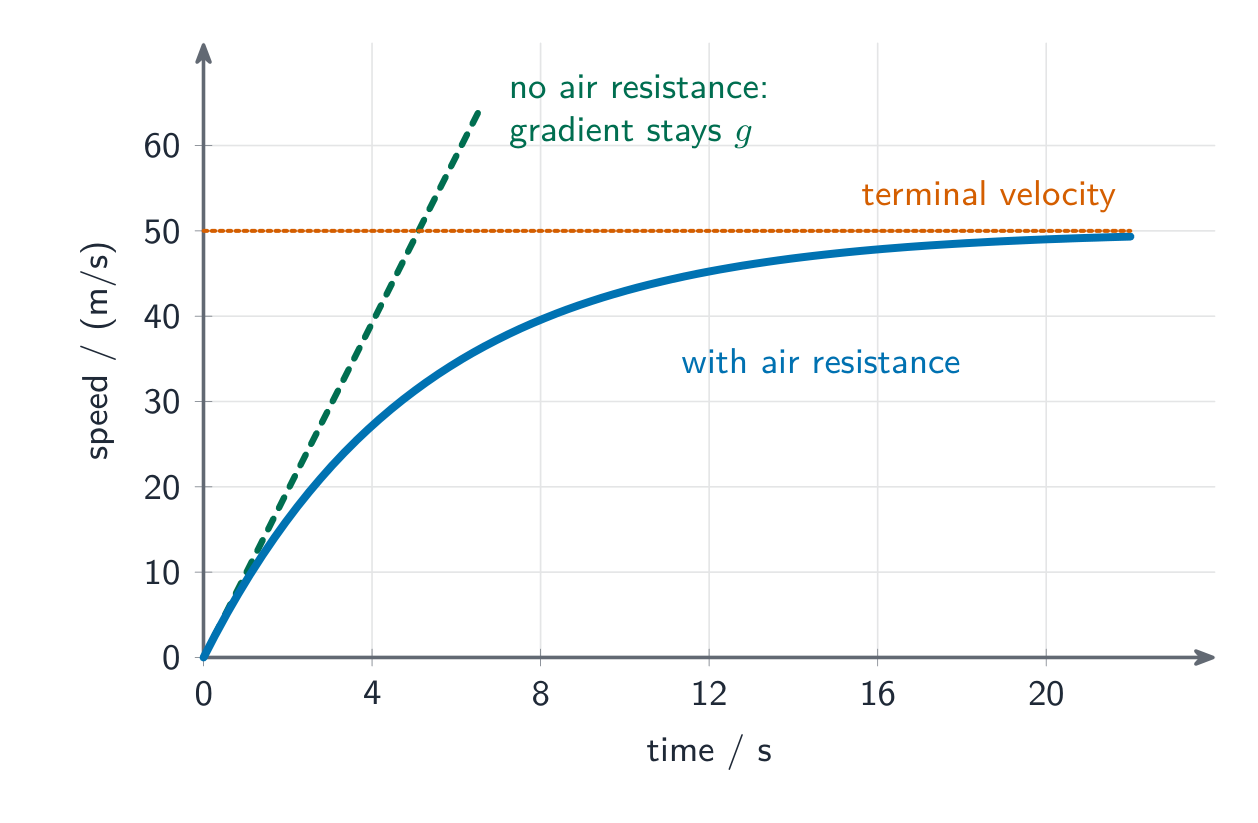
At terminal velocity the object is still moving fast. Zero resultant force means no acceleration, not "no motion". Write "the forces are balanced, so the speed is constant".
A skydiver reaches terminal velocity. This happens because:
Kesulitan 1/5 · 100 koin + bonus kecil pada penyelesaian pertama hari ini
As speed rises, air resistance grows until it balances the weight. The resultant force is then zero, so the speed stays steady.
Put the stages of a skydiver's fall in order, starting at the jump.
Kesulitan 3/5 · 200 koin + bonus kecil pada penyelesaian pertama hari ini
Air resistance grows with speed, which shrinks the resultant force until it is zero at terminal velocity.
You've got it
- speed $v = \dfrac{s}{t}$; average speed = total distance ÷ total time (stops included); velocity = speed in a given direction
- acceleration $a = \dfrac{\Delta v}{\Delta t}$ in m/s²; a deceleration is a negative acceleration
- distance–time: flat = at rest, gradient = speed, curve = speed changing
- speed–time: flat = constant speed, straight slope = constant acceleration, curve = changing acceleration; gradient = acceleration, area = distance
- free fall: $g \approx 9.8\ \text{m/s}^2$; with air resistance the object reaches terminal velocity when air resistance = weight
Velocity changes from 4 to 16 metres per second in 8 s at constant acceleration. What are the acceleration and the displacement?
The change in velocity is 12 metres per second. Average velocity 10 times 8 s is 80 metres.
What is the acceleration?
Kesulitan 1/5 · 100 koin + bonus kecil pada penyelesaian pertama hari ini
12 divided by 8 is 1.5 metres per second squared.