Mol dan konstanta Avogadro
Diperkenalkan| English | Makna |
|---|---|
| mole/məʊl/ | mol |
| Avogadro constant/ˌævəˈɡædrəʊ ˈkɒnstənt/ | konstanta Avogadro |
| molar mass/ˈməʊlə mæs/ | jisim molar |
How can a balance help count invisible particles?
- A tiny sample contains far too many particles to count individually. Chemists measure an amount in moles 摩尔 and connect it to mass.
- This lesson is Supplement. First name the particles: atoms, molecules, ions or formula units are different things to count.
A mole is a unit of amount
- One mole, symbol mol, contains $6.02\times10^{23}$ specified particles at the precision used in this course. This is the course value for the Avogadro constant 阿伏伽德罗常数, $N_A$.
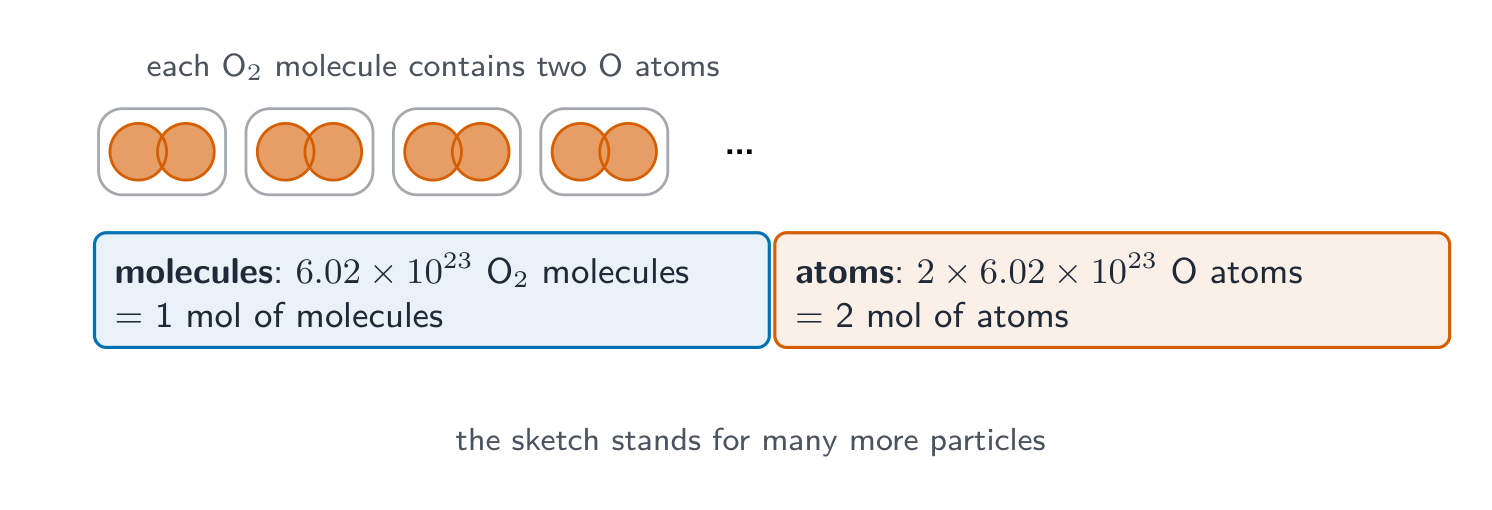
- One mole of oxygen molecules contains that many O₂ molecules, but twice as many oxygen atoms. Always say which entity the number describes.
Jumlah partikel dalam satu mol disebut konstanta ______.
Kesulitan 1/5 · 100 koin + bonus kecil pada penyelesaian pertama hari ini
Sekitar 6.02 × 10²³.
Convert between mass and amount
- Molar mass 摩尔质量, $M$, is the mass per mole, expressed in $\dfrac{\mathrm{g}}{\mathrm{mol}}$. Its numerical value matches $A_r$ for atoms or $M_r$ for a substance at this course's precision.
- Use $n=m/M$, $m=nM$ or $M=m/n$. Mass $m$ is in grams and amount $n$ is in moles; relative mass itself has no unit.
Water has $M_r=18$, so its molar mass is $18\ \dfrac{\mathrm{g}}{\mathrm{mol}}$. For 36 g of water, $n=m/M=36/18=2.0\ \mathrm{mol}$. For 3.0 mol of water, $m=nM=3.0\times18=54\ \mathrm{g}$. These are different samples.
Berapa banyak mol dalam 36 g air (Mr = 18)?
Kesulitan 2/5 · 140 koin + bonus kecil pada penyelesaian pertama hari ini
mol = 36 ÷ 18 = 2.
Berapa banyak mol dalam 88 g CO₂ (Mr = 44)?
Kesulitan 2/5 · 140 koin + bonus kecil pada penyelesaian pertama hari ini
mol = 88 ÷ 44 = 2.
Berapakah massa dari 3 mol air (Mr = 18)?
Kesulitan 2/5 · 140 koin + bonus kecil pada penyelesaian pertama hari ini
massa = mol × Mr = 3 × 18 = 54 g.
Jumlah mol dihitung sebagai:
Kesulitan 1/5 · 100 koin + bonus kecil pada penyelesaian pertama hari ini
mol = massa ÷ Mr.
Cocokkan setiap besaran dengan satuan atau deskripsinya.
Kesulitan 2/5 · 140 koin + bonus kecil pada penyelesaian pertama hari ini
Nilai numerik massa molar sesuai dengan Mr pada tingkat ketelitian kursus ini, namun keduanya merupakan besaran yang berbeda.
Convert amount to a particle count
- Use $N=nN_A$ for a count and $n=N/N_A$ for an amount. The number $N$ is a count, not a mass or a volume.
- For 0.50 mol of CO₂, the molecule count is $0.50\times6.02\times10^{23}=3.01\times10^{23}$. Each molecule has two O atoms, so it contains $6.02\times10^{23}$ O atoms.
Do not multiply a mass in grams directly by the Avogadro constant. Convert to moles first. For ionic NaCl, name formula units or specified ions, not NaCl molecules.
Berapa banyak molekul CO₂ dalam 0.250 mol? Gunakan NA = 6.02 × 10²³. Masukkan hanya koefisien dalam N = ___ × 10²³.
Kesulitan 2/5 · 140 koin + bonus kecil pada penyelesaian pertama hari ini
N=nNA=0.250×6.02×10²³=1.505×10²³ molekul.
Berapa jumlah atom oksigen, dalam mol, yang terkandung dalam 0.30 mol molekul O₂?
Kesulitan 2/5 · 140 koin + bonus kecil pada penyelesaian pertama hari ini
Setiap molekul O₂ memiliki 2 atom oksigen, sehingga jumlah atom = 2×0.30 = 0.60 mol.
Recover an unknown molar mass
- If a pure sample has mass 6.4 g and amount 0.20 mol, $M=m/n=6.4/0.20=32\ \dfrac{\mathrm{g}}{\mathrm{mol}}$.
- A matching molar mass does not by itself prove a substance's identity. Different substances can share the same numerical molar mass.
Sampul murni memiliki massa 2.8 g dan jumlah 0.100 mol. Temukan massa molar dalam $\dfrac{\mathrm{g}}{\mathrm{mol}}$.
Kesulitan 2/5 · 140 koin + bonus kecil pada penyelesaian pertama hari ini
M=m/n=2.8/0.100=28 $\dfrac{\mathrm{g}}{\mathrm{mol}}$.
Choose a route before substituting
- Decide whether the answer is mass, amount, molar mass or number of specified particles. Write the equation and include the required unit.
- If atoms inside molecules are asked for, first count molecules and then use the formula's subscripts. Check that a smaller fraction of a mole gives fewer particles.
Mass → amount uses $n=m/M$. Amount → particle count uses $N=nN_A$. Name what you are counting and keep grams, moles and counts separate.
Sebuah sampel H₂SO₄ memiliki massa 98 g dan massa molar 98 $\dfrac{\mathrm{g}}{\mathrm{mol}}$. Tentukan jumlah zatnya dan jelaskan perbedaan antara gram dan mol.
Jumlah numerik bergantung pada baik massa sampel maupun massa molar zat tersebut.
Sebuah sampel H₂SO₄ bermassa 98 g dengan massa molar 98 $\dfrac{\mathrm{g}}{\mathrm{mol}}$. Berapakah jumlah zatnya?
Kesulitan 1/5 · 100 koin + bonus kecil pada penyelesaian pertama hari ini
98 dibagi 98 adalah 1. Opsi lain — 2 mol (sampel air dan karbon dioksida pelajaran); 54 g (massa pelajaran dari 3 mol air).
CO₂ memiliki massa molar 44 $\dfrac{\mathrm{g}}{\mathrm{mol}}$. Tentukan jumlah zat dalam 11.0 g, dalam mol.
Kesulitan 2/5 · 140 koin + bonus kecil pada penyelesaian pertama hari ini
n=m/M=11.0/44=0.250 mol.
Sampul mengandung 0.20 mol CO₂. Temukan jumlah atom oksigen dan jelaskan mengapa jumlah molekulnya berbeda dengan jumlah atom oksigennya.
Bandingkan penalaran dan setiap kriteria; ekuivalensi kata dapat diterima.